The Real Problem

Now that it looks as though the Affordable Care Act is here to stay, it’s high time that we paid more attention to the graver problem in health care—its increasingly unaffordable cost. How unaffordable? Consider this report from eHealth:

  • In 47 of 50 cities surveyed, the lowest-priced plan would be officially unaffordable under Obamacare affordability standards for families earning 401% of the federal poverty level (about $82,000 per year in the contiguous US, making them ineligible for Obamacare subsidies).
  • In these cities, the average three-person household would need to earn an additional $28,939 per year before the lowest-cost plan becomes affordable according to Obamacare rules.
  • Government subsidies are generally made available to persons earning up to 400% of the federal poverty level, but middle-income households earning 401% or more of the federal poverty level are not eligible for subsidy assistance

In other words health care is sapping the economic strength of every other sector of the economy. You can only spend the same dollar once. Every dollar spent on health care or health care insurance isn’t spent on housing, food, clothing, saving, and so on.

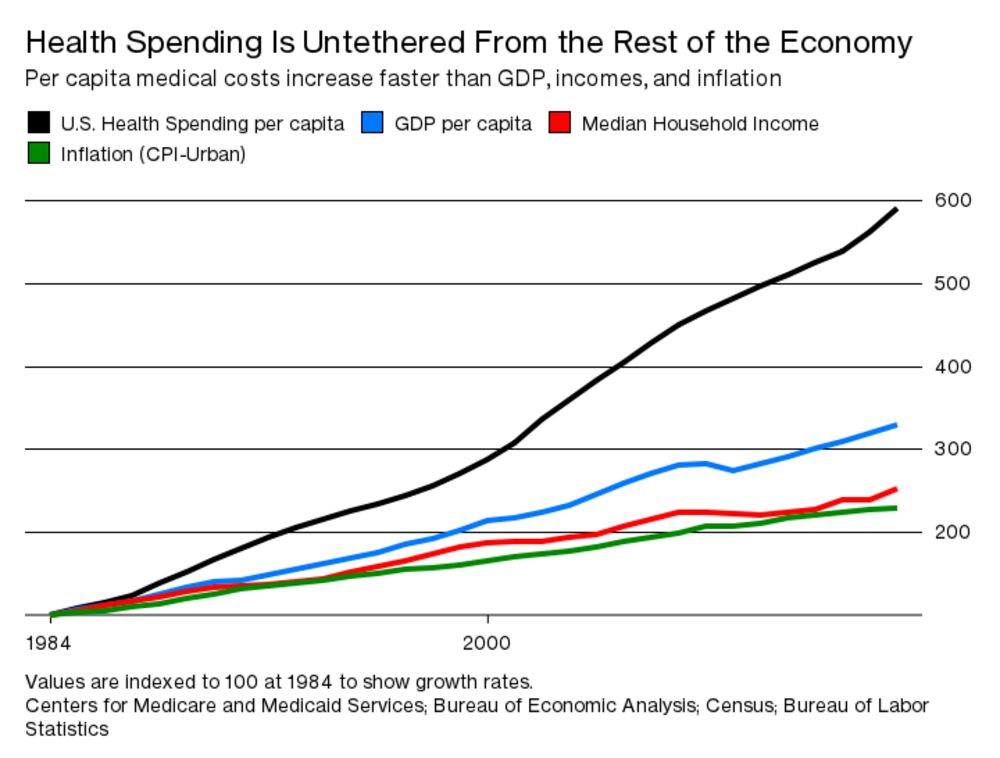
To gain a better understanding of how basic the problem is, consider the graph above, something I stumbled across in this article at Bloomberg from a few months ago on the same subject.

As you can see health care spending is outstripping the growth in U. S. GDP, incomes, and inflation by a multiple but, even though it’s difficult to believe, that understates the issue. GDP, median income, and inflation all include health care spending, incomes in health care, and health care cost increases.

A better comparison would be to compare health care spending with the increases in GDP exclusive of health care, incomes exclusive of within the health care sector, and inflation of non-health care goods and services. I believe that what it would reveal with respect to the actual relationship between health care and inflation, for example, is that health care is responsible for about half of inflation.

But health care unlike, say, clothing or food is heavily dependent on government spending. Between half and three quarter of all money spent on health care comes from government at one level or another. That in turn means that health care needs a strong and growing non-health care economy and that’s just not the case.

The Affordable Care Act always attacked the wrong problem (as I’ve been saying for the last seven years). It did so presumably making the incorrect assumption that extending coverage would reduce the growth in the rate of cost increases in health care. Now it’s time, well past time really, to address the graver problem. The increase in health care costs must be restrained to the same rate as the non-health care economy. That will require decreasing utilization, decreasing wages in the health care sector, or both.

3 comments

Risk Averse

In his most recent Washington Post column Robert Samuelson considers the decline of American entrepeneurialism:

Just recently, the Census Bureau released its latest figures for business start-ups, and they paint a picture strikingly at odds with the conventional wisdom. Instead of a boom in business start-ups, there has been a long-term decline. In 2015, start-ups totaled 414,000, “well below the pre-Great Recession average of 524,000 startup firms,” as the Census Bureau puts it.

To be sure, the slump reflects the lingering adverse effects of the recession. Venture capital firms, which provide funds for new businesses, “are more risk-averse,” says economist Robert Litan. But that’s not the whole story. A 2014 study by Litan and Ian Hathaway found that the start-up decline dates back to at least the late 1970s, affects all major industries and has been present in 365 out of 366 metropolitan areas.

There is little doubt that the propensity to start new companies has declined just as there is little doubt that new companies are responsible for most new job creation. Factors behind the decline which Mr. Samuelson considers include cultural change, ongoing economic doldrums, the ability of large companies to discourage startups, and reduced government-sponsored research and development.

There are all sorts of misconceptions about entrepeneurs. Most new businesses aren’t started by young people. They’re started by people in their 40s and 50s. Additionally, most startups aren’t financed via venture capital of bank lending. They’re financed from savings and borrowing from friends and family. Consequently, to Mr. Samuelson’s explanations for the decline in startups I would add stagnant wages, reduced savings, and the high and increasing cost of health care.

To cite my own experience I became a lot more risk averse in my 60s than I had been in my 40s or 50s. That’s why I went to work for somebody else rather than running my own business as I had for decades. Now I’m earning a multiple of what I did. Reduced rewards and higher risks. You really don’t need to look any farther for why people aren’t starting new businesses at the rate they used to.

3 comments

Generational Change

I see that defense analysts are beginning to catch on to something I’ve been warning about for decades. The United States’s ability to wage a Third Generation War (the kind we fought in World War II) is extremely limited. From Breaking Defense:

CAPITOL HILL: Is the arsenal of democracy out of business? Probably not, but America’s “increasingly brittle industrial base” may not be able to sustain our forces in a protracted war, the Chairman of the Joint Chiefs, Gen. Joseph Dunford, warned the Senate in a written statement this morning. It’s a problem a lot of people are wrestling with, from Dunford’s subordinates on the Joint Staff to academics and a White House-commissioned task force. There are solutions, a panel of experts said this afternoon on the Hill – if we just invest enough to research and develop them.

The article focuses on aerospace but there’s an even simpler example: RAM memory. We produce little RAM memory in the United States any more and we do need a continuing supply to prosecute war in the way to which we’ve become accustomed. The biggest producers of RAM memories are China, South Korea, Taiwan, and Japan.

The article is largely a pitch for additive manufacturing but I doubt that as a society we’re capable of the sort of sustained crash program that led to producing 400,000 airplanes a year and turned typewriter plants to manufacturing machine guns.

7 comments

Creative Destruction Is Creative

There’s an interesting article on Joseph Schumpeter’s theory of creative destruction at Bloomberg by Justin Fox:

In a 2012 paper for the Ewing Marion Kauffman Foundation from which I got much of the data for my Fortune 500 chart above, startup and technology researchers Dane Stangler and Sam Arbesman also question whether the kind of turnover we’re talking about here really is all that reflective of economic change and progress. Departures from and additions to such lists are often driven by waves of mergers and acquisitions that are more about rearranging corporate assets than creation or destruction. “Turnover is less a broad economic trend,” they write, “than a discrete temporal and sectoral phenomenon.” They also cite historical research showing waves of corporate churn in the 1920s and the turn of the 20th century that seem to have been at least as disruptive as those of the 1980s and 1990s.

So yes, modern capitalism produces and probably requires a lot of creative destruction. But this isn’t a relentless, ever-accelerating process. It goes in waves. For about 15 years now we’ve been in a lull, and it’s not at all clear when or how it will end.

There are some things that I think he misses in his piece. One of them is that creative destruction is creative. It results in greater efficiency which in turn leads to more jobs and higher incomes. Another is that there’s a lot more ferment in newly developing sectors than in old, established sectors.

There are multiple reasons for that including that established sectors are much better equipped to harness the force of government in their favor. In my view we missed a prime opportunity a decade ago to foster creative destruction rather than impede it by propping up General Motors and the big banks.

We should be much more closely focused on helping people hurt by the inevitable creative destruction and much less focused on helping companies or even business models.

18 comments

Is MetLife Too Big To Be Allowed To Fail?

In their op-ed this morning the editors of the Wall Street Journal rail against the Financial Stability Oversight Council empowered by Dodd-Frank:

odd-Frank empowered the Financial Stability Oversight Council (FSOC), which is comprised of 10 regulatory heads, with deciding whether nonbanks are “systemically important financial institutions.” The Sifi label imposes bank-style liquidity and capital requirements, among other compliance burdens, in return for an implicit taxpayer guarantee.

While the law outlined myriad criteria that FSOC could consider, Dodd-Frank left enormous discretion to regulators to write and enforce the rules. After a formal rule-making, FSOC in 2012 identified six factors it would use to assess a nonbank’s vulnerability to financial distress and how its potential instability could affect the broader financial system.

Yet in its analysis of MetLife, an insurance company that isn’t a bank, FSOC considered only the risks to the financial system. It failed to weigh MetLife’s liquidity risk or leverage, both of which showed financial strength. The council provided no explanation for why it departed from its guidance, nor did FSOC calculate the costs of its designation.

Metlife sued, and last year federal Judge Rosemary Collyer issued a scathing rebuke of the council’s “arbitrary and capricious” designation. In addition to rapping FSOC for not evaluating MetLife’s vulnerability, Judge Collyer explained that the council “never projected what the losses would be, which financial institutions would have to actively manage their balance sheets, or how the market would destabilize” if MetLife failed.

FSOC “hardly adhered to any standard when it came to assessing MetLife’s threat to U.S. financial stability” and “purposefully” refused to consider the costs of its designation in flagrant violation of administrative law, she wrote. A cost-benefit analysis, she noted, might have shown that the designation could have made MetLife more vulnerable to stress.

Richard Cordray, chief of the Consumer Financial Protection Bureau appointed by President Obama and still holding the job, is a case in point for my objections to technocracy. What qualifies him for the job? He’s a) a lawyer and b) a Democratic Party apparatchik. He’s never run a bank or insurance company or any other “systemically important” enterprise. He’s a consumer but it’s my understanding that there are a lot of those around so that can’t be it.

In theory “technocracy” means “rule by experts”. In practice it means “rule by the connected”, a particularly noxious form of aristocracy.

I don’t object to government regulation. I think it’s a necessity. I do object to ever-increasing government power being handed over to your friends and flunkies. That’s not conducive to good government.

After reading the editorial I still don’t know whether MetLife reasonably falls under the Financial Stability Oversight Council’s authority. I’m less confident in either it or the CFPB than ever. I continue to think that companies that are too big to be allowed to fail are too big to be allowed to exist. IMO the lesson of the last decade is that we should have allowed the big banks to fail and provided aid for the ordinary people hurt by their failure rather than propping up recklessly run and insolvent institutions. We’d probably be better off than we are now and we wouldn’t have a bunchy of big, insolvent banks sitting around.

1 comment

Which Women Were Given Hope?

Yesterday I read an op-ed in the New York Times that was so unhinged and disgraceful that I won’t even link to it. I’m sure you can find it if you care to.

The thesis of the op-ed was that China’s communist revolution, now roughly 70 years old, had given Chinese women hope.

Presumably, the author didn’t mean the thousands of women who died during the Long March or the tens of millions of women who were murdered during the Great Leap Forward and Cultural Revolution. Did she mean the tens or even hundreds of millions of women who were subjected to forced abortions under the One Child Policy? Or the hundreds of millions of predominantly girls who were aborted?

Perhaps she meant the women who have died, locked into their factories, when the factories caught fire? Or the women whose fathers, sons, and husbands have been killed or imprisoned by the regime over the period of the last 70 years?

This is a definition of “hope” I find difficult to recognize.

What has given Chinese women hope, the ability to “dream big”, is the abandonment of the principles of the revolution including China’s 30 years of autarky, something that persisted until Mao Zedong’s death. There would be even more hope if the Chinese Communist Party were to loosen the reins it continues to hold but I’m afraid that’s too much to hope for.

4 comments

Who Benefits?

MetLife chairman Steven Kandarian’s op-ed at the Wall Street Journal is mostly benign. In it he urges other large company CEO’s not to defend the various tax breaks their companies have been using:

To achieve meaningful tax reform, America’s business leaders need to do our part, as our predecessors did 30 years ago. If Congress is to succeed, we must be willing to put the national interest ahead of our narrow self-interest.

It will not be easy. The lobbyists and special interests have been busy since 1986. The tax code is again stuffed with loopholes, credits and deductions. Every provision benefits some company or industry, my own included.

The lobbyists hired to protect such preferences always predict doom if they are stripped away. But if our businesses cannot survive without tax subsidies, we should ask ourselves how much value we are truly creating for customers and shareholders.

It’s the last sentence that caught my eye and that’s a theme he repeated in the op-ed:

The argument for high corporate tax rates is that companies ought to pay their fair share. But businesses merely pass on the value they create to real people—owners, customers or employees.

As the late Mayor Daley used to say, let’s look at the record. Over the period of the last thirty years real wages have been practically flat and large company payrolls have been slashed. Today’s largest companies have far fewer employees than the giants of yesteryear. Consequently, it doesn’t seem reasonable to say that employees have captured much of the value added by today’s large companies.

Let’s look at the second leg of that tripod—customers. Consumer prices have not been falling. They’ve been rising slowly.

Over that period of the last 30 years the DJIA has risen more than 10-fold. Over the last 10 years it has quadrupled. It is obvious that owners have captured almost all of the economic surplus that has been generated over the period of the last 30 years. You can see it when you look at the ratio of CEO compensation to ordinary employee inflation in most companies and the proportion of income and wealth held by the top .1% of individuals.

We need tax reform because we need greater efficiency. The corporate income tax is a prime target for reform because it’s inefficient. But we shouldn’t stop there. We need to reconsider the entire list of neoliberal policies that have driven our society and economy for the last half century and, increasingly, for the last 25 years. They aren’t working for most people. They aren’t working for consumers or employees.

1 comment

The Challenge of Puerto Rico

I have searched in vain for a dispassionate, factual assessment of the damage in Puerto Rico. Very nearly all I’ve been able to come up with is that Hurricane Maria has wreaked enormous damage to the island’s structures, power grid, and telecommunications system. Communications, especially with the interior, are spotty and major news outlets are more interested in counting coup than they are in reporting the news. Much of the island may be without electricity for months or even years. There is a major dam that has been severely damaged and may be on the brink of failing.

Puerto Rico has a confusing and anomalous status. It is neither a state nor an independent country. It is a territory of the United States, notionally under the direct control of Congress—like the District of Columbia which should tell you something. However, it also has its own constitution and governor. In the most recent referendum nearly all of those voting voted for statehood but only 22% voted.

The island’s government has incurred enormous debt and the hurricane’s damage will make it hard for the island to make its interest payments.

In my view our response to the disaster in Puerto Rico should consist of four planks:

  • The Navy and/or Coast Guard should immediately be dispatched to Puerto Rico to render humanitarian aid, do what is possible to prevent a massive dam burst, and generally manage the situation there. The military is the only institution capable of responding at the level required in the time that is available.
  • Puerto Rico should be taken into a sort of receivership. A civilian manager should be appointed to assess the damage, continue the provision of assistance, and manage the ongoing federal government response. The commonwealth’s present government should be subordinate to this manager.
  • Congress should pass a massive emergency support stipend for Puerto Rico, as noted above to be administered by the federal manager. The money should be spent as quickly as possible.
  • Puerto Rico should either become an independent country or a state. It shouldn’t be a choice. Its status should be determined by Congress with all due speed. Its present status is a formula for failure.

The people of Puerto Rico should should not be required to face the problems imposed by domestic partisan political squabbling as well as the consequences of the natural disaster but that’s what’s likely to happen.

Update

At City Journal Nicole Gelinas says that there’s help that Puerto Rico needs now:

Puerto Rico is different. Gov. Ricardo Rosselló says power will be out for weeks or months.
Puerto Rico can get some power much faster, and already is. Big generators combined with the hundreds of electric-industry workers who are already descending from the mainland with emergency equipment can likely re-power critical sites in days, and major population centers in days or weeks.

One aircraft carrier can power and provide drinking water for a city.

13 comments

We All Lose

Echoing some of the things I said in my first post this morning, the editors of the Wall Street Journal have one paragraph worth passing on in their mournful editorial:

American democracy was healthier when politics at the ballpark was limited to fans booing politicians who threw out the first ball—almost as a bipartisan obligation. This showed a healthy skepticism toward the political class. But now the players want to be politicians and use their fame to lecture other Americans, the parsons of the press corps want to make them moral spokesmen, and the President wants to run against the players.

We all lose!

Sometimes the only way to win is not to play the game.

24 comments

Prevailing

Angela Merkel’s ruling coalition has won the German elections. Sort of. Deutsche-Welle reports:

Angela Merkel has won a fourth term, but official results have shown she’ll have a “tough road” for coalition talks. While the CDU remains the largest party, the far-right AfD will be the third biggest political force.

With all 299 constituencies reporting, Chancellor Angela Merkel’s Christian Democratic Union (CDU) and its Bavarian sister party the CSU came out ahead in Germany’s national election on Sunday, with 33 percent of the vote.

Rival Social Democrats (SPD) led by Martin Schulz tumbled to a mere 20.5 percent, while the Green and Left parties remained about the same as they did in 2013, each with 8.9 and 9.2 percent, respectively.

The only real success stories of the night were for the pro-business Free Democrats (FDP) and far-right Alternative for Germany (AfD). After failing to make the 5-percent hurdle to enter the Bundestag last time around, the FDP managed a 10.7 percent to cement its comeback.

As for the populist AfD, a remarkable showing of 12.6 percent means that Germany will have a far-right party in parliament for the first time in more than half a century.

In the coming days and weeks you are likely to read all sorts of claptrap about the German elections written by people who know better. Americans’ instincts for elections other than our own tend to be poor.

Germany does not have a “winner take all” system like ours. They have a multi-party parliamentary system. Each German voter votes twice: once for the “direct candidates” in their districts who must win by a plurality and the second time for a slate of candidates, the party list, in the province. Half of the Bundestag is composed of the direct candidates, the other half elected from the party lists.

I’m sure that some of those who voted for the Allianz für Deutschland (AfD) the Alliance for Germany, are in fact neo-Nazis but I also believe that most of those who turned out to vote for it were protest voters, unhappy with Angela Merkel’s de facto open borders program. They’re concerned about their jobs; Germany doesn’t have an unemployment program but it has a serious underemployment problem. Jobs are being divided into multiple microjobs. They’re also concerned that Germany is becoming de-Germanized. Treating those protest voters as though they were the same as the neo-Nazis will not rebuild the strength of the middle parties. Does any of this sound familiar?

That wasn’t the way the “European project” was supposed to work. They thought it would mean Europe becoming Germanized. Not only is that not happening but they’re worried that Germany is becoming de-Europeanized. AfD’s capturing nearly 13% of the Bundestag where it had previously held no seats shows which way the wind is blowing.

Expect the junior partners to Angela Merkel’s Christlich Demokratische Union Deutschlands, Christian Democratic Union Party, (CDU) to press their advantage in forming a new coalition government.

Update

The editors of the Wall Street Journal on the German elections:

This is a very German protest vote: safe. The AfD struggled for most of the campaign season, and its home-stretch surge owes to two factors. A television debate between Mrs. Merkel and her SPD challenger, Martin Schulz, this month highlighted how little the two major parties compete with each other. And polls showing Mrs. Merkel steamrolling her opponents reassured voters they could cast a ballot for the AfD without handing the party real power.

with which I agree but this:

The message is that Germans want competition. The AfD draws support from voters on both left and right who are disillusioned with 12 years of Mrs. Merkel’s bland-as-she-goes leadership, and with the SPD’s failure to oppose her for eight of those years when it formed coalitions with her.

Nah. Take the results at face value. A significant number of Germans want fewer Middle Eastern immigrants.

2 comments
