Understanding the DJIA

There’s a good primer on the Dow-Jones Industrial Average at Marketwatch, occasioned by the announcement that General Electric would be dropped from the index as of June 26. GE was the sole remaining of the original Dow companies and its ouster is an indication of the continuing decline in importance of heavy manufacturing in the U. S. economy. The only manufacturing companies left in the Dow 30 will be Caterpillar, United Technologies, and, arguably, Boeing.

I don’t believe that the United States can maintain a vibrant economy on the basis of finance and pharmaceuticals, both heavily subsidized sectors, but that’s the direction in which we’re heading and the departure of GE from the Dow is another milestone along that road.

4 comments

Summarizing the Immigration Debate

I think that David Harsanyi summmarizes the present spitting match about immigration pretty well at The Federalist:

It’s true that some Republicans act as if everyone coming over the border is an MS-13 drug mule, while some liberals act as if there is no criminality associated with unregulated immigration, even from a nation experiencing an epidemic of lawlessness and violence. But perhaps the biggest tragedy of the immigration debate is that, despite the acrimony surrounding it, it’s probably the most easily fixed. The majority of Americans still aren’t ideologically rigid on the issue. They’re open to immigration (and to Dreamers), but most also want secure borders. Falsely feeding the dueling perceptions that the United States is a budding fascist state or anarchy without a border create a political climate that makes immigration impossible to fix.

In separating families at the border Republicans mistakenly and reprehensibly think they’ve finally found the lever to wring concessions on immigration from Democrats with. As illustrated by Chuck Schumer’s rejection of a bill to keep migrant families together, keeping families together is a lower priority than retaining a campaign issue.

17 comments

A Future of Risk

In the past I’ve written about the risks posed by personal empowerment. Now the RAND organization sees them, too. From Colin P. Clarke at The National Interest:

Individuals and small groups have the potential to use an array of new and emerging technologies, including drones, virtual currencies, encrypted communications and artificial intelligence (AI). Additive manufacturing, or 3-D printing, has already been used by individuals to print workable firearms. Given that, there is a steady drumbeat of warranted concern over the potential use of specific technologies by nonstate actors. But it is not simply the use of technologies in isolation that presents the most significant challenge going forward, but rather the combination of these technologies—as evidenced in the Saudi scenario, where a drone was used in conjunction with a deliberate disinformation campaign perpetrated through social media.

The future is one in which an individual actor can kill millions and there is no way to put this jinn back in its bottle. The way to mitigate the risks posed by personal empowerment is with countervailing personal empowerment. I think we’re in for a bumpy ride.

0 comments

20 Years of Nothing


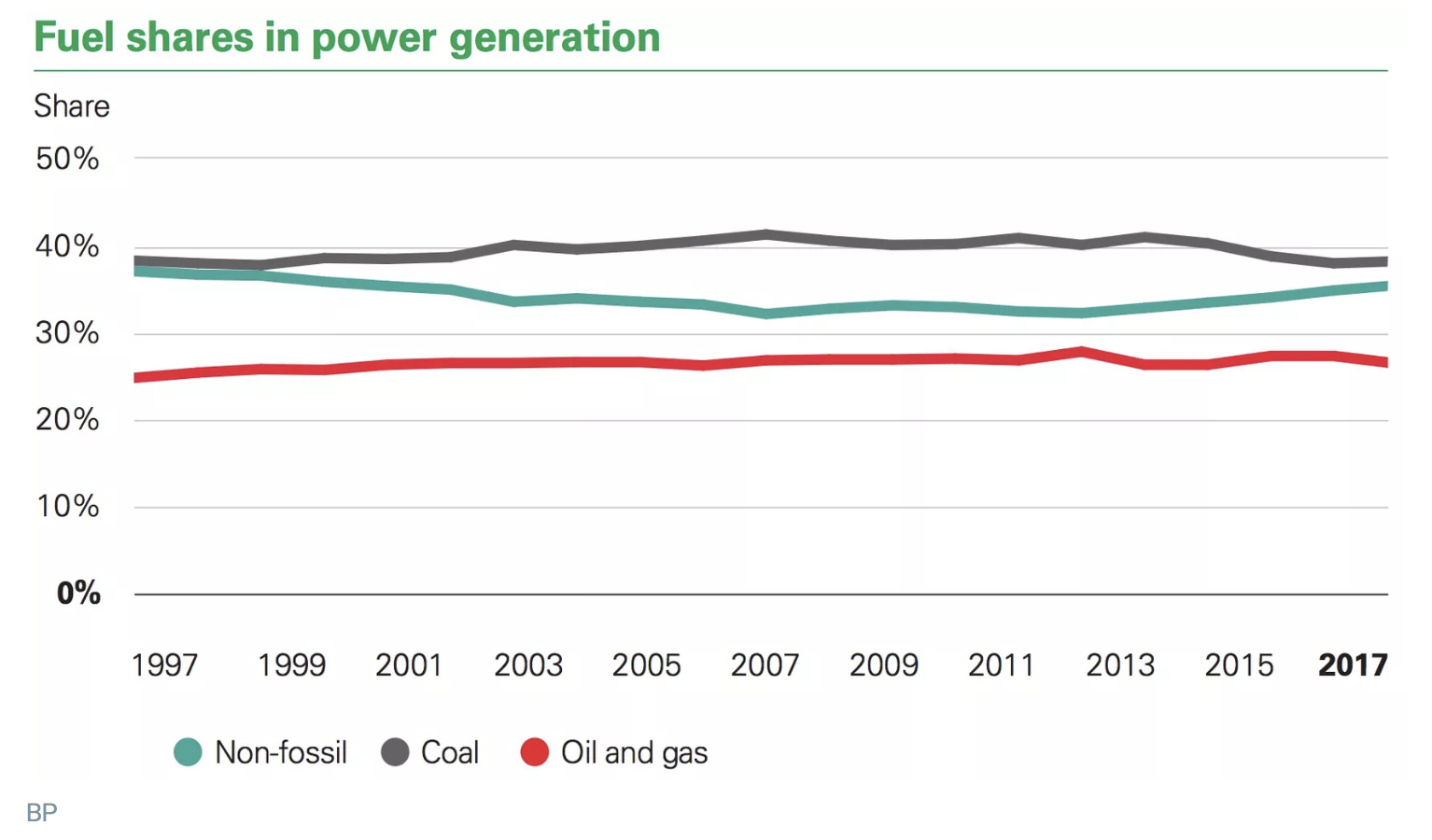
At Science Alert Carly Cassella reports on the developments in how energy is produced:

Last year, the share of coal in the power sector sat around 38 percent. It pains me to tell you this, but that is the exact same percentage that it was in 1998. In two decades, almost zero progress has been made.

As should have been obvious the Paris Accord was something between a press release and an attack vehicle on the U. S. Today the use of coal to generate power is actually increasing, mostly driven by China and India.

Keep in mind that the three largest producers of emissions are energy generation, transportation, and construction. Chinese construction alone would be enough offset anything the U. S. could do to reduce carbon emissions. If you’re interested in reduction of emissions as anything but a cudgel to beat your political opponents with, you’ve got to support more nuclear power generation and carbon capture.

14 comments

Asylum

As a signatory of the 1951 Convention Relating to the Status of Refugees and its 1967 Protocol, the United States is obligated to grant asylum to individuals who have a fear of persecution for reasons of race, nationality, religion, political opinion or membership of a particular social group. The United States is not obliged to accept applicants who have a fear of domestic violence or crime.

In INS v. Cardoza-Fonseca the Supreme Court held that individuals with a “well-founded fear” of physical harm or torture must be allowed to remain in the United States while their asylum requests are being processed.

The United States receives something upwards of 150,000 applications for asylum per year of which only a fraction, something between 10% and 30%, ultimately result in the applicant receiving asylum. The number of applications that are presently at some stage of the review process is something in the vicinity of 500,000. Most asylum-seekers whose applications are accepted are from the Middle East or Africa.

Beyond that just about everything is a matter of opinion. I don’t think that most applicants for asylum from Mexico and Central America have a clear understanding of what U. S. law requires for an asylum application to be granted. I don’t think there is clear evidence that most applicants from Mexico or Central America are engaging in fraud as the attorney general has alleged.

0 comments

Distinguishing Between Fact and Opinion

According to a recent survey by Pew Research, Americans aren’t very good at distinguishing between a statement of fact and a statement of opinion:

A new Pew Research Center survey of 5,035 U.S. adults examines a basic step in that process: whether members of the public can recognize news as factual – something that’s capable of being proved or disproved by objective evidence – or as an opinion that reflects the beliefs and values of whoever expressed it.

The findings from the survey, conducted between Feb. 22 and March 8, 2018, reveal that even this basic task presents a challenge. The main portion of the study, which measured the public’s ability to distinguish between five factual statements and five opinion statements, found that a majority of Americans correctly identified at least three of the five statements in each set. But this result is only a little better than random guesses. Far fewer Americans got all five correct, and roughly a quarter got most or all wrong.

What respondents thought were facts and which were opinions also tended to break along the lines of confirmation bias. Both Democrats and Republicans are more likely to think something is a fact if it supports an opinion they already hold. The more politically aware an individual, the more “digitally savvy”, and the more interested in the news, the better able that individual to distinguish between fact and opinion. The relationship between digital savviness and the ability to distinguish between a statement of fact and an opinion held even when controlling for education.

I think it’s a reasonable hypothesis that both politics and education are failing us.

3 comments

Solving the Problem Presented by Families at the Border

If the large number of op-eds, editorials, and news stories is any gauge, the pressure to end the Trump Administration’s present policy of separating children from their presumed parents at the border is reaching the boiling point. At The Volokh Conspiracy Ilya Somin rejects the idea that the law, including compliance with Flores v. Reno, requires such separation. Keep in mind when reading it that Mr. Somin supports open borders, a policy I think is cruel and racist since its costs fall most heavily on blacks and Hispanics. The decline in wages for people without high school educations does not support the claim of heavy demand for workers with limited skills. The rapid adoption of ordering kiosks in fast food restaurants will further erode such demand.

What then to do? As I see it there are several alternatives. What I favor is for Congress to make more funds available to detain families with children together under safe and humane conditions and to expedite their asylum petitions. The other prospective solutions are just opening the border, to release these families together on their own recognizance pending the decisions which presents serious problems of moral hazard, or just to turn them back at the border, which would be a failure of due process.

Can anybody think of any other solutions?

17 comments

Most Dangerous Countries

At RealClearLife Rebecca Gibian provides tips for travellers visiting the world’s most dangerous places:

When most people plan a trip, they’re thinking mostly about things like the architectural wonders, sun-kissed beaches, or powder-covered ski runs they will enjoy at their destination. Any thoughts for personal comfort and security are typically limited to making sure you have a valid passport, spare cash, appropriate shoes, and maybe be on the lookout for pickpockets. Whether or not your trip abroad risks injury, kidnapping, or possibly even death, on the other hand, isn’t on most people’s minds.

But for a lot of journalists, intense contingency planning to avoid such fates while traveling the world is all part of the job. When reporting from places like Mexico, Syria, or the Democratic Republic of Congo, journalists are exposed to everything from violent crime to abduction to actual combat. According to the Committee to Protect Journalists, 46 journalists were killed in 2017 while 262 were imprisoned worldwide. And since 1992, fifty-nine journalists have gone missing.

It struck me that she only gave passing mention to the places that are actually the most dangerous. According to most sources the most dangerous countries in the world in terms of intentional homicides are, in descending order of danger:

  1. Brazil
  2. Mexico
  3. Venezuela
  4. United States

with my natal home of St. Louis by far the most dangerous city in the United States, the only U. S. city in the top 20. I’d be willing to bet that where I spent my formative years is within a dozen blocks of where many of the murders occur.

But consider that list again. Now consider it in the light of the remark I’ve dropped here from time to time: I think the U. S. has more in common with Brazil or Mexico than it does with the United Kingdom, France, or Germany. Comparing us with those latter countries is pretentious.

I also wonder whether one of the bits of advice given by the author (“Do your research”) pertains to journalists visiting St. Louis. I suspect not.

1 comment

Grand Strategy Is a Loser

Stephen Loosley comments on John Lewis Gaddis’s book, On Grand Strategy at RealClearDefense:

Gaddis’s new book, On grand strategy, is sweeping in its dimensions and ambitions. He succeeds in forensically examining episodes in human history from the Hellespont to Hue, underlining where strategic imperatives are either achieved courtesy of the matching of ends and means, or destroyed by lack of judgement.

Amazon.com’s squib on the book quotes a review in the Wall Street Journal: “The best education in grand strategy available in a single volume . . . a book that should be read by every American leader or would-be leader.” I wish they had elected to tell us who the reviewer at the Wall Street Journal was because not only does that advice suggest that he or she does not understand American grand strategy, it advises a course of action sure to frustrate any “American leader”.

We are not the United Kingdom, Germany, France, Russia, or China. We do not have a grand strategy or, more precisely, American grand strategy is an emergent phenomenon created every day by the actions and born of the beliefs of millions of Americans. It is one of the great sources of frustration and mistrust of us by allies and enemies alike. One day we proclaim our eternal defense of human rights everywhere; the next we act in pursuit of crass economic advantage. In reaction to one challenge we back down or, more likely, don’t respond at all. In reaction to attack we respond with incredible ferocity.

American grand strategy is a compromise, worked out day by day in the interactions of people with different beliefs, whom Walter Russell Mead has characterized as optimistic realists (Hamiltonians), pessimistic realists (Jacksonians), optimistic idealists (Wilsonians), and pessimistic idealists (Jeffersonians). Paradoxically, our emergent grand strategy has resulted in one harder to characterize but more durable than those of the many competitors and enemies we’ve faced over the years, many of whom we’ve outlived.

Our emergent grand strategy is the reason that, ultimately, I’m unconcerned about North Korea, Russia, or China, each of which has an actual grand strategy more along the lines in which such things are actually thought of. Like Hrunting, those strategies will fail at the moment of greatest need while ours will muddle on.

1 comment

Life Is Pain

I recommend you read Caroline D’Agati’s remarks about suicide at The Federalist. Here’s a sample:

In one sense, I agree with Kate and Tony: they were right to be broken-hearted. This is a broken world that neither they nor you nor I will ever be able to set right. Gunmen will continue to kill. Terrorists will bomb. Disease and poverty will ravage. And in 150 years, mourners, victims, saviors, and perpetrators alike will be equally forgotten. The abyss of time makes no distinctions between the hero and the villain.

As Kate, Anthony, Robin, and so many other entertainers show, even giving joy to others, in the end, is not enough. So in the end, why bother? How can we not be defeated when we set our eyes on the brokenness of this world?

You may disagree with her answer but her statement of the question deserves consideration.

I think our society has gone seriously astray. Somehow, somewhere the belief that life can be lived without pain has crept in. It explains both a rising suicide rate and the increasing use of narcotics. In that belief we are abetted by advertisers, pharmaceutical manufacturers, and caregivers, variously well-intentioned. Life without pain is not possible; it isn’t even desirable.

When you couple that belief with the loss of a belief in an afterlife, suicide is not only not a sign of mental illness. It is a sign of sanity. It is the ultimate numbness.

Scholars of happiness have learned something. Monotonous, repetitive, even unpleasant activities can become sources of joy when approached as games. The best and happiest workers approach their work as a game whether making the most money, building the most successful companies, creating the straightest rows, stacking the most boxes, or find the most flaws in the widgets you’re inspecting. It is the game that creates joy, not something intrinsic to the activity but part of your internal landscape.

That’s akin to what the samurai believed. They believed that all of life is a game. Suicide is forfeiting.

There’s a great line in the movie A Matter of Life and Death. Peter, an English pilot over the Channel, is plunging to his death, his aircraft completely disabled by enemy fire. To the radio operator whom he’s never met he proclaims “I love you, June. You’re life and I’m leaving you.”

Life can either be approached with love and joy or not, as you choose. When you commit suicide, you forfeit the game, leaving the rest of us players behind.

19 comments
