COVID-19: a Quantitative Approach

In a piece at The Hill physician and epidemiologist Dorry Segev advocates a more quantitative approach to dealing with COVID-19:

Instead of just guessing, or assuming “one size fits all” (we saw what a disaster it caused when we assumed immunocompromised patients had the same response as everyone else), we can now test antibody levels and recommend boosters when levels fall below some threshold. We can even choose different thresholds for people of different risk profiles: If you have a higher risk of exposure to SARS-CoV-2 (or exposing others) because of your job, or if you have a higher risk of getting very sick with COVID-19 because of your comorbidity profile, you should get boosted at a higher antibody level. B if you have minimal exposure and are otherwise quite healthy, you could wait to reach a lower antibody level before boosting. This individualized approach would optimize protection while making the best use of available vaccine doses.

Antibody testing can also help us address the major controversy over natural immunity and “vaccine passports.” Many venues, including theaters and concerts and festivals, are starting to require proof of vaccination for entry. Unfortunately, this is quite a blunt instrument for determining how safe someone is to be around others, and it is becoming more and more unreliable as antibody levels from initial “full” vaccination are waning. Ideally, a space is safer if everyone in the space is immune: The risk of someone bringing the virus to the space is minimized, and the risk that the virus would impact the other immune folks in the space is also minimized.

So why have “immunity passports” devolved to “vaccine passports”? For a while, checking vaccination was much easier than somehow determining that someone had enough natural immunity to be safe: In the large clinical trials, nearly everyone mounted a strong antibody response to vaccination, so asking to see someone’s vaccine card was as close to a guarantee as we get these days that the person was immune. However, we are almost a year into vaccines, and antibody levels wane. Today, even vaccination does not necessarily mean strong immunity, and someone who had documented COVID-19 three months ago is likely more immune that someone who was vaccinated a year ago. The way to determine this is to check antibody levels: At a given antibody level, no matter how you got there (vaccines with or without boosters, natural infection with or without vaccines), it is safe for you to be around others.

It makes sense to me. However, nothing will be perfect and nothing will be risk-free. What’s the objective?
2 comments

Neat, Plausible, and Wrong

I thought you might be interested in Walter Russell Mead’s explanation in his most recent Wall Street Journal column of the Biden Administration’s embrace of a “green agenda”:

Bidenites think that climate offers an opportunity to pry Democratic greens and harder-left progressives apart. The deep-blue progressives want massive cuts in the military budget and a wholesale reorientation of American foreign policy toward longtime left-wing goals. Overall, the idea is a transformation of American budget priorities toward domestic spending.

Many greens, on the other hand, are more centrist in their general foreign-policy approach and, if satisfied that the administration is actively pursuing a hard-hitting climate agenda, will with varying degrees of enthusiasm support such Biden goals as a tougher policy toward China.

Bidenites reason that if they make enough greens happy enough with ambitious climate policies, and if they deliver enough money to enough progressive interest groups at home, the administration can count on enough Democratic support to pursue a strong Asia policy.
Central to this calculation is the belief of many in Bidenworld that pursuing a climate agenda entails at most a modest and manageable cost. If that’s correct, the path forward looks clear. Advancing the energy transition at home while pressing other countries to do the same addresses an important international problem and cements the administration’s political hold on an important segment of its base.

He goes on to relate that to the “energy crisis” being experienced in many if not most of the countries around the world.

I wanted to make a few observations. First, I was reminded of H. L. Mencken’s more than century old wisecrack:

There is always a well-known solution to every human problem — neat, plausible, and wrong.

If you paint in broad enough strokes, leaving out the implementation details, accomplishing just about anything looks simple. It is only when you dig into the implementation details and evaluate their costs and run-on effects that the actual cost becomes clear. Shorter: the devil is in the details.

Second, I’m willing to give the Biden Administration the benefit of the doubt. I don’t think that a “green” agenda is purely a matter of political expediency for them. I think they view it as a lovely coincidence that such an agenda bears political benefits. But I think they’re sincere about it—sincere and wrong. I don’t believe they have a secret motive of benefiting authoritarian energy-producing countries who probably don’t give a damn about the environment one way or another.

My third observation is this: isn’t provoking an “energy crisis” the point of a “green” agenda? What do they think will happen if you raise prices (the effect of carbon taxes, for example) and constrain supply, e.g. by abandoning nuclear power as the Germans have done?

4 comments

Simultaneously Endorsing and Condemning?

I wish the editors of the Washington Post would make up their minds. They start out by admonishing President Biden that he was not elected to promote Bernie Sanders’s agenda:

House progressives responded with a letter arguing that Democrats should not cut programs but merely fund all of them for a shorter period of time. “This is our moment to make the President’s vision a reality,” the letter read. “This bill offers us a chance to fundamentally transform the relationship between the American people and their government.”

But that is not what President Biden promised when he ran for president. Mr. Biden handily beat the left’s candidate, Sen. Bernie Sanders (I-Vt.), in the Democratic primaries, arguing that one need not stage a revolution to do good. He spoke about returning normalcy and competence to Washington, not renegotiating the social contract.

They then go on to endorse an aggressive agenda:

This does not mean Democrats should settle for little. If the 2020 election was not a vote for revolution, neither was it an endorsement of stasis. Mr. Biden promised that a return to normalcy would produce tangible results.

and include support for just about every facet of the “Build Back Better” “social infrastructure” bill. They appear to be arguing for prioritization but that exhibits a lack of understanding of contemporary politics. The reason that all spending bills these days are omnibus spending bills is that’s the only way the House leadership can cobble together enough votes to pass them.

0 comments

The Explanation

Gerard Baker’s speculation in his Wall Street Journal column that Trump is actually a covert Democratic operative reminded me of Robert Conquest’s Third Law of politics:

The simplest way to explain the behavior of any bureaucratic organization is to assume that it is controlled by a cabal of its enemies.

from which I deduce that the Republican Party is a bureaucratic organization.

3 comments

Missing the Lede

At Foreign Affairs Ray Tayekh outlines the risks of Iran’s joining the list of countries with nuclear weapons:

Soon after the Iranians test a nuclear weapon, there will be much handwringing and finger-pointing. American credibility will be in tatters, and U.S. allies and partners in the region will begin to doubt Washington’s commitment and ability to protect them. Iran will be seemingly at the height of its power.

But the Islamic Republic will then discover the reality that all other nuclear-armed states, including the United States and the Soviet Union, have eventually grasped: it is nearly impossible to translate an atomic capability into strategic advantage. The mullahs who rule Iran have spent decades pursuing the bomb—weathering international isolation, sanctions, and a campaign of assassinations and subversion—and they will surely try to press their perceived advantage. They will brandish their arsenal and make demands, such as insisting that U.S. forces leave the region and that oil prices be set according to their preferences.

But what will they do if they are rebuffed? What happens if Israel and Saudi Arabia, backed in no uncertain terms by Washington, react to Iran’s provocations with their own show of determination? It is extremely doubtful that Iran would risk its own obliteration by using nuclear arms against them. In the end, the weapon that was supposed to enshrine Iran’s regional hegemony will likely result in no measurable change in Iranian power.

He’s missing the obvious. It makes little difference how Washington or Ankara or Riyad respond. A nuclear-armed Iran is an intolerable risk to Israel and they can’t afford to wait until the Iranian regime has used its nuclear weapons. It only takes one nuclear weapon to destroy Israel completely and, even if Washington were to attempt to dissuaded the Israelis from acting, they simply can’t afford to depend on us. The likelihood is that should Iran test a nuclear weapon it would itself provoke nuclear war.

9 comments

A “Mexico First” Policy

In her Wall Street Journal column Mary Anastasia O’Grady calls attention to a development which is a bit disquieting. Mexico is apparently moving to reassert state control over its energy sector, potentially reversing 40 years of policy:

A state takeover of the entire electricity market and the end of an independent regulator makes no sense in a developing country that needs competition to ensure plentiful and cheap electricity for manufacturing. But AMLO’s new law isn’t about enhancing electric power. It’s about consolidating state power—via its companies, the CFE and Petróleos Mexicanos (Pemex).

Writing in the newspaper Milenio last week, Mexican legal scholar Sergio López Ayllón warned that under the reform the CFE “acquires constitutional autonomy, an unprecedented condition with enormous legal and economic consequences.” Mr. López Ayllón didn’t stipulate what those consequences might be. But it’s clear that by giving the CFE, which has long wrestled with corruption, constitutionally mandated control over the nation’s supply and pricing of this valuable commodity, Mexico would dangerously centralize political and economic power in the state-owned company.

There’s an estimated $45 billion in private capital—foreign and domestic—in Mexico that will be affected by this new law. Notably, it will cancel all permits and long-term power-purchase agreements with the CFE—which were necessary to secure financing.

AMLO’s initiative also destroys the nascent wind and solar industry. But he’s focused on helping Pemex unload its high-sulfur fuel oil, which is difficult to convert into revenue in the market. Greater use of CFE fuel-oil-powered plants implies rising pollution and emissions when cheaper and cleaner options are readily available.

The bill violates the U.S.-Mexico-Canada Agreement—formerly Nafta—as it abrogates contracts, capriciously strips investors of value, eliminates market-based competition, discriminates against private capital, cancels access to activities not reserved as exclusive in the agreement, and eliminates independent regulators, including in hydrocarbons. It also contravenes environmental commitments. As the seizure of the terminals demonstrates, for investors there’s more where that came from.

My reaction to this was how surprised should we be that the same stimuli produce the same responses in different countries? Trump’s policies didn’t materialize out of thin air—they were a political response to events as are President Xi’s actions in China and AMLO’s in Mexico. What is becoming increasinly apparent is that President Biden, regardless of his campaign rhetoric, is being driven willy-nilly into adopting policies more like those of President Trump than either he or his supporters imagined.

3 comments

Explaining the Disruption


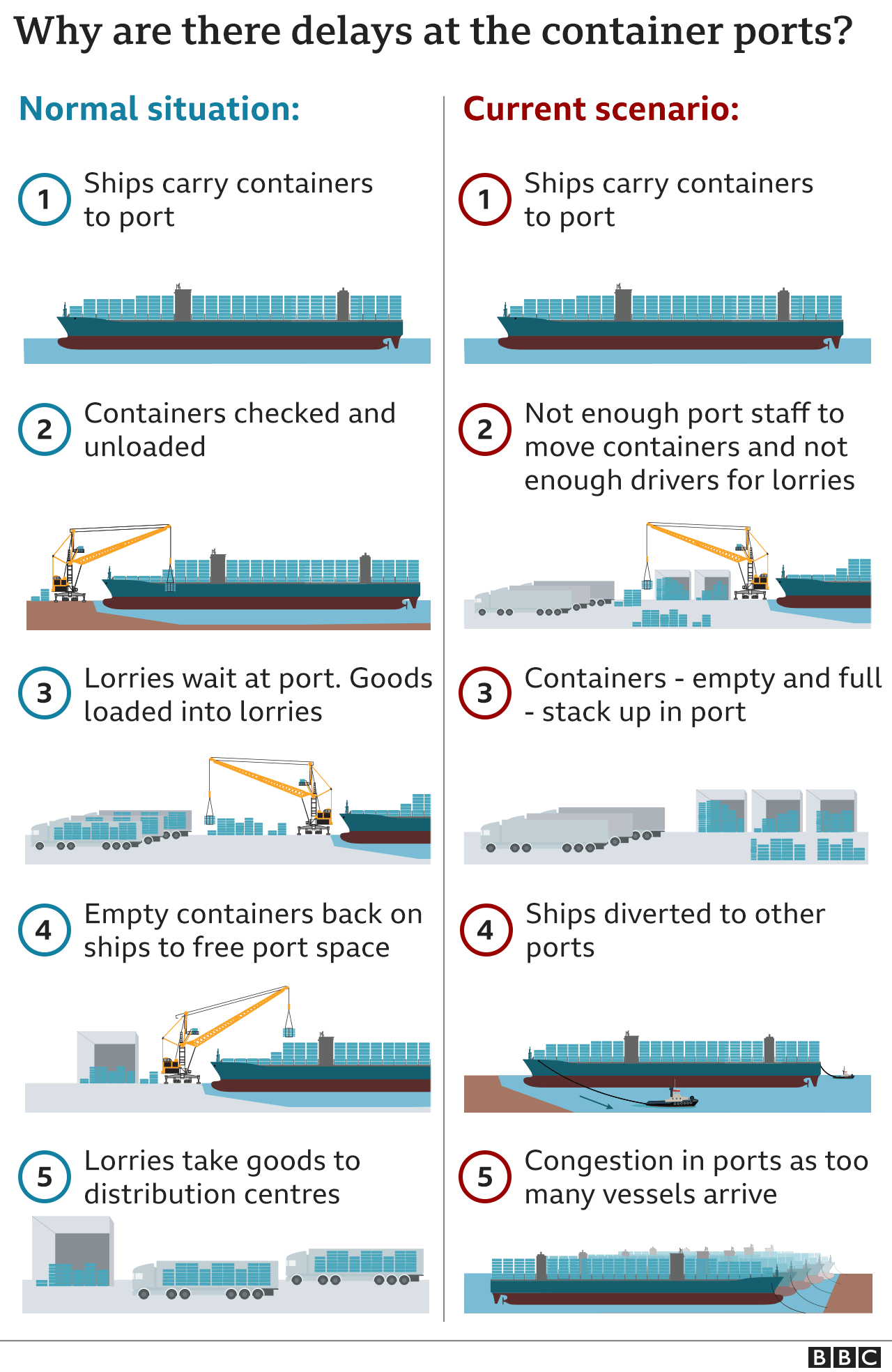
While people stew about supply chain disruptions and our own media do little or nothing to provide a clear picture of what’s going on I wanted to call attention to this article at the BBC which includes the handy infographic above. They do their best to explain things away:

“I don’t think anyone foresaw this huge surge in demand – especially after ships were laid up during the pandemic,” says Ms Porter.

The sight of ships waiting off the Californian coast has led to wider debates about the state of American supply chains. There have long been calls to upgrade infrastructure generally.

which I do not find particularly satisfying. My answer is that isn’t encouraging consumer demand the point of the stimulus packages passed last year and this? If they didn’t expect them to encourage demand what was the point?

So we’ve got a certain amount of pent-up demand, policy that encourages demand, and facilities which by design don’t have a lot of excess capacity (the figure I’ve read is 5%—if you know better please provide a citation. I would think that long lines at the ports would be an expected consequence rather than a complete suprise.

As I’ve said before I’m not a minarchist or an anarcho-capitalist. I think that federal spending to encourage facilities to maintain more capacity is a perfectly reasonable thing to do. But so is encouraging more domestic or nearshore production. Of the two I’d rather do the latter.

8 comments

Other Risks

Not unrelated to my post of last week, the editors of the Washington Post call out one of the run-on effects of the COVID-19 pandemic—a spike in the number of deaths due to tuberculosis:

With reduced access to diagnosis and treatment, deaths are on the rise. The WHO’s annual tuberculosis report, released Thursday, estimates that last year there were 1.3 million deaths, marking a return to the 2017 level and the first year-on-year increase since 2005. Also worrisome is that treatment for drug-resistant tuberculosis fell, as well as preventive treatment. Global spending on tuberculosis diagnostics, treatment and prevention declined, too.

The tuberculosis story is almost certainly going to be repeated with other global health campaigns, including the fights against polio, malaria, HIV/AIDS and more. The WHO and UNICEF report that 23 million children missed out on basic vaccines through routine immunization services last year, which is 3.7 million more than in 2019. Most of these, up to 17 million children, probably did not receive a single vaccine during the year.

In 1900 before antibiotic treatment about 200 people per 100K population died of tuberculosis. My back-of-the-envelope calculations tell me that’s considerably worse than deaths due to COVID-19. We don’t want to go back to those days and the more people contract TB and the more who are inadequately treated the greater is the likelihood that will happen.

10 comments

Stories of the Day

If you’re wondering why I have been so silent today here are the leading stories of the day:

  • Missionaries kidnapped in Haiti. Third World countries are dangerous and going there including as a missionary, maybe especially as a missionary is risky.
  • British MP murdered by Briton of Somali heritage. Was he motivated by radical Islam? Maybe some day people will start taking religion seriously at face value. That will require a substantial psychological readjustment.
  • Indocent exposure. The Chicago Art institute has fired its volunteer docents for being too white and too well-to-do.
  • About half of Chicago police officers have not been inoculated against COVID-19 and are reluctant to do so regardless of the mayor’s dictum. Who will blink first?

That’s about it. Other than the ordinary partisan bickering.

4 comments

Ruled or Represented?

When I considered this analysis by Michael Hendrix at the Manhattan Institute of an opinion poll of 20 major urban metro areas, two thoughts occurred to me. The first was how eccentric the 20 metro areas they polled were:

Note that with only a few exceptions those are coastal cities. They say it’s the cities with the largest population growth. The only Midwestern city in the list is Minneapolis and it barely makes the top 50 metro areas in the country. There are a half dozen Midwestern cities that are larger but I will freely admit that Chicago and Detroit, just to pick two, are shrinking.

The second thing was this graph:

Whatever you think of the merits of those opinions, you’ve got to admit that they’re not really consistent with the views expressed by Democratic elected officials. That leads to the question: are they actually representing their constituents? Or, maybe more precisely, what constituency are they representing?

5 comments
