You Ain’t Seen Nothing Yet

I’ve been writing about this subject off an on for decades. If you think the death, disease, and panic over COVID-19 has been something, wait until there’s a major outbreak of a drug-resistant “superbug” which is inevitable. Here’s a report by Kevin Outterson at STAT:

Failing to plan, it’s been said, is planning to fail. By this standard, the United States and other countries are planning for failure when it comes to preparing for the next public health crises, one of which will certainly be antimicrobial resistance, the phenomenon in which bacteria and fungi evolve to resist even the strongest treatments.

Covid-19 has demonstrated the catastrophic result of a virus catching the world unprepared. But over human history, bacteria have been our most dangerous foe. So it doesn’t make sense to me that the Biden administration recently released a pandemic preparedness plan that mentions the threat of antimicrobial resistance just once, and then only in passing.

This omission is ominous. Drug-resistant “superbugs” sicken nearly 3 million Americans each year and kill 35,000. Some experts estimate the real toll is much higher, with up to 162,000 Americans dying each year from antimicrobial resistance. An influential report commissioned by the Prime Minister of the United Kingdom and the Wellcome Trust estimated this scourge could kill as many as 10 million people each year around the globe.

While I agree that such a catastrophic eventuality is inevitable, there are things that can be done to minimize it and/or postpone it. The first thing is to reduce the profligate use of antibiotics both here and abroad. Countries in which antibiotics are available over-the-counter are commonplace whether de jure or de facto. In India antibiotics for human use are available over-the-counter without a prescription. In China and Indonesia in theory a prescription is required but in practice they are widely available over the counter. That accounts for a third of the world’s population right there.

Closer to home while in theory antibiotics for human consumption in Mexico require a prescription, in practice they are still readily available over-the-counter. Here in the U. S. antibiotics for use by animals, particularly farm animals, are available over-the-counter and that has risks all its own. Not only should we be tightening up on restrictions here, we should be providing incentives for other countries to tighten their own restrictions not just in theory but in practice and restrict travel to countries that don’t do so.
6 comments

Many a Slip ‘Twixt Cup and the Lip

I found this report at OilPrice.com by Irina Slav on China’s backing away from its environmental pledges grimly amusing:

China has taken a step back from emission reduction commitments amid the energy crunch that caused factory closures and power rationing.

In a statement, Premier Li Keqiang said that the stable supply of energy must be the foundation of any transition to a less emission-intensive future.

“Energy security should be the premise on which a modern energy system is built, and the capacity for energy self-supply should be enhanced,” Li said as quoted by Bloomberg.

Based on this, Beijing now plans to make sure that its goal to reach peak emissions by 2030 and a net zero emission status by 2060 will be pursued in a “sound and well-paced” manner.

which tallies perfectly with what I’ve been saying for a long time. There’s nobody better than the CCP at writing press releases. I have considerable admiration for that ability. Following through on the claims in the press releases? Not so much.

Go back and take a look at the graph I put up yesterday. The increase in global coal utilization along with its attendant air pollution not to mention carbon emissions can largely be attributed to China. China is in a difficult situation. A lot of the country’s economic growth over the last couple of decades has been in heavy manufacturing, notoriously energy-intensive. China has substantial coal resources but not enough oil or natural gas to supply its needs and the country remains committed to substantial self-reliance for vital needs which include both food and energy. Expect China’s expansion of its reliance on coal to be pushed back ever farther. Lord, make me net zero but not yet.

10 comments

What Causes “Havana Syndrome”?

An op-ed at National Defense Magazine by James Giordano urges Americans to “come together” to address “Havana syndrome”, a neuropsychological condition first reported by U. S. diplomats in Havana with mainly cognitive effects. After discounting natural environmental causes:

Despite some initial speculation that various environmental events — such as crickets, industrial noise and artifacts of sounds produced by various electronic equipment in the affected individuals’ apartments — each and all of these speculations were disproven.

and psychogenic causes:

Moreover, conjecture that these signs and symptoms may represent some form of psychogenic illness — in other words, a type of mass hysteria — were also disproven in light of evidence regarding the time sequence and occurrence of events.

the author considers deliberate human agency in the syndrome:

It was originally believed that most probable was some form of directed energy; likely a sonic device.

There was discussion as to whether this may have been an artifact of surveillance technology, or whether it was an intentional engagement to affect the capability and health of those individuals targeted.

To date, it remains unclear whether a surveillance component was indeed operative; but what is clear is that the individuals were selectively identified and targeted.

The author concludes by urging a substantial engagement both by federal authorities but also by the “whole of nation” in searching for a cause and treatment:

Thus, coordination of effort will be vital to sustain the effectiveness and time and cost efficiency of approaches employed for detection and deterrence. The dedication of resources and personnel by the Biden administration to further investigate and address Havana syndrome is noteworthy for a number of reasons, not least of which is that there is increasing development of currently available and emerging biotechnologies that are being considered as weapons against individual and group targets.

While cooperative governmental efforts are important, what is needed is a “whole-of-nation” approach that focuses resources in research academia, the industrial sector, and within and across local, state and federal governmental agencies. This whole-of-nation enterprise must first identify the nature and source of the problem, quantify the actual risk and threat, and then establish methods and means to mitigate and prevent such engagements.

Frankly, I’m skeptical. I’m not skeptical that people are reporting symptoms and dysfunction. I’m skeptical about the attribution of causes and about the nature of required engagement. One of the reasons for my skepticism is that we generally don’t look for diabolical superweapons in Cuba, Colombia, Georgia, Kyrgyzstan, or Uzbekistan which are prominent in the list of places where the condition has been reported.

I would suggest that the scope of the investigation be expanded a bit. Rather than focusing on overseas diplomats or intelligence officers, make the definition of the syndrome more rigorous and start looking for similar reports here in the U. S. among ordinary people. Again, I don’t dispute the reality of the condition. I just wonder if it may be related to something a lot more common, e.g. excessive or improper earphone utilization.

2 comments

Losing Air Superiority

Here’s an article at Voice of America suggesting that the U. S., which has relied on air superiority in most of its recent major military operations, may be on the verge of losing that superiority with respect to China:

For decades, the United States military has benefited from having air superiority over its enemies in all its conflicts around the world. The Pentagon’s multibillion-dollar investment in advanced warplanes, weapons systems, satellites and aircraft carriers has made air power a central part of America’s global projection of military might.

However, China’s People’s Liberation Army (PLA) is rapidly modernizing, and military leaders and analysts say that Washington may no longer be able to always rely on its air superiority.

Speaking at an Air Force Association conference last month, General Charles Brown Jr., chief of staff of the Air Force, said the PLA had what he called “the largest aviation forces in the Pacific” and had developed them “underneath our nose.” Brown predicted China could overcome U.S. air superiority by 2035.

At the same event, Lieutenant General S. Clinton Hinote, a deputy chief of staff, warned that the U.S. was not keeping pace with China’s advancements. “In a few important areas, we’re behind — tonight. This is not a tomorrow problem. This is a today.”

Hinote told reporters that as somebody who was aware of the evidence at all classification levels, he believed that China had caught up with the U.S. air power advancements, and he warned “the light is blinking red.”

and that China already has “local air superiority”. There’s also substantial evidence that the U. S. may lose naval superiority to China by 2030.

One thing is certain: we can’t depend on maintaining air superiority by virtue of technology without substantially more digital security that we have at present. Any new developments will simply be stolen and copied.

My own view is that we should be devoting serious attention to refurbishing our military capacity after 20 years of (in my view) excessive and futile utilization. I think we should be de-emphasizing land forces in favor of first enhanced and improved naval capability and second enhanced and improved air capability.

It’s going to require an enormous shift in attitude to come to terms with the new global reality. I have little confidence in the ability of our political leadership regardless of party to make the necessary adjustments.

5 comments

Fairness


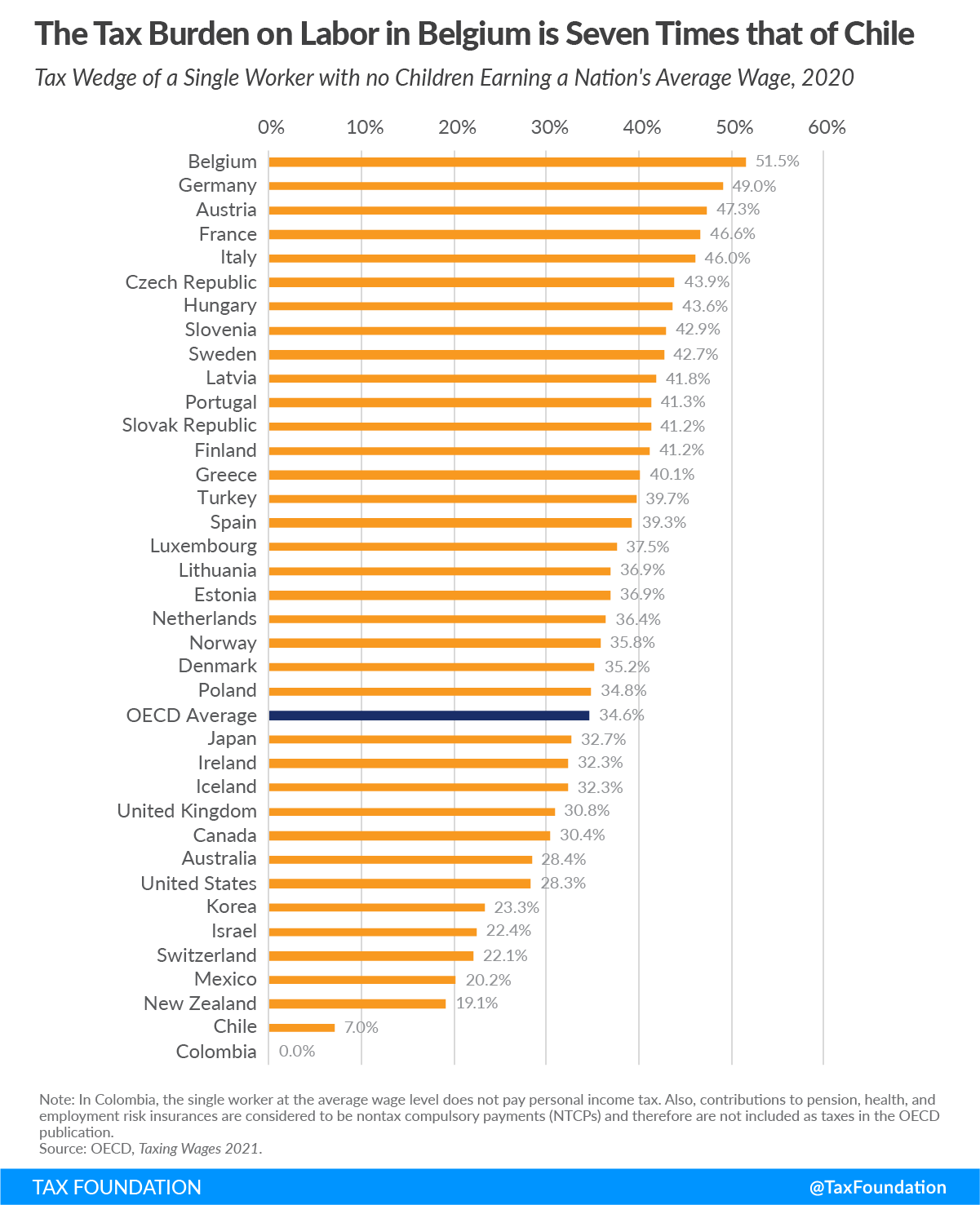
While you listen to the normal posturing about how “the rich” (generally undefined) aren’t paying “their fair share” (also generally undefined) in taxes, it might help to bear in mind that, while the U. S. tax system overall is sligntly regressive the tax systems in other OECD countries tend to be very regressive, particularly when you take value-added taxes into account.

As you can see from the chart above payroll taxes in the U. S. are pretty closely aligned with other countries in the “Anglosphere” with which we have much more in common culturally than we do with, say, France or Germany which have significantly higher payroll taxes than we do. Plus VATs which are highly regressive.

Following up on my previous post one of the ways in which the U. S. is an outlier is that we tend to trust our government much less than people in other Anglosphere countries or major economies. Opinions may differ on that but I think one of the factors is that our government is less trustworthy than theirs.

Just for the record I think we should move to a tax system that resembles the one described here. That would, however, deprive politicians of an issue on which to campaign so I don’t expect it to happen.

4 comments

The Unvaccinated

I found Zeynep Tufekci’s New York Times piece on the people who are resisting being vaccinated against COVID-19 pretty good once you skip over the customary boilerplate. Here’s its essence:

All this may make it seem as if almost all the holdouts are conspiracy theorists and anti-science die-hards who think Covid is a hoax, or that there is nothing we can do to reach more people.

Real-life evidence, what there is, demonstrates that there’s much more to it.

In brief what she found tallied closely with what I’ve been saying: those resisting being vaccinated tend to be those who who distrust the government, the healthcare system, or both:

Some key research on the unvaccinated comes from the Covid States Project, an academic consortium that managed to scrape together resources for regular polling. It categorizes them as “vaccine-willing” and “vaccine-resistant,” and finds the groups almost equal in numbers among the remaining unvaccinated. (David Lazer, one of the principal investigators of the Covid States Project, told me that the research was done before the mandates, and that the consortium has limited funding, so they can only poll so often).

Furthermore, their research finds that the unvaccinated, overall, don’t have much trust in institutions and authorities, and even those they trust, they trust less: 71 percent of the vaccinated trust hospitals and doctors “a lot,” for example, while only 39 percent of the unvaccinated do.

Trust is difficult; it must be earned and it can be easily lost. My experience at least is that coercion and punishment are not generally effective ways of building trust.

I found this interesting:

Along with the recognition of greater risk, access to regular health care may be an important explanation of why those over 65 are the most-vaccinated demographic in the country. They have Medicare. That might have increased their immunity against the Fox News scare stories.

One reason for low vaccination rates in rural areas may be that they are “health care and media” deserts, as a recent NBC report on the crises put it, with few reliable local news outlets and the “implosion of the rural health care system” — too few hospitals, doctors and nurses.

9 comments

The Great Society


As one of their “Five Facts” offerings No Labels has posted “Five Facts on the Great Society” at RealClearPolicy, summarized in their infographic above.

Of the programs they mention two, Medicare and Medicaid, are considered conditional successes, the housing component was largely a flop and is nearly forgotten, while Head Start is controversial. The controversy is whether it’s effective or not. There is scholarship going both ways on it, the main bone of contention being whether gains made by children under Head Start persist.

The reason I characterize Medicare and Medicaid as “conditional successes” is that they achieved the objectives of ensuring health care for the poor and elderly but they have cost enormously more than had been projected. In 1965 U. S. per capita healthcare spending was more or less aligned with that of other OECD countries particularly Canada, France, and Germany. Now U. S. per capita healthcare spending is a multiple that of other OECD countries. The reasons for that are complicated. However, since subsidizing willingness to pay is inherent to the structure of Medicare and Medicaid, it’s fair to say that has been wildly successful.

The housing component of the Great Society was better than what had proceeded it—much of the public housing built in the 1940s and 1950s has been torn down—but characterizing it as a success would be an exaggeration.

The circumstances in 1965 and those today are tremendously at variance. Johnson had just won the most decisive presidential victory in nearly 150 years; President Biden’s victory is, shall we say, not quite that decisive. When the Great Society programs were enacted Democrats had held the House for a decade (and most of the previous 30 years); today it bounces back and forth between the parties and the Democrats’ House majority is perilously narrow. The Great Society programs passed with bipartisan support; you can’t precisely say that passing “Build Back Better” would be unprecedented but its only precedent for passing major social legislation along purely partisan lines was Obamacare.

I read No Labels’s post as a gentle admonition to the progressives in the House to take the victory on the infrastructure spending bill and otherwise pull back on their plans.

1 comment

How It Changed


I thought you might find the graph at top of this page depicting coal consumption by sector eye-opening. As you can see burning coal to produce electricity only really took off after 1960. If you’re curious about what the situation looks like globally, I’m happy to oblige:

9 comments

Myth-Making

Although it was originally published in The Spectator UK, this essay by Jeff Fynn-Paul, I found “The myth of the ‘stolen country'” well worth reading in a more durable PDF form. It’s ten pages long.
Here’s a telling quote:

The real reason to perpetuate such a disastrously one-sided view, it seems, is if one is in a tiny minority of activists who has ‘drunk the kool-aid’ of Cultural Marxism — an ideology bent on bringing maximum embarrassment to Capitalism, Democracy, Western Civilisation and Europeans in general, in the vain hope that this will somehow bring about a sort of… what? Revolution? Really? Let’s not be naive. The only reason to be this consistently, this unreasonably angry about things which happened centuries ago, is if one sees the entirety of experience through the lens of perpetual racism and victimisation, and crucially, if one does not believe in the power of democracy to correct these wrongs.

At base, such people do not believe in the democratic process. Marxists have always believed that a handful of self-appointed intellectuals are better suited to creating a ‘good society’ than the rough-and-tumble of real-world parliamentary debate.

I don’t completely object to de-mythologizing but I do disagree with re-mythologizing in a divisive way that is readily falsifiable. What I mean is that I don’t think you need to believe that George Washington chopped down a cherry tree or never told a lie but I do think you need to believe that the country he fought to form was worth making and that his act of refusing to be named king was important, unique, and formative.

IMO it’s important to love our country warts and all, for what it is and not just what it might become, refusing to replace a romanticized past with another romanticized past.

7 comments

Attracting Comment

Well, Ezra Klein’s piece on David Shor is certainly attracting comment. Now it’s Megan McArdle getting into the act in her Washington Post column:

To me, Shor’s vision — sort your ideas by popularity, then “Start at the top, and work your way down to find something that excites people” — sounds less inspiring but more likely to help Democrats get and hold power. It doesn’t require Democrats to persuade voters that, say, an Asian American assistant professor has exactly the same interests as a rural, White call-center worker or a Hispanic plumber and that only a conspiracy of the very rich prevents them from realizing it. Democrats merely have to learn what voters already want.

But while Shor’s more prosaic strategy might be an easier sell to voters, it is apt to be a harder sell to the young idealists who staff campaigns and newsrooms. And the newsrooms might be a bigger problem than the political class.

As Matt Yglesias pointed out on Twitter, “A closed circle of young, college educated staffers is likely to end up further off-center the more they talk to themselves.” The mainstream media, and staffers’ internal fights spilling onto Twitter, are an important part of how the progressive vanguard talks to itself — and as the media skews ever-leftward, it helps sustain a rarefied bubble where divisive slogans such as “defund the police” can be questioned only with great delicacy, while significantly more popular propositions like “use the military to help police quell riots” cannot be defended at all.

and notice that she uses the same diction that I did. Vanguard.

I can only repeat that ideas appealing to a mostly white, mostly college-educated self-appointed vanguard are unlikely to be vote-getters, at least not until an extremely charismatic and persuasive champion appears on the scene and none is apparent at present. For my own part I find such champions, whether on the left or the right, peculiarly unappealing even off-putting but I also recognize that I’m in the minority in the view. Far too many, in Bill Clinton’s memorable phrase want to “fall in love”.

4 comments
