Summers’s Lament

And I agree with many of Lawrence Summers’s complaints about Trump’s tax proposal, expressed rather harshly in a Washington Post op-ed:

I have strong disagreements on tax policy with Republican economists such as Greg Mankiw, Glenn Hubbard and Martin Feldstein and with Treasury alumni such as Nick Brady, John Snow and Hank Paulson. Nothing I have ever heard or read from them seems absurd or dishonest in the way that almost everything coming out of this administration does.

We know enough to say that a tax-reform plan along the lines of the administration’s sketch would not substantially increase economic growth, would blow out the budget deficit and would make the United States an even more unequal place.

I think he exaggerates the role of the tax code in producing income inequality. I could list a dozen different policies that have probably been more significant including immigration policy, trade policy, and propping up the big banks during the financial crisis all of which were supported by Dr. Summers. He was also the Obama Administration’s Director of the National Economic Council when President Obama signed into law the single largest increase in the taxes of lower and middle income people in the history of the United States. I don’t recall his complaining about income inequality then. Should I mention his role in the Clinton Administration during which reforms which led to the enormous increase in executive compensation were enacted, China was granted Most Favored Nation trading status, and China was admitted to the WTO? He has also spoken in favor of the deindustrialization of the United States, one of the greatest factors in exacerbating income inequality. Under the circumstances I think he owes it to us to tell us what he supports rather than merely complaining about what he doesn’t like.

It’s too bad that Dr. Summers did not advocate for needed reforms to the tax code eight years ago when he had considerably more influence than he does now. Like the rest of the Obama Administration he took his eye off the economic ball and now he’s confronted with an administration whose priorities are very different from his.
1 comment

Will Corporate Tax Cuts Create Jobs?

I tend to agree with Marcus Ryu’s observation in his New York Times op-ed:

As an entrepreneur myself and a friend to many others, I know that lower tax rates will not motivate more people to start companies. People start companies for many reasons: a compelling idea, ambition for fame and fortune, a desire to be one’s own boss, frustration with one’s employer. I have never heard someone say, “I would have started a company, but tax rates were too high” or “I wouldn’t have started this company, but then George W. Bush cut tax rates, so I did.”

to the effect that cutting corporate income tax rates won’t increase the number of jobs. What he neglects to consider is that our present corporate tax code is already costing jobs and, worse, they’re the very sorts of jobs we need—managerial jobs, higher staff jobs—and replaced with nothing. “Inversions” to avoid the U. S.’s tax rates have taken place and continue to take place and when they do whole corporate headquarters move, too, taking their highly compensated jobs with them.

The corporate income tax is a very inefficient tax and the U. S. corporate tax code is out of line with those of other OECD countries. Reducing corporate tax rates wouldn’t be a master stroke that solves all of our economic problems but it would be a step in the right direction. If you’re concerned about its potential for worsening income inequality, increase the personal income tax rates.

4 comments

Life Imitates Art

Consider:

Carmelite Sisters Danced the Electric Slide from Carmelite Sister on Vimeo.

and

1 comment

Who Was “Josh Billings”?

There are a tremendous number of misattributed quotations out there. I’ve attributed quotations to the wrong people myself from time to time and I assume that I still do. I try to correct my mistakes over time.

I’ve noticed a pattern in misattributions. There’s a sort of system of archetypes at work. People attribute sayings to Einstein as a shorthand for indicating they think it’s smart, Ben Franklin when they think it’s clever, and Sam Clemens when they think it’s witty.

Just as “Mark Twain” was Sam Clemens’s pseudonym and the name of the character that he portrayed on the lecture circuit, very different from his actual personality, so “Josh Billings” was Henry Shaw Wheeler’s pseudonym and the character he played on the lecture circuit, sort of a rough-hewn Westerner. Wheeler was a rough contemporary of Sam Clemens’s, second only to him in popularity as a 19th century American humorist.

Here are some of the many quotations that are things that Henry Shaw Wheeler wrote that are generally attributed either to folk wisdom, Mark Twain, Ben Franklin, etc. (I’m translating from the original thick dialect in which he wrote and spoken on the lecture circuit.)

  • The squeaky wheel gets the grease.
  • It ain’t what you don’t know that gets you into trouble but what you do know that just ain’t so.
  • The lion may lie down with the lamb but the lamb generally doesn’t get back up again.
  • There is as much difference between vivacity and wit as there is between lightning and the lightning bug.
  • Love is like the measles; we can’t have it bad but once, and the later in life we have it the tougher it goes with us.
  • As scarce as truth is, the supply has always been in excess of the demand.

There are dozens if not hundreds of others. Here are some of his witticisms I wish were more widely known:

  • You should watch out for someone who pities everybody. The changes are they are profiting slily from the misfortunes of others.
  • About half the pity in this world is not the result of sorry but of satisfaction that it’s not our horse that’s broken its leg.
  • When a woman wears the britches, she generally has the right to them.

I think that more people should be familiar with Henry Shaw Wheeler, just as with Finley Peter Dunne (Mr. Dooley).

0 comments

Cost/Benefit Analysis

I have a quibble with this article at the Harvard Business Review, “The Great Recession Drastically Changed the Skills Employers Want”:

In recent research we investigate how the demand for skills changed over the Great Recession (2007-09). Using nearly all electronically posted job vacancies in 2007 and 2010–2015 collected by the analytics company Burning Glass Technologies, as well as geographic differences in economic conditions, we establish a new fact: the skill requirements of job ads increased in metro areas that suffered larger employment shocks in the Great Recession, relative to the same areas before the shock and to other areas that experienced smaller shocks. Our estimates imply that ads posted in a hard-hit metro area are about 5 percentage points (16%) more likely to contain education and experience requirements and about 2–3 percentage points (8‒12%) more likely to include requirements for analytical and computer skills.

Moreover, the vast majority of this “upskilling” persists through the end of our sample in 2015. That is, even while most measures of local labor-market strength had converged back to pre-recession levels, differences in advertised skill demands remain. This holds true even when we statistically control for the availability of skilled labor and the composition of ads across firms and occupations. In fact, we find that the same firms that upskilled by 2010 drive the persistence later in our sample period – the companies that reacted to the recession by looking for more skilled workers were still pursuing that strategy five years later.

My quibble is that they’re neglecting what is to me an obvious reality. Managers do things for reasons. They don’t just do them in a sort of Brownian motion or random walk. If managers are convinced that there is a reliable and unending supply of low-end workers or of workers with higher skills than present workers at lower pay (or they can use the claimed need for higher skills as a pretext for replacing present workers with workers who will work for lower wages), they will do so.

But such convictions are based on politics and policies and may be reversed. Then they’ll do something else. Managers may not be emotionless robots or perfectly rational but they’re not single-celled organisms or mindless particles, either.

The question that I wish were being considered but no one seems to be is why did so many companies, particularly large companies, have so many nonproductive employees previous to 2007 whom they continued to employ? I think that’s the $64 trillion question.

4 comments

Sunk Costs

I was a skeptic of the deal that President Obama struck with Iran. Not only did I think that it was based on false premises but I thought that the U. S. realized precious little from the deal that it would not have obtained otherwise and that the main objective of the deal was to burnish President Obama’s list of foreign policy accomplishments, not a legitimate reason.

However, once it went into force with all of its costs to the U. S. front-loaded, those became sunk costs. Now abrogating the deal would be foolish. If the deal has any benefits for the U. S. and if those benefits can be realized, the only way they can be realized is to leave it in force.

The reason I bring this up is not simply because President Trump is considering decertifying Iran’s compliance with the treaty but because it reflects a more general problem with American politics and policies over the last decade or so. Just because the previous administration made mistakes doesn’t mean that doing the opposite isn’t just as stupid. There are such things as path dependency and time dependency. You can’t unbreak eggs and there are such things as sunk costs.

9 comments

Why Niger?

The editors of the Pittsburg Post-Gazette wonder why American soldiers are fighting and dying in Niger:

The first question is, what are hundreds of U.S. troops doing in Niger? It is a French-speaking nation for which France has traditionally played the important “godfather” role, including with military forces. Niger is a poor nation of 21 million, with few notable resources apart from the fact of its central location, landlocked, and bordering on Algeria, Benin, Burkina Faso, Chad, Mali, Nigeria and southern Libya, a largely desert area of little or no strategic importance to the United States.

The claim in the past has been that some of the various shadowy tribal militia forces operating in the region have al-Qaida or Islamic State links but the intelligence supporting that argument for U.S. forces to be in Niger is shaky at best. They can better be described as armed bandit gangs.

The second major question is why Americans learn of U.S. military involvement in Niger, in combat in fact, only when American soldiers die? No one seems to recall an American president or Congress declaring war in Niger. What we are looking at instead is one piece of an expansion of U.S. military activity in Africa to justify the existence of the U.S. Africa Command, AFRICOM.

Good questions. I have a different question. Under what authority are they there? If it’s under the Authorization for Use of Military Force of 2001, that’s quite a stretch. If it’s under the president’s authority as commander-in-chief of the military, that’s an even greater stretch. That authority isn’t carte blanche. The U. S. armed forces are not the president’s personal military. If it just grew like Topsy, that’s insubordination.

There are three conditions for a just war (just ends, just means, just authority). Protecting Nigeriens would be just; extending U. S. influence in the region wouldn’t; providing a pretext to expand the role of AFRICOM would be even less so. Unless Congress has declared war against someone in Niger, I see no way that U. S. forces are fighting there under a just authority.

These interventions have a way of taking on lives of their own. The war in Vietnam began as picking up the French end. In 1959 was had nearly 1,000 advisors there, ostensibly training the South Vietnamese military. By 1961 the U. S. military was already taking casualties. The rest, as they say, is history. For another example, consider Afghanistan.

When there is no mission, it’s all creep.

0 comments

Slowly But Slowly


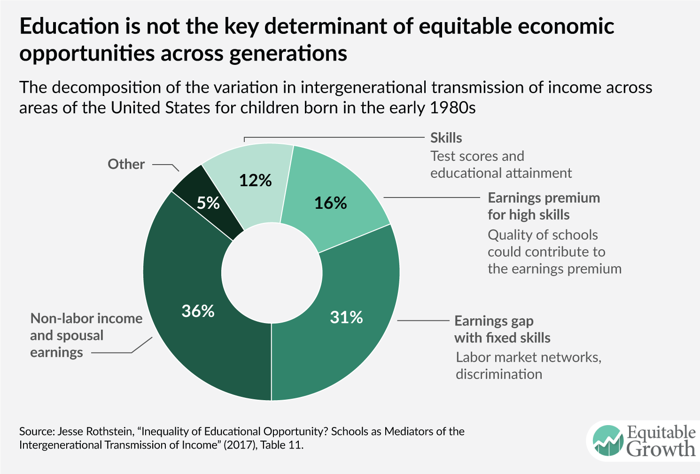
Slowly but slowly the scales are falling from people’s eyes and they’re beginning to understand how the terrible and wasteful overinvestment in higher education is stunting the U. S. economy. From the same article in Atlantic as the graphic above:

A new working paper authored by the UC Berkeley economist Jesse Rothstein builds on that research, in part by zeroing in on one of those five factors: schools. The idea that school quality would be an important element for intergenerational mobility—essentially a child’s likelihood that they will one day outearn their parents—seems intuitive: Leaders regularly stress that the best way to rise up the income ladder is to go to school, where one can learn the skills they need to succeed in a competitive, global economy. “In the 21st century, the best anti-poverty program around is a world-class education,” Barack Obama declared in his 2010 State of the Union address. Improving “skills and schools” is a benchmark of Republican House Speaker Paul Ryan’s poverty-fighting agenda.

Indeed, this bipartisan education-and-poverty consensus has guided research and political efforts for decades. Broadly speaking, the idea is that if more kids graduate from high school, and achieve higher scores on standardized tests, then more young people are likely to go to college, and, in turn, land jobs that can secure them spots in the middle class.

Rothstein’s new work complicates this narrative. Using data from several national surveys, Rothstein sought to scrutinize Chetty’s team’s work—looking to further test their hypothesis that the quality of a child’s education has a significant impact on her ability to advance out of the social class into which she was born.

Rothstein, however, found little evidence to support that premise. Instead, he found that differences in local labor markets—for example, how similar industries can vary across different communities—and marriage patterns, such as higher concentrations of single-parent households, seemed to make much more of a difference than school quality. He concludes that factors like higher minimum wages, the presence and strength of labor unions, and clear career pathways within local industries are likely to play more important roles in facilitating a poor child’s ability to rise up the economic ladder when they reach adulthood.*

IMO belief in the role of minimum wages or labor unions is cargo cult thinking. The significance of a strong manufacturing sector and culture isn’t. Here’s the sad truth about higher education:

  • Historically, the purposes of higher education were pre-managerial and pre-professional education and networking with others on similar tracks.
  • It still is.
  • We don’t produce enough managerial or professional jobs for everyone getting college educations to take those jobs.
  • Many of those pursuing higher education are not suitable for reasons of ability, temperament, or preference to be managers of professionals.
  • Many will end up taking jobs that will never generate incomes high enough to pay off their educational loans.
  • Fraternities, sororities, and other similar social organizations in colleges aren’t peripheral to the function of higher education. They’re central to it.
  • Consequently, higher education is a waste of time and money for many of those pursuing it.
  • Post-graduate education doesn’t make the U. S. more competitive with other countries. It’s a treadmill of which the primary beneficiaries are institutions of higher learning.

There is more at stake in this policy than validating the prejudices and choices of people who’ve been successful pursuing professional degrees. Concentrating the thrust of policy on higher education draws focus from where it should be: primary and secondary education, training in the skilled trades and the requirements of modern manufacturing, and hosts of other things none of which require higher education.

We need to stop subsidizing the choice of pursuing degrees in media and encourage learning how to weld.

3 comments

Nothing

We still know next to nothing about the mass murder in Las Vegas. Was Stephen Paddock actually the perpetrator? His background and history certainly don’t suggest it. Was he actually a “soldier of ISIS” as DAESH has repeatedly claimed? That seems even more incredible.

Were there other shooters? Was he part of a conspiracy?

IMO it’s still far too early to draw any conclusions. We need to know more.

10 comments

The King’s Speech

At the Wall Street Journal former Spanish foreign minister Ana Palacio writes about King Felipe’s speech and the Catalonian referendum:

The other constant in international coverage has been calls for “dialogue” or “mediation” between Spain and Catalonia. This is simply wrongheaded. “Dialogue” in general terms does not mean anything. It is pointless given that Catalan secessionist authorities refuse to live up to or even recognize their responsibilities under the law. “Mediation” connotes a bilateral relationship that does not exist. Catalonia is part of Spain. This is an internal issue that must be addressed by all of Spain.

So far the Spanish government has held back from invoking its constitutional authority to suspend home rule in Catalonia. But as the king said on Tuesday, “the legitimate powers of the state have the responsibility to guarantee constitutional order and the normal functioning of institutions.”

What’s really needed is introspection. As the king rightly noted, “Catalan society is fractured.” Spain needs to respond to what has happened, and to its causes. This will almost certainly involve a discussion about the future of the Spanish Constitution.

Catalonia has been part of Spain for the last millennium. To the best of my ability to determine it has no history apart from Spanish history. To my eye it appears to be a linguistic community rather than a country.

And I repeat the questions I posed before the referendum: what is the unit of measure of sovereignty? The nation? The county? The city? The block? The house? The individual?

1 comment
