The Sun-Times reports that Chicago Public Schools CEO Forrest Claypool is being accused of lying to investigators and the CPS Inspector General has called for him to be fired:
Mayor Rahm Emanuel’s schools chief “repeatedly lied†to investigators and engaged in a “full-blown cover-up†of behavior that he and the top attorney for Chicago Public Schools engaged in over the past 20 months, the CPS inspector general says in a report released Thursday.
In a blistering, 103-page document he sent Tuesday to the Chicago Board of Education, Inspector General Nicholas Schuler said he was “left with no recourse but to conclude†that the board should fire CPS CEO Forrest Claypool.
“Claypool greatly compounded the severity of his misconduct when he repeatedly lied to the [inspector general’s office] through two separate interviews,†Schuler wrote.
But Emanuel rushed to Claypool’s defense after the release of the report. And Frank Clark, the president of the school board — whose members were chosen by Emanuel — also has praised Claypool since getting the report.
The misconduct primarily has to do with the relationship between Mr. Claypool and the law firm of which he had formerly been a partner with suggestions of various corrupt activities.
Maybe it’s just my imagination but it certainly appears to me that the ongoing revelations of sexual abuse and impropriety have inspired a host of new conspiracy theories. Two, published in prominent media outlets, really struck me as loony. The first characterized the revelations as a conspiracy by Christians to further constrain sexual behavior. The second characterized Al Franken’s resignation as a move in a plot to oust Trump, sacrificing a pawn, as it were.
Maybe it’s just my imagination. Maybe it’s another form of misdirection. Maybe people just don’t know what they’re writing any more. Maybe it’s the next phase of the ongoing scandal.
Did you notice how few articles there were about Pearl Harbor or, more broadly, World War II yesterday? I think it’s reasonable to speculate that remembrance of the event has died with the “Greatest Generation”, the generation that fought it.
And speaking of graphs I found the one above, from this article by Robert Rapier at Forbes pretty interesting, too. What that tells me is that even if the United States and Europe reduce their carbon emissions to zero, something no one thinks is going to happen, it’s going to be darned hard for our species’s level of carbon emissions to decrease to the level that global warming activists say is necessary without a lot more activity in that area from China in particular than is presently the case.
I found this post at the blog of the Library of Law and Liberty interesting. Consider this passage:
If asked, most people today would likely equate authority with power. Power is rightly understood as the ability to compel obedience through intimidation and force. But unlike power, authority does not compel through such coercion. Rather, it is self-evident; people submit to authority voluntarily. Authority, properly understood, transcends the back-and-forth of political life. In that way, it resides outside the government.
In America, authority resides in the people and is expressed in the Constitution. In 1796, James Madison acknowledged this relationship between popular authority and the Constitution, arguing that, prior to its ratification, the Constitution “was nothing more than the draught of a plan, nothing but a dead letter until life and validity were breathed into it, by the voice of the people.â€
By virtue of this authority, the Constitution gives the government its power and stipulates both the ways in which that power may be used and the ends to which it may be directed. The Constitution also provides the means by which the people can check the government when it abuses its power.
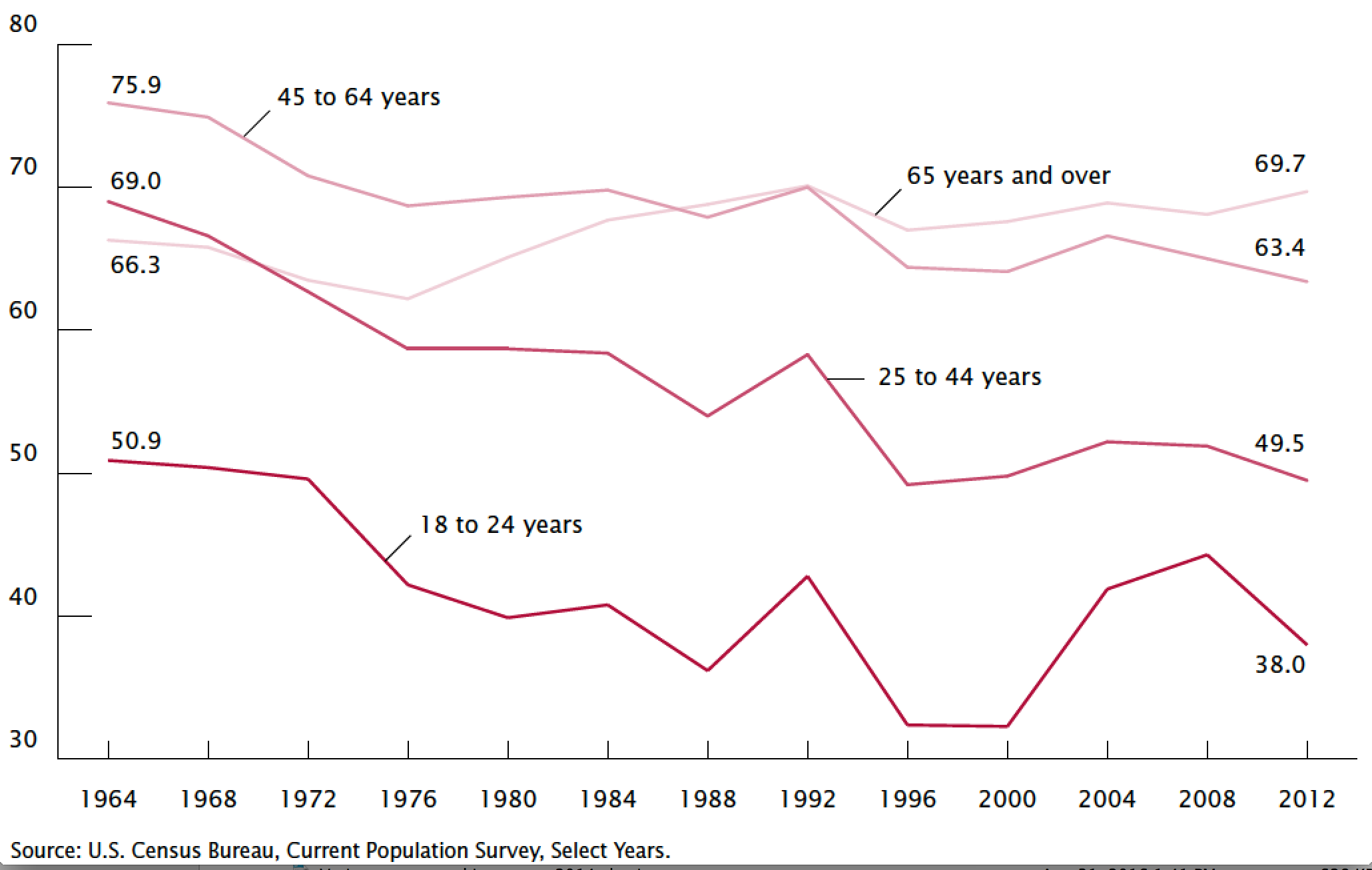
in the light of this graph:
while appreciating that the number of eligible voters bothering to show up and vote has continued to decrease since 2012.
There’s something else apparent from the graph. What it tells us is that although your propensity to vote probably rises as you get older and see a greater stake in what the government is doing if you are less likely to vote at age 25 than your parents were at age 25 you’re less likely to vote at age 65 than they are.
That suggests that my concerns over the future of the Republic are well-founded. We’re not just seeing a “crisis of authority”. We’re seeing a loss of governmental legitimacy.
Ronald Reagan, John Kennedy, Jack Kemp and other wise tax cutters of the past grasped the significant fact that the marginal tax rate is what matters most to individuals and businesses in their decision making on whether to work to earn more or where to invest.
The emphasis is mine. It could be true of businesses and in the rarefied circles in which Mr. Forbes socializes but I think that for most people decisions are made based on cash-on-hand and, generally speaking, they can’t just to decide to increase their incomes by working harder or longer. I earn the same whether I work 40 hours a week or 80 hours a week. Unless I moonlight, of course, and that could get me into big trouble with my employer. Most hourly employees’ hours are determined by their employers and most salaried employees’ wages are fixed.
I haven’t bothered to check the statistics but my guess is that all but a very small percentage of workers are either salaried or hourly. Receiving a sizeable income while being neither a salaried nor hourly worker is practically the definition of being upper class.
Ultimately, history will determine how Trump’s tax reform compares with Reagan’s. But one thing is certain: Once a plan is signed into law this year, many Americans will immediately see a difference in their taxes, for better or for worse.
For my money the most significant contrast is that Reagan’s tax reform had bipartisan support while Trump’s does not. The real comparison that should be made is between Trump’s tax reform and the Affordable Care Act.
There’s also one minor correction to their remarks that should be noted:
Reagan’s tax reform lowered the corporate rate to 34 percent. The current House and Senate bills lower the corporate rate to 20 percent, which is more in line with the Organization for Economic Cooperation and Development (OCED) average
There were several rounds of tax reform from 1981 through 1992. Reagan’s tax reforms kept the corporate rate at 40%. George H. W. Bush’s lowered it to 34%.
The only other observation I have is that I think that the notion that the response to tax cuts is linear, i.e. that a cut of six points will impel the same response whether the starting point is 40% or 34% is at best speculative and at worst specious. Will a 12 (or 14) point cut from 34% promote more investment, less investment, or be no different than
a cut from 40% to 34%? No one knows. The one-time, short term repatriation rate of 14% sounds like an excellent idea to me. That could result in an additional $400 billion in federal revenues which can pay for a lot tax cuts. One time, of course, but it’s still nothing to sneeze at.
General Electric plans to cut 12,000 jobs in its power division as the industrial conglomerate’s new CEO institutes sweeping changes and the company grapples with a decline in business for coal and natural gas products.
The company will cut nearly one in five positions in its GE Power unit. Overall, the layoffs equal about 4% of the company’s workforce of about 295,000 employees at the end of 2016.
Asked where the reductions would occur, GE spokesperson Katie Jackson said they would be “global.” The company said layoffs would span “professional and production employees.”
my immediate reaction was to go on over to GE Power’s web site to see where the company had production facilities. Imagine my amusement when I browsed to the company’s regional pages to see the above. The “Featured Stories” section for each region was empty with the exception of the page for South America.
The company has been saying that few of the layoffs will be in the United States. We know that they won’t be in France because of the terms of the agreement they struck when they acquired Alstom back in 2014.
Two competing narratives have come to dominate the discussion. In the first, China has no fondness for Kim Jong Un’s regime and is aligned with the rest of the world in viewing it as a threat to peace and stability. But Beijing is constrained. It has less influence with Pyongyang than the world imagines and fears creating a humanitarian catastrophe on the Chinese border. In short, the Chinese share the world’s concerns and would love to do more, but their hands are tied.
In the competing narrative, China has no real interest in pressuring North Korea too forcefully, since it serves as a useful buffer between the Chinese border and U.S. troops in South Korea. Realpolitik dictates that, despite real concern over Pyongyang’s instability and unpredictability, a somewhat erratic ally is immeasurably better than staring at your enemies across the Yalu River.
Most of the commentary on China’s efforts falls somewhere on the spectrum between these two narratives. But there’s a third possibility—that China has been deliberately allowing tensions on the Korean Peninsula to escalate, if not outright stoking them. More than two decades of U.S.-led diplomacy, sanctions and threats have all failed to halt North Korea’s nuclear and missile programs and resulted in only one real casualty: American credibility. The inability of the world’s only superpower to entice, coerce or force a small, impoverished nation to fall into line has undoubtedly been observed by Asian countries weighing whether to align with American or Chinese spheres of influence.
First, an observation. China’s role in North Korea’s nuclear weapons development program is clearly a little more than passive observer. It’s practically impossible for North Korea to have obtained the materials it has needed for its development program without their passing through Chinese sovereign territory. Consequently, the alternatives really are that the Chinese authorities think that North Korea’s nuclear weapons development furthers China’s interests, the Chinese calculated, probably incorrectly, that North Korean nuclear weapons just aren’t that important, or that accepting North Korea’s development program was the best of a number of bad alternatives. I think it’s probably a combination.
Generally speaking, I think that you get better results explaining things on the basis of dumb luck than on the basis of genius. The genius theory supports the notion that it’s all a plot and, frankly, I don’t believe it. The dumb luck theory suggests that it’s all been a gigantic miscalculation or that China doesn’t really have a good alternative. Sounds about right to me.
There are a couple of points I couldn’t work into my last post that I want to include here. I tend to think that the simplest explanations are best and I think that the greatest single problem in the Arab world is factionalism. In that light the Arab world’s problem isn’t Israel or colonialism. Those are just pretexts and they’re explained by factionalism rather than causing it. The Arab world’s tyrannical leaders exploit the factionalism to promote their own power and wealth.
The second point is that Saudi Arabia, Iran, and Turkey are all vying for leadership of the Muslim world and there can be only one. Don’t expect any lasting alliance between Iran and Turkey. Their interests are opposed. And each of their interests coincide only tangentially with ours.
And even less don’t expect a Muslim world to unite against us or anybody else on anything but the most temporary of bases.