When most news outlets operate hand in glove with one political party or another and the civil bureaucracy also works hand in glove with the same political party, do we have an independent press?
Apothegm
January 2, 2018So far today I don’t have a great deal to say but I do have apothegms. Here’s one. When you praise wealthy men because of what they do with their wealth, you’re not opposed to income inequality. You have specific things you want to accomplish and approve when the wealthy help to accomplish them. That’s instrumentalism not egalitarianism.
What Do the Iranians Know?
January 2, 2018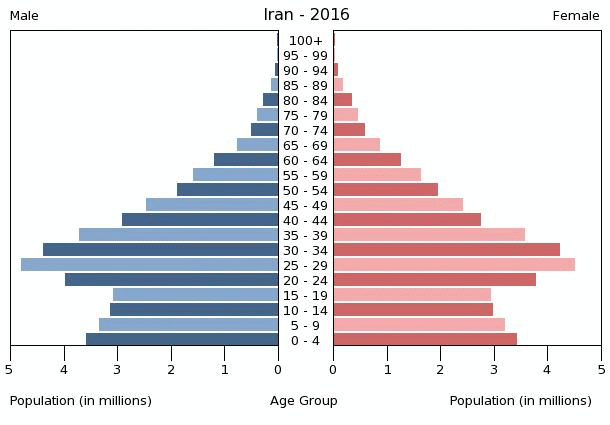
Two-thirds of Iranians know nothing about life before the mullahs took over other than what they’ve been told.
I Would Have Said 1965
January 1, 2018Does 2017 mark the end of “American hegemony”, as claimed by John Schindler at Observer?
The United States has been the world’s greatest power since 1945, when that mantle—half-passed from London to Washington after the First World War—firmly landed in American hands after the Second World War. Since 1991, when the Cold War ended with Soviet collapse, America has been the world’s hegemon, to use the proper term, the force whose power could not be seriously challenged on the global stage.
For 26 years now—a happy generation—America has been able to do whatever it wanted, to anyone, at any time of our choosing, anywhere on earth. Notwithstanding the decline of major sectors of the American economy, our military has covered the globe with deployments as the Pentagon has divided our planet into “geographic combatant commands†to formalize our hegemony. Our allegedly deep defense thinkers have hailed this as our viceroys enacting Washington’s benevolent imperial will anywhere we desire.
I think I would have marked 1965 as the end of whatever hegemony the United States has possessed.
I’d like to see Mr. Schindler’s explanations of
- North Korea’s nuclear weapons development program
- The Chechen wars
- The rise of China (almost all of which has taken place during our supposed hegemony)
- The conflict in Syria
- Leaving Saddam Hussein in control of Iraq at the end of the Gulf War
- The two terrorist attacks on the World Trade Center
in the context of American hegemony. Maybe hegemony ain’t what it used to be.
Are Ideologies Important?
January 1, 2018In the following post you can safely assume that just about every noun is enclosed in quotation marks. I’ve omitted them to save time and eyestrain. When I read Cameron Smith’s “take” (see what I mean?) on modern liberalism from the standpoint of a conservative at R Street:
Conservatives and modern liberals actually share classical liberal ideology as a common ancestor. That’s where we derive our focus on civil liberties, adherence to the rule of law and an open economy. Like our classical forerunners, most American liberals believe that government’s purpose is to protect our rights of life, liberty and the pursuit of happiness from both government oppression and each other.
But liberals immediately diverge from their conservative brethren with the view that government can and should improve civic equality and actively enhance the lives of Americans.
Perhaps President Franklin Delano Roosevelt best captured a liberal’s view of government. “Government has the definite duty to use all its power and resources to meet new social problems with new social controls,†Roosevelt wrote, “to ensure to the average person the right to his own economic and political life, liberty, and the pursuit of happiness.â€
I set out to write characterizations of both conservatives and liberals from my own perspective and solicit similar characterizations from my readers but I quickly realized that wasn’t a worthwhile task.
I am neither a liberal nor a conservative but share some views in common with both of them. My views are probably best described as pragmatic (although that word has gotten a bad name in recent years) or—my favorite description—eclectic. I guess I’m just not that much of a joiner.
Consider this from the linked post:
Modern liberals aren’t particularly concerned about the size of government because they believe it ought to be large enough to serve as a social and economic counterweight to the private sector.
I’m concerned about the size of government because I think that the larger government is the more bureaucratized it will inevitably be and the farther it will divurge from its putative job to just preserving the bureaucracy. But I’m worried about large private companies, too, particularly large private companies that derive their wealth from subsidies of various forms provided by the government. That Michael Jordan got a big paycheck didn’t bother me; that Jamie Dimon did because of the vast subsidies being doled out in the form of regulations to JPMorgan Chase.
Indeed, I’m practically a one-man litmus test for whether you’re a conservative or a liberal. If you’re a conservative, you think I’m a liberal and if you’re a liberal, you think I’m a conservative.
On top of that I don’t think that ideologies are that important when you get right down to it. I think that what’s important is what people do not what they think they’d do and there’s real congruence if not identity to what people who identify as either conservatives or liberals actually do. Both of them think that people who are a lot like them should run things and that they’d rather live surrounded by people who think like they do. To give a concrete example, there just aren’t that many white liberals living at 96th and Stony Island.
I think that Robert Conquest put it pretty well: everyone is conservative about what he knows best. Is there a corresponding observation about conservatism?
I’m too interested in how people actually behave in given circumstances and what will actually work to be either a conservative or a liberal.
You Learn Something New Every Day
January 1, 2018I was unaware that the federal government paid bonuses of any kind to federal employees and I’ve got to admit that I was horrified by the notion. At RealClearPolicy Adam Andrzejewski explains:
The U.S. Government doled out $1.5 billion in recruitment, retention, incentive, relocation, and performance bonuses last year (FY2016), but disclosed only 330,000 bonuses totaling $351 million. Performance bonuses of nearly $1.1 billion were withheld from disclosure, which is prohibited by anti-transparency language contained within the government-union contracts.
In our OpenTheBooks.com Oversight Report — Mapping the Swamp, A Study of the Administrative State, we mapped the 2 million disclosed federal bureaucrats by work location ZIP code. Search any ZIP code across America to review the name, agency, title, salary, and bonus of the administrative state. Just click a pin and scroll down to see the results that render in the chart beneath the map.
The largest federal bonus last year, $141,525, didn’t go to a rocket scientist or a doctor researching a cancer cure; it went to Bart Ferrell, a Human Resources Manager in charge of processing payroll at the Presidio Trust. This small land management agency, located in San Francisco, California, is the developer of the former military base.
Read the whole thing and weep. The entire situation is outrageous and, worse, lacking in transparency. If there’s one reform that’s necessary and pressing it is civil service reform.
When Every Viable Alternative Produces a Strategic Loss
January 1, 2018The problem I have with the editors of the Wall Street Journal’s remarks about Syria:
The upper house of the Russian Parliament this week approved a 49-year extension on its naval base in the Syrian port of Tartus, another sign of Vladimir Putin’s strategic gains from his intervention in Syria’s civil war. As the last Islamic State strongholds are defeated in Syria, the big question is whether the U.S. will cede the advantage to Russia and Iran and their client Bashar Assad.
The State Department confirmed recently that Islamic State has lost 95% of the territory it once controlled in Iraq and Syria, and the flow of foreign fighters into Syria is slowing. That’s the good news.
The bad news is that Mr. Assad remains in power, despite nearly seven years of civil war and two U.S. Presidents and successive Secretaries of State who have called for his ouster. The Syrian dictator’s predations have killed more than 400,000 civilians and displaced millions, and he’s still torturing, starving and murdering his enemies. The regime has spent most of this month shelling Eastern Ghouta, a rebel-held Damascus suburb, despite a proclaimed Russia-brokered cease-fire.
and
A key U.S. goal in Syria should be to deny Assad, Russia and Iran the strategic victory of controlling all of Syria. Only when Russia and Iran conclude that they can’t win militarily, or that the price of winning is too high, will they negotiate a genuine peace deal that allows for self-governing ethnic enclaves in Syria. The means to that end is supporting Syrian and Kurdish forces that oppose Assad and Islamic radicals. The alternative is a U.S. retreat that would allow an Islamic State comeback and perhaps a larger war in the Middle East.
is that there has never been a viable course of U. S. action with respect to Syria that would have resulted in a “strategic victory” for the United States. The alternatives we had were keeping our noses out of the whole sorry affair, supporting the Assad regime, or supporting Islamist rebels. We chose the last alternative.
The Assad regime never had any alternative but to quite literally fight to the death, not just for Assad but for Alawites more generally. That’s another thing that Americans have difficulty in coming to terms with. There are no mechanisms for accommodating to minority populations not merely in Syria but in the Middle East as a whole. Its history of the treatment of minorities is one of ignoring them in blissful isolation punctuated by periodic pogroms. Both Syria and Iraq had systems of minority rule for a half century. The political solution sought by the Obama White House and urged by the editors would result in genocide.
Somehow the notion that supporting Islamist rebels was the least bad alternative seems to have infected the Obama White House. Not only were they mistaken but they failed to take into account that Russia and Iran had and have higher stakes in the outcome in Syria than we do and, as events have shown, are simply unwilling to allow Islamists to take control of Syria. I’ve always disagreed with that view. I don’t think there are any conditions under which we should support Islamists. No good can come of it. It will always be ultimately antithetical to U. S. interests. The Obama White House was engaging in wishful thinking.
That left supporting the Assad regime, a course of action so cynical as to be politically untenable in the United States, or butting out. I thought we should butt out. That wouldn’t have given us a strategic victory but at least we wouldn’t have been supporting the bad guys.
Humor Has Become Impossible
December 31, 2017You might want to take a look at Dave Barry’s retrospective on 2017:
Looking back on 2017 is like waking up after a party where you made some poor decisions, such as drinking tequila squeezed from the underpants of a person you do not really know. (At least you hope it was tequila.)
The next day finds you lying naked in a Dumpster in a different state, smeared from head to toe with a mixture of Sriracha sauce and glitter. At first you remember nothing. But then, as your throbbing brain slowly reboots, memories of the night before, disturbing memories, begin creeping into your consciousness. As the full, hideous picture comes into focus, you curl into a ball, whimpering, asking yourself over and over: Did that really happen?
Its only real defect is that it’s too close to the truth to be genuinely funny.
Have a Happy New Year! Or at least a safe one.
China vs. U. S.
December 30, 2017Speaking of dystopian scenarios, at National Interest Robert Farley outlines how a war between the U. S. and China might unfold:
China could decide to intervene in a new Korean War under two circumstances; first, if it believed that the U.S.-ROK coalition was on the verge of destroying the DPRK (as was the case in 1950), and second, if it believed that the DPRK was winning and that Chinese intervention could preempt U.S. escalation. If the former case, China’s war objectives would be to prevent the destruction of the DPRK, and to prevent the DPRK from unleashing its nuclear arsenal. In the latter, the objective would be the opposite; to secure North Korean gains (whether these amounted to the entire Korean Peninsula or not), and to eliminate any temptation on the U.S. part to escalate to nuclear weapons. In either case, U.S. and ROK planners would pay careful attention to Chinese maneuvers, and both countries would have fully mobilized for war.
Read the whole thing. To the best of my knowledge every wargaming of war between China and the U. S. has resulted in a nuclear exchange which means that Mr. Farley’s scenario is unduly optimistic.
Additionally, there are some pretty good reasons that there won’t be war between the U. S. and China. One of them is that China has a lot more to lose today than it did in 1950.
Fast Forward
December 30, 2017Who doesn’t love a good dystopian scenario? Bloomberg presents eight of them and the view from 2028 if each of them actually happens. Their scenarios are:
- Trump Wins Second Term
- Fake News Kills Facebook
- Bitcoin Replaces the Banks
- North Korea Launches an Attack
- Corbyn Makes Socialism Great Again
- Generational Warfare Destroys Europe
- China Begins a Trade War
- Electric Cars End the Oil Era
Maybe I’m just not imaginative enough but I don’t see any of those other than Scenario #4 as particularly dystopian and I can think of one scenario more awful to contemplate than any of them: bioterrorism.
Indeed, I think that all that really needs to happen for 2028 to be pretty miserable is for present trends to continue. How’s that for pessimism?
I believe I can trust my readers to come up with some additional scenarios for 2028 that are pretty awful. What were the authors of the article too optimistic to see? Please avoid low probability scenarios.
BTW I thought the page showed a pretty creative use of Javascript and CSS.