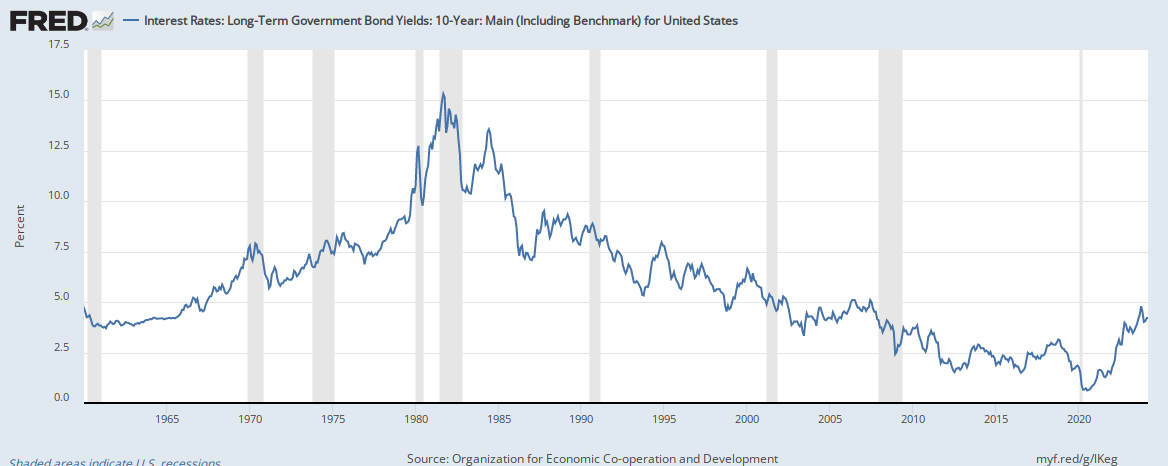
At RealClearPolicyNo Labelshas a post somewhat reminiscent of the analysis posts at Vox.com on the Federal Reserve. In the article five facts are highlighted:
The Federal Reserve was created in 1913 by President Woodrow Wilson following the Panic of 1907, one of the worst global financial crises of the 20th century. The Federal Reserve Act, which President Wilson signed into law, established a central bank for the entire country (for the third time, but the first time successfully).
The modern-day Fed was shaped by President Jimmy Carter, who signed the Federal Reserve Reform Act of 1977.
During the 2008 financial crisis, the Fed helped stabilize the economy by deploying a number of tools, including cutting interest rates, providing targeted assistance to financial institutions, and buying mortgage bonds.
However, not everyone agrees that the changes to the Fed since the financial crisis have benefited the American public.
While Trump is not the first American president to speak out against the Fed, there haven’t been many others.
When I read that fifth point I was reminded of James Carville’s wisecrack to the effect that when he died he wanted to come back as the bond market so he could intimidate everybody.
I only have a couple of remarks. First, the present long-term interest rate is 3.19%, the highest it has been in a decade. Is the Federal Reserve succeeding in its mandate? Is 3.19% high, medium, or low? As a point of comparison in 1977 the long-term interest rate was around 8% and prior to 1977 it had been pretty stable at around 5% (roughly the average over time) for many years. My second remark is that several economists and politicians have noticed that Fed policy has been running in a direction opposite to that of federal fiscal policy for a long time. When the Federal government spends money to promote economic growth, the Fed tightens monetary policy, vitiating the effect of the fiscal policy.
Third, since 1977 the Gini index for the United States, a measurement of income inequality, increased sharply and has remained at that much higher level level ever since. The big jump preceded the income tax reform of the 1980s, the large increase in low wage immigrant labor in the United States, and the big increase in the U. S. imports of manufactured goods.
How big a factor has Fed policy been in creating income inequality in the United States?
I actually sympathize with the Obama Administration about this:
In 2013, hundreds of CIA officers — many working nonstop for weeks — scrambled to contain a disaster of global proportions: a compromise of the agency’s internet-based covert communications system used to interact with its informants in dark corners around the world. Teams of CIA experts worked feverishly to take down and reconfigure the websites secretly used for these communications; others managed operations to quickly spirit assets to safety and oversaw other forms of triage.
“When this was going on, it was all that mattered,†said one former intelligence community official. The situation was “catastrophic,†said another former senior intelligence official.
From around 2009 to 2013, the U.S. intelligence community experienced crippling intelligence failures related to the secret internet-based communications system, a key means for remote messaging between CIA officers and their sources on the ground worldwide. The previously unreported global problem originated in Iran and spiderwebbed to other countries, and was left unrepaired — despite warnings about what was happening — until more than two dozen sources died in China in 2011 and 2012 as a result, according to 11 former intelligence and national security officials.
Read the whole thing. It was really a terrible breach and it took place in 2009 when the Obama Administration was just getting its footing. I doubt they could have done much to prevent it. Or it might have taken place in 2008 while it was still the Bush Administration’s watch.
However, I am having a bit of difficulty in connecting the dots. Revelation of a hidden Iranian enrichment facility—CIA security breach—multiple informants killed—Stuxnet—IAEA report on Iran’s pre- and post-2003 development activities—Obama Administration starts negotiating treaty with Iran—Joint Plan of Action commences—Obama Administration maintains staunch defense of agreement. Those are just some of the highlights. Something does not compute.
Yesterday brought the welcome news of the best wage gains for private-sector workers in more than a decade. Now the latest monthly employer survey from the National Federation of Independent Business, due out later today, strongly suggests that the good news for U.S. workers will continue.
The small-business owners participating in the survey are once again reporting that they are trying to expand their businesses but can’t find enough qualified applicants to fill all of their available positions. Naturally, wages are headed north as firms of all sizes compete for talent.
but this was the paragraph that jumped out at me:
And even as they struggle to find workers, businesses are not giving up trying. A seasonally-adjusted net 22% plan to create new jobs in the October survey. Also, 34% of survey participants reported raising compensation in hopes of hiring and keeping needed employees, historically strong and just three points below September’s record high.
That would be “welcome news” as Mr. Freeman phrased it if true. However, the NFIB survey did not measure rising wages. It’s a measure of the responses of small business owners of their intention to add workers or their statements that they had raised wages. Additionally, most small businesses have a very small number of employees—sometimes just one. What is needed is a salary survey that finds that wages are rising. Even the BLS’s report doesn’t do that. It just tells us whether payrolls (not wages) are rising, falling, or staying the same. Pending more information and better data I’ll hold my water.
I didn’t know whether to laugh or to cry about former Louisiana Gov. Bobby Jindal’s op-ed in the Wall Street Journal. In it he first asserts several points on which he says that Democrats and Republicans disagree, the “Roots of Political Polarization”. They are:
Truth vs. social justice
Individual vs. group identity
Growth vs. redistribution
Religious vs. secular
He follows with this conclusion:
It’s insufficient for Republicans to argue that cutting taxes and regulations will result in higher wages and profits. They must return to first principles, and start by reminding voters why growth matters. Conservatives must make the case for individual autonomy. Before arguing about the rights of evangelical bakers, conservatives need to show why all Americans, regardless of faith, should fight to protect each other’s religious liberties. If not, the left and right will continue talking past each other, wondering why the other side doesn’t understand its self-evident virtues.
While I agree that the only thing that Republicans can apparently agree on amongst themselves is cutting taxes, the problem is that Democratic and Republican politicians have everything in common. They have no principles. All they have is the urge to power.
How in the world can a Republican talk about truth with a straight face while Donald Trump is president? He’s the epitome of personal, subjective truth rather than objective truth. The phrase “speak your truth”, from Max Ehrmann’s 90 year old poem, was plastered on many a Baby Boomer’s dorm room wall and adopted as a sort of motto. Who speaks his truth more than Trump? But it remains a subjective truth only tangentially related to everyday, empirically observable, objective truth.
But how can Democrats talk about social justice with a straight face when most redistribution goes on, not from rich to poor, but from one group of rich people to a different group of rich people? A more just federal tax system wouldn’t rely so heavily on the payroll tax as at present. A Democratic Congress restored the payroll tax to its present height, the largest tax increase on the poor in recent history.
Rather than fisking the op-ed phrase at a time I’ll just conclude this way. There are no principles in politics. There is only winning and losing. Talk of principles is just for the rubes.
The editors of the New York Times are, apparently, four square behind a regressive tax on poor residents of Washington State:
Climate scientists and economists have long argued that the single best way to slow global warming is to put a price on greenhouse gas emissions from fossil fuels and raise that price over time, thus creating a sensible market incentive to reduce emissions and invest in cleaner energy sources. Carbon pricing was also high on the list of urgent recommendations of the United Nations Intergovernmental Panel on Climate Change, which warned in a major report this month that without swift action to control emissions the world will begin suffering global warming’s worst consequences — including, but not limited to, the displacement of millions of people by drought and sea-level rise — as early as 2040, much sooner than previously forecast.
It is thus encouraging that in this time of torpor and climate denial at the highest levels of the federal government, voters in the state of Washington will soon be given the chance to adopt, by initiative, a carbon pricing plan that would charge polluters like refineries a fee for emitting greenhouse gases. This would be what economists call a Pigovian tax, after the British economist Arthur Pigou. In this case, the fee would factor in the now unaccounted for costs of more frequent and intense hurricanes, wildfires, droughts and other natural disasters linked to climate change. In the words of George Frampton, a senior environmental adviser to Bill Clinton and co-founder of a group that favors carbon taxes, Partnership for Responsible Growth, it’s an overdue stab at “honestly pricing carbon,†which industry has until now been able to hurl into the atmosphere pretty much for free.
presumably on the grounds that you can’t make an omelet without breaking eggs. My question is why are the eggs that are broken always poor eggs?
As structured Washington’s tax is regressive. It will hardest on the poor in the form of higher energy bills.
The record of carbon taxes in reducing carbon emissions is mixed but its record in raising revenue is strong. On the emissions side their biggest effect has been to give European bureaucrats more opportunities for graft.
A better-structured plan would be one that was much, much higher and prebated the tax on a scale based on income. Such a plan would fall more heavily on the rich who, since carbon emissions increase geometrically with respect to income (relatively few of the poor have private jets or 10,000 sqft mansions), apparently need greater incentives to reduce their carbon emissions.
There’s a pretty good analysis of the issues the midterm elections will turn on by A. B. Stoddard at RealClearPolitics which I commend to your attention. The issues include immigration, domestic terrorism, and health care just to name a few. Here’s a snippet:
The separation of families was a liability for the GOP, but the caravan was midterm manna for Trump. It began at just the right time for him to tell Americans watching hordes of people traveling from Honduras and Guatemala that criminal elements, including various and sundry “Middle Easterners,†were intent upon invading the homeland. More than 5,000 active military personnel are now deployed to convince voters something is being done, and this number could stretch, Trump says, to 15,000 or more. Though no laws have been changed, and no new restrictions on asylum have been enacted, what is likely is that when the dwindled caravan arrives, its entry will surely be more organized and less dysfunctional with active duty troops on hand.
Read the whole thing. Her conclusion, meekly enough, is that it’s hard to tell what will actually happen.
Frankly, I doubt that most of the House elections or for governor will be on national issues and I’ll still be skeptical even when the major media outlets declaim that the election was a referendum on Trump, about health care, or about immigration. All politics remains local and we don’t conduct national referenda. The winners are likely either to be incumbents or the candidate best able to convince voters of their bona fides or both.
I’ve got to admit that I have no idea what the editors of the Wall Street Journal were trying to accomplish with their most recent editorial on the recent ups and downs of the stock market:
Stocks bounced back Wednesday, but before that the tech-heavy Nasdaq had slumped 12% since its August peak. Falling FAANG stocks— Facebook , Apple, Amazon, Netflix and Google parent Alphabet—have swung the S&P 500 into a correction zone. Netflix tumbled 21% and Amazon fell 20% in October. Texas Instruments , IBM and Nvidia have also seen substantial stock price declines.
A tech revaluation was perhaps inevitable as prices leapt over earnings like LeBron James over Kevin Durant. Amazon’s stock in September was trading at nearly 160 times earnings, which wasn’t going to last. But what makes this month’s tech sale so jarring is that it comes amid strong quarterly earnings growth.
and
It’s not surprising that investors are struggling to price tech stocks properly amid this evolving regulatory and competitive landscape while factoring in stronger U.S. growth and rising interest rates. Big tech was one of the few industries that prospered during the economic malaise under Barack Obama and thus naturally attracted more investors.
Tech stocks also received a boost from the Fed’s monetary exertions that kept the federal funds rate at nearly zero for years and suppressed long-term rates with quantitative easing. Investors thirsting for higher yields piled into riskier assets, and some are now retreating as the Fed unwinds its balance sheet and raises rates.
This return to realism is unfortunate for some investors but shouldn’t undermine the larger economy. The S&P is still up 21% since January 2017. It isn’t bad news if investors steer more capital to other productive businesses that can propel American growth.
The facts of the matter have been quite obvious for most of the last decade. The stock market, particularly the major indices, have become virtually detached from the greater economy. The values of a handful of tech stocks are impossible to justify based on the companies’ performance or just about anything else. The runup in those stocks accounts for most of the increase in the major stock indices over the last decade. And reselling of stocks does nothing to “steer more capital to other productive businesses that can propel American growth”. Only initial stock offerings do that. What percent of the total trade in stocks does the initial market comprise? 1%? 2%?
Trump’s rhetoric about immigrants and others appalls me. But that’s not in the same category as establishing a fascist dictatorship. Nor is tightening our immigration policy very much like invading other countries and sending millions of citizens to extermination camps. It’s offensive lunacy to suggest that these things are somehow inextricably linked.
And it’s not much more reasonable to claim a direct causal link between Trump’s rhetoric and the monstrous synagogue shooting in Pittsburgh, as is now happening. Jews are not among the groups Trump is known for slandering, and America has a pernicious history of anti-Semitic violence long pre-dating Trump. Sadly, there were deadly attacks at Jewish centers under both Presidents George W. Bush and Barack Obama.
So, no, friends, I’m not arguing that Trump is Hitler, or even Hitler Lite. I’m entirely confident that even if he wanted to trash the Constitution and impose a racist dictatorship, neither the institutions of the United States nor the people of the United States would permit it.
But one can dislike the president’s unpleasantly evocative phraseology without thinking the dark night of fascism must therefore be almost upon us. One merely needs to ask: Are Nazi Germany and Soviet Russia really the rhetorical company we want to keep? As conservatives, or as a nation?
A “slippery slope” argument is the claim that one step will lead to another step, ultimately culminating in some disastrous outcome. It is a form of proof by consequences. But sometimes an event is just an event, one step does not lead to a greater step, and the feared disastrou outcome is neither inevitable nor even likely. That is what’s called the “slippery slope fallacy”.
I console myself about the rhetorical excesses in reaction to Trump’s rhetorical excesses by believing that they’re just political posturing. Once a politician has engaged in political posturing 1,000 times it’s not too much of a stretch to think that the 1,001st rhetorical excess if probably political posturing, too.
My reaction to somebody who’s yelling “Fire” in a crowded theater first to assess whether there actually is a fire. If there is not I’d tell him not to yell “Fire” and try to calm the crowd. I would also be inclined to wonder why the theater was overcrowded to begin with. My reaction is not to drag a barrel of kerosene into the theater and I have to wonder about anyone who would.
I don’t think that James Freeman should be overly concerned with the views of today’s college students. From his WSJ column:
When asked for their opinions of capitalism, 45% said they have a favorable view, 31% expressed an unfavorable view and the rest had no opinion, were unsure, or didn’t answer. Not exactly a ringing endorsement of the property rights that have made the United States the most prosperous nation in history, pulled billions of people out of poverty around the world and enabled, among other things, the funding of great universities.
[…]
In fact few things in life are more harsh than living in a socialist economy. What’s the best way to help the youngsters avoid having to learn this lesson first-hand? Perhaps parents will choose not to leave their children’s education entirely up to tenured professionals and instead opt to assign readings on their own. Along these lines they might consider adding requirements each semester for any children who want tuitions paid on time. For example, students could be instructed to read and be prepared to discuss “The Opportunity Costs of Socialism†over Thanksgiving dinner.
I suspect that what most young people think socialism means is getting free stuff and helping poor people. The track record of state socialism—all that present U. S. “democratic socialists” are considering, when given free rein, is not good in those respects.
The track record seems to show that government in Europe is more benign and less grasping and, consequently, more trusted there than here. In the United States whether under alleged capitalism or alleged socialism government inevitably becomes a force for generating wealth for the rulers.
If there’s one think we know about youth it’s that it’s curable. The most straightforward way to combat state socialism in the United States is to ensure that young people have more to lose.
Despite its general lack of merit, a lawsuit by the New York attorney general’s office is an entertaining symbol of all that has gone wrong with the green movement in the era of climate-change politics.
Exxon is accused of failing to adopt sufficiently penitential accounting for its oil and gas projects in light of climate regulations that, ahem, don’t exist. Indeed, politicians around the world have declined to enact the green wish list even when given the chance, notwithstanding their endless verbal opposition to climate change.
Presume for a moment the accusations against Exxon are accurate. Then greens should actually be glad because Exxon has spared them future embarrassment when the company is forced to increase the recorded value of its assets to account for the failure of green politics to deliver the expected carbon regulations.
Words are challenged to express how laughable this case is. Before getting lost in distinctions that Exxon internally draws (and the attorney general muddles) between project-specific costs and policies that would suppress demand for fossil fuels generally, let’s remember a few things.
Like all businesses, Exxon seeks to take only those risks that will pay off, and has every incentive to anticipate future regulatory costs correctly. The attorney general’s office and its green backers have an entirely different purpose: They want Exxon to use its internal disciplines to prevent oil and gas development even if it would pay off.
This suit highlights a gripe of mine. How policy is constructed and how it relates to the real world are important. You have to consider actual conditions and how actual people and companies will behave. You can’t govern by The Think System any more than you can learn to play the bassoon by it.
It matters, for example, whether European governments have been calculating their countries’ reductions in emissions based on presumed inputs or based on measurements. If it’s the former, they may not have accomplished anything at all since we know that not just VW but other companies selling diesel-powered automobiles falsified their results. It matters whether the wood pellets that Germans are using to heat their homes to avoid coal or nuclear power were milled from recent growth or old growth. Having good intentions and wishful thinking aren’t enough.