Uncertainty

If somebody tells you to jump, you ask “how high?”, and they can’t tell you, that’s uncertainty:

The size and complexity of the Affordable Care Act meant that its implementation was never going to easy. But behind the scenes, even states that support or might support the Affordable Care Act are frustrated about the Health and Human Services Department’s special combination of rigidity and ineptitude.

To take one example, for the better part of a year states and groups like the bipartisan National Governors Association and the National Association of Medicaid Directors have been begging HHS merely for information about how they’re required to make ObamaCare work in practice. There was radio silence from Washington, with time running out. Louisiana and other states even took to filing Freedom of Information Act requests, which are still pending.

Now post-election, new regulations are pouring out from HHS—more than 13,000 pages so far and yet nuts-and-bolts questions are still unanswered. Most of what we know so far comes from a 17-page question-and-answer document that HHS divulged this week, though none of the answers have the force of law and HHS says they’re subject to change at any moment.

We have the better part of a century’s experience with the largest full-on public healthcare system in the world, larger than British National Health—the VA system. We have a half century’s experience with the largest single-payer system in the world—Medicare. We have no experience whatever with a public healthcare system with as many moving parts as the PPACA. The closest thing to it would be the Pentagon, that model of efficiency.

Fasten your seatbelts, we’re in for a bumpy ride.

2 comments

The Balanced Approach

The Washington Post’s editors are becoming skeptical of the credibility of the “balanced approach” for fiscal reform:

We’ve said time and again that revenue must rise. The latest Republican position on taxes, while an improvement, remains inadequate. GOP leaders now admit the need for more revenue, but they refuse to say how they would obtain it. Given the political difficulty of limiting any deduction or loophole, their supposed commitment to tax reform isn’t worth much without specifics.

But the underlying fiscal problem is that federal expenditures are slated to rise faster than economic growth because of rising health-care costs and an aging population. The long-term drivers are Medicare, Medicaid, Social Security and subsidies for the health-care exchanges established by the Affordable Care Act.

The budget can’t be brought even remotely into balance solely by taxing the top 1% or 2% of income earners and cuts in defense spending. If you add the income realized by the tax increases on the table and the savings realized cutting the defense budget in half (something I’ve advocated but which isn’t even remotely foreseeable), it doesn’t amount to half the deficit. 4% or 5% growth rates, something included in most budget-balancing projections, are figments of the imagination. Or outright lies, depending.

With a truly balanced approach to deficit reduction, tax increases must extend down to the top quintile (and maybe the top two quintiles) of income earners. That’s people earning more than $60,000 in round numbers. There must be serious defense spending cuts which means manpower cuts which means doing less. There must be new cuts in entitlements (Social Security, Medicaid, and Medicare). Counting the old cuts twice won’t do it.

Or we must plan to run high deficits for the foreseeable future.

That’s not partisanship. That’s mathematics.

2 comments

The Ref

I’ve been following an argument going on among self-described libertarians in the blogosphere over labor unions and right-to-work laws with a certain amount of bemusement. From my point-of-view, at least, they’re tying themselves into knots on the subject. The original kick-off was this article:

A “union shop” agreement between an employer and a union commits the employer to ensuring that new hires join the union within a specified period. Right-to-work laws ban union-shop agreements.

Let’s put it another way: They violate freedom of contract.

If employers choose to conclude union-shop contracts with unions, what gives the Indiana legislature the right to interfere?

Employers own the wages they will pay and the sites where work will be performed under such contracts. So it’s their right to dispense the wages and make the sites available specifically to union members, just as it’s their right, more generally, to trade with anyone they choose.

When a legislature interferes with voluntary employment contracts, it infringes people’s freedom to bargain with their own labor and possessions. Treating this kind of interference as acceptable means licensing arbitrary interventions into the market by politicians, who are ill-equipped to second-guess the decisions made by the real people making work agreements with one another.

Here’s a response from OpenMarket.org:

On more than one occasion, I’ve heard some libertarians object to right-to-work laws on the grounds that they undermine freedom of contract by barring employers from negotiating closed shop agreements with unions if they so choose. At Reason‘s Hit & Run blog, J.D. Tuccille repeats this argument. Tuccille says he opposes Michigan’s new right-to-work law because it “bans closed shops in which union membership is a condition of employment.”

Libertarians generally oppose banning contractual agreements into which parties voluntarily enter, so Tuccille’s objection seems reasonable — but only because it ignores the alternative.

another from Reason.com:

Right-to-work laws at the state level “balance” federal labor legislation only by countering state intrusion with state intrusion. The result is certain to be a continuing effort to “fix” problems caused by earlier laws. And politicians will be at the center of it all, building their authority while playing the sides against each other.

A free market in which businesses and labor negotiate conditions on their own can be created only by actually freeing the market. It will also reduce the power of government and the role of politicians. Yes, that is more difficult than enacting ever-more legal spackle.

and another from The Volokh Conspiracy:

One argument for right-to-work laws is that such rules provide a counter-balance against an inherent pro-labor bias in federal labor law. But if that’s really the problem, it would seem the better solution would be to fix federal labor law, not endorse yet more government interference with private economic arrangements. Are there better libertarian arguments for right-to-work laws? If so, I’d like to hear them, for at the moment (and despite my anti-union sentiments), I’m not convinced.

One thing we might want to do is define our terms. I would define libertarianism as the political policy that advocates minimizing coercion and maximizing individual freedom, liberty, and voluntary association. Minarchism is the sub-division of libertarianism that sees the legitimate role of the state as reducing aggression, theft, breach of contract, and fraud. Anarcho-capitalism is the belief that the state should be abolished entirely in favor of private defense and voluntary contracts.

When did all libertarians become minarchists and anarcho-capitalists? I see precious little about individual freedom in any of those posts, lots about contracts, and even more about constraining the state.

I have no particular animus against either labor unions or government. I see them as strictly instrumental. There will always be competing interests, selfish motivations, and rule-breaking. There needs to be a referee. Government is that referee.

Similarly, labor unions are useful to the degree that they lower the transaction costs for negotiating wages or advocate for the welfare of workers and their communities. They are unuseful to the extent that they act for the aggrandizement of union officials, promote inefficient work rules for companies, or are coercive.

What am I missing?

63 comments

The Art of the Deal

There’s an interesting but telling sentence in Mort Kondracke’s column considering whether President Obama will make a deal with Republicans on spending. Here it is:

Republicans impeached Clinton, and still he reached deals with them to balance the budget and enact welfare reform.

I think this is a mis-stating of the sequence of events. A more accurate formulation would be “Bill Clinton reached deals with Republicans to balance the budget and enact welfare reform but they impeached him anyway.” That formulation might go some way towards explaining the zero-sum approach that President Obama has taken towards negotiations during his presidency.

Nonetheless, I agree with the general thrust of the piece:

Certainly, the political gridlock of his first term was not all his fault. But he’s the president, and by every historical standard of negotiating leadership in partisan times — Abraham Lincoln, Lyndon B. Johnson, Bill Clinton — he falls short.

President Obama will get what he wants or we’re going over the cliff.

56 comments

Consequentialists vs. Deontologists

Deontologists condemn things because they’re illegal or just wrong. Consequentialists condemn them when they’re unproductive.

0 comments

Foreign Policy Blogging at OTB

I’ve just published a foreign policy-related post at Outside the Beltway:

Green Eyeshade War

There’s a conflict brewing between the U. S. and China over accounting rules and oversight. As the U. S. and China grow closer economically, I think the significance of stories like this will only grow, especially with the lax oversight in China and its civil infrastructure being what it is.

0 comments

I Wish I Were a Cartoonist

When I see a headline like this one, “Obama Expects GOP Tax Cave”, the image that comes into my mind is of a skin-clad, shaggy Grover Norquist, gnawing on a bone, crouching in the GOP tax cave.

90 comments

How to Become a Millionaire

Work for the teachers’ retirement systems for large states, apparently:

Among the largest states, almost every category of [ed. public] worker has participated in the pay bonanza. Britt Harris, chief investment officer at the Teacher Retirement System of Texas, last year collected $1 million — including his $480,000 salary and two years of bonuses — more than four times what Republican Governor Rick Perry received. Pension managers in Ohio and Virginia made up to $678,000 and $660,000, respectively, according to the data, which Bloomberg obtained using public- record requests. In an interview, Harris said public pension pay must be competitive with the private sector to attract top investment talent.

Psychiatrists were among the highest-paid employees in Pennsylvania, Ohio, Michigan and New Jersey, with total compensation $270,000 to $327,000 for top earners. State police officers in Pennsylvania collected checks as big as $190,000 for unused vacation and personal leave as they retired young enough to start second careers, while Virginia paid active officers as much as $109,000 in overtime alone, the data show.

The numbers are even larger in California, where a state psychiatrist was paid $822,000, a highway patrol officer collected $484,000 in pay and pension benefits and 17 employees got checks of more than $200,000 for unused vacation and leave. The best-paid staff in other states earned far less for the same work, according to the data.

I’m guessing there are no claw-back provisions when the funds go bust.

The entire article makes interesting reading. It illustrates how a combination of lucrative contracts, lax oversight, and downright fraud has boosted total compensation for many public workers.

8 comments

Sixties Nostalgia

Harold Meyerson’s Washington Post column this morning was, no doubt, inspired by the passage of “right to work” laws in Michigan yesterday. The upshot of his column is that he’s against them:

What conservatives haven’t acknowledged, and what even most liberal commentators fail to appreciate, is how central the collapse of collective bargaining is to American workers’ inability to win themselves a raise. Yes, globalizing and mechanizing jobs has cut into the livelihoods of millions of U.S. workers, but that is far from the whole story. Roughly 100 million of the nation’s 143 million employed workers have jobs that can’t be shipped abroad, that aren’t in competition with steel workers in Sao Paolo or iPod assemblers in Shenzhen. Sales clerks, waiters, librarians and carpenters all utilize technology in their jobs, but not to the point that they’ve become dispensable.

Yet while they can’t be dispensed with, neither can they bargain for a raise. Today fewer than 7 percent of private-sector workers are union members. That figure may shrink a little more with new “right to work” laws in Michigan — the propagandistic term for statutes that allow workers to benefit from union contracts without having to pay union dues.

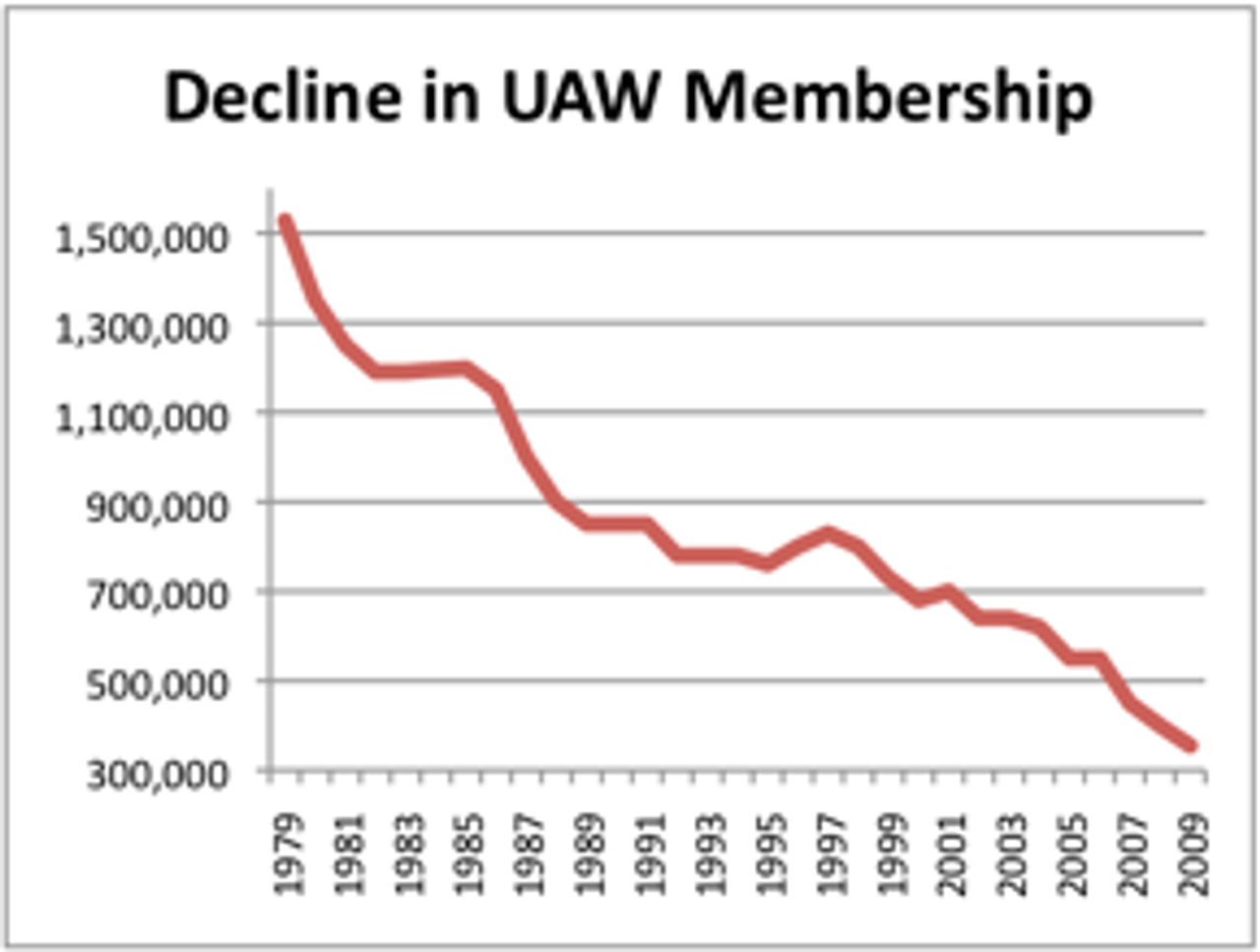
If Mr. Meyerson’s thesis is correct, I would think that the sectors with the strongest unions, like automobile manufacturing or trucking, would have not only higher wages but the highest aggregate wages. Imagine a graph that depicts the wages received by union workers. The Y-axis of the graph shows how high the wages are, the X-axis how many workers are receiving the wage. What I think that collective bargaining has accomplished is increasing the wage while lowering the number of people receiving that wage. See, for example, the history of the UAW over the last thirty years.

I don’t think that high wages for unskilled and semi-skilled workers can exist peacefully with borders that are open to cheaper goods from overseas and immigrant workers willing to work for less. My example would be the meat-packing industry. The U. S. meat-packing industry, concentrated in the upper Midwest, used to be one in which the workers received good wages. That’s no longer the case. An influx of immigrant workers, first from Mexico but now increasingly from Somalia, put an end to it.

I think that Mr. Meyerson is being nostalgic for the United States of the 1960s, the time when he was in high school and college. Let me tell a story to illustrate how.

Once upon a time the United States was a country in which the marginal utility of labor was rising. That is, the more people a company hired, the more money it made. In that country increasing the number of workers by immigration didn’t push down the wages of other workers. That was the way things were here until about 1970.

Now we’re an entirely different country. The marginal utility of labor for unskilled and semi-skilled workers is flat or decreasing. More unskilled or semi-skilled workers means that wages go down for other unskilled or semi-skilled workers. It isn’t the lack of collective bargaining rights but the lack of collective bargaining power.

One policy decision at a time we’ve gone from a country where healthcare was cheap and televisions were expensive to one in which healthcare is expensive and televisions are cheap. We could be the country we were in 1965 again. That was a country with lots of trade barriers, not much in the wage of environmental laws, much lower immigration from Mexico and the Caribbean, and in which non-whites were barely counted in the unemployment statistics. It would take a lot more than unions to do it and I doubt that most of us would want to live with the changes that would need to be made.

12 comments

The Council Has Spoken!

The Watcher’s Council has announced its winners for last week.

Council Winners

Non-Council Winners

3 comments