Silly Me

When I saw the headline on this Wall Street Journal opinion piece referring to the “Chicago pile”, I thought they were talking about the City Council. Imagine my surprise when it was about the influence of Fermi’s ground-breaking nuclear reactor at the University of Chicago on the Manhattan Project:

This weekend marks the 75th anniversary of what might be the 20th century’s greatest technological achievement. Working in wartime secrecy at the University of Chicago, a group of scientists built the first self-sustaining nuclear reactor out of wood, graphite and uranium. On Dec. 2, 1942, they succeeded in triggering the first sustained man-made nuclear chain reaction.

The experiment—called Chicago Pile 1, or CP-1—validated the theoretical ideas of scientists. The experiment was the first step to unleashing the destructive power of nuclear weapons, while also demonstrating the potential for an entirely new source of energy. It marked the start of an exciting era of collaboration and ambition in American science.

In many ways, CP-1 was a monument to scientific impatience. In the summer of 1939, Albert Einstein sent a letter (ghostwritten by fellow physicist Leo Szilard) to Franklin D. Roosevelt. The letter warned that Germany was at work on a new weapon of almost unimaginable power and urged the president to take steps to accelerate America’s research on nuclear energy.

Perhaps we should be referring to the City Council as “CP-2”.
3 comments

Flynn

I don’t have much to say about Michael Flynn’s plea deal. I’m still content to let the process work its way through. Will the plea deal result in the investigation finding an underlying crime? Stay tuned.

7 comments

Habemus legem

Well, the white smoke has ascended and the Senate has enacted a tax reform bill. That a final form will emerge from reconciliation, be enacted into law, and signed by the president is virtually assured. The Washington Post reports:

Senate Republicans passed a $1.5 trillion tax bill early Saturday morning that bestows massive benefits on corporate America and the wealthy while delivering mixed blessings to everybody else.

After a frantic round of negotiations, Republicans came together in near unanimity behind the landmark legislation. The final vote was 51 to 49, with Sen. Bob Corker (R-Tenn.) the lone GOP holdout. No Democrats voted for the bill.

The measure still has to be reconciled with an earlier House-passed version before being sent to President Trump. Yet in getting the bill through the Senate, Republicans succeeded where they failed earlier this year, when their efforts to repeal the Affordable Care Act collapsed in mortifying fashion.

This time, urged on by donors and fearful of facing voters in next year’s midterm elections without a legislative achievement to show, Republicans said time and again that failure was not an option.

“The American people wanted change,” said Sen. John Barrasso (R-Wyo.). “We were able to deliver.”

As I’ve noted before, tax law is like a ship. Over time it tends to acquire barnacles and needs to be hauled up into drydock and scraped clean. It’s been almost 35 years since we’ve had major tax reform so we’re due.

Sadly, my complaints about the Affordable Care Act apply to the tax reform bill as well. While it might have been necessary, it isn’t sufficient and the realities of both tax reform and health reform are similar: they’re politically painful to enact, for that reason Congress tends to avoid returning to the subject, and they rarely become better incrementally.

In this case I suspect that both the supporters of tax cuts and their opponents are exaggerating the benefit and harm, respectively. I doubt that we’ll get the growth we seriously need from this tax reform bill alone but it won’t be the end of the world, either.

2 comments

Poorly Served?

Consider this paragraph from a recent piece at the South China Morning Post complaining about Australia’s “rhetorical war” with China:

China and other nations in Asia have been poorly served by the existing world order and there is every need to let them have a greater say. Xi has pledged to make the system fairer. Rather than trying to shore up an outdated foreign policy, Australia should be trying to work for a more inclusive approach. While building improved ties and understanding with China, it can work for and encourage the strengthening of multilateral organisations such as the United Nations, G20 and the Asia Infrastructure Investment Bank.

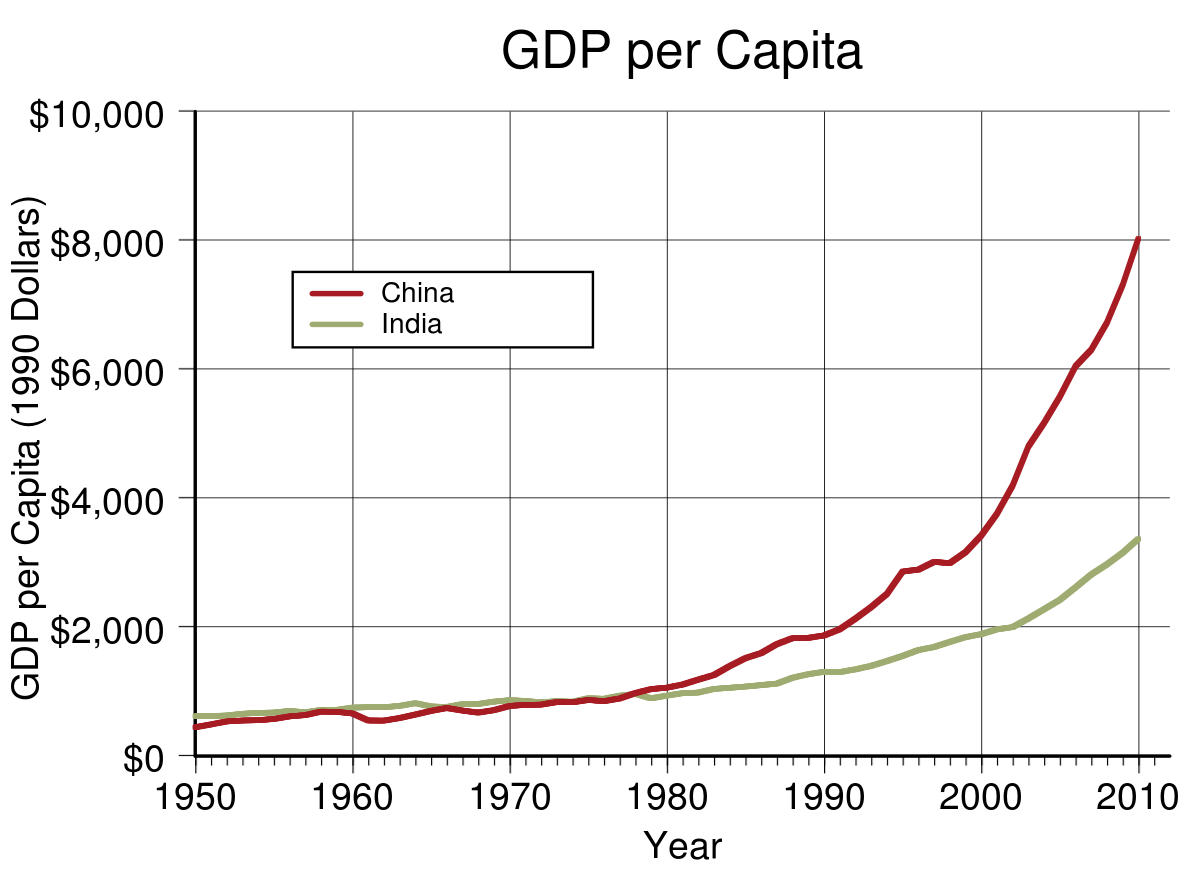
Now look at this graph:

What is the effective definition of “poorly served” in that context? It would seem to me that China has been very well served, indeed, by the “existing world order” whatever that may be.

2 comments

Deterrence?

I’m apparently full of questions this morning. For example, can anyone explain to me why Eli Lake, who calls in this Bloomberg View piece for a shift in policy from trying to prevent North Korea from obtaining nuclear weapons that can strike the United States to one of deterrence, believes that we can deter North Korea? Consider the history of the last 70 years between North Korea and the United States. What evidence is there that North Korea can be deterred? Is it wishful thinking? Delusion? Does he know something that I don’t?

My own view is that so long as we are not willing to inflict punishment on China for its facilitation of North Korea’s nuclear weapons development program we cannot either prevent the country from developing nuclear weapons capable of striking the United States or deter it from using them if they’re so inclined. The only thing we can do is prepare ourselves to take actions much more serious than deterring North Korea.

One more observation on deterrence: if the United States’s use of nuclear weapons is unthinkable, there is no deterrence. For deterrence to work other countries must believe that we can and will use nuclear weapons if provoked. And for that to happen we must think so as well.

8 comments

Question About Stocks

At any time in American history before now have we ever had the situation in which the companies whose stocks comprised so much of the total value the aggregate stock market and, more importantly, so much of the increase in value of the stock market indices, had never paid a dividend? What if anything does that mean?

My inclination is to believe that it means that the financial economy has become completely unmoored from any relationship with the real economy but I’m open to other interpretations.

11 comments

The Washington Limbo

How low can you go?

At The National Interest Amitai Etzioni opens with a bit of confused diction:

More people need to be aware that Congress exempts itself from laws that it imposes on the rest of us.
Congress has long exempted its own members from the laws and regulations it has imposed on all others. Most recently, this we-are-above the law position came into relief when the public learned the peculiar fate that awaits legislative branch employees who are sexually harassed in their workplace. They are subjected to a process unlike any other. It is hardly a small matter given that one in six female staffers on Capitol Hill said they had been sexually harassed in response to a July 2017 Roll Call survey.

but that isn’t Congress acting as though it’s above the law. That is Congress placing itself above the law. It’s constructing laws that deliberately exempt Congress from their requirements. It was his conclusion that I found interesting:

Only 13 percent of people approve of “the way Congress is handling its job,” according to a Gallup poll from October 2017. This is way below the low approval rating of the president. However, if more people were aware of the fact that Congress exempts itself from laws it imposes on the rest of us—the number may well be lower.

I think that’s wishful thinking. First off, 13% approval is essentially zero. You can find 13% of Americans who believe anything: that the world is 5,000 years old, that the earth is flat, that the sun revolves around the earth. But more depressingly not much more than a bare majority of Americans approve of their own Congressmen, just enough to elect and re-elect, ad nauseam.

That’s teetering on the brink. And it explains why so few Americans vote. It’s not because they approve of what’s going on. It’s because they’re in despair.

1 comment

Where Ignorant Armies Clash By Night

There’s a considerable amount of worthwhile insight in Patrick J. Deneen’s post at The Hedgehog Review, “The Tragedy of Liberalism”:

America is a nation in deep agreement and common belief. The proof lies, somewhat paradoxically, in the often tempestuous and increasingly acrimonious debate between the two main US political parties. The widening divide represented by this debate has, for many of us, defined the scope of our political views and the resultant differences for at least the past one hundred years. But even as we do tense and bruising battle, a deeper form of philosophical agreement reigns. As described by Louis Hartz in his 1955 book The Liberal Tradition in America, the nature of our debates themselves is defined within the framework of liberalism. That framework has seemingly expanded, but it is nonetheless bounded, in as much as the political debates of our time have pitted one variant of liberalism against another, which were given the labels “conservatism” and “liberalism” but which are better categorized as “classical liberalism” and “progressive liberalism.” While we have focused our attention on the growing differences between “classical” and “progressive,” we have been largely inattentive to the unifying nature of their shared liberalism.

but it also has a basic flaw. He’s behind the curve. He should change from present tense to past tense.

The great debate in American politics today isn’t between different strains of liberalism. It’s between Right Bolshevism and Left Bolshevism. There is very little of anything resembling liberalism in it. It’s about who should rule.

2 comments

The Furor

I want to poll the constituency about the ongoing scandal that so far has embroiled Harvey Weinstein, Charlie Rose, Matt Lauer, and a number of other show biz, media, and political figures of both political parties. What will its outcome be?

  1. Nothing lasting. It’s a flash in the pan. A 10 day wonder.
  2. It’s a fraud. A handful of women trying to exploit genuinely awful things that have happened to them to their advantage.
  3. It’s the long-overdue first step towards real reform.
  4. It’s the beginning of a Reign of Terror.
  5. It’s a pale version of what really needs to happen.

I think it’s a combination but the most likely are A, followed by D.

14 comments

This Is a Real Scandal

The editors of the Washington Post jump on the same podium as I did yesterday:

But Congress must shine a light on past misdeeds as well. Although the Office of Compliance has now released total figures for all settlements paid out in the legislative branch from 1997 onward, the data are vague: There’s no information as to how many cases were resolved, which offices were involved and how much of the $17 million total in settlements concerned sexual harassment complaints. What’s more, the tally doesn’t include settlements such as that reached by Mr. Conyers, whose office further obscured the complaint by paying the victim directly as a “temporary employee.” Lawmakers should make public as much information as possible about these settlements while respecting victims’ privacy. Americans have a right to know how their money was spent.

I don’t think that people appreciate how serious this is. The Congress does not have the power to use public money as apparently was the case. It is not among Congress’s enumerated powers and it is by no stretch of the imagination interstate commerce, the figleaf that has been used to cover most of the Congress’s overreach over the period of the last eighty years.

I think this is a real scandal and crisis. How do you reform the very fabric of the Congress? Impeachment of individual Congressmen doesn’t accomplish that. And if the White House knew about it it’s 1,000 times worse.

14 comments
