Consolidating Power

I’ve been following this for some time but I don’t believe I’ve written about it. At The Diplomat a translated article by Don Tse outlines how Chinese President Xi has been consolidating his power and protecting his position by purging potential opponents in the People’s Liberation Army:

A study of official and unofficial information indicates that the Qian Shao story has a ring of authenticity to it. In September, I wrote that Fang may have plotted a failed coup against the Xi leadership after observing certain unusual personnel activity at the time. First, Xi replaced another five CMC members in quick succession after Fang was removed, a development which suggests that something major had happened to allow Xi to make key personnel appointments seemingly uncontested. Personnel changes of such magnitude are usually decided and carried out only after a period of negotiation between Xi and the various CCP factions and Party elders.

Next, Fang and Zhang were not among the delegates invited to the 19th Party Congress, an indication that they were almost certainly in trouble. Overseas news media also cited sources claiming that the generals were being investigated. Recent efforts by Chinese state media to link Zhang Yang and Fang Fenghui with Guo Boxiong and Xu Caihou implies that the Zhang and Fang, like Guo and Xu, are also guilty of seeking to “wreck and split the Party” — official parlance for a coup attempt on the top leadership.

A failed coup attempt by Fang and Zhang would explain certain military developments since the 19th Party Congress. Contrary to the expectations of observers, Xi downsized the CMC from nine to seven members instead of increasing its membership to dilute its power and create additional checks and balances in the system. I earlier wrote that a smaller CMC would allow Xi to have greater control over the military and more time to reassess the loyalties of his senior generals while grooming a new leadership corp. Xi’s decision to downsize the top leadership body when it would be more intuitive and in line with his military reform to expand it makes sense if Fang and Zhang had been cultivating opposition to challenge the Xi leadership.

Then, in December, over 100 division-level officers from interior units were made to swap positions with their counterparts in the border regions, a possible precautionary measure by Xi to break up existing power networks and defamiliarize officers and their troops. As Xi frequently reshuffles military personnel, disgruntled senior officers will find it hard to form an effective anti-Xi coalition.

In sum, Fang Fenghui was very possibly purged because he and Zhang Yang challenged Xi’s authority to preserve their self-interests. The Fang and Zhang cases also show that Xi’s control over the military is far from absolute, and he may be in a more unstable position politically than observers tend to believe.

That last sentence is critical. President Xi has consolidated more power in his own hands than any Chinese leader since Mao. Is it a sign that he’s, well, more powerful than any Chinese leader since Mao? Or is it a sign that his power is shakier than we might think?

1 comment

Pat Novak…For Hire

As I’ve mentioned before, for the last couple of years I’ve listened to a lot of old-time radio as I drive to and from work. It beats listening to the news. I started with Westerns, listening to all of the extant episodes of Gunsmoke, The Six Shooter, Frontier Gentleman, and Have Gun, Will Travel. Then I turned to detective programs: Sam Spade, Philip Marlowe, Yours Truly, Johnny Dollar, Let George Do It, Richard Diamond, Private Detective, and Broadway Is My Beat. As I neared the end of the extant episodes of BIMB, I began to do a little research to determine what I’d listen to next and stumbled across Pat Novak…For Hire.

PNFH started as a regional program in 1946 in San Francisco with Jack Webb starring as Pat Novak and his roommate, Richard Breen, writing. When Webb and Breen moved to Los Angeles to produce a very similar show for national distribution, Ben Morris took over as Novak. Only one of the early Webb-Breen episodes survives and it’s good. The Morris episodes aren’t quite as good.

In 1949 the show was retooled for national release, Webb and Breen returned to their respective roles, and they changed the music to be a little jazzier, blues-ier. At that point Webb was just three years from creating Dragnet and Breen was just seven from winning an Academy Award for adapting the screenplay of Captain Newman, MD.

It was dynamite. Every episode has the same opening sequence. A fog horn. Footsteps. Then sotto voce Webb’s voice breaks in: “Sure. I’m Pat Novak…for hire” and the blues-y theme music comes in. Webb’s low affect monotone was perfect for the crisp, snappy, vivid writing. Here are some examples:

“I came home to read. Oh, it wasn’t a bad book–if you ever wanted to start a forest fire.”

“He stood at the door for a minute, and then he walked out. You got a funny feeling that he didn’t walk into the night, that he was big enough to wrap it around his shoulders and take it with him.”

“Your men couldn’t follow a moose through a revolving door.”

That sort of wisecrack salted every episode and Webb could handle them more realistically than most of the actors playing hardboiled detectives. It was a better channeling of Raymond Chandler than the writing of The Adventures of Philip Marlowe had.

Web was supported by Raymond Burr as Novak’s nemesis Lt. Hellman and some of the radio actors in the business: Tudor Owen, Virginia Gregg, William Conrad, Paul Frees, and many others.

IMO Gunsmoke was still the undisputed best episodic radio drama but Pat Novak…For Hire was the best of the hardboiled detective radio dramas.

2 comments

Look for the Silver Lining

Judy Garland was probably the finest female interpreter of popular song of the 20th century. A moving and uplifting song, beautifully rendered.

BTW, “Look for the Silver Lining” was originated by Marilyn Miller in the Broadway hit Sally in the 20s. Her performance was preserved on film in 1929. If you have the inclination, look it up. The acoustic microphones are hard to put up with and the singing style is a bit offputting but she was just sparkling. She must have been dynamite on stage.

0 comments

Get a Better Agent

I think that Christine Emba is drawing the wrong conclusions in her Washington Post column about Mark Wahlberg and Michelle Williams relative to Mark Wahlberg’s getting paid for reshoots in All the Money in the World while Michelle Williams did not. The question she should be asking is why did the agent that both of them use, Ari Emanuel, negotiate a contract for Michelle Williams that included reshoots while Mark Wahlberg’s contract did not?

Is Ari Emanuel (brother of Chicago Mayor Rahm Emanuel and Obama Administration medical consultant Ezekiel Emanuel) a sexist? Or was there something else at work?

Show business is a business.

7 comments

Beyond the Outrage

Consider the following. Earnings expectations for those without high school educations are bleak.

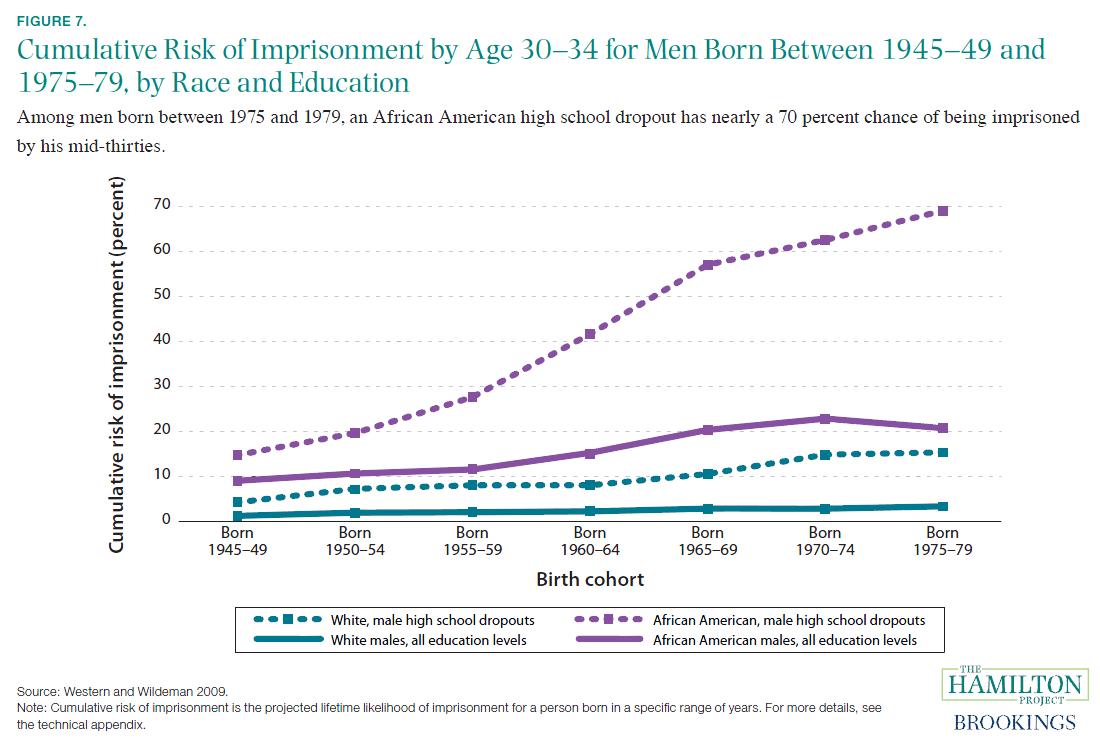
Without a high school diploma the odds are that you will be poor and remain poor. The odds are much greater that you will rely on public assistance. Or go to prison:

You are more likely to be unemployed and are at higher risk of losing your job in a recession:

Your children are more likely to be poor and education won’t help much:

Let me translate that graph for you. If you come from a really poor family, in all likelihood a college degree will boost you all the way up to becoming a member of the working poor while if you come from a middle income family, a college degree can make you upper middle class.

From the foregoing I conclude that the United States really doesn’t need to import people from other countries who can’t read and don’t speak English which impairs one’s prospects even more.

Haiti is a hard case but let’s consider it. Just about half of the population is illiterate and only a minority speak English. They speak Creole French.

Haiti has always been in terrible shape. It got off to a poor start. To the best of my knowledge it’s the only country in the world founded on a slave revolt.

Some of the Haitians’ problems were caused by the United States. In the early part of the 20th century we colonized Haiti. The Marines actually ruled Haiti in the late nineteen teens and early 20s. But Haiti was in terrible shape before our occupation and it has been in terrible shape since then.

Even the Haitians don’t want to stay in Haiti:

It’s even worse since the UN brought cholera to Haiti.

The best way to help people from poor, underdeveloped countries is not to bring them to the United States. It’s highly specific, targeted aid of the sort that Bill Gates has been championing, not the typical foreign aid programs, and I support that. Bringing poor people here where their prospects will be poor not only puts them into competition with our native-born poor, it’s a formula for resentment. An astonishing proportion of the Chechen immigrants to the United States either participated in the Boston Marathon Bombing, were accomplices to it, or knew about it before the fact. Far too high a proportion of the Americans who’ve joined DAESH have been Somali immigrants.

This is not the 19th century, during which the marginal product of labor and wages rose and would continue to rise for nearly a century.

I think that President Trump’s remarks the other day were injudicious, crude, coarse, offensive, and counter-productive—an “own goal”. He shouldn’t have said them.

Let’s not lose sight of the reasoned argument on immigration. If you have an argument for why we should be bringing more poor, illiterate, non-English speakers into the United States, please make it. No proof by anecdote, please. I believe there’s a moral argument in favor of more and better foreign aid. I don’t believe there’s a moral argument in favor of immigration.

I think we need an immigration policy more like Australia’s or Canada’s. I even think that we could increase the number of skilled workers we bring in, provided that we decrease illegal immigration. That will mean ending family reunification as an objective of our immigration policy, ending the diversity lottery, stiffening the requirements for immigration, and enforcing our immigration laws vigorously.

16 comments

Please, More Good News

The recording above was inducted into the Library of Congress’s National Recording Registry in 2015.

1 comment

Somewhat Confused

I was somewhat confused by this editorial in the New York Times against changing Medicaid to require employment or voluntarism. Does the Times support or oppose compulsory public service? Do they support compulsory public service for high school students but oppose it for the poor?

I have no strong feelings on the subject one way or another. I’d rather see more attention devoted to creating jobs. It seems excessive to me to expect Medicaid recipients to move to another party of the country to find work. Just because there are jobs on offer in North Dakota doesn’t mean there are jobs on offer in Chicago.

1 comment

The Great Experiment

In an op-ed in the Washington Post Jared Bernstein expresses skepticism about the likely effects of the recently enacted tax reform:

The timing of the tax cuts is such that they’re throwing a lot of fiscal stimulus—hundreds of billions in new, deficit spending—at an economy that’s already, on its own, closing in on full employment. Based on the already strong, negative trend in the unemployment rate, and the added stimulus, the unemployment rate could be in the mid-3s by the end of this year (it’s currently 4.1 percent). That’s a jobless rate we haven’t seen since the late 1960s.

As someone who constantly longs for very low unemployment, I welcome this development, should it come to pass. The tax cut is very poorly targeted; if I wanted to use the tax code to help those who’ve been left behind, I wouldn’t cut the estate tax. I’d significantly increase tax credits for low-income workers. But the Republicans, because they don’t care about the deficit when it comes to tax cuts, are engaging in an experiment that the more fiscally responsible Democrats would be unlikely to undertake: aggressive deficit spending at low unemployment.

How unusual is that? Well, looking at data back to the late 1940s, the average deficit-to-GDP ratio when unemployment was below 5 percent was close to zero. Since 1980, that same calculation yields an average deficit-to-GDP ratio of 0.5 percent. As I mentioned, the jobless rate this year may average less than 4 percent while the deficit-to-GDP ratio could be about the same, and closer to 5 percent next year. So, pretty unusual.

“Say’s Law” is a rule of thumb in economics that over time aggregate product necessarily creates aggregate demand and it underpins the reform. Dr. Bernstein’s op-ed is suffused with Keynesianism—the view that shortfalls in aggregate demand may persist and can be offset using deficit-driven fiscal stimulus.

My own view is that we’re engaging in fiscal stimulus in the absence of high unemployment but also in the absence of a shortfall in aggregate demand. If the tax reform causes an increase in business investment, it will be beneficial. If, on the other hand, the money is saved, retained in the form of cash or cash equivalents which include things like Treasuries, it won’t have much effect at all.

I believe that nowadays it’s very difficult to predict the results of fiscal policy because of globalization. The title I’d originally thought of for this post was “Stimulus in One Country”. I think that it’s quite possible that consumption effects of the tax reform might be to stimulate the Chinese economy.

6 comments

The Age of Feelings

“Agonistic” is a word I use occasionally around here which may be unfamiliar. I use it to mean the opposite of dispassionate reason—expressions of emotional and argumentative form. The graph above, drawn from an article in The American Interest by Peter Stearns, documents how expressions of basic emotions—joy, anger, shame, or sadness but particularly anger have all increased in recent years. Mr. Stearns observes:

References to all the so-called basic emotions have climbed considerably—sadness, anger, and surprise particularly, but also fear and, intriguingly, disgust, which had declined steadily since the early 19th century.14 Only happiness has remained flat, though joy is up, after a previous nosedive during the Depression and World War II. Self-conscious emotions have surged as well; this involves the dramatically rising claims about guilt, but also embarrassment (and shyness), as well as shame, with pride making smaller gains and only humility—predictably in an age of assertive individualism—holding fairly stable. Experts urge a distinction between shame and guilt—and any cultural anthropologist will insist on an inner-directed/outer-directed difference—but the fact is the two emotions have tended to move in tandem in American history, plummeting after the mid-19th century until the recent joint revival. Love and grief are up, though they have not reached late 19th-century levels. Not only has grief been embellished by the new public manifestations, but even love has found unexpected new targets, as in the rise of the quest for “soulmates” in evidence since the 1980s. Nostalgia, predictably, has surged,15 as has anxiety.

This the age of Facebook and Twitter and they are emphatically not media of reasoned discourse. They are devices for the expression and evocation of emotions, intended to move not convince.

As the United States changed from a primarily oral society to a literate one the expression of emotions decreased; now that we are becoming post-literate and, I would argue, primarily visual, emotional expression is back on the rise. In the past I have discussed at considerable length these phenomena and their implications under the subject “Visualcy”.

I have expressed considerable concern for these developments and their implications for the American polity. Mr. Stearns continues:

The extent to which many supporters seem to value Trump as an expression of emotion and resentment, almost independent of any specific platform, seriously roils the national political process. The startling prompts from the most recent Republican National Convention, at which speaker after speaker explicitly urged Americans to “be afraid, be very afraid,” and to see “carnage” everywhere they looked, reflected clever awareness of the nation’s emotional mood, while also contributing to that mood in turn. Impulses on both Right and Left, despite sharp partisan division, celebrate the growing priority of emotion in public life—including the vigorous if fruitless effort, again by each side, to seek the shame the other. Displays of emotion and the search for emotional validation severely complicate any constructive discourse, adding to the other changes in American character, including the key decline of trust.

The same trends also jeopardize tolerance. One of the virtues of the redefinition of American individualism, according to many late 20th-century studies, was a greater support for tolerance: I as an individual will indulge my impulses, but I will also respect the indulgences of others. And this has clearly played out in a number of important if incomplete values changes in areas such as interracial marriage and sexual orientation. But more fervent emotionality now threatens this trend, as it further underwrites partisanship: My group’s emotions are just fine, but your group’s need to be brought under control, for I reject their validity.

I don’t think that the trend is compatible with good, honest, effective liberal democratic government but I also don’t believe that these trends will or can be reversed. We’ll see.

14 comments

End the Online Exemption?

Is it time to end the sales tax exemption for online retailers?

The background is that online retailers are only required to collect sales taxes in states in which they have what are called “nexuses”, i.e. physical premises. That’s a benefit they’ve been given under law. It applies both to Amazon and to the smallest e-tailer.

Should that exemption be eliminated?

9 comments
