A Better Foreign Policy

I agree with William Ruger and Dan Caldwell’s assessment at RealClearPolitics:

The veterans of our most recent wars distinguished themselves in challenging situations time and again. When we consider martial valor and individual sacrifice, we shouldn’t only think about our troops on the beaches of Normandy or Iwo Jima. We should also remember those who fought in dusty places like Fallujah, Baghdad, and Kandahar, displaying heroism to rival that of previous generations. Thus, we rightly honor their service today.

However, the tactical successes and individual bravery of American fighting men and women over the past 17 years cannot mask the broader failures of U.S. foreign policy since 9/11. Nor should they be used as justification to continue endless wars disconnected from U.S. security in places like Afghanistan.

The best way to honor the sacrifices of our post-9/11 veterans and their families is to make sure we pursue a foreign policy that only calls on our troops to fight when absolutely necessary for our safety, prosperity, and way of life. We shouldn’t ask people to risk everything for their country when what they are fighting for has little to do with U.S. interests or can only be connected to them indirectly via distorted or idealistic theories of the world. We dishonor veterans when we continue to pursue failed policies that can’t be clearly linked to why so many of them joined in the first place: to defend America and our freedom here at home.

They’re right. There are only two problems. We don’t agree on what a better foreign policy would be or, more precisely, elites think one thing while most Americans think another and the elites’ view is prevailing. And there’s no foreseeable path that leads us to a better foreign policy. Who would be its standard bearers? Democrats? These are the same Democrats who’ve intervened in a dozen places around the world since 2009. Republicans? It is to laugh.

14 comments

Their Marching Orders

The editors of the Washington Post (known to some as “Jeff Bezos’s blog”) have proposed their agenda for the incoming Congress:

Democrats obviously cannot overcome the 60-vote rule in the Senate, much less Mr. Trump’s veto. They can, however, use the legislative process to address concerns that the GOP has unreasonably ignored or actively made worse in the past two years. Republicans have responded not at all to mass shootings; Democrats should pass an assault weapons ban, modeled on the federal law in force between 1994 and 2004, to show that they, by contrast, understand the need for action. The GOP slashed taxes for the rich without regard for exploding federal debt; a restoration of the pre-Trump estate tax would show that fiscal responsibility and greater equality of wealth can go together. In a society where millions fear for their most basic political rights, legislation to enhance protections under the Voting Rights Act, and to grant the District voting rights in Congress, would reassure. And, of course, they must keep their health-care promises.

They also urge the incoming Congress not to waste their efforts attempting to impeach either the president of Brett Kavanaugh. I’m afraid their suggestions will land on deaf ears.

Quite to the contrary I think that what will happen is that the incoming Congress will behave like an incoming presidential administration and throw a number of sops to their base, “their base” idiosyncratically defined as the “social democrats” who by and large flopped in the midterms. They will tilt at a number of windmills including the $15/hour national minimum wage (which would hurt their actual base), abolishing ICE, and, possibly, an assault weapons ban and I expect them to launch one or more investigations of President Trump.

If they were shrewd I think they’d start driving a wedge between President Trump and Mitch McConnell, championing things that Trump has said he’d support in the past that also fit in with their preferences and avoiding the “I” word. That might be tricky since it would require them to admit, at least tacitly, that all of their fulmination against Trump for the last two years has been political posturing.

5 comments

The Eleventh Hour of the Eleventh Day


of the eleventh month. Today we call it “Veteran’s Day” but it originally commemorated the armistice that concluded the First World War and was called “Armistice Day”. Lest we forget.

The image above is my grandfather’s draft card. World War I marked the greatest mobilization of Americans up to that point in our history and with it we were thrust onto the international stagel, I would say to our detriment. I suspect that much of the world would agree with me.

Today marks the centenary of that armistice. Americans, with our characteristic disdain for history, are in danger of abandoning any memory of that war. The last American veteran of that war, Frank Buckle, died in 2011. The last known veteran of that war died in 2012. Today few of the living have any actual memory of that war at all.

Among the reasons we should not forget World War I is the contrast Americans experienced between us and our European cousins. In our officer corps scions of wealthy families were as likely to rub elbows with sons of farmboys as not. Maj. MacArthur, son of a prominent Texas military family, served. So did Lt. Dwight Eisenhower, son of a Texas/Kansas clerk. They were both West Point graduates.

It wasn’t like that with the British or French officer corps and their treatment of their troops and ours when they came under European command showed it. The treatment of colonial soldiers, Aussies and Kiwis, by their British officers was notoriously casual of their lives. It was even worse for the Indian soldiers who served in Europe. Of the 130,000 Indian troops who served in France, 9,000 died.

Our more egalitarian military was an advantage and that’s an advantage we are recklessly casting away as our society becomes more stratified. It ignores that the sons of the aristocracy can be dolts while the sons of farmers can be brilliant.

If for no other reason we should remember World War I as an object lesson.

7 comments

Build a Better Mousetrap

How do you sell apples at 2-3 times the typical retail price of apples? Grow better apples. Read the story of the Honeycrisp apple at Bloomberg.

0 comments

Vacancy

Well, that’s something I didn’t know. According to this article at Bloomberg, 30% of apartments in China are vacant. I’m not sure how anyone knows what the vacancy rate actually is. I’m pretty confident that if reports that it’s 30% get out at all, it’s at least 30% and could be much higher.

Note: China’s working age population has already peaked.

3 comments

Congressional Nonfeasance

It would help if the “bipartisan, bicameral Select Committee to design a package of budget process changes to improve the timeliness and efficiency of federal budgeting” that Brookings refers to were something other than a strategy for doing nothing while appearing to be doing something.

Our experience is not good. Bowles-Simpson. Peterson-Pew. Committee for a Responsible Federal Budget. Kerrey-Danforth. Plenty of good ideas. Not much in the way of practical results.

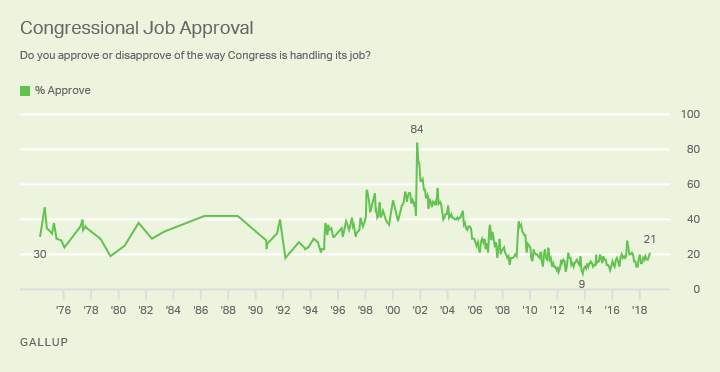
Congress has decided that its best strategy is to do nothing and there is a bipartisan consensus on that. That’s the bureaucrat’s decision. You’re less likely to get blamed for doing nothing than for doing the wrong thing. Is it any wonder that Congress’s approval rating is significantly lower than Trump’s?

As Sam Clemens put it more than a century ago, the U. S. has no native criminal class excepting, of course, the Congress. Or Will Rogers 90 years ago: “This country has come to feel the same when Congress is in session as when the baby gets hold of a hammer.”

Large percentages of Americans think their owner Congressmen are corrupt, under the control of special interests, and out of touch with their districts. Nonetheless they’re returned to office year after year because 51% (and I do mean 51%) of voters think they deserve to be re-elected. That’s the untold story of the last election. Most incumbents were re-elected.

0 comments

Conservatism of Disconnection

I think there’s something that Pete Peterson is missing in his post about the “conservatism of connection” at RealClearPolicy:

What began with some contentious conversations about the president evolved into deeper discussion about these historic levels of alienation, and how an “invitational conservatism” focused on defending civic institutions — including a healthy patriotism — is the necessary response to this era of disconnection. Out of three days of deliberations, we composed a principles document titled, “A Way Forward,” defining a term we’ve come to call a “conservatism of connection.”

“Authentic conservatism is essentially about three connections.” The essay lists:

  1. Connection to the Past: We retain from our heritage what is valuable and worth cherishing
  2. Connection to Our Future: We innovate as conditions change to adapt inherited ways to new conditions
  3. Connection to One Another: Through America’s famed mediating institutions, we connect to one another in achieving the common good.

This is the conservatism of Burke’s “little platoons,” Tocqueville’s “individualism rightly understood,” and also of Robert Nisbet’s “quest for community,” Russell Kirk’s commitment to “voluntary communities”, and, more recently, Rod Dreher’s “crunchy cons.” This conservatism of connection confronts radical individualism and exclusive forms of community on all fronts — from Ayn Rand’s “Galt’s Gulch” nirvana on the right to the left’s identity politics.

which is that not all people called “conservative” are conservative in any discernible way. Burkean conservatives, paleocons (William F. Buckley-style conservatives, mostly over 70), and social conservatives are. Anarcho-capitalist objectivists aren’t. Neoconservatives aren’t. And what to make of “Trump conservatives”?

Here’s the problem: those three latter groups have disproportionate influence.

1 comment

The Art of Polling Has Become Tougher

According to Tom Bevan’s post at RealClearPolitics only one major pollster got both the results of the 2016 presidential and the Florida midterms right—Robert Cahaly, senior strategist for the Trafalgar Group:

Cahaly managed to pick up support for Trump that all other pollsters missed by employing a unique method that sought to measure support from voters who’d been “inactive” in recent election cycles, as well as adding a question to his surveys designed to isolate the effect of social desirability bias among Trump voters – the concept that people won’t tell pollsters their true intentions for fear of being stigmatized or being politically incorrect.

After asking voters who they were supporting in 2016, the pollster followed up by asking them who they thought their neighbors were supporting, Trump or Clinton. Cahaly consistently found a high degree of variance between who respondents said they were voting for and who they thought their neighbors were voting for, suggesting there was in fact a “shy Trump effect” at play.

Two years later, Cahaly’s method once again proved solid. In one of the most polled races of the cycle, Trafalgar stood alone as the only polling firm to correctly show a Ron DeSantis gubernatorial victory in Florida – as well as Rick Scott winning the Senate race there. (Both narrow outcomes will likely result in recounts.)

I think it’s only going to get tougher from here on out.

BTW I wanted to touch on my thoughts about voter fraud. I was a judge of election for 25 years. Not only have I seen actual attempted voter fraud, I can see the opportunities for fraud. Those who scoff at voter fraud are generally being highly specific. They’re talking about voters walking into a polling place and casting a vote by pretending they’re someone they aren’t. I agree that’s pretty rare. It’s just too easy to detect. As an election judge I have personally turned people away for just this reason. Under present law I would probably be required to issue them provisional ballots.

But there are other types of fraud. There’s voter fraud perpetrated by the election staff at a voting place. I believe that any polling place that hasn’t finished tabulating the votes three hours after the polls have closed is probably engaging that sort of voter fraud. Tabulation doesn’t take time but manufacturing votes does and it’s pathetically easy though tedious to do. I haven’t seen or done this because I run a taut ship but I know enough to see how it could be done by people less scrupulous than I.

There are also non-citizens who claim the right to vote fraudulently. When they’re detected at the polling place, they may be issued provisional ballots. They’re still fraudulent and there’s practically no way of detecting it. I believe I have seen this, also, as a judge of election.

Another species is voter fraud is perpetrated by voters who are registered multiple times in different jurisidictions and who vote multiple times, either absentee or in person. I think there are millions of such voters, particularly in Florida.

Yet another variety of voter fraud is at the wholesale level, perpetrated by election officials manufacturing ballots in mass quantities. There’s plenty of reason to suspect that’s what’s going on in Broward County. What else is one to think when boxes of ballots show up for the first time days after the election? Quis custodiet ipsos custodes?

Our system depends on trust and as trust is eroded through misfeasance, malfeasance, or nonfeasance it becomes unworkable.

1 comment

Referenda Ain’t What They Used To Be

Sociology prof Musa al-Gharbi casts some rain on the Democrats’ parade in an op-ed at the Washington Post:

Despite significant structural disadvantages and a difficult Senate map, some great ballot initiatives were passed, state legislatures got bluer in many instances, and Democrats won governorships in some key states. These are worth celebrating (in contrast with claims to have “won the popular vote,” which are spurious). Yet, on balance, Democrats should be more disturbed than comforted by how the elections shook out.

For instance, turnout was much higher than in 2014. However, the increased engagement proved to be bipartisan: Trump’s supporters also showed up in force, significantly undercutting the expected “blue wave.”

Yes, Republicans ultimately lost control of the House — but even here, the Democrats’ continued weakness shines through:

It was expected that the Republicans would lose a significant number of seats, irrespective of public opinions about Trump. Republicans had many more difficult House seats to defend than Democrats overall. There were twice as many Republican incumbents defending House seats in states Hillary Clinton won in 2016 than there were Democrats defending seats in states Trump won.

Republicans also had more than twice as many “open” House seats to hold on to as their Democratic rivals had: 36 Republican representatives chose not to stand for reelection this year because they were retiring or seeking another office. Seven others either resigned or otherwise left office before the election. As a result, Republicans had 43 House seats to defend without the benefit of a true incumbent candidate. On top of this, Republicans had three “open” Senate seats, and one more with a pseudo-incumbent (interim Mississippi Sen. Cindy Hyde-Smith took office in April).

Yet Democrats managed to win surprisingly few of these “open” contests. In the vast majority of cases, a new Republican was elected instead, and they tended to be even closer to Trump than their predecessors. So Trump actually cemented his hold over the Republican Party: Most of his staunchest Republican critics have either stepped down, been removed through a primary challenge or otherwise failed to win reelection. On top of this, virtually all of the Senate Democrats who voted against Supreme Court Justice Brett M. Kavanaugh from the states that Trump won in 2016 were voted out of office and replaced by Republicans.

I have a question for Democrats looking towards 2020. 2018 saw the highest turnout of the “youth vote” in history, much of it going to Democratic candidates. Republicans essentially negated that increased turnout through increased turnout of their own. If your plan is even greater turnout, what makes you think that is likely let alone possible?

The last two years have seen non-stop negative coverage of Trump and Republicans generally. That did not result in a “blue wave” but a continuing stalemate. Is doubling down on strategies that have had disappointing results really the best we can do?

3 comments

Interest

In his Washington Post op-ed about the relationship between the United States and the countries of the Indo-Pacific region, Vice President Mike Pence opens with a succinct statement of American interest:

We seek an Indo-Pacific — from the United States to India, from Japan to Australia, and everywhere in between — where sovereignty is respected, where commerce flows unhindered and where independent nations are masters of their own destinies. This region, which includes more than half of Earth’s surface and population, has experienced great progress when these principles have been respected. While some nations now seek to undermine this foundation, the United States is taking decisive action to protect our interests and promote the Indo-Pacific’s shared success.

Our Indo-Pacific strategy rests on three broad pillars. It begins with prosperity. A full two-thirds of global trade traverses the seas, skies, roads and railways of the Indo-Pacific. U.S. trade in the region is worth more than $1.8 trillion annually, supporting more than 3.3 million U.S. jobs, and our total regional investment in the Indo-Pacific is nearly $1 trillion — more than China, Japan and South Korea’s investment combined.

and concludes

The United States seeks collaboration, not control. The president announced our renewed commitment to the region one year ago; this week, it will be my privilege to demonstrate our resolve with further action and investment. Our nation’s security and prosperity depend on this vital region, and the United States will continue to ensure that all nations, large and small, can thrive and prosper in a free and open Indo-Pacific.

I wish he had a better understanding of the U. S. interest which is somewhat broader than that. It is not merely in maintaining the free passage of trade but, in the 21st century, the free passage of information as well. Not only our prosperity but that of all of the countries of the Indo-Pacific region, including China, depends on it.

As a supplemental question, is Google’s facilitation of The Great Firewall of China consistent with American interest? I think the answer is obviously not. Why do we tolerate Google’s engaging in foreign policy antithetical to U. S. policy?

1 comment
