Quantifying the Illusion of Awareness


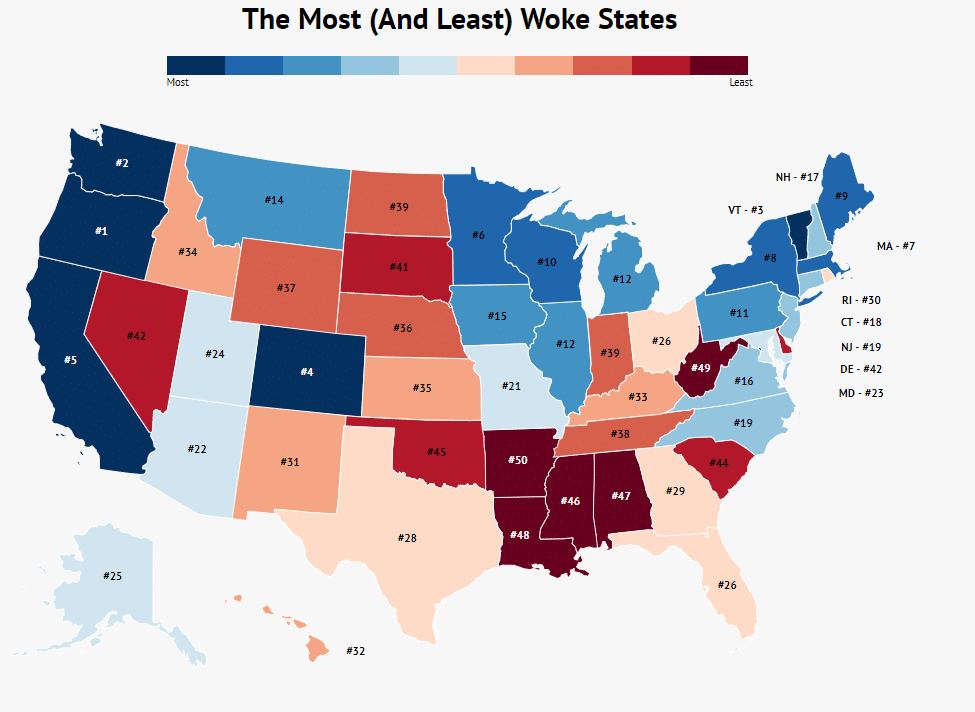
There have been some attempts at quantifying just how “woke” some states are, cf. the map above. At Zippia Kathy Morris explains:

It’s 2021 and every other Gen Zer is calling themselves woke. What does it mean to be woke?

Being an old Millennial, I googled to find out. Merriam-Webster defines it as, “ aware of and actively attentive to important facts and issues (especially issues of justice).” That’s nice.

However, Urban Dictionary adds it’s a “pretentious” and “deluded” awareness. That’s less nice.

We set out to find the most woke states- and the states where it still means getting up in the morning.

Based on her analysis the most “woke” states are:

  1. Oregon
  2. Washington
  3. Vermont
  4. Colorado
  5. California
  6. Minnesota
  7. Massachusetts
  8. New York
  9. Maine
  10. Wisconsin

I think she’s measuring something but I’m not sure what it is. That is very nearly a list of the whitest states. Maybe the least black states?

IMO the degree of wokeness is extremely variable within states, from extremely “woke” places, e.g. Evanston just a few miles north of me, to place which aren’t very “woke” at all, e.g. say Rockport, Illinois on the west side of the state.

5 comments

When Will the Outbreak Be Over?

At the Atlantic Alexis C. Madrigal reflects on when the outbreak of COVID-19 will be over in the U. S.:

The most obvious interpretation of “beating COVID-19” would be that transmission of the coronavirus has stopped, a scenario some public-health experts have hashtagged #ZeroCOVID. But the experts I spoke with all agreed that this won’t happen in the U.S. in the foreseeable future. “This would require very high levels of vaccination coverage,” said Celine Gounder, an infectious-disease specialist at NYU who served on Joe Biden’s coronavirus task force during the transition. The U.S. may never reach vaccination rates of 75 to 85 percent, the experts said.

“The question is not when do we eliminate the virus in the country,” said Paul Offit, the director of the Vaccine Education Center and an expert in virology and immunology at the Children’s Hospital of Philadelphia. Rather, it’s when do we have the virus sufficiently under control. “We’ll have a much, much lower case count, hospitalization count, death count,” Offit said. “What is that number that people are comfortable with?” In his view, “the doors will open” when the country gets to fewer than 5,000 new cases a day, and fewer than 100 deaths.

That latter threshold, of 100 COVID-19 deaths a day, was repeated by other experts, following the logic that it approximates the nation’s average death toll from influenza. In most recent years, the flu has killed 20,000 to 50,000 Americans annually, which averages out to 55 to 140 deaths a day, said Joseph Eisenberg, an epidemiologist at the University of Michigan. “This risk was largely considered acceptable by the public,” Eisenberg said. Monica Gandhi, an infectious-disease specialist at UC San Francisco, made a similar calculation. “The end to the emergency portion of the pandemic in the United States should be heralded completely by the curtailing of severe illness, hospitalizations, and deaths from COVID-19,” she said. “Fewer than 100 deaths a day—to mirror the typical mortality of influenza in the U.S. over a typical year—is an appropriate goal.”

Another yardstick that has been proposed is by number of newly-diagnosed cases:

Some experts were even more conservative. Crystal Watson, a health-security scholar at Johns Hopkins University, suggested a threshold of 0.5 newly diagnosed cases per 100,000 people every day, and a test-positivity rate of less than 1 percent. That would translate to fewer than 2,000 cases a day in the U.S., compared with the current 60,000 or more. We’d also want to log at least one month of normal hospital operations without staff or equipment shortages, she said.

which I find a bit facetious. As the ability to diagnose cases becomes more effective shouldn’t it shorten the duration of the outbreak? That wouldn’t necessarily be the case.

You would think that after nearly a year of a global pandemic there might be more agreement about when it was no longer a pandemic and when local outbreaks were over. Apparently not. Keep in mind that in some countries, e.g. New Zealand, Australia, and Singapore, the outbreaks are already materially over. In other, including the U. S., it will certainly be many months and might even be years before the present outbreaks are over. That in turn implies that, unless much more stringent bans on international travel are imposed than have been the case to date, the global pandemic will not be over for a very long time.

4 comments

We’re #1!

A report from researcher at University of Illinois at Chicago and former Chicago alderman Dick Simpson has found (PDF) that Chicago is the most corrupt major city in the U. S.:

Nonetheless, the DOJ statistics show that since the department began collecting the data in 1976, Chicago is the most corrupt federal judicial district in the nation, and that Illinois, on a per capita basis, is the third most corrupt state.

Table 1 shows the rankings of the nation’s top 15 judicial districts, including their major city, by the total number of public corruption convictions. Since 1976, Chicago had a total of 1,770 convictions and an average of 41 per year, Los Angeles had 1,588 and an average of 37, New York/Manhattan had 1,361 and an average of 32 per year, Miami had 1,234 and an average of 29, and Washington D.C. had 1,199 and an average of 28 per year.

I initially intended to title this post “I Demand a Recount” on the basis of its only finding Illinois the third most corrupt state. When I dug further into the report I found that on a per capita basis Illinois is by far the most corrupt state. Both of these findings should surprise no one who pays any attention to the news from Chicago or Illinois.

I have a couple of observations to add. First, the claim made in the report that corruption is spiking cannot be determined using the methodology of this report. All that one can say is that the successful prosecution of corruption in Chicago and Illinois are spiking. I sincerely believe that the successful prosecutions are merely the tip of a filthy iceberg.

Additionally, conspicuous by its absence from the report is any proposal for mending the situation or mitigating the risk of ongoing corruption. It’s blithe to propose that voters just stop voting for corrupt candidates but how? Just to take a single example, no Republican was on the ballot for mayor of Chicago and that’s been the case for some time. We had a choice between two candidates, either of whom was certain just to take her turn at the trough. Chicagoans chose the closest thing to an outsider available which judging by performance was an error. What were we to do?

I think it’s patently obvious that the Illinois Democratic Party is a criminal conspiracy but proving it is another matter. Merely getting such a case into court would probably be impossible. So prosecutors just slowly chip away at the edges while the basic corruption remains.

The solution many erstwhile Illinoisans are seizing is flight. Illinois has greater net population losses than any other state. That solves nothing for those who remain.

7 comments

We Have No Allies

In an op-ed in the Wall Street Journal former Treasury Secretary Henry Paulson says that we can out-compete the Chinese by returning to the neoliberal orthodoxy on trade if our allies go along with the gag:

The U.S. and China are engaged in a strategic competition that will determine the shape of global politics this century. But when it comes to trade, a critical dimension of that competition, America is ceding the field.

In recent years, the U.S. has imposed unilateral tariffs and trade barriers on allies and adversaries alike. Controls on the trade of technology, while important for national security, have been unnecessarily broad and often unilateral. The U.S. withdrew from the Trans-Pacific Partnership (TPP). And it has, through a mixture of negligence and obstruction, hobbled the World Trade Organization. These actions undermined America’s leadership of the global trade system, to the dismay of our allies and partners and to the detriment of our firms and workers.

At the same time, China has expanded its trade footprint. Already the world’s largest exporter, China is rapidly displacing the U.S. as the largest trade partner for much of the world. Ninety countries traded twice as much with China as with America in 2018. Last year China surpassed the U.S. as the largest recipient of foreign direct investment.

and

Our work must start at home. America’s economic prosperity and the effectiveness of our political system and global leadership are rooted in domestic economic strength. We need an economic recovery program that invests in core technologies such as telecommunications and advanced computing, while also attracting the best minds from around the world to foster innovation. And as the economy recovers, we need a plan to defuse our national debt bomb over time.

China isn’t going to give America the courtesy of waiting. If the Biden administration wants to compete seriously and fulfill its promise of fashioning a “middle-class foreign policy,” it will be essential for Mr. Biden to craft a broad trade agenda that ensures U.S. workers aren’t cut off from some of the fastest-growing markets in the world.

I would submit two realities to Mr. Paulson. The first is that we cannot resume our position of economic strength unless we produce a lot more of what we consume than is presently the case and that is impeded by China’s illegal subsidization of its state-owned enterprises. Why buy an iPhone or a pair of socks made in the U. S. when you can buy those products for less money when they’re made in China?

The second is this. We have no allies. We have a few clients, e.g. Israel but not a single ally other than on paper. Germany, the United Kingdom, Japan, France, etc. are all pursuing their own national interests and right now those national interests rely on China. And China is controlling the market for rare earths, steel, consumer electronic goods, and many, many other sectors. What does he plan to do about that?

What the U. S. needs to do is to re-industrialize. We foolishly threw that economy away twenty years ago. And neoliberalism has no solution for it.

9 comments

Oh, That Inflation

The editors of the Wall Street Journal have some questions for Federal Reserve Chairman Jerome Powell. First and foremost they wonder what he thinks is happening:

The yield on the 10-year Treasury note—the most important price in the global economy—surged to 1.37% Monday from 0.917% at the start of the year. The German 10-year bund, the eurozone’s benchmark bond, on Monday hit an eight-month high of minus-0.28%, after rising 12 basis points last week. Japan’s 10-year government bond reached a two-year high of 0.12%.

No doubt this is in part a healthy response to good pandemic news. Falling case counts in the U.S., U.K. and other vaccine leaders are bringing the light at the end of the lockdowns into sight. Bond investors expect growth to revive, and rising yields signal faster growth. If this is correct, expect economic optimism to push yields still higher despite the Fed’s near-zero short-term rate target and aggressive asset purchases.

But Mr. Powell has gone to extraordinary lengths to keep yields low, so how does he view these recent bond movements? Is this healthy, and is he content for investors to make their best guesses about the recovery? Or does he intend to fight investors, perhaps with some version of Japanese-style yield-curve control that would set rates by fiat at longer maturities? If so, why?

A less benign reading of bond-price trends is that investors expect that the combination of economic recovery, loose monetary policy and a fiscal blowout from the Biden Administration will stoke inflation. An early warning might be last week’s report of a 1.3% January increase in producer prices, a post-2009 high.

Inflation already is here if you look at asset and commodity markets instead of consumer prices. Bitcoin is up about 80% this year despite an Elon Musk-induced plunge Monday; copper has nearly doubled in price per ton since March; emerging-market bonds have been issued in higher-than-normal quantities this year, at abnormally low interest rates; the S&P 500 and Nasdaq set new records this month; the U.N.’s index for global food-commodity prices reached its highest level since 2014 in January; the Case-Shiller housing index rose 9.5% in November, the fastest pace since 2014; and Brent crude oil is back to about $65 a barrel.

Some of that is related to rosier economic growth prospects after a terrible year. But how much? Some of the price rises appear to be attributable to less benign supply pinches as the economy continues to adapt to the post-Covid era. Nor can one ignore the phenomenal 26% increase in the money supply as measured by M2, which John Greenwood and Steve H. Hanke flagged in these pages Monday.

Which brings us back to Mr. Powell, who with his predecessor, Treasury Secretary Janet Yellen, seems convinced that since inflation didn’t ignite after 2009 it never will again. He also sounds sanguine about the risks of soaring asset prices, for which he’s said monetary policy isn’t a suitable remedy anyway.

What, precisely, makes him so sure inflation isn’t a danger? Is he recalibrating his inflation expectations in light of the unprecedented runup in household savings over the past year, a fiscal blowout of world-historical proportions, and much faster growth in monetary aggregates than occurred after 2009? If not, why not?

The question I would ask him is this. Is he unconcerned about inequality? Rapidly increasing asset values increases the disparity in both wealth and income between “the rich” and the rest of us. Additionally, when those inflated asset values leak into the non-monetary economy by, say, purchasing land or houses or buildings or anything else that impinges on the non-financial economy, it might increase the values of those things as well to the detriment of the non-rich.

4 comments

I Don’t Believe in Democracy

Have you noticed that none of those calling for the preservation of democracy are matching that with a call for direct democracy? I don’t honestly know how they rationalize their beliefs. Direct democracy is not impossible or even impractical—we now have the technology to implement it at scale. The criticism of it remains what it was 300 years ago: it’s dangerous.

I don’t believe in democratic government; I believe in republican government, limited to the exercise of enumerated powers.

My supposition is that the demands for democracy are actually demands to win regardless of the cost. When democracy works against their preferred outcomes, they’ll demand something else.

3 comments

It Will Never Be Over

In his New York Times column Bret Stephens takes note of some egregious examples of “woke” overreach:

In 2015, Bon Appétit ran an article by the food writer Dawn Perry about hamantaschen, the triangular cookies that are a tradition during the Jewish festival of Purim. It was headlined — brace yourself for outrage — “How to Make Actually Good Hamantaschen.”

Six years later, a woman named Abigail Koffler found the article while researching hamantaschen fillings. She was not amused.

Perry, Koffler wrote on Twitter, isn’t Jewish. Perry’s husband, Koffler added, had been forced out of his job at Condé Nast last year based on accusations of racial bias. Above all, Koffler objected, “Traditional foods do not automatically need to be updated, especially by someone who does not come from that tradition.”

Most Jews would probably be grateful for an “actually good” hamantasch. Yet within hours of Koffler’s tweets, Bon Appétit responded with an editor’s note atop the article, now renamed “5 Steps to Really Good Hamantaschen.” It’s a note that defies summary, parody and belief.

“The original version of this article included language that was insensitive toward Jewish food traditions and does not align with our brand’s standards,” the editor wrote. “As part of our Archive Repair Project, we have edited the headline, dek, and content to better convey the history of Purim and the goals of this particular recipe. We apologize for the previous version’s flippant tone and stereotypical characterizations of Jewish culture.”

Behold in this little story, dear reader, the apotheosis of Woke.

No transgression of sensitivities is so trivial that it will not invite a moralizing rebuke on social media.

No cultural tradition is so innocuous that it needn’t be protected from the slightest criticism, at least if the critic has the wrong ethnic pedigree.

concluding:

A friend of mine, a lifelong liberal whose patience is running thin with the new ethos of moral bullying, likes to joke, “Woke me when it’s over.” To which I say: Get comfortable.

It will never be over because it’s not about offense. It’s about power and the urge to wield power over one’s fellows is part of human nature and not naturally self-limiting.

4 comments

Abusing the System

I read this piece in the Los Angeles Times with a mixture of chagrin and smug satisfaction:

A California program intended to improve COVID-19 vaccine availability to people in hard-hit communities of color is being misused by outsiders who are grabbing appointments reserved for residents of underserved Black and Latino areas.

The program to address inequities in vaccine distribution relies on special access codes that enable people to make appointments on the My Turn vaccine scheduling website. The codes are provided to community organizations to distribute to people in largely Black and Latino communities.

But those codes have also been circulating, in group texts and messages, among the wealthier, work-from-home set in Los Angeles, The Times has learned. Many of those people are not yet eligible for the vaccine under state rules.

Some people able to make appointments have been driving to Cal State Los Angeles to get the shots.

Very nearly every abuse of the systems set up to inoculate people that I predicted back in December have actually come to pass.

On a more personal note my wife has received both her first and second inoculations as an esssential workers. I’m still trying to get an appointment. Although I’m qualified due to my age supply issues are preventing my getting my first inoculation. Now that my wife’s been inoculated I’m in less of a hurry than might otherwise be the case. I check on a daily basis to see if there’s any change. I’ll get inoculated when I can.

1 comment

Complaining About the Situation You Created

I found this piece at Politico and the situation it describes a combination of comical and tragic:

Women’s rights activists and allied Democrats are growing increasingly vocal about what they call the unfair targeting of women and people of color nominated by Joe Biden to top posts in his administration.

Their fears had been bubbling for weeks, as Biden’s nominees of color came under sharp attack from conservative groups or saw their nominations delayed or opposed in greater numbers. But the worries burst out into the open over the weekend as Neera Tanden’s nomination to lead the Office of Management and Budget neared defeat at the hands of a Democrat.

Women’s rights activists and allied Democrats are growing increasingly vocal about what they call the unfair targeting of women and people of color nominated by Joe Biden to top posts in his administration.

Their fears had been bubbling for weeks, as Biden’s nominees of color came under sharp attack from conservative groups or saw their nominations delayed or opposed in greater numbers. But the worries burst out into the open over the weekend as Neera Tanden’s nomination to lead the Office of Management and Budget neared defeat at the hands of a Democrat.

Let’s start with the last complaint first. Does the White House really want to complain that the ambassador to Germany is as important to them as the director of the Office of Management and the Budget? In that case withdraw Ms. Tanden’s appointment as director of OMB and appoint her ambassador to Germany. Ambassadorships historically have frequently been considered inconsequential and ways of rewarding party loyalists and contributors, cf. the talk of appointing Rahm Emanuel to be ambassador to Japan.

But consider the charges of racism and sexism more closely. When you brag that you’re appointing a more diverse set of people than any administration in history, following up by complaining that scrutinizing your appointments is racist and sexist is bizarre and demeaning. The complaints about Ms. Tanden are that she’s too partisan to be director of OMB and unqualified to boot. Is the claim that all South Asians and women are highly partisan and unqualified? Surely not. Are they arguing that considerations of temperament and qualifications are off limits so long as the appointee is a woman and South Asian? I remember Sen. Joe Biden voting against the confirmation of a Jewish woman appointee to the Supreme Court on the grounds she was unqualified. I thought he did the right thing. Was I wrong or has something changed? I also recall that Jewish and conservative groups made precisely the same frivolous claims of sexism and anti-semitism.

The problem is not that Ms. Tanden is a woman or of South Asian descent. It is that she’s virulently partisan, Mr. Biden ran on unifying the country, and she’s not qualified for the job. In particular Ms. Tanden is not a unifying candidate but a divisive one.

Withdraw her appointment, chalk it up to lessons learned, and appoint a more qualified, less divisive candidate.

5 comments

As Fast As We Can

At ProPublica Isaac Arnsdorf and Ryan Gabrielson explain that we’re producing vaccines against COVID-19 as fast as we can and there’s nothing we can including using the DPA to order more that will change that:

Vaccine supply chains are extremely specialized and sensitive, relying on expensive machinery, highly trained staff and finicky ingredients. Manufacturers have run into intermittent shortages of key materials, according to the U.S. Government Accountability Office; the combination of surging demand and workforce disruptions from the pandemic has caused delays of four to 12 weeks for items that used to ship within a week, much like what happened when consumers were sent scrambling for household staples like flour, chicken wings and toilet paper.

People often question why the administration can’t use the mighty Defense Production Act — which empowers the government to demand critical supplies before anyone else — to turbocharge production. But that law has its limits. Each time a manufacturer adds new equipment or a new raw materials supplier, they are required to run extensive tests to ensure the hardware or ingredients consistently work as intended, then submit data to the Food and Drug Administration. Adding capacity “doesn’t happen in a blink of an eye,” said Jennifer Pancorbo, director of industry programs and research at North Carolina State University’s Biomanufacturing Training and Education Center. “It takes a good chunk of weeks.”

And adding supplies at any one point only helps if production can be expanded up and down the entire chain. “Thousands of components may be needed,” said Gerald W. Parker, director of the Pandemic and Biosecurity Policy Program at Texas A&M University’s Scowcroft Institute for International Affairs and a former senior official in the Department of Health and Human Services office for preparedness and response. “You can’t just turn on the Defense Production Act and make it happen.”

Even if the companies had started building new facilities back in September, they still wouldn’t be online yet. Raw materials are a bottleneck, too:

Raw materials for the Pfizer and Moderna vaccines are also in limited supply. The manufacturing process begins by using common gut bacteria cells to grow something called “plasmids” — standalone snippets of DNA — that contain instructions to make the vaccine’s genetic material, said Pancorbo, the North Carolina State University biomanufacturing expert.

Next, specific enzymes cultivated from bacteria are added to cause a chemical reaction that assembles the strands of mRNA, Pancorbo said. Those strands are then packaged in lipid nanoparticles, microscopic bubbles of fat made using petroleum or plant oils. The fat bubbles protect the genetic material inside the human body and help deliver it to the cells.

Only a few firms specialize in making these ingredients, which have previously been sold by the kilogram, Pancorbo said. But they’re now needed by the metric ton — a thousandfold increase. Moderna and Pfizer need bulk, but also the highest possible quality.

“There are a number of organizations that make these enzymes and these nucleotides and lipids, but they might not make it in a grade that is satisfactory for human consumption,” Pancorbo said. “It might be a grade that is satisfactory for animal consumption or research. But for injection into a human? That’s a different thing.”

And that doesn’t address additional bottlenecks like the possibility that Moderna and Pfizer are in competition with one another for some equipment and materials and that some of the equipment requires components that are only available from overseas.

I’ve been pointing this stuff out for months but it’s nice to see people better-informed than I saying it, too.

4 comments
