What Lesson Will They Learn?

Bending but not breaking my practice of not posting on the goings-on in states other than my own (and California where my wife’s family lives), I wanted to ask a question. What lesson will House Democrats take away from yesterday’s election results? I’m seeing a lot of editorials, columns, and posts giving advice.

My offhand guess is that the House leadership will take them as a sign that they must redouble their efforts in getting a maximally transformative “infrastructure” (as opposed to infrastructure) bill passed in reconciliation.

46 comments

The Awful Truth

At New York Magazine Eric Levitz reports on an “autopsy”, i.e. after-action report, on the 2020 elections, characterizing the findings as “not good news for Democrats”:

America’s rising generations are less white, religious, or conservative than any of their predecessors. The biases of America’s legislative institutions may be on the GOP’s side, but time is on the Democrats.’

Or, so we like to tell ourselves. In truth, a close look at last year’s election results suggests that Democrats shouldn’t rest their hopes on demographic change.

The three findings are:

  1. Democrats are losing white working-class supporters to the GOP and death.
  2. Elevated turnout among nonwhite voters made Nevada’s electorate more diverse — but no more Democratic.
  3. Democrats lost more support among young Hispanic voters than among old ones.

which is precisely what I have been saying for the last two decades. The belief that Hispanics will be an unshakeably Democratic voting bloc as blacks have been for the last three generations is a miscalculation. Hispanics are an ethnic group (multiple ethnic groups in fact) who are behaving much the same as previous ethnic groups have. Just as Italians and Greeks were once considered non-white but are now generally considered white except by “one drop” racists left and right, so most Hispanics think of themselves as white and will increasingly be seen that way by other Americans.

I don’t find that bad news for Democrats but it’s pretty bad news for those who think they can ignore working class interests because they have reliable voting blocs who will support them come what may just by relying on identity politics. I won’t be posting on it but I strongly suspect that the outcome in Virginia says the same thing.

Something he fails to mention: the days of “one a Democrat always a Democrat” are long gone. People vote across party lines all of the time now and, increasingly, consider themselves independents because they don’t see themselves in either political party. Additionally, youth is not a permanent condition and major life events have been demonstrated to move people to change parties. Young Democratic voters will ultimately not be young any more. Whether they will be Democratic voters remains to be seen.

1 comment

2030 Is Madness

At RealClearEnergy Michael Kelly explains the complexities of electrification:

A typical house in the UK draws 2-3kW of electrical power, averaged over the year, with peaks of order 5kW in winter. A single slow charger for a car draws 7kW, with a fast-charger drawing 15kW. The substations in most suburbs were installed before the need for recharging car batteries, and most will need to be upgraded to handle the extra demand.

Given also that 40% of UK cars do not have a garage and are parked on the street, there is also the problem of how they will be charged. Cars used by commuters will need charging points, either at home or place of work, or both. As many local authorities have bylaws preventing electric cables from crossing pathways, how will suburban commuters be assured that they can charge their cars? In the last major winter storm in 2012, when the M25 London orbital road was gridlocked, it was electric cars with flat batteries that delayed the clear-up.

At the same time, Britain’s adoption of net zero means that it has to decarbonize home heating. At present, this is mostly done cheaply and efficiently with natural gas. The average energy used per day in our personal mobility and logistics is relatively constant through the year, with small excursions downward on weekends and variations over seasons. This is in contrast to the future demand for electric heat to replace gas heating: here, there exists a factor of between 8 and 10 between the use of gas in winter and summer. The current gas grid copes with that by a faster flow of gas. This feature would also be required for a future grid capable of handling all our heat demands.

Where will all this extra electricity – averaging more than the grid of today – come from? Will the current transmission system be able to cope? If both heating and mobility are to be provided without fossil fuels, the UK will need to more than treble the energy in the current electricity grid. Renewable energy cannot make up the difference. We simply do not have the area, onshore and offshore, for sufficient wind and solar farms.

Those complexities include generation, storage, and transmission and they can’t simply be waved away or assumed that they will be addressed within the target timeframe.

One complexity he does not consider: I’m not convinced that batteries of the requisite capacities and quality can be produced in sufficient quantities within the timeframe.

10 comments

The Next Shoe

Bill McBride warns that the next shoe to drop in our story of increasing prices is rents:

Clearly rents are increasing sharply, and we should expect this to spill over into measures of inflation in 2022. The Owners Equivalent Rent (OER) was up 2.9% YoY in September, from 2.6% in August – and will increase further in the coming months.

I think that the eviction moratorium has a lot more to do with that than Bill seems to. As it works out there is a bit of evidence in support of that suspicion as this piece at CNBC reported:

About 18% renters in America, or around 10 million people, were behind in their rent payments as of the beginning of the month.

It is far more than the approximately 7 million homeowners who lost their properties to foreclosure during the subprime mortgage crisis and the ensuing Great Recession. And that happened over a five-year period.

As I said at the time they should have put a property tax jubilee in place is they were going to impose a moratorium on evictions. The sharp increase in rents can be explained largely by landlords trying to recoup lost revenue.

4 comments

What, Me Worry?


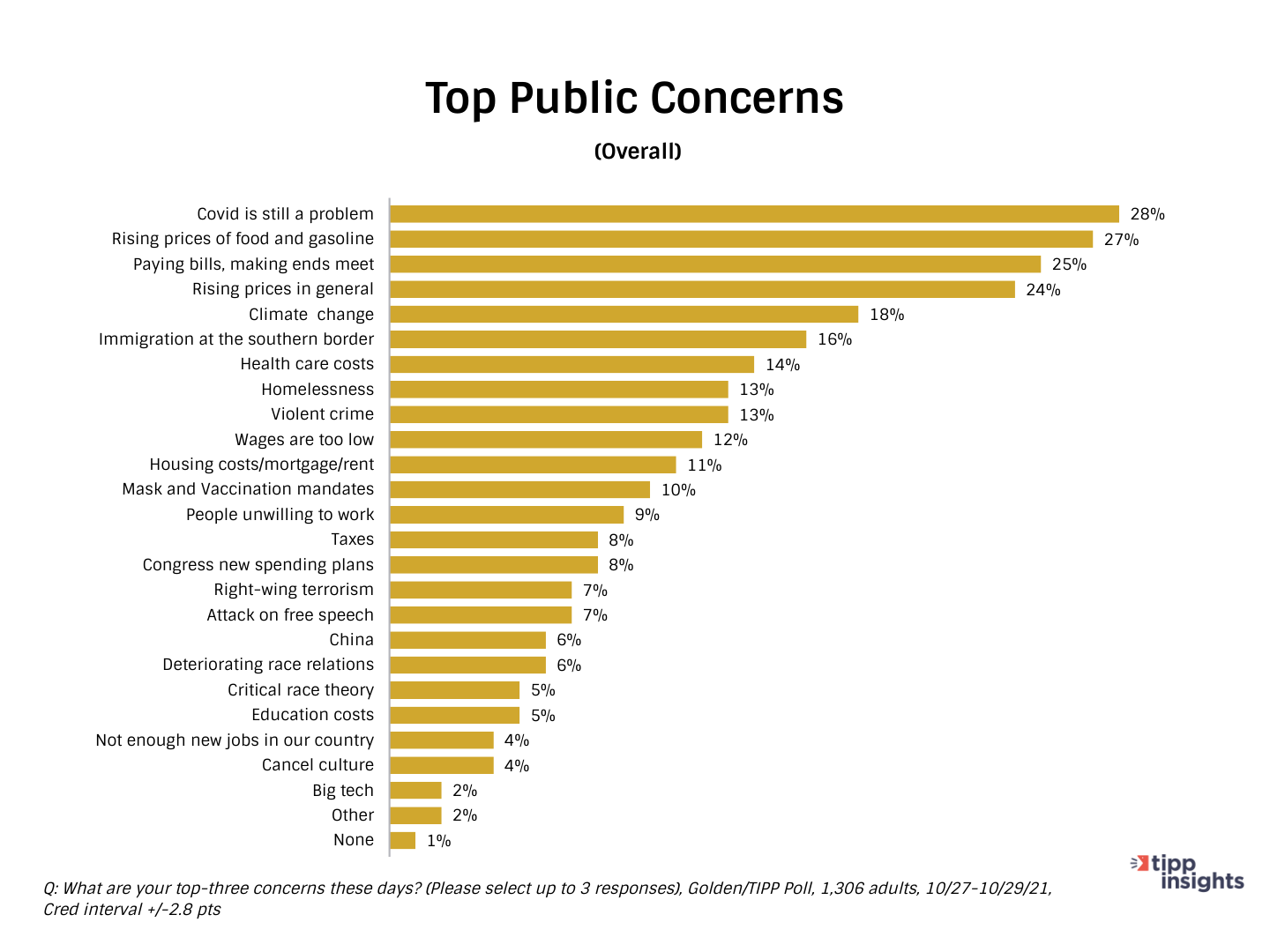
I wanted to call this post from TIPP Insights to your attention. It describes and analyzes the results of their latest poll of Americans’ top concerns today. At the very top is that COVID-19 is continuing to be an issue which proves that they pay attention to the news reports. Of the next 10 six are related to rising prices which proves that they pay bills. I would characterize the remaining concerns as “niche” concerns.

Democrats, Republicans, and independents have somewhat different primary concerns with Democrats being most concerned about COVID and climate change, Republicans most concerned about rising prices of food and gasoline and the situation at our southern border, and independents mostly concerned about rising prices in their various manifestations. For all three groups rising prices are in the top five. Can we stop calling it “inflation”? They’re distinct although both are concerns right now.

Read the whole thing—it’s mostly graphs.

2 comments

Where Has He Been?

Lawrence Summers clearly views the G20 agreement on a group-wide minimum corporate tax a triumph judging by his Washington Post op-ed:

The leaders of the Group of 20 nations, representing the largest economies in the world, gathered Saturday to announce agreement on a deal that will create a more worker-centered global economy.

This agreement is arguably the most significant international economic pact of the 21st century so far. It is built around a profoundly important principle: Countries should cooperate to raise corporate taxation, not compete to reduce it. At a time of much cynicism about government, this agreement is a triumph of American leadership, for Treasury Secretary Janet L. Yellen and her colleagues. It also demonstrates the power of ideas to shape economic policy, as tax scholars have for years been pondering the conundrums of taxing global companies.

For too long, governments have been complicit in the light tax burdens of their companies, competing in a race to the bottom that has steadily lowered corporate tax rates. This competition to lighten tax burdens on mobile capital has occurred amid trends of rising inequality, rising corporate profits and a rising share of capital income (relative to labor income) in national income.

I’m afraid I can’t see it that way. Here’s a list of the corporate tax rates for the G20 countries. As I read it the agreement requires the United States to limit the applicability of deductions without requiring the other members of the group to do much of anything. Furthermore, since the Republic of Ireland, Luxembourg, various crown colonies, UAE, etc. aren’t members of the G20 it has no impact on them whatever. I expect the continued departure of corporate headquarters from the United States to restart with the attendant loss of jobs that entails. And that ignores that the tax itself is not efficient economically.

What caught my eye and what worries me is how he characterizes the agreement:

This new global minimum tax is a triumph of Detroit over Davos.

In 1950 Detroit was a city of almost 2 million people. Now it’s a third that size, a shell of its former self with many once prosperous neighborhoods in ruins. I’m afraid that he’s right.

4 comments

Once Upon a Time…

I want to tell you a story. Once upon a time in a Europe long, long ago there was a war that extended over a substantial part of the continent without any borders and without any limits. It went on for decades—so long in fact that many people did not remember a time before the war. And that war had followed almost immediately after another even longer war. Tired of war the leaders of that time came up with a novel idea. Individual countries would have agreed-upon borders. Sovereigns were responsible for what went on within those borders, those borders were “inviolable”, and other countries were not to interfere in what went on within those borders. Because the treaties that arrived at that solution were concluded in cities in Westphalia those principles are called “Westphalian sovereignty” and “Westphalian states”. Those principles have prevailed in European-dominated diplomacy ever since. They have worked pretty well despite our frequent violations of them.

What moved me to repeat that story was this editorial in the Washington Post:

Haiti has descended into a state of political, economic and security collapse.

The free fall in the Western Hemisphere’s poorest country is accelerating, and it is a pipe dream to imagine it can pull itself together without outside intervention. To oppose a muscular international force that could restore some semblance of order is to shrug at an unfolding humanitarian disaster.

In the face of Haiti’s agonies, the heedlessness of the Biden administration and the United Nations is unconscionable.

Haiti has been in a state of chaos for most of the years since 1791 when slaves in the western quarter of the French colony of Saint-Domingue rebelled against their masters and established their own country. We haven’t helped matters there a great deal. The United States occupied Haiti for about a decade a century ago. It was not precisely a benign occupation.

Haiti is not the only country in the world in a state of “political, economic and security collapse”. The characterization is apt for much of Africa and a broad swathe of west Asia reaching from the Hindu Kush to the Bosporus.

How do you reconcile the sort of intervention the editors are calling for with Westphalian states? Keep in mind that should we choose to abandon the concept of Westphalian states it would introduce the risk of war without boundaries and war without end.

One more quibble with the editors’ advice: there is no such thing as an “international force” and we should resist the creation of such a thing as strenuously as possible. There have been multi-national forces. The last multi-national force in Haiti spread cholera there resulting in many deaths.

My question is what is the basis for intervening in Haiti but not in Somalia? Or Sudan? Or Ethiopia? Or the enormous list of other countries? Where does it end?

7 comments

She-Monsters

TCM and several other networks have been showing round-the-clock horror movies for the last several days. In the past I have posted a list of what I think are the best supernatural horror movies but, in the interest of equal opportunity, why not make a list of monster movies in which the monster is a woman?

Bride of Frankenstein (1935)

This movie, directed by James Whale, features a reunion of Boris Karloff as The Monster and Colin Clive as Victor Frankenstein with a young and pretty Elsa Lanchester in a dual role as Mary Wollstonecraft Shelley and The Bride. It is, if anything, more atmospheric than the original.

Dracula’s Daughter (1936)

Gloria Holden’s performance in the title role is genuinely eerie in an otherwise forgettable movie.

Cat People (1942)

An incredibly atmospheric movie directed by Jacques Tourneur, produced by Val Lewton, and starring the gorgeous Simone Simon as a woman who transforms into a panther when angered. Or does she? We never realyo know for sure. The all-time classic of this subgenre.

She Devil (1957)

I include this movie not just because a woman plays the monster but because it is based on Stanley G. Weinbaum’s unforgettable short story, “The Adaptive Ultimate” which is a lot better than this movie. File this one under “Science Is Bad”.

Attack of the 50 Foot Woman (1958)

No list of movies in which a woman played the monster would be complete without this incredibly campy, gorgeously trashy entry. I haven’t been able to find out what Allison Hayes who portrayed the title character thought of this being the movie for which she is most remembered. My guess is that she thought it was a paycheck.

The Wasp Woman (1959)

Roger Corman produced and directed this entry in the list of movies in which a woman is the monster. A not atypical 50s creature feature.

The Vampire Lovers (1970)

What list of horror movies would be complete without a Hammer film? As it works out this movie is based on the earliest novel of my knowledge in which the vampire was a woman, J. Sheridan Le Fanu’s great Carmilla which I recommend reading. It’s available on Project Gutenberg. There are a half dozen movie adaptations with various names.

One of the things that is very notable about these movies is how much more exploitative the 1950s movies were than those made before. I suspect it’s related to the transition of horror movies from A to B that took place in the 1940s.

What are your suggestions for entries in this list?

5 comments

Halloween 2021

My wife’s brainstorm for decorating our house for Halloween last year was such a triumph she decided to reprise it again this year, adding a few cutouts of bats to our pillars. We were surprised to find we had received a ribbon from the neighborhood association for our Halloween decorations.

0 comments

Smugness As Business Model

I don’t visit Vox.com very frequently because every time I do it’s quite obvious that I’m not its target audience. At Quillette Batya Ungar-Sargon analyzes how Ezra Klein and his partners (which used to include Matthew Yglesias) have turned their characteristic smugness into a business model:

Vox’s trademark style would be a cheeky, barely concealed smugness that flatters its readers into believing that by reading the website—which, not coincidentally, would sustain all of the liberal opinions that young, affluent, educated people already hold—they can rest assured that they are among the ranks of the correct, the informed, rather than one of the stupids.

In combining that smugness with a youthful, Whiggish optimism that equates information with progress, Klein figured out how to commodify being in the know in the social media age. After all, the point is not to know things so much as it is to broadcast that you know them. And the folks at Vox realized there was a goldmine to be had if they could turn sharing a Vox article on social media into the method whereby someone signaled their identity, the way a certain kind of person used to walk around with a New Yorker magazine peeking out of her handbag. In other words, Vox capitalized on one of the mainstays of the journalism status revolution: the anxiety members of broader elite classes have about whether they are elite enough.

Obviously, it’s a winning formula. There’s nothing like reinforcing what people already believe as self-evident unassailable fact to be popular with those people. Actual education requires changing what people already believe rather than challenging it.

7 comments