Releasing its long-awaited military strategy for the next decade, Tokyo said Friday that by fiscal 2027, it would spend about 2% of its gross domestic product on defense, up from about 1% now. Based on current GDP, that would bring annual spending to the equivalent of around $80 billion, putting Japan third in the world behind the U.S. and China.
Around $3.7 billion is earmarked over the next five years for missile systems, including American Tomahawk missiles, which would give Japan the ability to target foreign military facilities if an attack appeared imminent. That is a turnaround from Tokyo’s postwar pacifist outlook, enshrined in its war-renouncing constitution, which made it wary of threatening other countries.
The new strategy “marks a major transformation of our postwar security policy,†said Prime Minister Fumio Kishida at a news conference. The strategy said the missile plans and other steps would warn potential aggressors such as China, North Korea and Russia that it would be too costly to attack Japan.
I don’t believe that Japan is acting as a lackey to U. S. aggression in this. It is rather obviously Japan’s reaction to China’s military buildup and “wolf warrior diplomacy”. Additionally, Russia’s invasion of Ukraine must have caused the Japanese to hear footsteps.
Consider:
Shedding Tokyo’s usual reticence over China, the strategy released Friday includes a long list of complaints about Beijing’s conduct, including its close ties with Russia and its incursions near Japanese-held islands.
Whatever its cause I suspect the Chinese will look at this development with some foreboding. It is just barely within living memory but a militaristic Japan inflicted considerable suffering on China 85 years ago. And as we should not forget the Japanese can be fearsome opponents.
Here’s the portion relevant to the present discussion:
The US side declared: The United States acknowledges that all Chinese on either side of the Taiwan Strait maintain there is but one China and that Taiwan is a part of China. The United States Government does not challenge that position.
There are competing interpretations of that passage. One interpretation is that the United States concurred with “all Chinese on either side of the Taiwan Strait”. The other, which is what I hold, is that it is diplo-speak for an agreement to disagree. The United States neither affirms nor rejects the unity of Taiwan but states a preference to a peaceful settlement of the issue by the Chinese and Taiwanese.
I have no ability to determine what the views of the people of Taiwan were 50 years ago but, assuming they were as stated, it is rather clear they have changed. See these findings by Pew Research: and
I suspect that events in Hong Kong since reunification have not bolstered support for unification with the mainland in Taiwan. Also note that Taiwanese opinion does not appear to be moving in China’s direction—the young are more likely to consider themselves as Taiwanese only than the old.
Today is Kara’s ninth birthday. Kara is my special friend. I spend more time with her than I do with any of the other dogs. She and I walk five miles a day together, practically every day regardless of weather. She is probably the sweetest Samoyed we have ever had.
Within my own wheelhouse of civil-military relations, we have seen the United States military go from being perhaps the most consistently-admired major institution in our society to one with less-than-majority support—with a 25% drop between November 2020 to February 2022. And, no, it’s not because of losing efforts in two wars, for which the American public largely blames politicians. It’s because the military brass are increasingly seen as partisan political actors taking sides in the culture wars.
I find the assertion that confidence in the media is instrumental with Republicans averring confidence in Fox News while Democrats believe CNN misses the point. It hasn’t always been that way. Just 20 years ago, believe it or not, scholarly analysis found Fox News to be among the most unbiased sources. Fox is even more biased now than it was 20 years ago and the same is true for most outlets. I found this remark from James’s comments gobsmacking:
Fox News is , objectively, a propaganda organ of the Republican Party.
CNN is a reasonably accurate news organization.
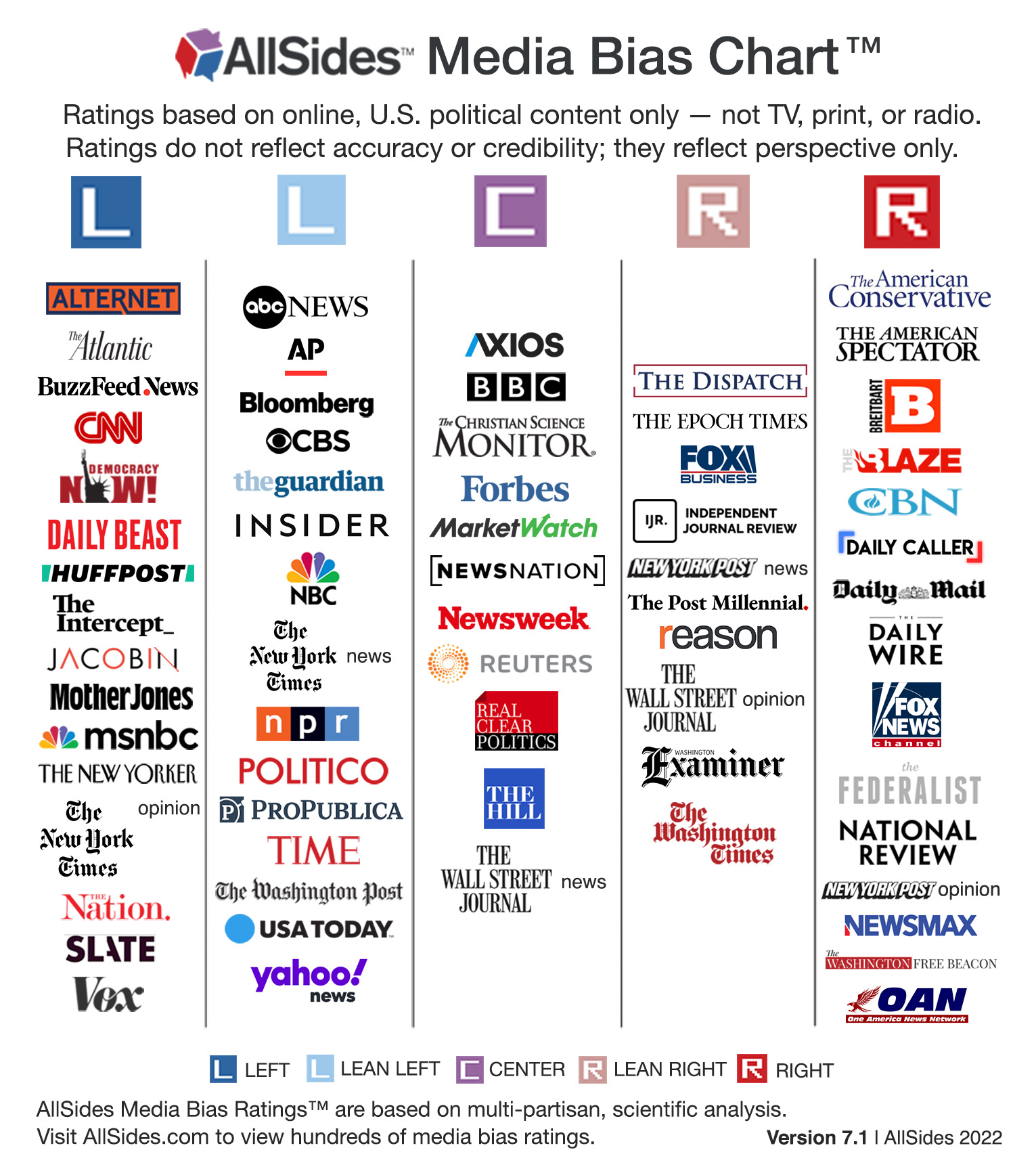
for which the commenter received substantial support. I agree that Fox News has become a propaganda organ. As evidence that CNN, too, is a propaganda organ I submit the following:
Take note of the following:
Fox News has a right bias.
CNN has a left bias.
CBS, ABC, NBC, the Washington Post news reporting, and New York Times news reporting lean left.
Wall Street Journal news reporting exhibits neither a left nor right bias.
New York Timesopinion articles illustrate a left bias.
Wall Street Journalopinion pieces are right-leaning.
The reactions at OTB hearken back to one of my earliest posts here at The Glittering Eye. Where you sit depends on where you stand. If your views are far left, you tend to view views that comport with your own as unbiased while any view less on the left than yours is a right-wing view and conversely with the far right.
I also wanted to commend this post by David Roza at Task & Purpose on the present assessment of China’s air force to your attention. Here’s a snippet:
For years, U.S. Air Force leaders have sounded the alarm about China’s increasing power and America’s shrinking technological edge. But what are the specific forms of power and technology that have U.S. officials so worried? Considering the language barrier, cultural differences and the lack of transparent governance or a free press, it is difficult for average Americans to know what threats service members may face in a possible conflict in the western Pacific.
But not to worry, the Air Force prepared several easy-to-read briefings and videos to bring you up to speed. Though some of the videos date to late 2021 or early 2022, their general observations still hold up.
“[W]e must accelerate learning across the Air Force to stay ahead of the pace,†said Air Force Chief of Staff Gen. Charles ‘CQ’ Brown Jr. in a memo published on Thursday, alongside a series of “toolkits†put together by the Air Force’s China Aerospace Studies Institute (CASI).
Were it up to me I would not be overly concerned about Chinese air power but Taiwan, Japan, South Korea, and Philippines don’t have the luxury. India in particular should take note.
I rarely cite Zerohedge but I found “Tyler Durden’s” post there about the strange things going on in the labor market pretty interesting. Here’s the meat of it. There are two major metrics for employment: the establishment survey which tallies payroll head counts and the household survey which reckons individual employment situations. Normally, they’re pretty closely aligned but starting in March of this year something “snapped”. Now they’re diverging sharply.
Whether this divergence was due to wrong seasonal adjustments (a remnant of the overreaction taken by the Dept of Labor following the covid crunch to normalize for a new normal labor market), due to erroneous Birth-Death assumptions (here too, the Dept of Labor was assuming early cycle new business creation which clearly is wrong with the economy late cycle and millions of businesses shutting down, ignoring the open PPP fraud that took place in early/mid-2000s as everyone “opened up” businesses to get free money from the government), due to the Establishment Survey inability to tell the difference between full, part and multiple-jobs – as a reminder we first showed that since March, the US had lost 400K full-time jobs offset by far lower paying part-time jobs as well as double-counted multiple jobholders…
… due to the record high rate of estimation – recall the 49% Establishment survey response rate was much lower than the 70-75% rate typical in November, meaning the Dept of Labor was literally making numbers up to “complete” the survey…
… or some other reason, perhaps including the Biden admin tapping certain Bureau of Labor Statistics officials on the shoulder and advising them to show strong numbers if they want to keep their… well… jobs, we did not know, but we did know that according to the Household Survey, just 12,000 jobs were created since March, while according to the Establishment Survey – which moves markets and sets Fed policy – the increase in jobs over the same period was 2.692 million!
The divergence is now at an all-time high. Most policymakers including the Federal Reserve rely on the establishment survey. If the household survey is correct, that means that a lot of policy is being predicated based on bad assumptions.
You might not think that concrete would make an interesting subject for an article but I found this one at Noema by Joe Zadeh pretty interesting. The condensed version is
Concrete is cement plus aggregate (gravel)
The carbon emitted in cement production exceeds that produced by the airline industry.
Concrete degrades over time.
There are no really good ready replacements for concrete. Even now there are skyscrapers going up in Norway and Switzerland that use what is effectively plywood rather than concrete. Time will tell how effective and durable those are.
Some of the plans for reducing carbon emissions require a lot of building and that means a lot of cement production. If it were “one and done” that might be defensible but it isn’t. I question whether those plans will actually achieve the objectives their proponents intend. IMO if you’re genuinely serious about reducing carbon emissions you should want to build less rather than more just as you should want to increase the amount of nuclear power generation rather than reduce it.
Michael and Leonard Hochberg have posted the third installment in their series at RealClearDefense. In this installment they consider yet another strategic option: “bleed Russia dry through a long war”. Here’s a snippet:
There are advantages to be gained by such a cynical maneuver. Although Russia is largely self-sufficient in food and energy, a long war would drive Russian political and economic isolation. It is reasonable to expect that the sectors of their economy that depend on advanced technology–especially computer chips–made in the West would collapse. Key sectors, like domestic civilian aviation, are already in the early stages of collapse due to lack of spare parts.
Although I suspect this will be the strategic option selected by default, it has a couple of serious downsides to be considered.
First, they may be underestimating Russia’s resources. More importantly, it’s the “fight the war to the last Ukrainian” strategy. Will Russia run out of weapons before Ukraine runs out of people?
But they’re right. It’s an extremely “cynical maneuver”. In one sense the entire Russia-Ukraine War becomes a protracted commercial for U. S. arms and munitions.
I encourage you to read Roman Popadiuk’s post at RealClearPolitics on why Ukraine matters. In it he sounds a number of the notes I have sounded here and which people seem so reluctant to take seriously. Perhaps they’ll believe them from a source other than myself. Mr. Popadiuk was our first ambassador to Ukraine. Here’s the meat of his argument:
U.S. backsliding on Ukraine will also embolden China to pursue its expansionist goals in Asia and help intensify Beijing’s actions against Taiwan, including a possible invasion. The latter would test the U.S. policy of “strategic ambiguity†whereby the U.S. does not make clear whether or not we will defend Taiwan against Chinese aggression. There is the possibility, therefore, that a Chinese invasion of Taiwan could bring the U.S. into direct conflict with China. It seems wise to stop this train of events by standing firm against the Russian aggression in Ukraine, thereby sending China a clear signal that U.S. resolve is strong.
How the U.S. acts in Ukraine will also send signals to the world on whether or not the U.S. can be depended upon for political, diplomatic, and economic support. Any weakening of the U.S. stance on Ukraine can lead countries to make accommodations with China, as well as Russia, and hasten greater China-Russia cooperation to undermine U.S. positions and standing in the world. China is already challenging U.S. and Western interests with its Belt and Road Initiative, an economic development program which has provided China with political and economic inroads in various countries.
I have precisely two quibbles with the piece. They’re quibbles not objections. First, why oh why is our Eastern European foreign policy so heavily influenced if not completely crafted by Poles and Ukrainians? And second, although I do believe we should be providing support to Ukraine and it should be more open-ended than it appears to be at present I also think we should be giving it much more oversight than we are at present. We have interests other than Ukraine. Using taxpayer money (not to mention borrowed money) wisely and carefully is one of those interests. So is ensuring that our aid to Ukraine is actually used to bolster Ukraine rather than bolstering American arms manufacturers or Ukrainian oligarchs.
I was going to write a post about the loss of confidence in a significant number of institutions, e.g. the Federal Reserve, the Supreme Court, the Catholic Church. When I started I realized that I struggled to think of any institutions in which we retained substantial confidence.
That has been developing for quite a number of years. Gone are the days in which a newscaster is the most trusted person in America. I have two questions.
First, is there widespread (and well-deserved) confidence in any institutions these days? And second is it merely as Mme. de Cornuel put it more than 200 years ago that “no man is a hero to his valet”, i.e. when you know enough about anybody it tends to lower your confidence in them, or is there something new at work?