Doubling Down

The editors of the Washington Post are chagrined that the economic sanctions imposed on Russia are not working particularly effectively:

Longtime visitors to Moscow and other cities report that shelves are full and daily life is visibly unchanged, thanks partly to huge state subsidies. It is now clear that the West’s campaign to weaken Russia’s finances in hopes of dampening Mr. Putin’s resolve and popular support will be a slog, not a sprint.

Still, Washington and its allies retain potent ways to undercut the Kremlin’s war-making capacity over time — if they are honed and intensified. Better coordination and tighter enforcement of existing restrictions hold the key to sharpening the war’s costs for Russian industry and consumers, and to further sapping Russia’s ability to continue manufacturing high-tech weapons.

A report by Shweta Sharma in The Independent explains why that might be:

The European Union is still the largest importer of oil products from Russia among the countries that have imposed some of the strictest sanctions on Moscow since the invasion of Ukraine, new data has revealed.

It is because the EU indirectly imported oil from countries that have become the main buyers of energy from Moscow undermining its own sanctions.

Five “laundromat” countries that export Russian crude to the EU were identified by the Centre for Research on Energy and Clean Air (CREA) in its new report.

The countries ramp up their imports and sell the refined products to Western counterparts that have imposed sanctions to whittle down the Kremlin’s revenues that fund the Ukraine invasion.

The five countries are China, India, Turkey, the United Arab Emirates (UAE) and Singapore.

And guess which country is the biggest importer of oil products from India? The United States, of course:

But the surprise is that the United States has emerged as the biggest purchaser of refined oil products from India, despite protestations periodically about India continuing to trade with Russia in defiance of Western-led sanctions imposed in the wake of its invasion of Ukraine.

U.S. and EU sanctions on Russian oil exports “do not apply to refined products produced from Russian crude exported from a third country as they are not of Russian origin”.

“People were asking where all the Russian Urals crude could go if Europe wasn’t buying. When India took 1.2 million bpd in December, they said surely India cannot do more. And in January, it is 1.7 million bpd,” Viktor Katona, lead crude analyst at Kpler, a data and analytics firm told The Telegraph. The newspaper says that India’s purchases of Russian crude oil have gone up to 1.7 million barrels per day in January this year.

Doubling down on sanctions against Russia and, particularly, limiting exports to Russia more severely as the editors propose, is mere theater. To have any real impact the reach of the sanctions must be extended to include China, India, Turkey, the UAE, and Singapore. Need I point out that if you do not will the means you cannot will the end?
8 comments

Rushing

I was gratified to see that David French’s take on the death of Jordan Neely as expressed in his New York Times column was much the same as mine:

Behind every statistic is an individual case, and it’s not hard to see how the law failed Neely. He had been arrested more than three dozen times, largely for minor transgressions, though in four cases for punching people, twice in the subway. He was on a list maintained by the city of the 50 homeless people in greatest need of urgent assistance. Most notably, in November 2021, Neely punched and seriously injured a 67-year-old woman as she exited the subway. An assault of that kind is profoundly dangerous, and any person who commits such an act should face meaningful consequences.

Neely spent 15 months in jail while the case awaited resolution, but ultimately he was not sentenced to prison. Instead he was told to report to a treatment facility, where he was to remain for 15 months and stay drug-free. He left after 13 days. A warrant was issued for his arrest, but in spite of subsequent encounters with outreach workers and at least one with the police, he was not taken back into custody.

Think of the many failures that put Neely on the train that day. Treatment efforts were inadequate. The sentence for his unprovoked assault did not match the severity of the crime — and, in any case, it was not enforced. When he walked away from the facility, the police failed to arrest him again. One can both be troubled by the problems of mass incarceration and recognize that just sentences for violent crimes should remove the perpetrators from the streets for substantial periods.

In short, Neely should not have been in that subway car; he should have still been in the treatment facility or in jail. But he was on the subway, and his conduct was deeply disturbing.

My question is what was the rush? Practically nothing can be accomplished in 13 days. You can barely diagnose a mentally ill person in that amount of time let alone treat him or her.

Is it that the system is so over-burdened? Is is that those responsible cannot be bothered? Is it that there are much more serious matters that require urgent attention? More serious than life and death?

I’ll repeat what I’ve said before. Whether Mr. Penny is convicted or acquitted, I sincerely hope that the matter does not conclude there. There are many other parties who are just as responsible for Mr. Neely’s death as Daniel Penny and they shouldn’t be allowed to escape scot free.

12 comments

Mortality Due to Cancer


I’m going to open with the journey that led to this post. It started with this post by John Horgan questioning the U. S. Prevention Services’s updated guidelines on early breast cancer screening. Basically, his conclusion is that the new guidance may actually lead to more deaths which appears to be the inference derived from the service’s own data. That led to this post of his on cancer mortality which in turn led to the graph at the top of the page from Our World in Data.

I wish the graph had been updated to the present day. Twelve years can be an eternity. I also wish the graph had been adjusted for age. As a pathologist buddy of mine observes everybody dies of something. If heart disease doesn’t get you cancer will.

Several things jumped out at me from the graph and I wanted to reflect on those. The most obvious is that less smoking has resulted in an enormous difference in the mortality due to lung cancer. It probably has reduced mortality due to other forms as well. But that isn’t the only thing.

Note that death rates for several forms of cancer (pancreas, leukemia) were increasing until the mid-1960s and have plateaued since then. I would speculate that the adoption of Medicare/Medicaid resulted in a decline in cancer deaths.

Several cancers (breast cancer in women, prostate cancer in men, colo-rectal cancer) show sharp declines in mortality in the 1990s. In the cast of prostate cancer I can only speculate the approval of the PSA test was instrumental. There may be a similar factor in breast cancer in women. Routine colonoscopies may be related to the declines in mortality from that cause. All of those would seem to contradict Mr. Horgan’s observations.

Mortality due to liver cancer, stomach cancer, and uterine cancer has been decreasing for a long time—over the last century. Mortality due to liver cancer in men, bucking the trends, has actually increased since 1980. I have no explanation for that. I would suspect it is behavioral or environmental.

5 comments

Behaving Erratically

I wanted to call your attention to what I think is a very good piece by Sean McMeekin at Compact on what he refers to as our “erratic Russia policy”. Here’s a snippet:

The lack of historical or material ties between America and Ukraine notwithstanding, defending Ukraine’s territorial integrity is now, judging by countless pronouncements by official Washington, a cardinal principle of US foreign policy, even as Russia’s most essential interest, judging by countless pronouncements by Vladimir Putin and other Russian officials, now requires waging war against Ukrainians because they are American-supported.

Does any of this make sense?

I wanted to make two points. The first is that I don’t think you can explain our policy with respect to Russia without understanding how little it is affected by national interests and how much affected by personal interests. For the last 30 years and in all likelihood substantially longer our posture has been heavily influenced by people making money based on our relations with Ukraine, Georgia, etc. or by people who are otherwise interested—Polish-Americans, Ukrainian-Americans—or both financially and otherwise interested.

The second observation is that over the last 30 years there have been several of what you might think of as “inflection points”. The first of these inflection points was our engagement in Yugoslavia. That marked the end of NATO’s existence as a defensive alliance and its transmogrification into, well, something else. To this day the Chinese consider our bombing of their embassy in Belgrade during that engagement as deliberate.

We can’t plead opposition to genocide. If that were the case we would be attacking China, Myanmar, and many other countries in which genocides are still taking place.

The second is our invasion of Iraq. We removed Saddam Hussein, largely on the pretext of his possession of weapons of mass destruction, basically because we could. He wasn’t a threat to us; he wasn’t supporting our enemies. Iran is a considerably greater threat to us and we haven’t invaded Iran. Ultimately, our invasion of Iraq enabled a genocide which almost wiped out the Yazidis in northeastern Iraq.

The third is our involvement in the removal of Moammar Qaddafi in Libya. Although, unlike the previous two examples, there was a Security Council resolution which authorized our protecting civilians there, reasonable observers conclude our degradation of the Libyan military which enabled his overthrow to have gone substantially beyond our mandate there. Interest didn’t justify it; neither did international law. What did was the hypothetical and bloodthirsty “responsibility to protect”.

There are many other examples but those are the most blatant.

What we need to understand about these actions of ours is that the United States is that guy yelling and behaving erratically doing Michael Jordan impressions in the subway car. What prevents somebody from wrestling us to the ground is that we’re too big and strong.

1 comment

Failed By City Government

The editors of the Wall Street Journal remark on a story I touched on yesterday:

Every subway rider in New York City knows the experience. You get on a train, and a passenger nearby is shouting to himself or at others. He may ask for money or harass a passenger. You move away as far as you can, perhaps wondering if you should intervene to calm him down or stop the harassment. Should you take the risk? Most of us walk away and get on another subway car.

What they describe “most of us” is doing is the right course of action. They go on to praise the man who killed Jordan Neely as a “samaritan”:

Daniel Penny, a Marine veteran, took that risk on May 1 and intervened to subdue Jordan Neely, a homeless man who was acting erratically, shouting and claiming he had little to live for. Mr. Penny subdued Neely, put him in a chokehold, and Neely died. On Friday the Manhattan district attorney charged Mr. Penny with second-degree manslaughter for which he could serve up to 15 years in prison.

At this point and with respect to whatever transpired in that subway car, the justice system is working as it should. If the case goes to trial a jury will decide whether Mr. Penny was justified, if he went too far, and, if found guilty, what the punishment should be. They will consider his state of mind and the outcome. Mr. Penny may be acquitted, he may be convicted of a lesser offense, or he may be found guilty.

However, we shouldn’t lose track of the fact that the city failed Mr. Neely. The editors touch on that:

Neely’s death is a tragedy, but the charges against Mr. Penny raise troubling questions about the decline of public order and the way the mentally ill have been left to fend for themselves on our streets and public spaces.

I don’t think they’re pointed enough. Mr. Neely should never have been in that subway car. He had already been determined to have been a danger to himself or others. To my mind that means that treatment for his mental condition should have been mandatory and compulsory and he shouldn’t have been roaming loose. The inability of the subway system to function both as a transportation system and a means of housing the homeless is a completely separate topic.

Whatever a jury decides about Mr. Penny’s actions, that shouldn’t let city authorities off the hook.

3 comments

What the Numbers Say

The youth unemployment rate is 9.57%. The real annual earnings for individuals with high school diplomas or less have been flat or declining for decades, see here and here.

If there were a high demand for entry level/low skill workers, we would see something different. The youth unemployment rate would be roughly the same as the general unemployment rate and wages for those workers would be rising.

An ever-increasing supply of workers willing to work for very low wages has several effects. First, it lowers the wages of entry level/low skill workers. It increases income inequality. It also distorts the economy by causing more to be invested in activities that exploit that unending supply of entry level/low skill workers. That includes things like hospitality (fast food), construction, agriculture, etc.

That is what we’re seeing. It’s not good for us as a society.

1 comment

The Slippery Slope

Let’s talk about the death of Jordan Neely. If you’re not familiar with the story, he was a mentally ill homeless man behaving erratically on the New York subway. Daniel Penny, characterized as a “24 year old ex-Marine”, put Mr. Neely in a headlock which he held for three minutes. He was assisted by several other of the car’s passengers. Mr. Neely was taken to a hospital where he was pronounced dead. The death has resulted in demonstrations, complaints of racism and anti-homeless bigotry, and an endless torrent of columns and op-eds.

I suspect I’m the only person here who has taught self-defense. As practically anyone who teaches self-defense will advise, the first rule of self-defense is avoidance. The second is defusing the situation. You don’t resort to force unless there is no other alternative.

Mr. Neely was not harmless. He had assaulted an elderly woman a couple of years ago.

I think there is a slippery slope here. The slope goes from avoidance to “stand your ground” to force when you feel threatened to shoot first and ask questions later. Not only is that not effective self-defense it’s no way to organize a workable society.

13 comments

Farewell to All That

This letter, posted at RealClearPolitics, from longtime Cook County prosecutor Jason Poje makes for depressing reading. He’s not the first prosecutor to resign and I doubt he will be the last. Here’s a snippet:

The simple fact is that this State and County have set themselves on a course to disaster. And the worst part is that the agency for whom I work has backed literally every policy change that had the predictable, and predicted, outcome of more crime and more people getting hurt.

Bond reform designed to make sure no one stays in jail while their cases are pending with no safety net to handle more criminals on the streets, shorter parole periods, lower sentences for repeat offenders, the malicious and unnecessary prosecution of law enforcement officers, overuse of diversion programs, intentionally not pursuing prosecutions for crimes lawfully on the books after being passed by our legislature and signed by a governor, all of these so-called reforms have had a direct negative impact, with consequences that will last for a generation.

Read the whole thing. One point that he makes is worth repeating. Our legal system is adversarial. In it defense attorneys defend and prosecutors prosecute. When defense attorneys defend and prosecutors defend, the system can’t work.

2 comments

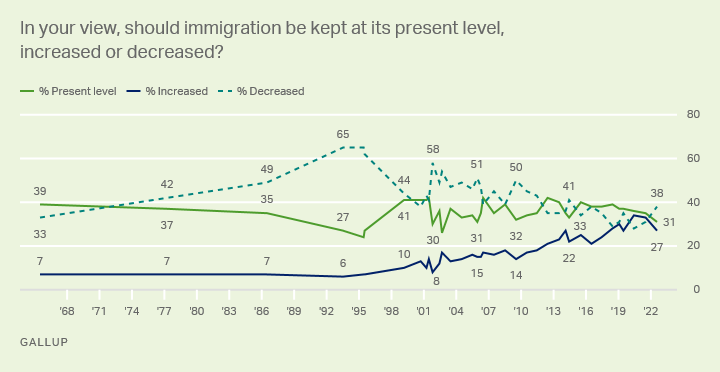
Undermining Support for Immigration


The editors of the Wall Street Journal who have long supported increased immigration lament:

All of this is depressing enough for its human and other costs, but also for those who believe the U.S. needs more legal immigration. Even pro-immigration Republicans aren’t going to support more legal visas until the border is all but closed. A deal to legalize the Dreamers brought here illegally as children looks to be more distant than ever.

The only way to stop the migrant deluge now is to radically change the incentives to come. Send the message that if you are caught arriving illegally at the border, you will be deported and put on a banned list for legal entry. No exceptions. Once the flow subsides, it might then be possible to rebuild enough public trust for a bipartisan immigration compromise.

The tragedy is that Joe Biden has done more to undermine public support for immigration than Trump adviser Stephen Miller ever imagined he could.

I have include the graph at the top of this page for context. As you can see, since Joe Biden became president the percentage of people who think we should have more immigration or about the same amount of immigration has declined while the percentage of those who think it needs to decrease has risen. In fairness the trend began before he became president; he just hasn’t helped.

My own view is that the number of immigrants should remain about the same but the mix of immigrants should be different than at present. That can’t be accomplished without controlling the number crossing our southern border.

I have a neighbor who just retired from a lengthy job working for the federal government processing asylum requests. She’s depressed about the situation. I may try to solicit a guest post from her.

10 comments

Family Ties

I won’t expand on the Wall Street Journal’s editorial about the Biden family business:

House Republicans on Wednesday released their latest report on the Biden family’s business ties, and one conclusion is that it’s good to be related to Joseph Robinette Biden. Hunter Biden and his relatives traded profitably off the Biden name with transactions that suggest the main family business is influence peddling.

other than to observe that that Michael Kinsley was right: the scandal is what’s legal. Influence-peddling is not illegal in the United States. Being an unregistered foreign agent is.

Also, I don’t care about George Marcos. It sounds to me like he’s a pathological liar. You can fool all of the people some of the time, etc.

5 comments
