Assessing the Status

George Friedman assesses the status of the war between Russia and Ukraine. Following the Wagner Group’s march towards Moscow, whatever the heck that was:

Two things became unlikely: that Russia would destroy the Ukrainian army and occupy Ukraine, and that Ukraine’s army would drive Russia out of Ukraine. The only logical step is a negotiated settlement. The question is what that settlement might consist of. The only logical settlement – on the surface, at least – is a division of Ukraine. One option might be that Donbas, full of ethnic Russians and on Russia’s border, is ceded to Moscow. But Ukraine cannot cede more – or even this – because it reasonably doesn’t trust the Russians not to base a force there and attack again in the future. The Russians will have a great deal of trouble accepting this. They have lost much in the war, and returning with only Donbas would be an insult to the dead and devastating to Putin. Ukraine must have a militarily defensible boundary and a shallow concession. Russia must validate the claim that it is a great power and can settle for far more than Ukraine can concede. Each side must make a powerful move to convince the other that a bad compromise is better than defeat.

Not everyone sees it that way. For example, Peter Juul sees the U. S. war aims as:

  1. Complete Russian withdrawal from Ukraine’s internationally recognized territory—including Crimea and territories seized by Russia since 2014. Russia renounces any and all claims to Ukrainian territory within its internationally recognized borders as part of an agreement formally ending hostilities.
  2. As part of an agreement formally ending hostilities, Russia formally and explicitly recognizes and reaffirms Ukraine’s freedom to choose its own alliances and geopolitical alignments—explicitly including potential Ukrainian membership in NATO and the European Union.
  3. A de-militarized zone is created along the Ukrainian-Russian border, overseen by the Organization for Security and Cooperation in Europe. The precise parameters of this zone should be cleared with Kyiv before the publication of any American war aims document.
  4. The full, immediate, and unconditional release and return of all Ukrainians now held by or deported to Russia, including prisoners of war, civilians, and the more than 700,000 Ukrainian children Russia has abducted from Ukraine.
  5. The United Nations, European Union, or some other credible multinational organization establishes a special war crimes tribunal for Ukraine to investigate and try Russian war criminals.
  6. Russia ceases its threats against the territorial integrity and political independence of all OSCE member nations—in particular Baltic and Eastern European states—in accordance with its obligations under the Charter of the United Nations.
  7. Removal of all Russian nuclear weapons from Belarus. Russia refrains from implicit and explicit threats of nuclear weapons use and nuclear war. Nuclear arms control talks including but not limited to Russia and the United States recommence at the earliest possible date.
  8. The United States, the European Union, and Turkey guarantee the free flow of Ukrainian grain and other agricultural products via the Black Sea. Russia formally pledges not to interfere with Ukrainian agricultural exports.
  9. The reduction and removal of certain sanctions against Russia, not including those on military equipment, goods, and technology or on Russian energy exports.
  10. A certain portion of Russian frozen financial assets will be seized or surrendered to help pay for reconstruction of Ukraine. The exact details of this point should be negotiated with relevant European allies and cleared with Kyiv.

Since the U. S. does not have the ability to supply the Ukrainians I have no idea how the United States would achieve those goals short of direct intervention of U. S. forces in the war, something President Biden has categorically rejected.

Mr. Friedman goes on to describe how he sees Russia’s actions but I think his explanation is far too complicated and he’s ignoring something. The simplest possible explanation of Russia’s actions is that John Mearsheimer was right: Russia plans to “wreck Ukraine”. Putin doesn’t want to occupy it, at least not all of it, but to wreck it.

Update

Another precinct heard from. Here’s Dominick Sansone at The National Interest:

The issue at the center of the disagreement is that the respondents do not believe that such an end can be reached unless it proceeds from total Ukrainian victory and the destruction of the current Russian regime. The reason for this is presented as a matter of fact: Russia can simply no longer be treated as a real nation-state. As articulated by Stent, any negotiation with Moscow is impossible because they are liars, and an armistice will inevitably be a “temporary solution while Russia regroups and plans its next attack.” Such a conclusion obviously leads the international community to an impasse in which the only way out is through.

I have no idea how the outcome (the end of Russia) can be accomplished. He concludes:

Unfortunately, this seems to be the mindset of not only those experts and diplomats responding to Charap’s sensible argument, but the Western foreign policy establishment more broadly.

13 comments

My Excellent Adventure


Last week I spent the entire week in my new employer’s office in Eastern Pennsylvania. Mighty purty country. I was busy—including travel time I put in 60-70 hours last week and, as you might anticipate, I’m a bit tired.

As is my usual practice I took a little time to

  1. Check out local restaurants. I prefer to avoid chains. I think I identified all of the restaurants worth eating in within 5 miles of the office.
  2. Do a little antiquing. Pictured above is my splurge. I paid 50¢ for the wineglass displayed above. Based on the style, manufacture, and composition I estimate it’s around 150 years old. Even with a few small chips on the base it was a good buy.

Now I’m back and trying to get back into the swing of things.

5 comments

The WSJ’s Assessment

I found the Wall Street Journal’s editors’ assessment of the latest developments in the matter of Hunter Biden fairly mild under the circumstances:

All of this underscores Joe Biden’s horrendous judgment in blending his son’s business with his duties as Vice President. Mr. Biden was the Obama Administration’s point man for Ukraine, which was fighting Russia’s first invasion, and he can’t claim ignorance about his son’s dealings.

and

Whether or not Joe Biden took a dime from these dealings, this is a form of political corruption. Covered up by the press in 2020, it will be an issue in 2024.

I think we should all agree that:

  1. The Biden family has been engaging in influence-peddling
  2. Although influence-peddling is not illegal per se it is a corrupt practice
  3. It’s a problem

Are those fair assessments? I’m not certain how the problem can be remediated. IMO the best way is term limits but that has proven quite difficult to put in place and will only limit the problem not prevent it.

As an Illinoisan all of this is very familiar to me. We’ve been trying to clean house here for nearly 50 years. The tendrils of corruption just go deeper and deeper.

18 comments

The Wake-Up Call

In an op-ed in the Wall Street Journal former World Bank President David Malpass says that Fitch’s downgrading of U. S. debt should serve as a wake-up call:

The essence of Fitch Ratings’ Tuesday decision to downgrade U.S. Treasury debt: We’re experiencing a slow-motion fiscal train wreck, not a “soft landing,” and it’s draining global capital and endangering the dollar.

concluding:

The downgrade is a clarion call to rethink fiscal, monetary and regulatory policies. With Europe, Japan and China nearly stagnant, the most important swing factor in the global growth outlook is U.S. private-sector innovation. To reach its potential, that ingredient can no longer be stalled by regulatory mandates and government’s passion to grow and pick winners and—mostly—losers.

I found this observation interesting:

The Federal Reserve has been silent about the conflict between its mandate to provide price stability and the continuing fiscal blowout. Its more than $7 trillion in bonds support Washington’s deficit spending by holding down bond yields, blurring the line between fiscal and monetary policy. The New York Fed’s April Open Market Operations report describes a plan to buy trillions more in U.S. government bonds, apparently without regard to the issuer’s fiscal policies or bond rating.

This undercuts the central bank’s independence by exposing it to losses when interest rates rise. It also undercuts growth, considering the Fed will have to continue funding its bond portfolio with interest-paying debt. The central bank currently borrows $3.2 trillion from banks and $2.1 trillion in reverse repos from money-market funds, on which it pays 5.4% and 5.3% in interest, respectively. That creates economic inequality by forcing the necessary savings for short-term floating-rate working-capital borrowers—the heart of private-sector dynamism—into long-term bonds. The crowding out has harmed median income growth since the Fed started building its permanent government portfolio in 2010.

Rather than sound the alarm over this fiscal drain, regulators have protected the status quo. Their power has ballooned since the days of the “Greenspan put” in the 2000s, when Wall Street expected the central bank to pause or cut interest rates to protect stock-market valuations. The Fed can now do much more: by buying huge amounts of bonds, mortgages and repos outright and paying top interest rates to U.S. and foreign banks and money-market funds. The regulators can also back large depositors after bank failures, as they did with Silicon Valley Bank in March. These powers risk moral hazard—and each payment comes at taxpayers’ expense without the accountability of Congress’s appropriations process.

The Federal Reserve’s dereliction of its responsibilities didn’t start when Joe Biden was inaugurated president. If the Fed had acted earlier inflation might not have gotten so high so fast. Scott Sumner has written on that subject extensively. The Federal Reserve governors have acquired a very bad habit of trying to “run the economy” over the last 30 years or so. The problem is that the only way they or executive branch regulators can “run the economy” is, to use Mr. Malpass’s diction, impel the U. S. economy to operate below its potential.

I seriously doubt that anything will come of this “wake-up call”. The incentives of all of those who might take action point in the direction of inaction. And they won’t change those incentives themselves. Change would need to be forced on them.

8 comments

Somethng’s Gotta Give

The editors of the Wall Street Journal quote Fitch Ratings on their downgrade of the U. S. credit rating from AAA to AA+:

“The rating downgrade of the United States reflects the expected fiscal deterioration over the next three years, a high and growing general government debt burden, and the erosion of governance relative to ‘AA’ and ‘AAA’ rated peers over the last two decades that has manifested in repeated debt limit standoffs and last-minute resolutions,” Fitch said in explaining its decision.

concluding:

The reason U.S. debt hasn’t been downgraded earlier and more often is because the dollar remains the world’s reserve currency. But that “exorbitant privilege,” as the French like to call it, is not a birthright. It can vanish in a flash if markets perceive a broader American decline in governance or its ability to meet its financial obligations.

This is where political leadership matters, and where it has failed. The White House criticized Fitch’s decision, but there’s a reason the downgrade happened on Mr. Biden’s watch. It’s a no-confidence vote in U.S. political leaders, and that starts at the top.

There’s a lot to criticize. I don’t think that the rating agencies should exist at all in their present form and they certainly shouldn’t be anointed as at present. That is a license to steal. Of course the administration will complain about it.

However, let’s go to the numbers. Consider:


and


I could draw the trend lines but I’ll just say what I see. The trend on federal tax receipts has either been flat or declined over a very long period (when you subtract the noise) while the trend on federal outlays has risen over almost as long a period.

Clearly, something gotta give. The U. S. credit rating is where that dichotomy is landing.

I have criticized every cut in the personal income taxes over the last 20 years. I don’t believe this is a partisan failing other than Republicans always want to cut taxes while Democrats always want to increase spending. As noted in comments recently nothing is likely to change until there’s a crisis.

Keep in mind Hemingway’s notable observation about how bankruptcy happens: gradually then suddenly. The worst time to attempt remediation is during a crisis. But it’s easier politically.

8 comments

Why Do We Have Government?

Given recent events in Chicago, I think it appropriate to reflect on why governments exist. The primary purpose of government is to preserve public safety and order. Mayor Johnson seems to have lost track of that. Governments are not primarily jobs programs, methods of housing and feeding migrants, or ways of picking winners and losers. All of those can be done in other ways but only government is authorized to preserve public safety and order.

By far the best way to inculcate good behavior in young people is to instill consciences in them. They should do the right thing because it is the right thing. If they don’t have consciences, young offenders need to be restrained. That isn’t “demonizing” them, as Mayor Johnson likes to put it. It’s acknowledging reality and the first responsibility of government.

2 comments

Reminder

Considering the latest arraignment perhaps it’s time to make one of my periodic disclaimers. I think that

  1. I have never voted for Donald Trump and do not intend to do so if he becomes the Republican nominee in 2024 as is widely expected.
  2. I will not vote for anyone, Republican or Democrat, whom I consider to be of low character.
  3. President Trump should be prosecuted to the full extent of the law.
  4. Many may be very surprised at how difficult it will be to secure a conviction.
  5. Even if convicted the “extent of the law” may not be as great as some seem to hope.

Any charge that requires mens rea, intent, which I believe is all of them will be much more difficult to prove beyond reasonable doubt than some seem to think.

11 comments

Score One for the Fiscal Theory

In an op-ed in the Wall Street Journal John Cochrane takes a victory lap:

As inflation eases, representatives of different schools of thought are taking victory laps. But who really deserves one? What have we learned about inflation?

I think the episode is a smashing confirmation of the fiscal theory of the price level. Where did inflation come from? Our government borrowed about $5 trillion and wrote people checks. Crucially, and unlike in 2008, there was no mention of how the new debt would be repaid, no promise of debt reduction later. The spending was couched as an “emergency expenditure” not going through the usual budget process or requiring offsets. Treasury Secretary Janet Yellen, argued that “with interest rates at historic lows”—they were then—debt isn’t a concern, so “the smartest thing we can do is act big.”

People could have looked at all this new debt, thought it would be repaid with interest, and therefore regarded it as a good investment. They didn’t. They chose to try to spend the new debt rather than save it. But we can’t all sell, so that drives up prices.

The “fiscal theory” of the price level is the view that government fiscal policy is the primary determinant of the price level, i.e. inflation. Therefore, for sustainable price levels the federal government must run a balance budget over the business cycle. Unlike folk Keynesianism which holds that federal spending always stimulates the economy, that is completely consistent with what Keynes taught. If fiscal theory actual explains what we have experienced over the last several years, our present structural deficit is highly problematic.

Think of currency as stock in the federal government. When the federal government runs a structural deficit, the stock loses value.

Dr. Cochrane concludes:

A fiscal point of view isn’t encouraging about the future, however. Inflation is easing but remains high. The U.S. is running a scandalous $1.5 trillion deficit with unemployment at 3.6% and no temporary crisis justifying such huge borrowing. Unfunded entitlements loom over any plan for sustainable government finances. The Congressional Budget Office projects constantly growing deficits, and even its warnings assume nothing bad happens to drive another bout of borrowing.

Do people believe that the U.S. now can raise future taxes over spending by $1.5 trillion a year to finance new debt without more inflation? When the next crisis comes and Washington wants to borrow, say, $10 trillion for more bailouts, stimulus, transfers and perhaps a real war, will markets have faith that the U.S. can repay that additional debt? If not, another cycle of inflation will surely erupt, no matter what the Fed does with interest rates.

As Dr. Cochrane notes, neither the economists he refers to as “team transitory” (inflation can be explained by supply shocks) monetarists, nor those clinging bitterly to the Phillips Curve actually explain what has transpired. Here’s his comment on the monetarist view:

But does money alone drive inflation? Suppose there had been no deficit, and the Fed had done another $5 trillion of quantitative easing, buying $5 trillion of bonds in exchange for $5 trillion in reserves. Would people with $5 trillion more cash but $5 trillion less Treasury bonds, and thus no net increase in wealth, have tried to spend money, driving up prices? We pretty much know the answer—similar QE throughout the 2010s had basically no effect on inflation. In the monetarist view, more money and less bonds has exactly the same effect as more money and more bonds. In the fiscal view, overall government debt, including reserves, matters, not its particular maturity.

I suspect that no one will learn anything from what has transpired.

11 comments

An “Indigo Blob”?


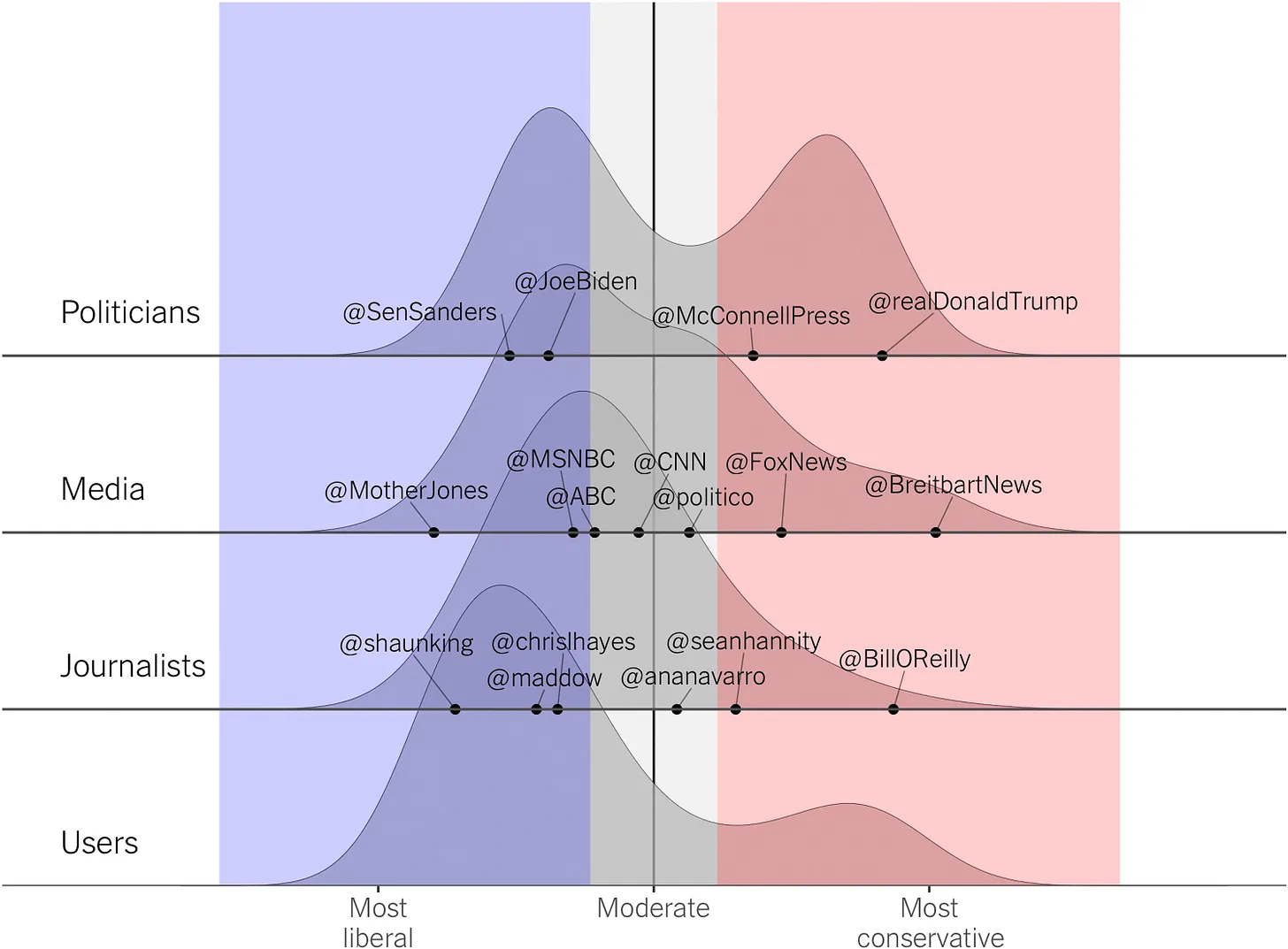
The graphic above was sampled from a post by Nate Silver. It in turn was taken from an academic article (linked to in Nate’s post). It illustrates the ideological leanings of Twitter users.

I’ve read both the post and the original article and, unfortunately, it does not really enlighten me on the question that occurred to me: how were the classifications arrived at? The biggest warning flag to me was the characterization of CNN as “moderate”. I suspect that “moderate” is not the right term. “Eclectic” might be better.

Read the entirety of Nate’s post. However the classifications were arrived at I think it makes pretty good sense. TL;DR is

  1. Twitter used to have a sharp leftward bias
  2. That produced some very bad decisions
  3. Right-leaning users lean right harder than left-leaning users lean left

I think the first two are correct and I’m not so sure about the third.

5 comments

Lonely Is the Head

Along similar lines is this post by Mohammed Soliman at the Foreign Policy Research Institute<:

Despite the optimistic aspirations in Washington that the collective West could carry the burden of dual containment against China and Russia, it will ultimately fall on Washington alone to pursue this resource-consuming strategy to maintain global primacy. The Russian invasion of Ukraine sent a clear message that the United States could no longer prevent revisionist powers from challenging the global order that Washington had established and committed to uphold after World War II. With America’s position as the center of the global order, it is currently navigating a significant transformation marked by a gradual shift of global power towards the East and Asia more broadly. In response to these evolving dynamics, the United States must exhibit adaptability and embrace the necessity of adjusting rather than stubbornly resisting these geopolitical changes. As a nation, it is crucial for the United States to acknowledge the inherent limitations, cost, and unsustainability of pursuing global primacy or an expansive definition of American interests and responsibilities. Washington can’t do everything everywhere, all at once.

It is the überhawks and believers in American hegemony who have gotten us into the fix we’re in. I don’t expect them to get us out of it. I don’t know what will happen but it is unlikely to be good.

My only real hope right now is for the special providence that looks over fools, drunkards, and the United States of America.

5 comments