The Council Has Spoken!

Here are the Watcher’s Council winners for last week.

Council Winners

Non-Council Winners

0 comments

Good Old Movies About Lawyers

Glenn Reynolds has been posting lately on movies about lawyers. He’s mentioned The Verdict, Absence of Malice, and The Paper Chase. Sweeping past some obvious fairly recent candidates like The Rainmaker and The Devil’s Advocate since I’m a fan of old movies I’d like to suggest some older movies about lawyers or that feature lawyers that you might find interesting.

Young Mr. Lincoln

Although this picture is ostensibly about the young Abraham Lincoln, it’s a rather different take on him: a young lawyer just getting started. Touching performance by Henry Fonda. Don’t miss the great scene in which he stands down an angry mob storming the jail to lynch a couple of young men accused of murdering a law officer. After the mob leaves the mother of the two young men asks him “Who are you?” to which he responds “I’m your lawyer”.

All That Money Can Buy

Dramatization of Stephen Vincent Benet’s The Devil and Daniel Webster. Edward Arnold’s Daniel Webster matches wits with Walter Huston’s Mr. Scratch to save the soul of a farmer who’d foolishly sold his soul to him. Academy Award-winning score and Best Actor nomination for Walter Huston.

The Paradine Case

Gregory Peck falls in love with the accused poisoner he’s defending played by Alida Valli. This is a courtroom melodrama directed by Alfred Hitchcock with a remarkably attractive cast. Except for Charles Laughton, of course.

Witness for the Prosecution

Billy Wilder’s adaption of Agatha Christie’s play features great performances by Charles Laughton as the attorney for the defense, Tyrone Power as a heel, and an astonishing performance by Marlene Dietrich.

Anatomy of a Murder

This movie about a rape case was considered extraordinarily frank for its time. Directed by Otto Preminger with strong performances by James Stewart, Arthur O’Connell, Lee Remick, Ben Gazzara, George C. Scott, and the irreplaceable Eve Arden.

Trial

Will idealistic law professor Glenn Ford realize that wily communist Arthur Kennedy is using him for his own nefarious ends? This 1955 picture is clearly a product of its times and is interesting if only for that reason.

7 comments

Not Investing Is Not Investing

Barry Ritholtz chimes in on whether businesses are holding on to more of their cash with this observation:

The average cash-to-assets ratio for corporations more than doubled from 1980 to 2004. The increase was from 10.5% to 24% over that 24 year period. That was the findings of a 2006 study by professors Thomas W. Bates and Kathleen M. Kahle (University of Arizona) and René M. Stulz (Ohio State). When looking for an explanation, the professors found that the biggest was an increase in risk.

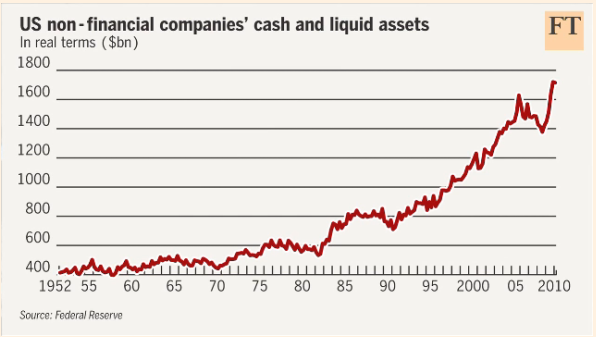
Indeed, the phenomena of corporate cash piling up has been going on for a long long time. You can date it back to the beginning of the great bull market in 1982 to 86, went sideways til the end of the 1990 recession. It has been straight up since then, peaking with the Real Estate market in 2006. The financial crisis caused a major drop in the amount of accumulated cash, but it has since resumed its upwards climb.

and includes this graph.

Well, yes. To my eye it looks as though between 1952 and 1986 the cash position of corporations has roughly doubled and then doubled again since about 1996. Since I’ve been complaining about this phenomenon since about that time and been doing it on this blog since this blog has existed it’s not surprising to me.

How does it refute the fact that businesses are holding on to more cash than they used to?

I’ve never complained that businesses were hoarding cash because Barack Obama was elected to the presidency. Check around. I’ve complained pretty routinely that businesses weren’t investing enough to promote future economic growth and hadn’t been for some time. In one of my earliest posts I pored over big pharmaceutical companies’ annual reports and other financial statements and arrived at the conclusion that R&D spending varied with inflation while marketing expenses (and, I suspect, the amount spent lobbying) varied with earnings.

The future is now.

6 comments

It Can’t Happen Here

A British MP is sorry for being too drunk to vote on the budget:

A Kent MP has apologised for being drunk in the House of Commons and missing a vote on the Budget.

Mark Reckless said he did not feel it was appropriate to take part in the vote in the early hours of Wednesday because of the amount he had drunk.

The Conservative MP for Rochester and Strood told BBC Radio Kent: “I made a mistake. I’m really sorry about it.”

I can’t imagine that happening here. I mean being drunk constituting an impediment to a representative’s voting. It might even help.

2 comments

So What If Businesses Aren’t Spending?

Invictus at The Big Picture takes on the assertion that businesses aren’t spending because the Obama Administration is anti-business:

Since we know that Personal Consumption Expenditures comprise 70 percent of GDP, I’m not sure why “getting companies to start investing” would be considered the key. The demand problem we have on our hands is what is keeping companies’ spigots closed.

which I think goes to the root of our problem. The primary alternatives for a thriving economy are personal consumption, business spending, and exports. In the short term government spending might be added to that list but, since government spending must come from somewhere, e.g. present or future taxes or debasing the currency, in the long run that’s not a viable alternative.

In my view at 70% we are now overly reliant on personal consumption. By that I don’t mean that we should slash consumption. I just mean that businesses should be doing more R&D, preparing for tomorrow’s products, and attempting to cut costs by investing in technology (which allows other companies to spend more on R&D). We also need to export more. I’d be happy with small increases in R&D and exports.

Emphasizing a policy that aims at a return to the 70% is just delaying the inevitable re-balancing that must take place if we’re to have a thriving economy.

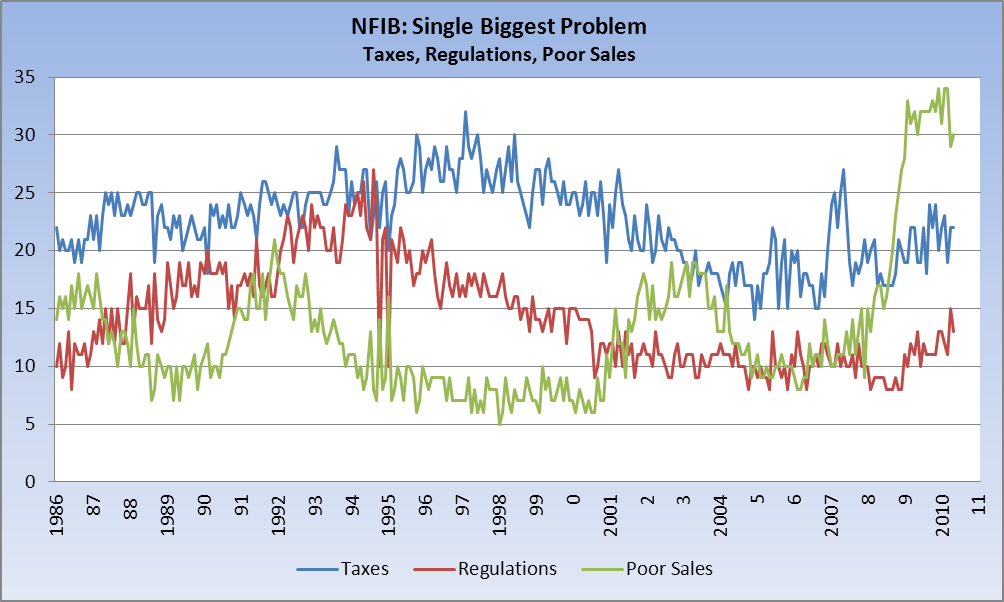
He then produces a chart (from NFIB of which I am a member) that shows that the single largest concern for small businesses at roughly 33% is low sales while 22% say that their biggest problem is taxes and another 12% say that their biggest problem is regulations. While the chart handily refutes the claim that high taxation is business’s biggest problem or th regulation is business’s biggest problem, it misses a couple of important things.

First, the number of those that say that either taxes or regulation, i.e. “the government” is their biggest problem is at least as large as those who say that low sales are their largest problem. And, importantly, two-thirds say that something other than low sales is their biggest problem. In my view that handily refutes the argument that increasing consumer demand should be the sole focus of policy.

14 comments

Slouching Towards 2012

Turning and turning in the widening gyre
The falcon cannot hear the falconer;
Things fall apart; the centre cannot hold;
Mere anarchy is loosed upon the world,
The blood-dimmed tide is loosed, and everywhere
The ceremony of innocence is drowned;
The best lack all conviction, while the worst
Are full of passionate intensity.

The lines above are from William Butler Yeats’s poem, The Second Coming, and the title of Paul Krugman’s post this morning refers to the second to last line in the stanza. I recognize that it’s petty of me and I may well be over-analyzing but I find that its use typifies the problem that I have with technocrats, among them Dr. Krugman.

In his post he quotes Duncan Black and takes the Democrat leadership to task for a lack of boldness in attacking Republicans, the adversaries. Toujours l’audace!

It’s a bit hard for me to see how much more the White House might attack Republicans when every second sentence seemingly is a complaint about the situation they inherited from from George W. Bush and his Republican Congress.

However, I also find the complaint revealing. He’s criticizing what they’re doing or not doing. Consequently, the Democratic leadership is implicitly “the best” because of who they are rather than what they do. This is a sort of technocracy that I don’t recognize. The Greek root techne refers to making things and doing things, to acquired skill rather than the congenital worth of aristocracy.

Support should be predicated on what you actually do, not just what side you’re on or whether you have all of the right credentials.

4 comments

Alan Sullivan, RIP

Alan Sullivan, who blogged at Fresh Bilge, has died. He stopped by here occasionally as I visited his blog on occasion. He’s been living under the shadow of death for quite a while.

Eternal rest grant unto him, O Lord, and may perpetual light shine upon him.

0 comments

Sam Clemens, Again

This article on the long-awaited publication of Sam Clemens’s autobiography provides me another opportunity to kvetch about a pet peeve of mine. Here’s a snippet from the article:

In popular culture today, Twain is “Colonel Sanders without the chicken, the avuncular man who told stories,” Ron Powers, the author of “Mark Twain: A Life,” said in a phone interview. “He’s been scrubbed and sanitized, and his passion has been kind of forgotten in all these long decades. But here he is talking to us, without any filtering at all, and what comes through that we have lost is precisely this fierce, unceasing passion.”

Uh, no. The “avuncular man who told stories” is Mark Twain, a character created and promoted by the writer Samuel Langhorne Clemens as surely as he created Tom Sawyer, Huckleberry Finn, or Pudd’nhead Wilson. Everything that is known, can be known, or will ever be known about him is already known.

What we might learn about from the autobiography is more about Sam Clemens, the man. Sam Clemens was not Mark Twain. He just played him on the lecture circuit.

1 comment

Wall Street Is Hiring

A propos of a comment I made to an earlier post here this morning, apparently Wall Street is hiring:

While much of the country remains fixated on the bleak employment picture, hiring is beginning to pick up in the place that led the economy into recession — Wall Street.

The shift underscores the remarkable recovery of the biggest banks and brokerage firms since Washington rescued them in the fall of 2008, and follows the huge rebound in profits for members of the New York Stock Exchange, which totaled $61.4 billion in 2009, the most ever. Since employment bottomed out in February, New York securities firms have added nearly 2,000 jobs, a trend that is also playing out nationwide at financial companies, commodity contract traders and investment firms.

The financial sector accounted for 6% of GDP in 2006, an historic high. There have been findings there there is an optimal size for the financial sector of an economy, the size is independent of the state of the economy and does not vary over the business cycle, and, if the financial sector grows beyond that optimal size, it has adverse consequences for aggregate output, investment, consumption, growth rates, and social welfare. By some reckonings (cited above) the present size of the financial sector remains about twice its optimum size.

It’s amazing how much more you’ll get of something when you throw a couple of trillion dollars worth of borrowed money at it.

3 comments

How About Some Good News?

So many of my recent posts have been discouraging that I thought I’d post some good news for a change.

A man in Somerset, England has found an enormous cache of Roman coins. Its value is believed to be around $1.5 million.

A cure for cancer has been found to be 100% effective in mice and has produced “surprisingly good” results in vitro with human cervical, prostate, and breast cancer cells.

A reforestation project under way in north eastern Panjshir province of Afghanistan promises to reduce soil erosion, landslides, and instability of the sides of the valley.

Finally, I have mixed feelings in reporting this as good news but, since it’s certainly good news from the poor woman’s point-of-view, I’ll report it that way here. A retired teacher living in the Chicago suburb of Northbrook after first being dunned for $4,000 by the Social Security Administration has received an unexpected $24,000 payoff from the administration:

Fran Lubelchek and the Social Security Administration have a long and twisted history.

When the 70-year-old retired schoolteacher began receiving benefits five years ago, the government miscalculated her monthly payment. By the time it realized the error years later, Social Security had overpaid the Northbrook resident by roughly $14,000.

To pay the money back, Lubelchek and Social Security worked out a deal. Because she received a teacher’s pension, her correct monthly Social Security payment was small, about $100. To repay the $14,000, Lubelchek agreed to receive no monthly benefit until she was almost 85.

After a number of twists and turns here’s the final resolution:

But Social Security employees also discovered that many years ago, wages Lubelchek had not earned were attributed to her account. Based on those erroneous wages, Lubelchek had more money deducted from her paychecks than should have been.

The extra deductions meant Lubelchek had paid an extra $37,218.70 into the system.

To make things right, the government took the $12,591.70 Lubelchek owed Social Security from the $37,218.70 it owed her.

The end result: Social Security deposited $24,627 into her checking account Wednesday morning.

2 comments