Alternative Strategies for Budget-Balancing

Former Republican Senator Pete Domenici and former CBO and OMB director Alice Rivlin propose an approach to balance the budget (and boosting the economy) somewhat different from the one floated by the chairmen of the president’s task force:

To ensure a more robust recovery, we propose a one-year “payroll tax holiday” for 2011, suspending Social Security payroll taxes for employers and employees. We also would phase in the steps to reduce deficits and debt gradually beginning in 2012, so the economy will be strong enough to absorb them.

We would stabilize the debt held by the public at less than 60 percent of gross domestic product, an internationally recognized standard; reduce annual deficits to manageable levels; and balance the “primary” budget (everything other than interest payments) by 2014.

We would dramatically simplify the tax system, establishing individual tax rates of 15 and 27 percent (from the current high of 35), cutting the corporate tax rate to 27 percent (from 35 today), ending most deductions and credits while simplifying the rest, and ensuring that nearly 90 million households no longer have to file returns. To reduce the debt, we would supplement our spending cuts with a 6.5 percent “debt-reduction sales tax.”

We would strengthen Social Security so it can pay benefits for the next 75 years by gradually raising the amount of wages subject to payroll taxes; slightly reducing the growth in benefits for the top 25 percent of beneficiaries; raising the minimum benefit for long-term, low-wage workers; indexing benefits to life expectancy; and changing the calculation of cost-of-living adjustments to better reflect inflation. We would not raise the age at which senior citizens can begin receiving benefits.

We would control health-care costs – the biggest driver of long-term deficits – by reforming Medicare and Medicaid while, starting in 2018, capping and then phasing out the tax exclusion for employer-provided health care. We would reform medical malpractice laws and help address the health costs tied to rising obesity by imposing a tax on high-calorie sodas.

We would freeze domestic discretionary spending for four years and defense spending for five, both at 2011 levels, and then limit their future growth to the rate of growth in the economy.

Finally, we would cap domestic and defense discretionary spending (with tight exceptions for true emergencies) and trigger across-the-board cuts if the caps are breached; enact a strict pay-as-you-go statutory rule for tax cuts or expansions of entitlements; and enact long-term budgets for major entitlements while creating a Fiscal Accountability Commission that would recommend policy changes every five years if entitlements are exceeding their budgets.

while debt reduction commission member Congresswoman Jan Schakowski has her own alternative to the plan offered by commission chairmen Simpson and Bowles:

The Schakowsky plan is based on five key elements:

1) Increased economic stimulus to spur growth in the immediate term

· Provide $200 billion to invest over the next two years in measures to create jobs and spur economic growth, including passing the Local Jobs for America Act; and funding for education and law enforcement; Unemployment Insurance, Federal Medical Assistance Percentages (FMAP) and Supplemental Nutrition Assistance Program extensions; and infrastructure.
· Adopt the President’s proposals to eliminate overseas tax havens and incentives for outsourcing

2) Smart, targeted spending cuts

· Non-Defense Discretionary – $7.55 billion in savings through increased efficiency and cuts to programs that benefit large corporations that don’t need assistance.
· Defense Discretionary – $110.7 billion in cuts from the 2015 defense budget, including efficiency savings, reducing our troop levels, cutting weapons systems we don’t need, and scaling back the wartime increases in the size of the military.

3) Mandatory spending cuts
Health Care – at least $17.2 billion in savings by implementing measures to bring down the cost of health care to the federal government and lower health care inflation overall.
Other – $7.7 billion in savings by cutting agriculture subsidies in half, and redistributing federal support to offer greater benefits to small family farms reduce subsidies to large corporate agribusiness.

4) Reductions in tax expenditures
Raise $132.2 billion by closing tax subsidies for companies that ship American jobs overseas.

5) Increases in revenues
Raise $144.6 billion in revenue through progressive reforms to the estate tax, treating capital gains and dividends as regular income, and enacting a cap and trade proposal that includes protections for lower-income people.
Enact President Obama’s budget proposal to let the Bush tax cuts for the top 2 brackets expire and return to 2009 estate tax levels.
Non-tax revenue – raise $7 billion by addressing places where the private sector is currently under-paying.

I think that both of these plans have some serious flaws but of the two I prefer the Domenici-Rivlin approach. Among other things I think that a payroll tax holiday is more likely to spur both spending and employment than other forms of stimulus.

6 comments

Foreign Policy Blogging at OTB (Updated)

I’ve just published some foreign policy-related posts at Outside the Beltway:

“Haiti’s Cholera”

In this post I review the outbreak of cholera in Haiti that has claimed more than 1,000 lives so far. The most recent development is anti-UN peacekeeper riots (Nepalese peacekeepers are blamed by Haitians for the outbreak). This story gets precious little attention from the American press. The Haitian people aren’t to blame for this outbreak but they’re certainly paying a price. There’s a lot of blame to go around—everything from centuries of bad government to feckless U. S. interventions to too many people to slack property rights. Does any country have more aid workers per capita than Haiti? Haiti’s outside help, as the cholera outbreak demonstates, may even be contributing to the poor country’s problems.

“The Price of Tea in china”

Food prices are rising fast in China. The Fed’s quantitative easing could put even more upwards pressure on Chinese food prices and the actions the Chinese government has announced, including price controls, anti-gouging measures, and subsidies, probably won’t help much, either.

Update

Another:

“Congratulations, Greece”

The risk assessment company Maplecroft has published its Terrorism Risk Index for 2010. Greece has achieved the distinction of being the country whose risk of terrorism has increased the most over the post year and has supplanted Spain as being the European country (other than Russia) most at risk of terrorism.

0 comments

The Lame Duck

So, which of the pending items on the legislative agenda will the lame duck session of Congress tackle?

  • Extending the “Bush tax cuts”. What would they be called then? My guess is they’ll be called the “Bush tax cuts” when they’re re-extended in 2050.
  • The inheritance tax
  • The alternative minimum tax
  • The scheduled cut in physicians’ reimbursements under Medicare
  • The DREAM Act (allowing immigrants who came to this country illegally at a young age to obtain legal status)
  • Card check

All? None? Something else?

I seem to recall that the Congress failed to pass a budget and we’re operating under a continuing resolution. Since they’ve kicked that can down the road until February I doubt anything will be done on that one.

5 comments

My Mom’s Birthday, 2010

The picture on the left is of my mom when she was in college. In this picture she’s between five and ten years younger than my earliest memories of her. This is much the way she looks to me as seen through the eyes of memory and far, far different from my last memories of her.

Over the last few months as I’ve had the opportunity of talking at length with my niece I have been very much impressed by the differences in childhood experiences between me and her mother, my youngest sibling.

My mother was a young woman with a husband with whom she was very much in love and who loved her. She took care of the house and children, made her children’s clothes, was a den mother. Despite the time and energy that all of this took she and my dad always took time for regular weekly date nights. They’d go to dinner or the movies or go down to Gaslight Square for live entertainment.

She lived in a small house in a rundown (to say the least) neighborhood in which we were the most prosperous family on the block. She dreamed of a bigger house in a nicer neighborhood, poring over pictures in magazines, going antiquing. She was my mom.

Her mother was a still relatively young widow who taught school full time, attended graduate school, and struggled to make ends meet. Although there were older kids in college (and graduate school), those older siblings rarely visited. Most of the time it was just my mom, my youngest sister, and her twin. The twins took care of the big house in the nice suburb while my mom worked. They were probably the least prosperous family in the neighborhood.

She was my friend.

And yet these two very different women were really one woman. I miss you, Mama.

4 comments

What Is a First Principle?

When I read this quote from President Obama this morning:

“I neglected some things that matter a lot to people, and rightly so: maintaining a bipartisan tone in Washington,” he told reporters in a brief question-and-answer session aboard Air Force One as he returned from a 10-day trip to Asia. “I’m going to redouble my efforts to go back to some of those first principles,” he promised.

my immediate reaction echoed Inigo Montoya: that does not mean what he thinks it means.

A “first principle” is an axiom. You cannot put on or doff a first principle at will. I think he meant, simply, principle.

I believe that the clearest way to infer what a person’s principles are is by his or her actions. I think the president has made his principles pretty clear over the last several years and they have nothing to do with bipartisan tone.

My complaint about our presidents over the last several decades is that they do not appear to have solid principles. What did the last four presidents want to accomplish with their presidencies? I honestly have no idea.

7 comments

How They’re Choosing to Balance the Budget

As a follow-up to my earlier post on using the NYT game to balance the budget, I thought I’d round up what others in the blogosphere were doing.

Reuter columnist Felix Salmon elects a balance of 69% tax increases and 31% spending cuts, cuts mostly coming from the defense budget and by eliminating government contractors.

Barry Ritholtz of The Big Picture has a balance of 39% tax increase and 61% spending cuts. He doesn’t give his detailed choices.

Arnold Kling goes for cutting entitlements and no tax increases. His colleague, David Henderson, makes similar choices but also cuts military spending.

My colleague at OTB, Doug Mataconis, makes most of the spending cuts and increases taxes on the highest income earners.

Professor Stephen Bainbridge makes choices similar to mine but is more favorably disposed to an immediate reduction in the number of federal employees and a reduction in aid to the states than I am.

Steve Hynd of Newshoggers prefers 62% tax increases with 38% spending cuts, mostly from the military budget.

Robert Farley of Lawyers, Guns, and Money balances the budget by cutting military spending, means-testing Social Security (!), and raising taxes.

I’ll add others as I find them. The one conclusion I’d draw at this point is that there’s no simple consensus for anything revealed by the responses which pretty much tells you how we got to the point at which we find ourselves.

Update

Reuters columnist James Pethokoukis balanced the budget entirely via spending cuts.

Derek Thompson employed a 50/50 balance of spending cuts (varied) and tax increases. He summarizes his actual preferences:

My dream budget would be more wacky than the Times feature allows. For example, I would use a carbon tax to partially reduce corporate income rates and I would use a national sales tax (a value-added tax) to partially reduce payroll tax rates on employers. This would, ideally, move our tax code away from taxing income and employment toward incentivizing green energy and savings.

OTB colleague Steve Verdon weighs in with a package of spending cuts and, somewhat to my surprise, tax increases. It’s a pretty temperate, reasonable approach to the extent that’s possible within the confines of the game.

6 comments

How to Improve the NYT’s Budget Balancing Toy

Quite a few people are all atwitter about the New York Times’s “You Balance the Budget” game. If you’re interested in how I approached the task, my results are here (PDF). In general, I cut defense spending, raised taxes, and cut healthcare spending. Those are the big ticket items at any rate.

My colleage at OTB, Doug Mataconis’s results are here.

I think the game is counter-productive, even pernicious, for a number of reasons. It’s not complex enough. You should be able to means-test Medicare as well as Social Security. There are any number of budgeting-cutting measures that are completely omitted. There’s no mention of increasing user fees. It combines some things that should be listed separately, e.g. reducing the size of the Navy fleet (which I oppose) with reducing the size of the Air Force fleet (which I support).

Possibly the worst defect of the game is that it resorts to handwaving in some critical areas. So, for example, “cap Medicare spending”, isn’t accompanied by the important “how?” I’ve given my answer here.

It trivializes the process. The question before us isn’t how we balance the budget. It’s how, in the absence of a consensus on what sort of a country we should be and in the presence of genuine differences of opinion, we can arrive at a political solution for balancing the budget that won’t wreck the U. S. or world economies.

Let me give some examples of some of the issues. I’m sure that “eliminate foreign aid” will be an alternative that many will select. What they don’t recognize is that a lot of U. S. foreign aid comes in the form of credits for the products of American businesses. Cutting foreign aid in that context means reducing subsidies for businesses. In the long run I’m in favor of that but in the short run I suspect it would drive us back into recession.

Similarly, I agree with the idea of reducing the number of federal employees and federal grants to states. However, doing so quickly enough so that it would have an effect on the budget by 2015 would add an additional million federal, state, and local government workers to the ranks of the unemployed. It’s got to be done more gradually than that.

It’s easy to balance the budget in the comfort of your own home, implementing solely your own priorities. Do your priorities represent the entire country? Do they represent anybody but you?

I have a suggestion for improving the NYT’s game. In addition to some of the things I’ve suggested above I think they should be capturing all of the preference data generated by people playing their game, eventually to publish it with some analysis of the broad patterns that are represented. I suspect that it would be very interesting and, possibly, horrifying to some.

Let me speculate on what they’d find. I think they’d find several patterns emerging, separately or in combination. I’m going to call these patterns “impulses”. Here are some of the impulses I suspect are present.

The Isolationist Impulse

This impulse would be represented by wanting to cut foreign aid and reduce U. S. military commitments abroad. This is a venerable view in American politics and it’s one with which I have a certain amount of sympathy. However, it’s short-sighted. Our foreign aid and foreign military commitments are a projection of our national interests. It’s true that we spend more than most (or even all) of the other countries in the world combined. That’s because the other OECD countries are all free riders on the world security and stability that our military expenditures provide. Everybody can’t be a free rider. Can we reduce our commitments substantially? Sure. Can we eliminate them altogether? That will probably cost us more than maintaining some level of commitment.

The Minarchist Impulse

This impulse is basically one to reduce everything—taxes, the military, entitlements, government subsidies of all flavors. Everything. This is another view with which I have a certain amount of sympathy. The U. S. of 2010 is not the U. S. of 1930. Government is an enormous part of daily life, too much, and constitutes a huge, intolerable drag on the economy. IMO there is no path to recovery that does not lie, in the long term at least, through a dramatic change in what the government does and how it does it.

The Welfare State Impulse

This impulse is, essentially, to emulate Germany. Cut military spending to a third of what it is now or eliminate it entirely. Tax more. Do not constrain the growth in Social Security, Medicare, or Medicaid spending. It works fine for Germany because the Germans can always free-ride off of us and there’s a U. S. to which they can export. We have no larger superpower on which we can rely and, as was seen in the G20 conference last week, all of the world’s exporters including Germany are vehemently opposed to our constraining our imports or expanding our exports. I also suspect that most Americans who admire this alternative have never lived in Germany.

The Jacksonian Impulse

Those who follow this impulse are likely to want to cut taxes and exempt the military from cost reductions. There may be some variants of this group, some wanting to preserve spending on Social Security and Medicare, others wanting to cut it.

These competing impulses are the nexus of the problems we have in arriving at fiscal sanity. For any one of these impulses to succeed fully means that the others must fail.

19 comments

U. S. Healthcare Expenditures


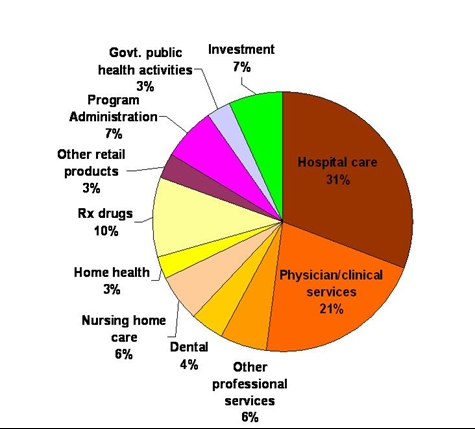
I’m posting this graphic, courtesy of the Kaiser Family Foundation, largely for future reference. Although I’ve read other estimates elsewhere, the estimates in that chart comport with most of the estimates I’ve read and with my own experience.

As you can see hospital care and physician/clinical services accounts for the majority of costs, 51-52%. However, if you pry a little more closely into nearly all of the expense items represented by slices of the pie, they boil down to wages. Physicians’ wages, dentists’ wages, administrators’ wages, pharmaceutical companies’ executives’ wages, all of the wages in the sector.

If someone were to ask me what I would do to reduce healthcare expenditures in the U. S. with a wave of my magic wand, I’d answer “cut healthcare wages in half”. If that were to be done, physicians, broadly, would still be earning more than their OECD counterparts and we’d still be spending more per capita and overall than any other OECD country but we wouldn’t be spending three times as much as the next-largest spender.

If you were to ask me how we got to where we are now, I’d answer “historical error”. Forty years ago we ignored rising healthcare costs (and wages!). After that initial period which ended around 1980 most of the increase can be explained by inflation (that healthcare inflation is a large component of the general rate of inflation so, consequently, cost of living adjustments in healthcare that are in line with the general rate of inflation creates a positive feedback situation is a subject for another time).

For those who believe that our high healthcare expenditures are due to something else, I have a question: how is price discovery done in healthcare?

One of the explanations frequently given (including in the link above), technology, is IMO hooey. The Japanese use high tech procedures as frequently as we do (in some cases more frequently) and their costs are a fraction of ours with better outcomes. Besides, actual ledgers for hospitals, etc. don’t show that. What they show (at least in my experience) is increasing costs of labor.

Another explanation given at the link is likewise hooey. It is mathematically impossible for prescription drugs to be the primary driver of healthcare expenses. It only comprises 10% of expenditures. That’s nearly the amount by which healthcare expenditures increased last year. It might be growing fast but it isn’t the primary driver.

11 comments

The Optimal Allocation of Resources

There’s a little bickering going on among the associate bloggers at Outside the Beltway on the subject of earmarks, the appropriations that used to be referred to as “pork-barrel legislation”. First, Doug Mataconis scoffed that cutting earmarks was mere symbolism:

I’d call the earmark debate entirely symbolic, and quite possibly a diversion from forcing politicians to think about real spending cuts. According to one statistic, earmarks account for about an infinitesimally small part of the actual federal spending.

noting that Congressional pay is a microscopic proportion of the total budget. Then Dodd Harris retorted that cutting earmarks was more than mere symbolism:

We wouldn’t — and shouldn’t — wave off a few hundred million in spending for an unconstitutional program that harmed free speech as unimportant merely because it didn’t cost much in the grand scheme of things. The same logic applies to earmarking.

This morning James Joyner put in his oar:

…unless eliminating earmarks coincides with a radical reconception of how our government operates, it may be a step in the wrong direction. The feds spend billions on highways, airports, and other infrastructure projects. Without earmarks, we’d basically have federal bureaucrats deciding how to spend that money. That may in fact be less wasteful and more efficient. But I don’t see how this doesn’t constitute a major redistribution of discretionary power away from Congress — who’s supposed to decide how Federal funds are allocated — to unelected people not mentioned in the Constitution.

Rather than address the meat of this argument in this post I want to address a minor squabble that’s occuring in the comments to James’s post on the role and value of bureaucracy.

Resources are not infinite but scarce. There are any number of strategies that in theory result in an optimal allocation of resources including autocracy, representative government, techocracy, and markets. And I agree: benign all-knowing philospher-kings, humble, eager representatives of the people without ambitions or foibles of their own, brilliant polymath selfless techocrats, and perfectly efficient free markets would all be nifty. Unfortunately, none of them exist in life. Comparing our current Congress with an ideal bureaucracy isn’t just comparing apples and oranges. It’s comparing the bruised, worm-eaten apple on the shelf to a perfectly Photoshopped picture of an orange.

In practice there are any number of reasons to believe that representative government has advantages over autocracy or technocracy. It has been known for well over a half century that for many real world problems there is no one right way. Believing that there is one right way is merely an artifact of limited knowledge: it ignores competing information and unpredictable, capricious, and idiosyncratic personal utility curves.

Representative government, in theory at least, has the ability incorporate more information and to arrive at agreements that take these maddening variances into account. Markets, again in theory at least, have the ability to incorporate even more information and, hypothetically, arrive at an optimal allocation of resources.

However, we live, work, and function in the real world and in that world there are some activities in which bureaucracies are the only practical way of addressing them, some activities in which representative government should be preferred, and yet others in which markets should reign supreme.

The original form of our government in which the federal government was limited to its enumerated powers has, sadly but probably inevitably and permanently, been abandoned. In looking back at it we should recognize that the original form, particularly when incorporated with a commitment to the principle of subsidiarity, had much to recommend it.

To use the bridge-building metaphor, in that old, obsolete original form when Springfield (to pull a city name out of a hat) wanted to build a bridge the city fathers didn’t appeal to state or federal representatives or file a request with the state or federal Departments of Transport, they raised the money and built it. If they didn’t want the bridge enough to finance or build it, the bridge didn’t get built.

In these more enlightened times elected representatives appropriate money to build bridges for Springfield and, if the decisions were relegated totally to the federal Department of Transportation, the experts would decide whether Springfield should have a bridge, the desires, knowledge, and will of the people of Springfield be damned.

33 comments

Will the Deficit Panel Report Be DOA?

The New York Times is reporting that the bipartisan deficit reduction committee appointed by President Obama early this year has produced a draft report of its recommendations:

WASHINGTON — A draft proposal to be released Wednesday by the chairmen of President Obama’s bipartisan commission on reducing the federal debt calls for deep cuts in domestic and military spending starting in 2012, and an overhaul of the tax code to raise revenue. Those changes and others would erase nearly $4 trillion from projected deficits through 2020, the proposal says.

The plan would reduce Social Security benefits to most future retirees — low-income people would get a higher benefit — and it would subject higher levels of income to payroll taxes to ensure Social Security’s solvency for at least the next 75 years.

The article is quite terse. Among the elements of the proposal appear to be reducing marginal income tax rates, eliminating or curtailing some current deductions, some form of means-testing Social Security, raising the Social Security retirement age, military spending reductions, and a 3:1 ratio of spending cuts and revenue increases. I endorse all of those measures, at least in principle.

However, there are some things that fill me with foreboding. The NYT article doesn’t mention further cuts in Medicare spending. Without reductions in federal healthcare spending all other measures will be in vain. And then there’s this:

The Senate majority leader, Harry Reid of Nevada, and Representative Nancy Pelosi, who will remain the House speaker until January, have promised in writing that the Senate would vote first and, if it approves a plan, the House would vote as well.

Should the package of proposals fall short of the necessary 14 votes in the deficit commission, as many people expect, proponents of deficit reduction, including some administration officials, hope that at least some of its recommendations could be the basis of efforts to pare deficits once the economy fully recovers.

The emphasis is mine. “Fully recovers” to what? Some sectors of the economy will never recover to the heights they saw just a few years ago. The prices of tulip bulbs have never gone back to the levels they saw during the Tulip Mania of the 17th century and that was nearly 500 years ago. We were in the midst of a bubble a few years ago, for goodness sake.

What desperately needs to happen is for the Congress to act decisively and then to stop. The uncertainty will be as killing to the economy as the deficit and the current misallocation of resources that the last couple of years have seen the Congress dutifully bronzing for eternity.

Is the panel’s report dead on arrival? If that’s the case I’m afraid we’ll have a choice between deflation and hyperinflation. Our creditors won’t tolerate our current level of profligacy indefinitely.

42 comments