Admitting Ukraine (Updated)

In the wake of the announcement of Sweden’s membership in NATO, there is an active discussion of adding Ukraine to NATO and, as you might expect, some difference of opinion. In his piece discussing the NATO summit in Vilnius at RealClearPolitics Charles Lipson seems to think Ukraine’s membership is inevitable:

Two issues dominate the longer-range future: rebuilding Ukraine and its membership in NATO. A Western rebuilding effort will succeed only if lots of partners provide lots of funding and only if the war is truly over. The country cannot be rebuilt if peace is unstable. Second, they will discuss a timetable for Ukraine joining NATO and undoubtedly postpone it.

The goal of Ukrainian membership is obvious: to deter any future Russian attacks. The danger is just as obvious: If Russia did attack its neighbor, it would activate NATO’s Article 5 and lead to a direct war between Russia and the West, not the proxy war now grinding on.

while at The National Interest Christian A. Preble thinks the opposite—that talk of NATO membership for Ukraine is a cruel hoax:

First, simply put, Ukraine doesn’t have the votes, and it won’t get them. While current NATO members are almost universally sympathetic to Ukraine’s plight and fully supportive of its efforts to defend and restore its territory, they will not unanimously support its accession to NATO—and unanimity is required, as Sweden’s case reminds us. This political reality has been well understood ever since the 2008 NATO Summit in Bucharest, when then-President George W. Bush pressed NATO to make a rhetorical commitment to Ukraine and Georgia eventually joining the alliance, despite clear indications that their bids for membership lacked support among key NATO members.

The reticence around admitting Ukraine and Georgia into the alliance in 2008 was based on the rational assumption that Russia would react harshly to NATO’s further enlargement to the east. Those who objected to the Bush administration’s 11th hour push for Ukrainian and Georgian membership pointed to Russia’s vehement objections to NATO positioning additional forces on its border. At the time, advocates for NATO expansion dismissed such concerns, arguing that because Moscow had acquiesced to previous rounds of enlargement, it would do so again.

I think there are issues unmentioned by either writer including tensions between Ukraine and Poland and Ukraine and Romania that will provide additional barriers to Ukraine’s membership which, as pointed out, must secure unanimous agreement.

Update

Communique from the summit:

11. We fully support Ukraine’s right to choose its own security arrangements. Ukraine’s future is in NATO. We reaffirm the commitment we made at the 2008 Summit in Bucharest that Ukraine will become a member of NATO, and today we recognise that Ukraine’s path to full Euro-Atlantic integration has moved beyond the need for the Membership Action Plan. Ukraine has become increasingly interoperable and politically integrated with the Alliance, and has made substantial progress on its reform path. In line with the 1997 Charter on a Distinctive Partnership between NATO and Ukraine and the 2009 Complement, Allies will continue to support and review Ukraine’s progress on interoperability as well as additional democratic and security sector reforms that are required. NATO Foreign Ministers will regularly assess progress through the adapted Annual National Programme. The Alliance will support Ukraine in making these reforms on its path towards future membership. We will be in a position to extend an invitation to Ukraine to join the Alliance when Allies agree and conditions are met.

Does that look inevitable to your or not? It looks like backpedalling from the statement in 2008 to me.

9 comments

The Media Squabble

There’s quite a bit of disagreement in the media about the NATO summit and it doesn’t all fall within party lines. The editors of the Wall Street Journal are optimistic:

The first task in Vilnius is to sustain support for Ukraine through a difficult counteroffensive and whatever comes next. Western leaders still seem reluctant to say they want Ukraine to win outright, which is a mistake because it sends the Kremlin mixed signals about Western resolve. But barring a decisive victory, the allies have a stake in helping Ukraine negotiate a peace from a position of strength. That will mean more advanced arms shipments.

NATO also needs to finish the expansion it started in the wake of the Ukraine invasion when Sweden and Finland announced their intention to join. Finland is now a member but Turkey’s Recep Tayyip Erdogan is blocking Sweden’s bid for no good (or even obvious) reason. This week’s summit will be a chance for other leaders to remind Mr. Erdogan that Turkey benefits from belonging to the bloc, which comes with a commitment to be a team player.

A bigger question concerns Ukraine after the war. A debate is underway over whether Ukraine should benefit from a formal Western security guarantee, or perhaps join NATO. President Biden is cautious about membership, but the West has already decided that defending Ukraine from Russia is in its interest—hence the weapons supplies.

Ukraine at the end of the war will have one of the strongest militaries in Europe, with modern weapons and inter-operability with NATO. The prospect of joining NATO would help Volodymyr Zelensky sell a negotiated peace to Ukrainians, while enhancing deterrence against Mr. Putin and Russia’s next Putin.

and they support President Biden’s decision to send cluster munitions to Ukraine:

Ukraine isn’t seeking to use these bombs against civilians. It wants them because they are running out of other munitions and figures they can compensate for some of the advantage Russia still holds. The greater risk to Ukrainian civilians is from Russia’s invading army and indiscriminate weapons targeting.

If you can’t see a moral distinction between Russia’s aggression and Ukraine’s use of cluster bombs for defense, then you have the blurred vision. Those best suited to make the tradeoff between risks are the Ukrainians whose lives are on the line every day.

The New York Times disagrees:

With Ukraine using up ordinary artillery shells at a huge rate (the United States alone has sent more than two million rounds to Ukraine), the cluster munitions, of which the United States has a bountiful supply, could give Ukrainian forces an advantage in prying the Russians from their trenches and fortifications along the 620-mile-long front. Besides, Russia has been using its own cluster munitions, as has Ukraine, from the outset of the war, and Ukraine’s leaders have been urgently asking for more.

This is a flawed and troubling logic. In the face of the widespread global condemnation of cluster munitions and the danger they pose to civilians long after the fighting is over, this is not a weapon that a nation with the power and influence of the United States should be spreading.

However compelling it may be to use any available weapon to protect one’s homeland, nations in the rules-based international order have increasingly sought to draw a red line against use of weapons of mass destruction or weapons that pose a severe and lingering risk to noncombatants. Cluster munitions clearly fall into the second category.

and

While it is Ukraine’s decision to choose what weapons it uses in its defense, it is for America to decide which weapons to supply. At the outset of the conflict, the United States resisted sending advanced weapons for fear of encouraging a wider war and Russian retaliation. But as the fighting dragged on and Ukraine proved increasingly capable of standing up to Russia, line after line has been crossed, with Washington and its allies agreeing to provide sophisticated weapons like the Patriot air-defense system, the HIMARS long-range rocket launcher, the Abrams tank and soon the F-16 jet fighter.

There is a legitimate debate about whether this amounts to the sort of mission creep that marked conflicts in Vietnam or Afghanistan. Sending cluster munitions to Ukraine amounts to a clear escalation of a conflict that has already become far too brutal and destructive. But the greater issue here is sharing a weapon that has been condemned by a majority of the world’s nations, including most of America’s close allies, as morally repugnant for the indiscriminate carnage it can cause long after the combatants have gone.

The WaPo hasn’t weighed in on either subject but its columnists are all over the map.

4 comments

Try Something Different

At the Sun-Times Alden Loury laments the Supreme Court’s ruling in the affirmative action case:

Even though affirmative action got me admitted to a predominantly white college, it didn’t mean that I was accepted. The officers chose only to question five Black men in a sea of white students parading along Green Street — including many who had also gathered briefly in small groups as we had.

The sympathy I felt for my white classmate who did not get accepted has eroded over the years, as I’ve gained a deep knowledge of the overt racism of our past and the more subtle forms of discrimination that persist. Affirmative action may have provided me an advantage in getting into the U. of I. But he has advantages in practically every other facet of life.

Data shows he’s more likely to be approved for a mortgage, hired for a job, benefit from generational wealth and see his property values appreciate faster. He’s also less likely to attract the suspicions of law enforcement or the public at large.

The six Supreme Court justices who voted to kill affirmative action may have followed the letter of the law, but their assessment that the policy is “unfair” feels tone-deaf in a nation that was literally built on a system of oppression — a system that most Americans don’t seem to be motivated to change.

Fifty years ago I argued in favor of preferential access to education for black Americans, the descendants of slaves. During that period I also opposed mass immigration on the grounds that black Americans, the descendants of slaves, would be injured by it. Unfortunately, I was right. The primary beneficiaries of affirmative action in the form it has taken have been African and Caribbean migrants. Today I think it’s time to try something else. I suggest providing preferential access to education based on poverty or even zip code of family residence but I’m open to other approaches.

I also think that a Supreme Court that follows “the letter of the law” and precedent is precisely what we need. I’m seeing precious few critiques of the SCOTUS ruling on legal grounds that wouldn’t also defend Plessy v. Ferguson. Most of the criticisms I’ve seen complain about the policy and setting policy is not the SCOTUS’s job. That’s the job of the Congress. I find it difficult to fathom how the longest-serving members of Congress have longer tenure than any of the SCOTUS justices with their lifetime appointments.

16 comments

Meeting in Vilnius

The editors of the Washington Post look forward to the NATO summit in Vilnius:

As things stand now, only 11 of 31 members meet its target of spending 2 percent of annual gross economic output on defense.

Yet they have little choice but to step up their game, because Mr. Putin has proved that it is folly to play down the threat Moscow poses.

That danger is likely to persist following the illegal war in Ukraine, whenever it finally ends, and addressing it will be high on the Vilnius agenda. NATO’s collective security guarantee, under which all members pledge to respond to an attack on one, means it cannot grant Kyiv’s wish for accession without drawing the alliance into the war against Russia. But the leaders can and should craft concrete, long-term plans to give Ukraine top-shelf arms, training and intelligence.

while at The Guardian Simon Tisdall insists that NATO forces “step in” to prevent Ukraine from losing to Russia:

The pressing question of Ukraine’s membership is expected to dominate this week’s pivotal summit of 31 Nato states in Vilnius, Lithuania’s capital. Volodymyr Zelenskiy knows a gold-embossed official invite is unlikely to arrive while his country is still at war with Russia. But Ukraine’s leader is urging US president Joe Biden and alliance leaders to take immediate “concrete steps”, including security guarantees, a roadmap and timeline. Zelenskiy argues that would boost morale and send an implacable message to Vladimir Putin.

Zelenskiy is right. Like Finland, Ukraine’s accession should be fast-tracked. Yet important though this issue is, Nato faces a far bigger question this week: whether it is doing enough to ensure Kyiv wins the war – or at least, doesn’t lose.

There’s a risk, if the current counteroffensive produces no breakthrough, weapons supplies run short, a new winter energy crisis strikes and western public support drops further, that Zelenskiy will be forced into negotiations – even into trading territory for peace. Secret, informal US-Russia talks are already under way. If Ukraine were already a Nato member, as promised 15 years ago, all this would not be happening.

My hypothesis from the president’s recent announcement that he would send cluster munitions to Ukraine was that he was doing it because we had run out of other munitions to send and those were gathering dust on the shelves. I see that others have begun to think of that as well.

I suspect that if the topic of NATO membership for Ukraine is the main topic for the summit, discussion may get pretty heated. Arguendo, let’s assume that Ukraine is admitted to NATO. What will happen?

  1. The alliance will collapse
  2. Nothing much that isn’t already happening
  3. NATO member states will begin committing troops to Ukraine
  4. Russia will immediately start using nuclear weapons to attack Western capitols
  5. Something else (specify)

I lean towards some combination of B (most likely) and A.

I would also suggest that we can tell nothing from President Biden’s repeated assertion that there will be no American “boots on the ground” in Ukraine. As conditions have changed we have done several things, e.g. sending F-16s, sending long-range weapons, sending F-16s, that he had said we wouldn’t do.

3 comments

The NATO Summit

Stephen Bryen predicts the likely outcome of the upcoming NATO summit:

It will be very hard to get a NATO consensus on the road ahead, no matter how much arm twisting Washington uses on its European partners.

Europe is already in a recession thanks to both the COVID catastrophe, to the sanctions on Russian energy and the huge unemployment levels, impacting recent immigrants. The impact of all that is social unrest across Europe. France is already experiencing a serious revolt, and while the French situation has eased in the past few days, it will come back. Meanwhile the German government coalition​ is steadily losing popular support and the AfD, Germany’s right wing party, is now the second most popular party in the country. Sholtz and his coalition partners don’t know what to do: they may try banning AfD as a last ditch effort. Italy is also far from out of the mess, as the country already has a conservative leadership but is being battered by unprecedented waves of immigrants coming from the Middle East.

Europe is out of money and out of bullets. It is not in a mood to give a blank check to Ukraine or risk a bigger war that might spread into Europe.

concluding:

It will be interesting to see how Vilnius plays out. It will certainly be a propagandistic show, but there is a good chance Vilnius will be a flop.

I suspect our European allies will be delighted to see the U. S. contribute more to assisting the Ukrainians. Beyond that I won’t be surprised if there is little consensus.

2 comments

The Elephant in the Room

Continuing on a subject that I touched on the other day, Kendall Qualls touches on something I mentioned in his piece at RealClearPolitics:

Anyone who examines the condition of black Americans objectively will see what I see – a culture that has departed from its roots of faith, family, and education. Since the 1960s, we have gone from 80% of black children being born into two-parent homes to 80% of black children being born to single mothers in 2017. Affirmative action programs cannot and will not make up for the decline of two-parent families over the last 50 years and its effects on generations of black children.

Research reveals that children from two-parent families, regardless of race, experience high levels of academic success compared to children from fatherless homes. A 2021 study from The Institute for Family Studies found that “Black children in single-parent homes were 3.5 times more likely to live in poverty.” The same study found that black children raised by two parents had a 70% higher chance of graduating from college, while those raised by single parents were “twice as likely to be incarcerated by their late 20s.”

The retort from those who believe that present day problems of people whose great-great-grandparents were slaves can be traced directly to that slavery is frequently declaiming that even to point out what Mr. Qualls calls “the elephant in the room” is racist.

1 comment

10 Year Treasury Yield


The yield on the 10 Year Treasury Bond rose today to the highest level since George W. Bush was president. While mortgage rates aren’t actually tied to the 10 Year Treasury Bond, they do tend to rise in tandem.

I don’t know what the implications of this will be. I doubt it will result in an increase in real estate sales. I suspect it will result in a higher proportion of cash sales and further concentration of wealth.

4 comments

Your Adversary Gets a Vote

As should have been expected, the Chinese government has not been content to remain passive as the U. S. attempts to bar technological exports to China and has responded by restricting exports of rare earth metals necessary for semiconductor manufacturing. Mai Nguyen reports at Reuters:

July 5 (Reuters) – China said on Monday it will impose export restrictions on gallium and germanium products used in computer chips and other components to protect national security interests.

The decision, widely seen as retaliation for U.S. curbs on sales of technologies to China, raised concerns that China might eventually limit exports of other materials, notably rare earths, whose production China dominates.

The editors of the Wall Street Journal remark:

Janet Yellen arrives in Beijing Thursday in an attempt to improve U.S.-China relations, and on Monday the Communist Party rolled out the red carpet: new export restrictions on minerals that are critical for the production of semiconductors, solar cells and other tech products. Huanying, Madam Treasury Secretary.

China’s Ministry of Commerce said that, starting Aug. 1, gallium and germanium will be subject to export controls in the name of national security. China accounts for about 94% of global gallium production, and China wants everyone to know it will use minerals as a political weapon. Beijing wants the U.S. to stop limiting tech exports to China that could have military uses, even as Beijing sprints to expand its navy and weapons to push the U.S. out of the Western Pacific.

Ms. Yellen shouldn’t fall for it. The Chinese have played the critical mineral card before, notably in 2010 when they temporarily halted exports to Japan after a collision at sea near disputed islands.

The main result of that gambit was to encourage the rest of the world to produce more rare-earth metals. The U.S. Geological Survey says China’s share of rare-earth output has fallen to 70% from 98%. The same could happen to gallium and germanium.

I’ll just repeat what I said in response to President Biden’s CHIPS and Science Act. We do need to produce more semiconductors here but that’s not enough. We need a complete supply chain for semiconductors that doesn’t run through China. Or Russia.

1 comment

Is This Cigar Just a Cigar?

I was astonished to awaken this morning to find both the editors of the New York Times:

A first step in resetting the conversation is to eliminate the debt ceiling before its next scheduled appearance in 2025. President Biden has brushed aside calls for his administration to pursue a legal ruling that the ceiling is unconstitutional. In doing so, he is repeating the mistake he made last fall, when he failed to press for legislation to repeal the ceiling. A case pending in federal court in Boston, brought by federal workers concerned that a default would come at the expense of their pensions, offers a potential vehicle. Other legal avenues also should be explored. It makes sense to pursue a ruling while there is no imminent danger of hitting the ceiling. If courts reject the legal challenges, that would also be clarifying.

Any substantive deal will eventually require a combination of increased revenue and reduced spending, not least because any politically viable deal will require a combination of those options. Both parties will have to compromise: Republicans must accept the necessity of collecting what the government is owed, and of imposing taxes on the wealthy. Democrats must recognize that changes to Social Security and Medicare, the major drivers of federal spending growth going forward, should be on the table. Anything less will prove fiscally unsustainable.

That will require painful choices. But the failure to make those choices also has a price — and the price tag is increasing rapidly.

and the editors of the Washington Post:

Unless Americans are willing to live with a substantially smaller military, reduced Social Security payments, more crowded classrooms and other diminishments in what their government provides, lawmakers need to find about $2 trillion in additional tax revenue over the coming decade, on top of the money-saving budget reforms that we have detailed elsewhere. Congress’s task is to raise the money without dulling efficiency and warping incentives to grow, innovate and work.

writing about the urgent moral necessity of increasing taxes. Just to give a quick take the preferences of the WaPo editors are eliminate the “carried interest loophole” (disagree), let the Trump tax cuts expire (agree about personal income taxes, disagree about business taxes), and imposing a carbon tax (regressive).

I think there are two points worth making. The first is that taxes are by definition withdrawing money from the private sector. That always reduces economic activity.

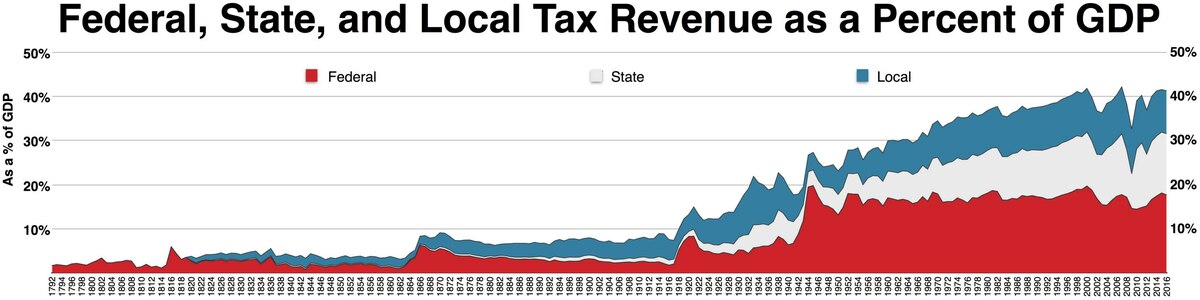
The second is that raising tax rates is hard enough but generating additional revenue is that real kicker. Consider this graph:

As you can see although there’s considerable noise in the federal tax receipts as a percentage of GDP it has remained within the same range for nearly 80 years regardless of changes in the tax code.

State and local tax revenues have skyrocketed over that period. When they declaim about federal revenues, they’re actually saying that the federal government needs to break through that 22% barrier.

I know there are lots of countries that pay a larger percent of GDP in taxes than we do. Most of them have much higher social cohesion than we do, too. As a consequence they receive more in government services than we do. Our problems are (in descending order of importance) poor ROI on government spending, too much government spending, not enough tax revenue.

12 comments

Something That’s Always Being Rehashed Can’t Be a Dirty Little Secret

I wanted to add my own musings to Steven L. Taylor’s post at Outside the Beltway so I’ll do it here. Steven opens with the Reuters article about which I wrote last week. Here’s a snippet of what he wrote:

To be clear: I am not asserting some notion of guilt-by-ancestral association. But, at a minimum, understanding how a given person got where they are in the now matters. It all illustrates that as much as we want to pretend like we are all self-made, this is simply not true in the main. Even if we build most of the structure, we cannot pretend like some of the foundations upon which we build were not laid by those who preceded us. Some acknowledgment and understanding of that fact is requisite.

The rest of this post may be a bit stream of consciousness so bear with me.

I may be the wrong person to comment on this. I literally cannot remember a time when I was not aware of what slavery was, that it was evil, and had consequences, some of which may persist to the present day. I knew that slaves were sold on the steps of the old St. Louis Courthouse. I knew that’s where the Dred Scott case was originally heard and what that was. I knew what the Civil War was. At least three of my great-great-grandfathers had fought for the Union in that war.

Here’s something you may not have thought of. Some white people benefited from slavery but others were injured by it. The explanation should be simple. You can’t compete on a wage basis with a wage of zero. My ancestors mostly fell into that category—they were injured by slavery and did not derive a benefit from it. That might explain why some of my ancestors were abolitionists.

By the time Abraham Lincoln was elected president he had been speaking publicly against slavery for decades. His views were known. After his election in 1860 the southern states began to announce their secession from the Republic. First South Carolina, then Mississippi, Florida, Alabama, Georgia, Louisiana, Texas, Virginia, Arkansas, North Carolina, and Tennessee. It is not a coincidence that the Civil War started a month after his inauguration.

One thing that remains unmentioned: the percentage of white political leaders whose families benefited from slavery vs. the percentage of whites whose families did not. I suspect that the real implication is that a lot of old money is based on slavery. It should be obvious that not all whites have old money.

Steven transitions to remarks about a Gallup poll and I want to focus on those. There is a drastic difference between the views of white Americans on the vestigial effects of slavery on black Americans today and the views of black Americans. Twice as many black Americans (63%) as whites (32%) think that slavery has “a lot”. There’s actually more than one matter there. The mere difference in views is important but that’s not the only important thing. To what degree are black Americans right?

I think they are partially right but not entirely. A lot has happened in 150 years. Consider, for example, the percentage of out-of-wedlock births which is closely related to the percentage of single-parent households:

I think it’s not unreasonable to attribute the discrepancy between blacks and whites in prior to 1950 as being a consequence of slavery. But not the discrepancy between blacks and white after 1965. IMO some of that must be attributed to the Great Society program.

I’d like to see a breakdown of the rates among black women based on urban vs. rural as well. I suspect it’s a lot lower among black rural women.

7 comments
