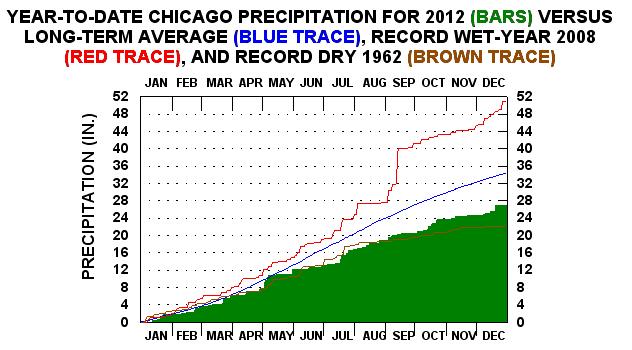
After a prolonged period of really quite mild weather, winter has come to Chicago in earnest. Temperaturs have dropped into the teens, single digits, even, briefly, below zero. After eleven months without snow, Chicago’s “snow drought” has been broken. There’s about an inch of snow on the ground here.
The snow drought was always actually a precipitation drought. In each month of 2012 Chicago’s precipitation for the month came very close to the driest on record. Precipitation is far below average.
On Tuesday Chicago conducted its Point-in-Time Homeless Count. Squads of volunteers and city employees combed Chicago’s streets and alleys, canvassing the city for homeless people sleeping in the street despite this coldest weather of the year. Chicago is estimated to have under 2,000 unsheltered homeless people, roughly a third of Chicago’s homeless. It’s not that there are no shelter berths available for them. They sleep on the street for their own reasons whether because they’re afraid of the shelters, lack the mental capacity to find shelter, or simply prefer to sleep outside to their other alternatives. In doing so they put themselves at risk of death from hypothermia.
According to the Centers for Disease Control, fewer than 700 deaths per year are hypothermia-related in the United States. Of those roughly half are out-of-doors, with the greater number being in Alaska, Wyoming, and Montana. Deaths of the urban homeless due to hypothermia are actually quite rare in the United States.
Typical scenarios for death due to hypothermia in the United States are
Case 1. In December 2003, a man aged 69 years with dementia was reported missing from his residence in Vermont. Despite extensive searches, his body was not found until March 2004 in the backyard of a nearby home. During that period, outdoor temperatures ranged from -14°F to 57°F (-26°C to 14°C). Descriptions and photographs of the scene suggested that the man had tried to cover himself to keep warm. Cause of death was reported as hypothermia, with dementia as a contributing factor.
Case 2. In February 2004, a male aged 16 years was found dead 40 yards from a road in a rural park in northwestern New Mexico. He had last been seen alive the previous day when he was dropped off at high school. The boy was found wearing damp, light clothing; his jacket and neck chain were recovered a short distance away. Temperatures in this region ranged from 11°F to 42°F (-12°C to 6°C) on the day he was found. An autopsy identified minor abrasions and contusions on his face and extremities. His blood alcohol concentration (BAC) was 0.15 g/dL, nearly twice the state legal limit of 0.08 g/dL for drivers. Toxicologic analysis of blood and urine also revealed 2 ng/mL of delta-9-tetrahydrocannabinol (THC) and 50 ng/mL of delta-9-carboxy-THC, both active ingredients in marijuana that suggest recent or chronic marijuana use. The cause of death was certified as hypothermia from cold exposure, with alcohol and marijuana intoxication as contributing factors.
Case 3. In February 2004, a man aged 18 years was found dead near a creek in southeastern Alaska. He was dressed lightly for winter conditions. The man had been missing for approximately 1 day, during which temperatures had ranged from 39°F to 45°F (4°C to 7°C). Toxicologic testing revealed a BAC of 0.18 g/dL, twice the state legal limit of 0.08 g/dL for drivers, and a urine ethanol concentration of 0.28 g/dL. The cause of death was listed as combined effects of alcohol intoxication and hypothermia.
The primary risk factors for death due to hypothermia, considered a preventable cause of death, are advanced age, mental impairment, and substance abuse.
Deaths of homeless persons due to hypothermia have declined in recent years due to a variety of local, state, and federal programs. Federal programs include the Homelessness Prevention and Rapid Re-Housing Program and the Homeless Emergency Assistance and Rapid Transition to Housing program. In total several billion dollars are spent per year combating homelessness.
I wrote this post for several reasons. The first, obviously enough, is that it’s cold here in Chicago. The second reason was in response to a particularly stupid comment to this post at OTB. The reason that homeless people die of the cold in the United States is not, in general, that we “don’t give a damn”. We’re doing what we reasonably can. Essentially, it’s for cost-benefit reasons. Greatly reducing the number of such deaths below their present very low numbers would require measures we abandoned years ago, e.g. forcible involuntary institutionalization of the mentally ill. We have made trade-offs and, sadly, any trade-off will come at the cost of some lives.