In Re Bergdahl

When asked my opinion of the Bowe Bergdahl case, here’s what I said.

As Lord Sankey said in 1935, the presumption of innocence is the golden thread that runs through the criminal law. That is as true of our code of military justice as it is of our civil code. I’m concerned that too many are forgetting that in the case of Bowe Berdahl. Let the case work its way through the courts. That’s what hearings and trials are for.

I do find it interesting that the editors of the New York Times a) assume that Berdahl is guilty and b) think he should be absolved from that for political reasons. There is another ancient legal dictum that covers that: fiat justitia ruat caelum or let justice be done though the heavens fall.

9 comments

More on Looking Forward in the Middle East

I see that Pat Lang is about as perplexed by our foreign policy in the Middle East as I am:

In pursuit of our new/old post modern goals we have spread havoc across the world while fostering the revolutionary change that we imagine all mankind eagerly awaits.

– Russia/Ukraine. The NED and the doyenne of neocon missionary work have actively sought regime change in Ukraine and Russia and have not felt the need to disguise their intentions. Can we doubt that POTUS is an active backer of this policy? If he were not, then Nuland would be returned to hanging out with her husband at one or another of their lobbies or think tanks.

– Tunisia, place of martyrdom of the poor green grocer man, the western style democracy sought there hangs by a thread.

– Egypt, sanctified by the hysteria of the mob and western press; that went well did it not? Now Sisi, who owes Saudi Arabia and the other Gulfies a lot, makes menacing noises about intervention in Yemen. Has the Egyptian Army forgotten what happened to them in Yemen fifty years ago? Nasser called it his” Vietnam.”

– Libya, I thought that one was a good idea. I was wrong.

He continues in that vein. Just to refresh your memory, Col. Lang is a former Green Beret, the first ever instructor in Arabic at West Point, and has extensive knowledge of the Middle East, particularly Yemen. I suspect his post was prodded by the goings-on in Yemen now and our role in them.

12 comments

The Council Has Spoken!

The Watcher’s Council has announced its winners for last week.

Council Winners

Non-Council Winners

The announcement post at the Watcher’s site is here.

0 comments

The Imaginary Recovery

If you’re looking for something else to be depressed about this post by Jeffrey Snider at RealClearMarkets on the state of the economy and what that portends for Federal Reserve policy is a pretty good choice. It’s a bit hard to excerpt but here’s an interesting snippet:

In that respect, the closing of the “output gap”, the academic calculation of “slack”, is highly misleading. Again, far be it for the FOMC to point out and emphasize the true reason for that outcome as it would at least muddy the preferred recovery narrative if not end it entirely. Larry Summers perhaps put it best earlier this year when he stated, with appropriate frankness,

“The United States is now about 10 percent below potential, as it was estimated in 2007. In so far as the output gap has closed, it is not because we have gotten closer to what we thought potential was. It is because we have revised downwards our assessment of the economy’s potential. That 10 percent potential represents about $20,000 per American family.”

To be even more blunt, the reason that there may be less slack now is not because the economy has finally found its recovery but rather because it may never do so at all. You can quibble with the mathematic construction of the measure or its theoretical basis, but what is important here is that the very people that believe in these sorts of things are now forsaken by their very creations. If there is actually a reduced level of slack in the economy right now, it is only because the US economy has permanently shrunk via the Great Recession.

Thus explains the great “mystery” about why the numbers so differ with what people feel and say about the matter. This cannot be overstated by hyperbole, as it essentially confirms what many of us have been saying for years and years; that the Great Recession was no cycle but rather a permanent rift in economic function that will alter our history and social standing for a long, long time (depending on how it is ultimately dealt with). Again, I make no claims about the figures or even the concept of “slack” except to point out that orthodox economists have now endorsed an idea that disproves a great deal of their own theoretical foundation.

The way I prefer to look at it is that the increases in productive capacity that economists were figuring on were predicated on productive capacity that never existed to begin with. When viewed that way growth has been very slow not just for the last eight years but for the last fifteen years. The purchasing and wage commitments that were made during the period of imaginary growth are with us still, holding us back. That’s what state and local governments and taxpayers are running into.

What should be clear from Mr. Snider’s post is that monetary policy won’t save us and we should be looking elsewhere. As is a recurring theme on this blog, our economic problems are the foreseeable outcomes of about a half century now of very bad policies. To change the outcomes we must change the policies.

4 comments

Looking Forward in the Middle East

The great Negro League and later integrated major league baseball player, Satchel Paige, once gave a bit of advice: don’t look back—something might be gaining on you. As we survey the situation in the Middle East,, roughly from the Dardanelles on the western border of Turkey to the Radcliffe Line that divides India from Pakistan, nearly every country is either at war, engaged in a civil war, or fallen into chaos. We are involved, directly or indirectly, in at least five of those conflicts.

In the interests of honoring Mr. Paige’s advice and to avoid futile rehasing of what we should or shouldn’t have done, let’s focus on what we’re doing and what we should do. We can’t undo past bad decisions. We only live with their consequences. That doesn’t mean we should keep making the same bad decisions over and over again.

What are our interests in the Middle East? I can think of seven:

  • Oil
  • Israel
  • Non-oil trade
  • Humanitarian
  • Our military assets in the region
  • Terrorism exported from the region.
  • The dangers posed by a nuclear-armed Iran

not necessarily in that order. I think that we can reasonably say that all of those interests are threatened right now and that what we’re doing now isn’t doing much to move things in a more positive direction.

We could always take the recent advice of former UN Ambassador John Bolton and immediately bomb Iran into submission. Not only would doing that place all of the interests listed above in jeopardy, it ignores something basic. The only way you can control the outcome on the ground is to be on the ground and barring some catastrophe I just don’t see that happening.

Also, that would advance the interests of Saudi Arabia which either directly or indirectly is the sponsor of a lot of the Islamist radicalism that’s causing so many headaches in so many places.

I personally don’t have much more interest in Israel than I do in Tajikistan, a country with roughly the same population and somewhat less interest than in Switzerland, ditto. There’s a humanitarian interest but that’s about it. That means my views are so divergent from those of so many Americans I’m just in no position to offer advice on what we should or should not be willing to do to secure that interest.

Our non-oil trade with the Middle East is actually pretty minor. Other than arms, of course. We sell a lot of arms to the countries of the Middle East or, said another way, we would be contributing to the problems there if Russia, France, Germany, the UK, and China weren’t eager to expand their markets there. We’re not the primary supplier of arms to Syria so I guess that’s something.

Should we decamp completely from Afghanistan? IMO U. S. aid to the country will evaporate shortly after we leave and when that aid ends what little civil order exists now in Afghanistan will collapse completely. Do we care? If we don’t care what happens in Afghanistan why have we been there for the last six years? For the last 14?

I also think that our attempts at securing humanitarian interests in the region are doing more harm than good. Shouldn’t the basic rule of a responsibility to protect be primum non nocere, first do no harm?

I don’t claim to have any answers but I can certainly see the problems. Increasingly, I feel like the doctor who’s the narrator in the novel The Bridge on the River Kwai. It’s all madness.

I simply can’t figure out what the White House or Congressional Republicans are trying to accomplish or see that the means they want to employ as suitable to those interests. We seem to be doing things to do things.

13 comments

To Coin a Cliche

I honestly don’t know what to make of this story. Apparently, the U. S. declassified a previously top secret document outlining Israel’s nuclear weapons capabilities (or, at least, some details of its nuclear weapons development program).

The Pentagon has declassified a document that was once labeled “top-secret,” which goes into sophisticated detail about Israel’s nuclear weapons program. The document was released quietly just prior to Israeli Prime Minister Benjamin Netanyahu’s March 3 speech to a joint session of Congress.

Israel has never officially confirmed or denied the existence of a nuclear weapon’s program within its borders.

The Pentagon declassified sections covering Israel’s nuclear program, but “kept sections on Italy, France, West Germany and other NATO countries classified, with those sections blocked out in the document,” Israel National News reported.

The 386-page top-secret memo, titled, “Critical Technological Assessment in Israel and NATO Nations,” goes into great detail about how Israel turned into a nuclear power in the 1970s and 80s.

“As far as nuclear technology is concerned the Israelis are roughly where the U.S. was in the fission weapon field in about 1955 to 1960,” the report assesses.

Questioning the timing has become something of a cliche but it certainly looks apt in these particular circumstances. First, why did the U. S. declassify the report just prior to PM Netanyahu’s visit? And why is this just being noticed now? I find the whole thing mystifying.

9 comments

Your Bonehead Plan of the Day

I’m not sure I’ve heard about anything much dumber than the provision in the Trans-Pacific Partnership Agreement, leaked today, to allow foreign companies to recover for U. S. actions that hurt foreign companies’ investment expectations. Suing for actual damages I can see. But investment expectations?

7 comments

How Do the Returns to Capital Actually Function?

I want to turn your attention to an interesting post at The Economist’s blog. It seems that an MIT grad student (and blogger!) has mounted a very credible counter-argument to Thomas Piketty’s thesis on capital and wealth, expressed in Dr. Piketty’s best-selling book, Capital in the Twenty-First Century, that captured so much attention last year. Here’s the substance of the post:

In his book, Mr Piketty argues that over the long run the rate on return of wealth exceeds economic growth: a dynamic summed up in the equation r>g. Over time, this relationship increases inequality as the share of national income going to those who own capital (the rich) rises, while the portion going to labour (everyone else) falls. He also argues that the return on capital in recent history has been remarkably stable, even as economic growth has fallen, and that this trend will continue in the future.

Mr Rognlie mounts three main criticisms of these arguments. First, he argues that the rate of return from capital probably declines over the long run, rather than remaining high as Mr Piketty suggests, due to the law of diminishing marginal returns. Modern forms of capital, such as software, depreciate faster in value than equipment did in the past: a giant metal press might have a working life of decades while a new piece of database-management software will be obsolete in a few years at most. This means that although gross returns from wealth may well be rising, they may not necessarily be growing in net terms, since a large share of the gains that flow to owners of capital must be reinvested.

Second, Mr Rognlie’s research suggests that Mr Piketty has overestimated how high the returns on wealth are likely to be in the future. These should also decline over time, he reckons, unless it is very easy for the economy to substitute capital (like robots) for workers. Yet the historical evidence suggests that this is far harder than he suggests.

And third, Mr Rognlie finds that the growing share of national income deriving from capital income has not been distributed equally across all sectors. The return on non-housing wealth, in fact, has been remarkably stable since 1970 (see chart). Instead, surging house prices are almost entirely responsible for growing returns on capital.

There’s more at the linked post.

If you’re the sort of person who skips to the end of a mystery story to find out whodunnit, in Mr. Rognlie’s view the culprit is homeowners rather than “top-hatted capitalists or famous hedge-fund managers” who are responsible for the phenomena Dr. Piketty has pointed out. Which is another way of saying how terrible our policies have been over the period of the last 60 or 70 years but that’s a subject for another post.

6 comments

Cui Bono?

Fellow St. Louisan Yogi Berra is reputed to have said that in theory there is not difference between theory and practice but in practice there is. When George Will lauds the virtues of concentrated wealth and monopolies:

Every day the Chinese go to work, Americans get a raise: Chinese workers, many earning each day about what Americans spend on a Starbucks latte, produce apparel, appliances and other stuff cheaply, thereby enlarging Americans’ disposable income. Americans similarly get a raise when they shop at the stores that made Sam Walton a billionaire.

[…]

Monopoly profits are social blessings when they “signal to the ambitious the wealth they can earn by entering previously unknown markets.” So “when the wealth gap widens, the lifestyle gap shrinks .” Hence, “income inequality in a capitalist system is truly beautiful” because “it provides the incentive for creative people to gamble on new ideas, and it turns luxuries into common goods.” Since 2000, the price of a 50-inch plasma TV has fallen from $20,000 to $550.

I think there’s something he needs to explain. If, as he claims, leaving wealth in the hands of the wealthy:

The best way to (in Barack Obama’s 2008 words to Joe the Plumber) “spread the wealth around,” is, Tamny argues, “to leave it in the hands of the wealthy.” Personal consumption absorbs a small portion of their money and the remainder is not idle. It is invested by them, using the skill that earned it. Will it be more beneficially employed by the political class of a confiscatory government?

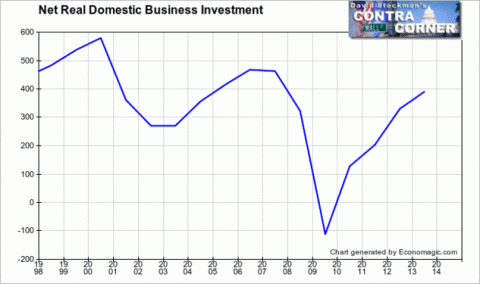
results in more business investment and greater prosperity in the United States, how is it even as the income of the wealthiest has skyrocketed real domestic business investment has lagged?

Over the last thirty years we have imported inexpensive goods from China and exported jobs. While there is some benefit to the average Joe in the cheap manufactured goods coming into the United States, most of the benefit is going to the wealthiest.

There is a balance to be sought. We aren’t realizing it right now and the reason we aren’t is that, rather than purchasing U. S. goods and services with the dollars they obtain through trade, the Chinese are buying Treasury bonds. That does very little for the average American but lots for politicians, Goldman-Sachs, Warren Buffett, and the people the federal government actually spends money on (healthcare providers and wealthy elders).

3 comments

Spending More Money on Medicare Is Easy

Although the editors of the Washington Post are right to take note of the incipient agreement on abolishing the always-ignored Sustainable Growth Rate in Congress—that’s the provision that induces the annual exercise in cowardice, the “doc fix”:

THE HOUSE of Representatives is on course to pass a major piece of Medicare legislation with strong support from the leadership and rank and file of both parties. Yes, you read that right: On Thursday, the House is scheduled to vote on a package that permanently eliminates the expensive annual budgetary charade known as the “doc fix,” while enacting tens of billions of dollars worth of structural reforms to the massive program for seniors — and providing a two-year, $5.6 billion dollop of funding to an important children’s health-care program to boot. For their labors in moving this bill to the brink of passage, we’d pat House Speaker John A. Boehner (R-Ohio) and Democratic leader Nancy Pelosi (Calif.) on the back — if they weren’t already doing so themselves.

I don’t think they appreciate how weak a victory it is. They try to rationalize the move as the beginning of a process:

Arguably, ending the doc fix helps pave the way for more reforms because of all the legislative time and attention that will no longer be wasted on that exercise.

That’s nonsense. The House has merely agreed to say out loud what has been left unsaid for the last 15 years: spending more money on Medicare is easy. It will always be ready to spend more money on Medicare.

Despite the rejoicing over the slower rate of growth, Medicare spending continues to grow at a multiple of the non-healthcare rate of inflation, GDP, and incomes. As a matter of basic math that can’t continue indefinitely and I would submit that failing to address the basic, structural problems in our healthcare policy is already having an adverse effect on economic growth and jobs.

Effective reform, reform worthy of the name, will necessarily involve making hard decisions rather than easy ones. What the House has passed is just more of what we’ve been doing for the last half century.

0 comments