Pfizer On Why Treasury Is Wrong

The CEO of Pfizer has weighed in on Treasury’s inversion-quashing rules change in an op-ed at the Wall Street Journal. Here’s his peroration:

Companies like Pfizer and Allergan contribute to the communities in which we operate. To be pilloried as “deserters” when we are trying to stay competitive on a global stage so that we can continue to invest in the U.S. is wrongheaded. Government policy should encourage investment certainty and job creation. Combining these two businesses would have had a positive impact on the lives and livelihoods of many people.

While the Treasury’s proposal is a shot at Pfizer and Allergan, this unilateral action will hurt other companies as well. If the rules can be changed arbitrarily and applied retroactively, how can any U.S. company engage in the long-term investment planning necessary to compete? The new “rules” show that there are no set rules. Political dogma is the only rule.

The editors of the WSJ chime in:

He’s right, as every CEO we know will admit privately. This politicization has spread across most of the economy during the Obama years, as regulators rewrite longstanding interpretations of longstanding laws in order to achieve the policy goals they can’t or won’t negotiate with Congress. Telecoms, consumer finance, for-profit education, carbon energy, auto lending, auto-fuel economy, truck emissions, home mortgages, health care and so much more.

Capital investment in this recovery has been disappointingly low, and one major reason is political intrusion into every corner of business decision-making. To adapt Mr. Read, the only rule is that the rules are whatever the Obama Administration wants them to be. The results have been slow growth, small wage gains, and a growing sense that there is no legal restraint on the political class.

I’m of mixed mind on this subject. While I tend to agree with Mr. Reed’s argument as expressed in the quoted passage, I’m not particularly sympathetic with Big Pharma.

Patents are government-granted monopolies. Big Pharma lives and dies by patents. As such they are creatures of the government. When you take the king’s shilling, you are the king’s man. As such the best advice is kwitcherbellykin.

Let’s not lose sight of the reality that our present tax law is antiquated, in need of reform, and out of step with international norms and standards. If it weren’t out of step with international norms and standards, there wouldn’t be any opportunities for the kind of leveraging that inversions provide.

Treasury’s actions are not motivated by patriotism, zeal for the law, or fiscal reality but by politics. Corporate taxes are inefficient. That’s not really in dispute. If you want to increase revenues, increase the personal income tax. The primary reason we have corporate taxes is not fiscal but political. Corporations not paying their fair share makes for good stump speeches.

What I’d like to see is a little more emphasis on how we’re going to improve economic growth and job creation. Don’t just tell me “infrastructure spending”. That’s no more a magic talisman than “free trade” is. Modern infrastructure projects don’t involve getting together crews of unskilled labor out of the ranks of the unemployed. They’re a process of letting government contracts to one or more of a handful of preferred vendors who’ve already hired their crews and bought their equipment.

3 comments

The Standard-Bearer

My former business partner once made a wisecrack that’s stayed with me. I think of it as the “reverse Voltaire”: “I may agree with what you say but I’ll reject to the death your right to say it.” That’s what occurred to me when I read GE CEO Jeffrey Immelt’s rejection of Bernie Sanders’s critique of American business in his op-ed in the Washington Post:

We at GE were interested to read comments Monday by Sen. Bernie Sanders (I-Vt.), who told the New York Daily News editorial board that GE is among the companies that are supposedly “destroying the moral fabric” of America. The senator had been asked to cite examples of corporate greed at its worst. Somehow that got him to talking about us.

GE has been in business for 124 years, and we’ve never been a big hit with socialists. We create wealth and jobs, instead of just calling for them in speeches. We take risks, invest, innovate and produce in ways that today sustain 125,000 U.S. jobs. Our engineers innovate every day to build hardware and software solutions that meet real-world challenges. Our employees are proud of our company. I meet second- and third-generation employees whenever I travel across the country. I am one myself. Our suppliers and partners are proud of our company. Our communities are proud of our company. Our pride, history and hard work are real — the moral fabric of America.

I think he’s conflating “moral fabric” with “economic fabric”. Once upon a time there was something called “political economy”, the study of the conditions of consumption and production within a country. Political economy was practically inseparable from ethics. Adam Smith was a moral philosopher.

Those days are gone. They don’t teach political economy in business school.

I utterly reject Jeffrey Immelt’s lecturing me on the moral fabric of the United States. He should remove the beam from his eye before admonishing me to remove the mote from my own. I see nothing in Mr. Immelt’s education or background that suggests that he’s had any formal training in ethics or morality after he was 12 years old. He’s no more an authority on ethics or morality than the average guy on the street.

GE excels at making money but it has never been a particularly good U. S. citizen or citizen of the world. The company has been involved in shady schemes, cover-ups, and sharp business practices for longer than I’ve been alive.

GE is cagey about where it earns its money but by every indication it still earns half of its revenues in the United States. About a third of its employees are in the U. S.—its U. S. employee base has been shrinking for generations, even as the company’s revenues grew.

We really should start taking a page out of the rulebooks that other countries use. Most developed (and many developing) countries require companies to have local partners or establish certain levels of employment in their countries if they want to do business in those countries. GE doesn’t have large foreign footprints through the goodness of its heart. It’s a strategy for expanding its customer base. We might think about imposing some of the same requirements on international companies like GE that France, Germany, and China do.

There may be companies that can make a good case for how they contribute to the moral fabric of the United States but GE isn’t one of them and Mr. Immelt is a lousy standard-bearer for that cause.

3 comments

Misdirection

In this piece at Atlantic on income inequality, proving the adage I found an acorn from sociologist Kevin Leicht:

It’s not entirely clear that the labor market is actually producing the quality jobs that college graduates are supposed to take. A lot of college graduates are taking jobs that don’t require a college education. The second problem is that the value of a college diploma is inversely related to the number of people that have it. So if you increase the number of people with a college degree, the college-wage premium will probably disappear. Or it will only grow because the unfortunate few who don’t have a college degree will make practically nothing.

which are the points I’ve been making for some time. Sadly, I found his prescriptions for remediation pretty weak.

Basically, as me auld mither said many times, we need to decide what kind of country we’re going to be. If we’re going to be a country with a lot of people earning minimum wage, a small struggling middle class, and a too-large nearly hereditary upper class, we should have one set of policies (the ones we’ve got—we’re well on our way). If we’re going to be a somewhat smaller country with a much smaller number of people earning minimum wage, a larger, more secure middle class, and a smaller upper class, it will take some pretty drastic policy shifts at this point.

In particular I don’t think you can use the tax code to accomplish it. The tax code is a pretty good way to block access to the middle class or the upper class but it’s not much good at getting reducing the number of working poor.

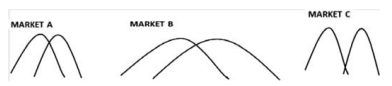
One more thing. Maybe I misunderstand the point that’s being made by the three scenarios but I think it’s woefully inadequate. Or maybe they just can’t draw good curves. If they think that we conform to Scenario C, explain Oprah. I think that the curves in all three scenarios should have “long tails”.

10 comments

Forum Question: What About Digital Technology?

The Watcher’s Council forum question this week was about digital technology. I didn’t feel that I had anything meaningful to contribute on the subject so I didn’t participate and it looks like a number of my fellow Watchers felt the same way.

The reflections of several of the Council members on the topic are here.

0 comments

The Silent Costs of Trade

Over at Nouriel Roubini’s EconoMonitor site, Ed Dolan has a post you might find interesting that brings up some points that aren’t mentioned frequently enough. The graph above, taken from the post, illustrates one of them—the cost in benefits of each $1,000 increase in imports from China:

Consumers benefit from free trade through lower prices and access to a wider variety of products. The impact on workers is more complex. Some lose jobs at factories that can no longer compete with imports. Waiters at local restaurants lose income when unemployed factory workers stop taking their families out to dinner. At the same time, new jobs open up as trade expands employment in export industries, and as lower prices of imported goods leave consumers with extra money to spend on local goods and services.

The impact on workers depends to a large extent on whether those who lose their jobs to import competition can find their way to the new jobs created elsewhere. To take an example from my last post, suppose consumers save $1.1 billion from cheaper imported tires at the cost of 1,200 jobs lost in the tire industry. At more than $800,000 in gains to consumers per job lost, that sounds like a huge net gain for the economy as a whole. But is it a net gain for Joe, the tire worker? Not unless he quickly finds a new job as good, or nearly as good, as the one he lost.

But what if Joe, after losing his job at age 45, never finds steady work again? What if has to get by for the rest of his life on odd-jobs, food stamps, and Social Security? If that is typical, then the net gains from trade in tires would be smaller, and the losses would be more concentrated on the directly affected industry and region, rather than spread widely via labor and product markets.

The post purports to be about the policy solutions to the problems it raise but, like most of its ilk, it’s long on the problem analysis and short on the solutions.

I don’t oppose trade. I don’t oppose free trade. I do think we need to view our notional “free trade” agreements with a more critical eye. What are the actual likely costs and benefits? Who pays the costs? Who reaps the rewards?

This observation from the post:

What can be done to mitigate the way the social safety net impedes adjustment to trade shocks? I am sure there are many places where tinkering with the rules could help, but here are two proposals that are more radical than mere tinkering.

One would be to move toward a system of universal health insurance that fully decouples coverage from employment, income, or place of residence. I discussed the advantages of such a system in this earlier post which discussed Sanders’ “Medicare for all” proposal and contrasted the US healthcare system with those of other wealthy countries.

but that just highlights one of our basic political problems. The party that presently tends to be most supportive of free trade also tends to be most resistant to any increases in federal spending and you can’t fund new federal programs without an increase in federal spending.

4 comments

Rats Millionaires Leaving Sinking Ship Chicago

The Trib is reporting that millionaires are leaving Chicago faster than any other city in the United States:

Millionaires are leaving Chicago more than any other city in the United States on a net basis, according to a new report.

About 3,000 individuals with net assets of $1 million or more, not including their primary residence, moved from the city last year, with many citing rising racial tensions and worries about crime as factors in the decision, according to research firm New World Wealth. That represented about 2 percent of the city’s high net worth individuals.

Cities in the United States that saw a net inflow of millionaires included Seattle and San Francisco.

Chicago was among four cities worldwide with the biggest flight of millionaires.

You can hardly blame them. The factors are numerous. Chicago isn’t a destination city like San Francisco, LA, or New York. Chicago’s public employee pension problems. Illinois’s public employee pension problems. The nearly daily reports of somebody being gunned down in the streets. That isn’t happening in the neighborhoods where I’d expect millionaires to be living but bad press affects the whole city.

They’re using a pretty expansive definition of “millionaire”, too: net assets. Basically, if you own a good-sized home and have much in your 401K, you’re a millionaire by that standard. It probably includes most physicians and a lot of lawyers who probably don’t think of themselves as millionaires. It’s outside my bracket.

But millionaires leaving means that the burden of paying for all of those services we’re paying for will fall on people earning a lot less than $1 million.

8 comments

The Shape of the Recovery

In a post by Claire Boston and Carol Ko at BloombergView, ostensibly on how over-extended American businesses are, the graph above caught my eye. Look at the right hand side, the most recent years. It illustrates a point I’ve been making for some time: businesses aren’t investing.

That can’t be explained by slack demand or IMO anything else other than a basic change in how corporate managers are behaving. My interpretation is that they’ve given up on growing their businesses in favor of goosing the price of their companies’ stock. Let’s be realistic: that’s the way the incentives point. With so much of managers’ compensation based on stock performance, they’re doing exactly what you’d expect them to do.

And getting rid of employees is an easy, brainless way to give a quick, temporary jolt to your stock price. Then IBGYBG.

If we aren’t getting the growth we need from business investment, that leaves only four other components on which we might rely. As I posted a few days ago, consumers are over-extended, too, so don’t expect much from consumers. Any attempt at increasing exports is bound to be met with resistance and reaction from our trading partners so that’s no solution, either. Note well that we’ve fallen far short of President Obama’s pledges on exports. As I pointed out at the time, his promises were mathematically impossible and, consequently, couldn’t be taken too seriously.

That leaves government spending or imports. If you wonder why I keep saying that we need to produce more of what we consume, look no farther.

As to the meat of the post, if half of what the authors claim is true, the next recession—and there will be a next recession, eventually—is going to be a doozy unless something changes.

Update

Just to flesh out the potential implications a bit according to Moody’s they expect the default rate on corporate bonds to increase at least 20% by the end of this year and possibly by more than 300%.

Nowadays some of the biggest holders of corporate bonds are other corporations. A 300% increase in the default rate could trash balance sheets to the extent that it produces a cascade. That’s a worst case scenario.

Other large holders of corporate bonds are banks and insurance companies which have barely recovered from their near-death experience of nearly a decade ago.

4 comments

Why?

In his Poetics Aristotle wrote that the theater requires the “willing suspension of disbelief”. I guess I have some problems with that. For example, when watching a TV program this evening I couldn’t help but wonder why a character who was supposed to be a middle-aged urban Southern white man was speaking with a Southern rural black dialect.

4 comments

The First Pin Drops

Reuters is reporting the Iceland’s prime minister has resigned over the revelations in the “Panamanian Papers” of his dealings:

Iceland’s Prime Minister Sigmundur David Gunnlaugsson is to step down after leaked documents from a Panamanian law firm showed his wife owned an offshore company with big claims on collapsed Icelandic banks, his party said.

Gunnlaugsson became the first prominent casualty from the revelations in the so-called Panama Papers, which have cast light on the financial arrangements of an array of politicians and public figures across the globe and the companies and financial institutions they use.

I would be surprised if he were the last. Still not much word of Americans on the list.

6 comments

Speaking of Change…

And speaking of change, this is one of my favorite songs. There aren’t a lot of songs in which the artist’s rendition and the song are so completely identified but this is one of them.

4 comments