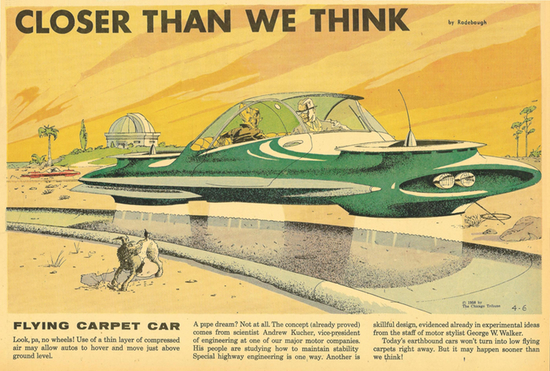
Later Than You Think


I’m glad to see that there’s somebody out there who thinks the same way I do about autonomous vehicles. As it turns out it’s Jeremy Bowman at the Motley Fool:

While the excitement over self-driving cars is clearly palpable, there are a number of reasons the autonomous vehicle revolution may not happen as soon as some think.

There are 253 million cars on American roads today, nearly one for every person in this country. The average age of those vehicles is 11.4 years. While it’s easy enough to envision an urban millennial foregoing car ownership and depending on apps like Uber and Lyft, as many already do, making that system work for the majority of Americans will be much more difficult and slower to take hold.

The average value of a used car is now close to $20,000. Though the average age of a used car sold is just around five years, it helps show the value of the cars on the road today. Even if we assume the average value of a used car is $10,000, that would put the value of all of the cars in the U.S. today at $25.3 billion. After real estate, there is no personal property Americans have more money tied up in than cars, and they aren’t about to abandon that kind of money to take advantage of self-driving vehicles. The added cost of self-driving functionality may also dissuade potential buyers. The need to turn over all of that inventory means that once autonomous vehicles become widely available, it will still take about an additional 15 years for the fleet of cars on the road to turn over. So, even if self-driving cars are in mass production by 2020, the complete shift wouldn’t take place until 2035.

The high-profile fatal accident this summer involving a self-driving Tesla underscored a problem with the transition to autonomous vehicles. Since most auto accidents are caused by human error, autonomous vehicles have the potential to make driving much safer than it it is today, but the technology just isn’t there yet. Deploying it is likely to reveal similar faults to the one that caused that accident this summer, making the transition a tricky one for regulators and insurers.

The Obama administration endorsed autonomous vehicles and issued a set of guidelines surrounding the burgeoning industry, but toeing the line between ensuring public safety and allowing innovation may not be so easy. Though autonomous driving technology is expected to lower insurance rates, the question of who is at fault in an accident in such a vehicle remains an open one. Some have posited that automakers will offer their own insurance to cover the vehicle.

Plenty of questions still need to be answered in the regulatory environment, but an entrenched car culture and the bureaucracy surrounding the auto industry won’t be undone overnight. In the self-driving revolution, the technology may only be the first step since consumer acceptance and inventory replacement will take several years to overcome before autonomous vehicles become mainstream.

The reasons that the adoption of autonomous vehicles is likely to be slower than many think outlined above include reluctance on the part of consumers to destroy their own wealth and regulatory barriers, both of which I’ve mentioned in the past. There are four other reasons you might want to consider: the 90% rule, security, liability, and lack of value.

The 90% rule, well known in development circles, goes something like this. When a development is 90% working, you’ve completed 10% of the effort. All of those concept cars about which you’ve read glowing articles? That’s 90% of the effort. Completing the remaining 10% is likely to take much longer than anybody thinks and possibly much longer than is worth completing.

Security is another big issues. It’s one think when hackers break into your computer. It will be another thing entirely when they break into your car.

The insurance and regulatory issues mentioned above don’t touch on the issue of liability. Once upon a time there was a computer company (Burroughs) that was driven out of business by lawsuits due to bugs in their operating system.

My guess is that there are probably 10,000 lawyers out there ready to go to court to argue that any problems with an autonomous vehicle are failures of workmanship. Another way of saying that is that even Google with its notoriously deep pockets is about one class action lawsuit away from bankruptcy. It’s something they’ve never faced with the search engine and marketing tools that are their core business. They’re smart guys. They probably know it. They want to promote the technology they’ve developed, not put autonomous vehicles on the road.

The final issue is consumer benefit. We know how the technology is supposed to benefit manufacturers. What’s the benefit to consumers? Especially consumers who already own old-fashioned, antiquated non-autonomous vehicles.

Here’s a test case. Fully autonomous vehicles have been practical for decades in one area that is much, much simpler than automobiles: railroad trains. Why aren’t all choo-choos autonomous? I’ve listed the reasons above.

Consequently, I think that we’re going to see crash protection, unassisted parking, and other applications of smart vehicles that haven’t even been thought of yet. But it may be decades before fully autonomous vehicles are widely adopted, if ever.

1 comment

Interested Parties

You know, I’d be a lot more impressed if the head of the PVC manufacturers’ association brought the problems presented by mandatory adoption of PVC pipes to our attention than when the head of the ductile iron pipe manufacturers’ association does.

That’s the problem when these things are decided politically. The interested parties are vitally interested. What is truth?

It seems to me that one argument against mandatory use of PVC pipes is that poly-vinyl chloride is made from oil and we’re importing a lot of that already while ductile iron is mostly made domestically from domestically-sourced materials (there’s a heated argument about the Chinese dumping ductile iron into the U. S. market which they probably are).

5 comments

The Impossibility of Perfect Accuracy

I recognize that the new-found love of direct democracy in some circles is simply instrumental in nature. However, I wonder if they’ve thought the implications of electing the president by direct popular vote through.

What happens when the margin of error is greater than the margin of victory? Under such circumstances the winner is indeterminate.

If we were to adopt such a thing, the precise number of legitimate votes cast would become an issue of vital importance. We’d also need to adopt a national mandatory biometric voter ID.

I’ve seen estimates of the error in the popular vote on the order of 3-4% of the total. That includes ineligible voters, illegal multiple voting, outright fraud, tabulation error, etc.

One of the unappreciated effects of our Electoral College system is that the precise number of popular votes cast isn’t nearly as important as it otherwise might be.

6 comments

Food for Thought

Recently I stumbled across this quote of George Orwell (from “Second Thoughts on James Burnham”, Polemic, 1946):

It was only after the Soviet régime became unmistakably totalitarian that English intellectuals, in large numbers, began to show an interest in it. Burnham, although the English russophile intelligentsia would repudiate him, is really voicing their secret wish: the wish to destroy the old, equalitarian version of Socialism and usher in a hierarchical society where the intellectual can at last get his hands on the whip.

0 comments

Help!

I’m a prisoner in Downton Abbey! Neither my wife nor I watched Downton Abbey while it was in production but my wife is binge-watching it streaming now. I didn’t watch Upstairs Downstairs when it was in production, either, but enjoyed it very much when it was re-broadcast later. I’ve glanced at Downton Abbey. To my eye it appears to be Upstairs Downstairs with higher production values and, by and large, less appealing characters. I’m a republican who self-identifies as Irish (my observation has been that identity tends to run in the maternal line). I find it difficult to sympathize with the problems of the English aristocracy between the wars.

The best thing about the series appears to be Maggie Smith. Either the writers give her all the best lines or they’re the best lines because she delivers them. Something not adequately recognized by its fans: to all appearances Downton Abbey is a comedy portraying itself as a drama. Imagine it with a laugh track.

Some interesting oddities. In the opening credits of the show they pan across a single dinner plate—beaded gold rim, embossed family seal. With the exception of the embossed family seal which I assume to have been hand-applied after firing, the plate appears to be my mother’s china. Also, the rug in Downton Abbey’s front hall is a larger version of the one that’s in my living room.

2 comments

The Early Returns

Donald Trump’s early appointments may provide us with some clues on what the Trump Administration will look like more generally. These appointments include (as I had predicted) Mike Flynn for National Security Advisor, Mike Pompeo as Director of National Intelligence, and Jeff Sessions as Attorney General. None of these appointments are particularly surprising and neither are the reactions from the progressive establishment.

In common is that all three are Trump loyalists. Should we have expected anything else, especially from the early appointments? President-Elect Trump clearly places a high value on personal loyalty, a quality he holds in common with Hillary Clinton and President Obama.

IMO nearly every Southern white male over the age of 60 probably has some racist baggage or at least arguably has some racist baggage and Jeff Sessions is no exception. When his career is viewed in context is he a bigot, a Southerner, a Southern bigot, or a white Southern politician who espoused whatever views were necessary to be re-elected, particularly with respect to same sex marriage? Is there a difference among those things? Are views very similar to those articulated by President Obama five years ago intolerable bigotry now?

I don’t know the answers to any of those questions. Perhaps we’ll have a better idea after confirmation hearings. Frankly, I doubt it as I expect more heat than light from them.

WRT Gen. Flynn and Rep. Pompeo I think we can reasonably conclude that Donald Trump wasn’t kidding about his foreign policy ideas during the campaign. At first glance Flynn’s and Pompeo’s views are quite similar to those of the President-Elect.

As H. L. Mencken quipped nearly a century ago, there is always a well-known solution to every human problem — neat, plausible, and wrong. Probably our gravest security problem at present is the challenge presented by radical Islamist terrorism.

That some Muslims present particular security problems is not equivalent to saying that Muslims inherently present security problems or that Islam itself is irremediably violent. IMO much more attention should be attached to the sponsorship of terrorism by Muslim states than on ordinary individual Muslims.

A steely-eyed view of what constitutes state sponsorship would help, too. In aristocracies the aristocrats are the state. Our political problem is that too much of our foreign policy establishment just can’t bear the implications of that.

1 comment

RIP, Agua Dulce Mighty Special


Last night was not a happy one in our home. Agua Dulce Mighty Special RAE MX MXS MXJ MJG NF, our Smidge, has died. She was only seven.

Four weeks ago to the day she was diagnosed with Stage 4 metastatic liver cancer. Shortly after her last agility competition five weekends ago she began exhibiting symptoms that were initially diagnosed as pancreatitis. Additional investigation revealed terminal liver cancer. We were told she had days to live.

We elected palliative care, making her as comfortable as possible and letting her live her normal life as completely as we could. It’s what I would want for myself under similar circumstances.

She had four weeks of happy life after her diagnosis, eating food she liked, getting lots of love, running an agility course every now and again. Yesterday she began failing very rapidly.

The picture above was taken a few weeks ago when our friends did something very special for Smidge and us. As of her last official agility competition Smidge was just 10 points short of the 750 needed for her Master Agility Championship (MACH).

My wife and Smidge had attended an agility competition in which Smidge had been slated to complete but was unable due to her health. At the end of the competition, the bars on the jumps were lowered and Smidge went on a final agility run. When she completed it she was given an honorary MACH bar, signed just as would have happened officially if she had been able to complete her MACH as she surely would have. We were tremendously touched. There wasn’t a dry eye in the house. Mighty special, indeed.

Now there’s a Smidge-shaped hole in our pack and in our hearts.

7 comments

Best News of the Day

Director of National Intelligence James Clapper has submitted his resignation. From NBC News:

Director of National Intelligence James Clapper delivered some reassurance Thursday to Americans worried about the Trump transition — along with his resignation.

“I know a lot of people have been feeling uncertain about what will happen with this Presidential transition,” Clapper said. “There has been a lot of catastrophizing, if I can use that term, in the 24-hour news cycle and social media. So, I’m here with a message: It will be okay.”

The exit of Clapper, who submitted his resignation Wednesday evening, is not a surprise.

What’s surprising is that he’s stayed out of jail. Committing perjury used to be a serious offense.

2 comments

Required Reading

I strongly recommend you take a little time and read this post by medical professional (and Trump opponent) Scott Alexander. Here’s the context:

I work in mental health. So far I have had two patients express Trump-related suicidal ideation. One of them ended up in the emergency room, although luckily both of them are now safe and well. I have heard secondhand of several more.

Like Snopes, I am not sure if the reports of eight transgender people committing suicide due to the election results are true or false. But if they’re true, it seems really relevant that Trump denounced North Carolina’s anti-transgender bathroom law, and proudly proclaimed he would let Caitlyn Jenner use whatever bathroom she wanted in Trump Tower, making him by far the most pro-transgender Republican president in history.

I notice news articles like Vox: Donald Trump’s Win Tells People Of Color They Aren’t Welcome In America. Or Salon’s If Trump Wins, Say Goodbye To Your Black Friends. MSN: Women Fear For Their Lives After Trump Victory.

Vox writes about the five-year-old child who asks “Is Donald Trump a bad person? Because I heard that if he becomes president, all the black and brown people have to leave and we’re going to become slaves.” The Star writes about a therapist called in for emergency counseling to help Muslim kids who think Trump is going to kill them. I have patients who are afraid to leave their homes.

Listen. Trump is going to be approximately as racist as every other American president.

Here’s his peroration:

Stop turning everything into identity politics. The only thing the media has been able to do for the last five years is shout “IDENTITY POLITICS IDENTITY POLITICS IDENTITY POLITICS IDENTITY POLITICS IDENTITY POLITICS!” at everything, and then when the right wing finally says “Um, i…den-tity….poli-tics?” you freak out and figure that the only way they could have possibly learned that phrase is from the KKK.

Stop calling Trump voters racist. A metaphor: we have freedom of speech not because all speech is good, but because the temptation to ban speech is so great that, unless given a blanket prohibition, it would slide into universal censorship of any unpopular opinion. Likewise, I would recommend you stop calling Trump voters racist – not because none of them are, but because as soon as you give yourself that opportunity, it’s a slippery slope down to “anyone who disagrees with me on anything does so entirely out of raw seething hatred, and my entire outgroup is secret members of the KKK and so I am justified in considering them worthless human trash”. I’m not saying you’re teetering on the edge of that slope. I’m saying you’re way at the bottom, covered by dozens of feet of fallen rocks and snow. Also, I hear that accusing people of racism constantly for no reason is the best way to get them to vote for your candidate next time around. Assuming there is a next time.

and here’s his conclusion:

Stop making people suicidal. Stop telling people they’re going to be killed. Stop terrifying children. Stop giving racism free advertising. Stop trying to convince Americans that all the other Americans hate them. Stop. Stop. Stop.

The post is full of quotes, graphs, and meticulously documented. Read the whole thing.

5 comments

Question

Since Donald Trump’s election I’ve seen a lot of thrashing back and forth and handwringing about the Affordable Care Act. “Repeal and replace” seems to be a foregone conclusion.

My question is whether the problem is the ACA or the very idea of insurance as applied to healthcare? The cost of healthcare insurance is proportional to the cost of healthcare. There’s no way to control the cost of healthcare insurance without controlling the cost of healthcare and the cost of healthcare is presently rising at a multiple of all other costs.

Even if healthcare costs could be brought under control, to make insurance applicable to healthcare you’d need to limit what was covered to insurable risks. That’s politically impossible.

9 comments