Chicken

I could have laughed out loud when I read Chinese Foreign Minister Wang Yi’s characterization of the situation between the U. S. and North Korea, reported here in the National Post:

China’s foreign minister urged North Korea to halt its nuclear activities and the U.S. to suspend nearby military drills, as a way to quell growing tensions and get Kim Jong Un back to the negotiating table.

“The two sides are like two accelerating trains coming towards each other, with neither side willing to give way,” Foreign Minister Wang Yi said Wednesday in Beijing. “The question is, are the two sides really ready for a head-on collision? Our priority now is to flash a red light and apply brakes on both trains.”

The Chinese could stop the Kim regime’s headlong rush to nuclear weapons capable of striking the mainland U. S. any time they cared to without threatening the regime’s collapse. Why haven’t they? My only guess is that they want the North Koreans to develop those weapons regardless of the consequences. Seems like a reckless strategy to me.

It brings to mind a somewhat different metaphor than the onrushing trains to me. In the world’s highest stakes game of “Chicken”, they’re taking the role of Natalie Wood, pictured above in a slightly fuzzy image.

This is clearly a game of “Let’s You and Him Fight” in the tragic mode. Why the Chinese think they can benefit from it eludes me.

4 comments

Damned If You Do

At Bloomberg View Megan McArdle phrases the alternatives that Republicans face about the Affordable Care Act slightly differently but arrives at the same place:

You do not fix a concrete eyesore in stages. You either knock it down, or you leave it where it is and learn to live with its flaws. If Republicans want to actually do a radical renovation of our nation’s health policy architecture, then they should get a reasonable estimate of the costs, grit their teeth, and go ahead and actually build something sound, and enduring, while demolishing substantial portions of the ugly and unsustainable mess we currently have.

If Republicans cannot get up the will to bear those costs, then they should do nothing, and start preparing their rebuilding strategy while they wait for the flaws in Obamacare’s structure to bring down the individual market on its own. Neither strategy is painless, because the ossified mistakes of earlier policy making have taken all the cheap and attractive options off the table. But either is better — for America, and for the Republican Party — than setting new mistakes in stone.

For Democrats the alternatives are slightly different. They must choose which they value more: President Obama’s legacy or the welfare of the American people. And their own.

10 comments

Reversing Outflows?

Well, this is interesting. The Chinese government has, apparently, succeeded in reducing its capital outflows. From Better Dwelling:

The world’s greatest overseas real estate binge might finally be over. According to the People’s Bank of China (PBoC), China saw its foreign exchange reserves rise to over US$3 trillion. The unexpected rise is the first in 8 months, and may indicate that the new regulatory crackdown on capital outflows is actually working. This is bad for real estate markets that have seen a sudden surge of buying activity from Mainland Chinese buyers.

China’s capital outflows turned into inflows, meaning more foreign currency went into the country than left. The PBoC found itself with US$6.9 billion more than the month before, a 0.25% increase. This comes after US$220 billion in outflows in 2016, and another $12 billion in January. While it doesn’t seem like a lot in contrast, analysts polled by Reuters expected a drop of more than US$25 billion. Analysts are now adjusting projections since this means China’s foreign reserves are a full US$31.9 billion higher than they anticipated. This could mean that China’s new capital controls are much more effective than analysts had previously anticipated.

Okay, now it’s time to play “Name That Outcome”. Name three likely outcomes and your confidence level in each of them. Some that occurred to me include:

  • Nothing. It’s only temporary. (50%)
  • British Columbia, California, and Florida real estate price increases will slow. (25%)
  • Members of Congress will have conniptions. (100%)
3 comments

Unpredictable

In his latest Washington Post column Robert Samuelson confesses the awful truth: economists just aren’t that good at predicting the future course of the economy.

You knew it all along: Economists can’t forecast the economy worth a hoot. And now we have a scholarly study that confirms it. Better yet, the corroboration comes from an impeccable source: the Federal Reserve.

The study compared predictions of important economic indicators — unemployment, inflation, interest rates, gross domestic product — with the actual outcomes. There were widespread errors. The study concluded that “considerable uncertainty surrounds all macroeconomic projections.”

Just how large were the mistakes? The report, though written mostly in technical jargon, gives a straightforward example:

“Suppose . . . the unemployment rate was projected to remain near 5 percent over the next few years, accompanied by 2 percent inflation. Given the size of past errors, we should not be surprised to see the unemployment rate climb to 7 percent or fall to 3 percent. . . . Similarly, it would not be at all surprising to see inflation as high as 3 percent or as low as 1 percent.”

And unlike, say, meteorology, economic forecasting isn’t getting much better:

Clearly, much economic forecasting is guesswork. Worse, the gap between prediction and reality may be widening. The study — done by David Reifschneider of the Federal Reserve and Peter Tulip of the Reserve Bank of Australia — found that forecasting mistakes had worsened since the 2008-09 financial crisis.

An interesting question (which the study did not ask) is whether economic forecasting has improved in the past century. In the 1920s, with no computers, forecasters relied on random statistics: freight car loadings; grain harvests and prices; bank deposits. Today, forecasters employ elaborate computer models that scan dozens of statistical series describing the economy. Yet the predictions seem no better.

I think there are a number of reasons for this. First, the political stakes can be very high. Confirmation bias can influence an economist to make predictions simply unsupported by the numbers.

Second, winds typically do not change their course to take advantage of the potential for leveraging a weather forecast into new profits but people do respond to policy changes. The conditions today may be drastically different than those built into the economic models.

Third, the data aren’t very good. Our ways of measuring behavior aren’t particularly accurate for all sorts of reasons. Barometric pressure doesn’t lie but people do. For some things the Internet has made an enormous difference. The Billion Price Project provides data in real time or near real time previously unavailable.

Finally and in my opinion most importantly, fine tuning is just impossible. Many, many economists predicted that the real estate bubble would burst but not nearly as many could tell you precisely when or how high prices would go. In other words they could tell you the general direction but not the precise direction or force. That’s the equivalent of telling you that the wind will blow sort of from the west but not whether it’s from the west, northwest, or southwest or at what force.

14 comments

Pants On Fire

A Miami lawyer’s pants burst into flames during the course of, ironically, a trial for arson, reports the Miami Herald:

A Miami defense lawyer’s pants burst into flames Wednesday afternoon as he began his closing arguments in front of a jury — in an arson case.

Stephen Gutierrez, who was arguing that his client’s car spontaneously combusted and was not intentionally set on fire, had been fiddling in his pocket as he was about to address jurors when smoke began billowing out his right pocket, witnesses told the Miami Herald.
He rushed out of the Miami courtroom, leaving spectators stunned. After jurors were ushered out, Gutierrez returned unharmed, with a singed pocket, and insisted it wasn’t a staged defense demonstration gone wrong, observers said.

Instead, Gutierrez blamed a faulty battery in an e-cigarette, witnesses told the Miami Herald.

Presumably, his client was pleased at this turn of events. Under the circumstances it’s surprising it’s surprising this sort of thing doesn’t happen a lot more often.

0 comments

The Real Story of the H-1B Visa

From a commentary by Karen Pedersen at IEEE Spectrum:

In 2014 (the last year we have good data), Infosys, Cognizant, Wipro, and Tata Consultancy used 21,695 visas, or more than 25 percent of all private-sector H-1B visas used that year. Microsoft, Google, Facebook, and Uber, for comparison, used only 1,763 visas, or 2 percent.

What’s the difference? Infosys, Cognizant, Wipro, and Tata are all outsourcing companies. Their business model involves using H-1B visas to bring low-cost workers into the United States and then renting those workers to other companies. Their competitive advantage is price. That is, they make their money by renting their workers for less than companies would have to pay American workers.

This is the real story of the H-1B visa. It is a tool used by companies to avoid hiring American workers, and avoid paying American wages. For every visa used by Google to hire a talented non-American for $126,000, ten Americans are replaced by outsourcing companies paying their H-1B workers $65,000.

And those are just the H-1Bs. The stories I could tell you about L-1s!

3 comments

The Republican Alternative

I haven’t been paying much attention to the Republicans’ proposed alternative to the Affordable Care Act for any number of reasons, the most important of which is that I don’t believe that it will survive contact with the enemy. For those who are paying attention to it, are there any genuinely thoughtful analyses of it? I mean by that analyses that couldn’t have been sitting in a drawer for the last seven years and that recognize that the Affordable Care Act will need to be reformed in order to survive and that reform must be in the direction of the politically possible.

IMO whether you support or oppose the Affordable Care Act there are a couple of things you should keep in mind. First, inaction means that the ACA will cease to be operational of its own weight. It must change or die. Second, the range of viable options is actually pretty limited.

15 comments

Barack Obama, Voice of the Establishment

There’s an interesting article by academic Paul Miller at War on the Rocks, assessing President Obama’s foreign policy legacy. Dr. Miller opens by characterizing the prevailing view of President Obama’s legacy:

In place of the black-and-white establishment view that the United States must always do something, Obama played a “long game” in which patience, balance, restraint, and pragmatism counted as much as the establishment’s fetishes, strength and credibility.

Indeed, this seems to be Obama’s own view of his legacy.

and continues by analyzing whether that view holds water. His conclusion: it doesn’t.

The premise of these assessments of Obama’s foreign policy legacy is that there is something identifiable as the foreign policy “establishment” that has a consensus worldview; that the establishment consensus led to foolish adventurism and needless conflicts in strategically unimportant regions; and that the solution, therefore, was to challenge establishment interventionism and exercise more restraint. Ben Rhodes, Obama’s deputy national security advisor for strategic communications, complained that U.S. foreign policy was dominated by groupthink — or, as he called it, the “Blob” — from which Obama struggled hard to break free. A New York Times Magazine profile quotes Rhodes on this point: “The reason the president has bucked a lot of establishment thinking is because he does not agree with establishment thinking.”

But what if these premises are wrong? What if Obama, Rhodes and their supporters wove a misleading narrative about what ailed U.S. foreign policy? Obama’s foreign policy worldview came from his self-conscious effort to learn the lessons of history — specifically, the lessons of the George W. Bush administration — which no one will fault. As anyone who has ever taken a class in history or political science knows, Obama knew George Santayana’s famous aphorism that “those who cannot remember the past are doomed to repeat it.” But learning the lessons of history can be difficult, even deceptive. Obama does not seem to have known Robert Jervis’ important riposte to Santayana that “those who remember the past are condemned to make the opposite mistake.”

I think there’s some appeal in the idea of President Obama’s foreign policy as a revanchist return to the foreign policy establishment’s consensus rather than one of “restraint”. It certainly conforms to a commonplace European view of President Bush as a reckless cowboy.

Although you might strain to think of what President Obama did in Iraq and Syria as restraint, I don’t think that a reasonable person would think of his “Afghan surge”, aid to the rebels in removing Qaddafi from Syria, or expansion of the use of drones in that light.

8 comments

Friedman on China

George Friedman notes China’s continuing economic slowdown:

Chinese Premier Li Keqiang told the National People’s Congress that China’s GDP growth rate would drop from 7 percent in 2016 to 6.5 percent this year. In 2016, the country’s growth rate was the lowest it had been since 1990. The precision with which any country’s economic growth is measured is dubious, since it is challenging to measure the economic activity of hundreds of millions of people and businesses. But the reliability of China’s economic numbers has always been taken with a larger grain of salt than in most countries. We suspect the truth is that China’s economy is growing less than 6.5 percent, if at all.

The important part of Li’s announcement is that the Chinese government is signaling that it has not halted a decline in the Chinese economy, and that more economic pain is on the way. According to the BBC, Li said the Chinese economy’s ongoing transformation is promising, but it is also painful. He likened the Chinese economy to a butterfly struggling to emerge from its cocoon. Put another way, there are hard times in China that likely will become worse.

China’s economic miracle, like that of Japan before it, is over. Its resurrection simply isn’t working, which shouldn’t surprise anyone. Sustained double-digit economic growth is possible when you begin with a wrecked economy. In Japan’s case, the country was recovering from World War II. China was recovering from Mao Zedong’s policies. Simply by getting back to work an economy will surge. If the damage from which the economy is recovering is great enough, that surge can last a generation.

Here’s his peroration:

Faced with this same problem in the past, Japan turned into a low-growth, but stable, country. But Japan did not have a billion impoverished people to deal with, nor did it have a history of social unrest and revolution. China’s problem is no longer economic – its economic reality has been set. It now has a political problem: how to manage massive disappointment in an economy that is now simply ordinary. It also must determine how to manage international forces, particularly the United States, that are challenging China and its core interests. One move China is making is convincing the world that it remains what it was a decade ago. That strategy could work for a while, but many continue viewing China through a lens that broke long ago. But reality is reality. China no longer is the top owner of U.S. government debt, an honor that goes to Japan. China’s rainy day fund is being used up, and that reveals its deepest truth: When countries have money they must keep safe, they bank in the U.S.

I don’t believe that the similarities between China and Japan are quite as strong as Mr. Friedman appears to. Japan became rich before its growth slowed; and China is enormously larger than Japan. In this case a difference in degree is really a difference in kind.

China is over-built in a huge number of sectors and expanding into more. It has enough excess capacity to supply the entire world with steel or cement or television sets or any number of other goods for years to come.

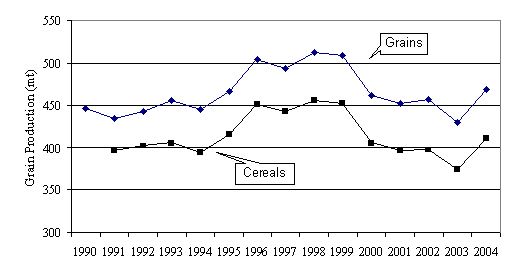
I think the better comparison is with the Soviet Union. The Soviet Union became the marvel of the world in the 1930s by moving relatively unproductive labor resources from agriculture into industrial production. That’s what China did, too. Unlike the Soviet Union China was able to accomplish that while actually increasing agricultural production. But that has largely ended:

And China’s working age population has peaked, largely due to the One Child Policy:

China can rescind the OCP but regardless more workers will still be decades away. And can China continue to abuse its soil, air, and water without reducing agricultural yields?

China may need to choose between its official policy of food independence and plowing money into industrial capacity. But will additional capacity actually yield more growth? Or has China’s already vast over-capacity effectively forestalled its future growth?

2 comments

Sweden’s Refugees

In an op-ed at the Wall Street Journal Foreign Policy editor James Traub remarks on the challenges that the refugees that Sweden has accept pose for the country:

The truth about refugees is complicated. Sweden offers a kind of laboratory in that regard: Almost all the non-Europeans in the country arrived as refugees. The Chileans, Iranians, Kurds and Bosnians have done very well; Eritreans and Somalis, less so. Labor-force participation and educational attainment among non-European immigrants are far lower than among native Swedes. Yet Sweden has one of Europe’s strongest economies.

The question that cannot yet be answered is how well the 100,000 or so Syrian, Iraqi, Afghan and other refugees who will be granted permanent residence in the country will integrate. Will they embrace Sweden’s extremely secular, extremely progressive culture? Probably not. Polls find that Muslim immigrants are vastly more conservative than native Europeans on matters of sex, family and the role of religion in public life.

I believe that’s something too little noted. The social and political views of the refugees that the United States accepted following World War II were by and large more liberal than those of the Americans who preceded them. Many arrived here intent on becoming 100% American.

The world is much changed since then and the social, political, and religious views of the new streams of refugees are significantly more conservative. Will they be as intent on fitting in to their new homes or insist they their new countries adapt to them, or, most likely, some of both? How will that work in the ethnic states of Europe? How will that work here?

Mr. Traub closes with a warning:

The answer to xenophobia cannot be xenophilia. For mobile, prosperous, worldly people, the cherishing of diversity is a cardinal virtue; we dote on difference. That’s simply not true for many people who can’t choose where to live, or who prefer the familiar coordinates of their life. That was the bitter lesson that British cosmopolites learned from Brexit. If the answer is to insist that the arrival of vast numbers of new people on our doorstep is an unmixed blessing, and that those who believe otherwise are Neanderthals, then we leave the field wide open to Donald J. Trump and Geert Wilders and Marine Le Pen.

0 comments