Yesterday I mentioned my niece, Tatiana, so I thought I might put a little context into things. Do you recall the family wedding I mentioned a month or so ago? The picture above was taken there. These are my nieces and nephews.
Tatiana is in red in the picture above. Her husband, Neal, my sibling’s second child, is standing behind her.
You might be interested in this interview at Science about deradicalization programs, programs that attempt to convince people to abandon extremist mindsets. Here’s a telling quote:
We know that in the vast majority of “lone wolf†cases, family and friends knew about the radicalization process or attack plan. Just look at the recent Manchester concert bombing case, where the attacker’s friends and community members made multiple attempts to alert the authorities. What deradicalization provides is a program in the middle acting as some sort of communicative bridge between security officials, family members, and communities. But the basic mechanism is the same across all groups: You need to have access to the radicalized person, identify the factors driving their ideology, design an intervention plan, and then track its impact.
That the record of deradicalization programs is spotty seems to me to be a reasonable criticism. Isn’t the lack of proven efficacy an equally valid criticism of bombing people and removing their governments?
As if we needed it, the evidence that human brains don’t mature until our early 20s continues to mount as reported by NPR:
Impulsive children become thoughtful adults only after years of improvements to the brain’s information highways, a team reports in Current Biology.
A study of nearly 900 young people ages 8 to 22 found that the ability to control impulses, stay on task and make good decisions increased steadily over that span as the brain remodeled its information pathways to become more efficient.
The finding helps explain why these abilities, known collectively as executive function, take so long to develop fully, says Danielle Bassett, an author of the study and an associate professor of bioengineering at the University of Pennsylvania.
“A child’s ability to run or to see is very well developed by the time they’re 8,” she says. “However, their ability to inhibit inappropriate responses is not something that’s well developed until well into the 20s.”
As the United States continues to lumber after its mutually contradictory objectives in Afghanistan, American analysts continue to struggle to justify our cognitive dissonance. Among the latest attempts is this fine summary of the situation in Afghanistan from Ehsan M. Ahrari at Small Wars Journal. Although I recommend that you read it in full, the section I want to point out is this tidbit on the role of Pakistan:
Pakistan is the only regional power that holds a few cards, in the context of pushing for negotiations between the Taliban and the government of President Ashraf Ghani. However, it also brings a lot of baggage with it. It is disliked by the Afghan government for its perceived hegemonic aspirations toward that country, and the Taliban do not place a lot of trust in Pakistan in its role as an honest broker. However, Pakistan remains important because it is willing to provide security havens for the Taliban and is a source for their arms.
Pakistan is the epitome of those mutually contradictory objectives. Pakistan is not our ally, probably plays host to more Al Qaeda members than any other country in the world, and is the implacable enemy of India, whom we should want to be an ally. As long as the Taliban can flee across the border into Pakistan with impunity we will never root them out. Pakistan remains the fourth largest recipient of U. S. aid.
There’s a simple reason for that. We need Pakistan’s cooperation to continue to prosecute our war in Afghanistan. It’s far cheaper to move fuel and war materiel through Pakistan than to get it into Afghanistan any other way.
My wife and I just finished watching the hooding ceremony as our niece completed her studies at the Cornell University College of Veterinary Medicine, live streaming on the Internet. Congratulations, Tatiana!
One of the economy’s biggest mysteries is this: The labor market is the strongest it has been in a decade, yet wages are rising barely faster than inflation.
For some reason, the booming job market and ultralow unemployment rate, which fell to 4.4 percent in April, haven’t led employers to raise pay in a meaningful way. That flies in the face of a basic assumption of how the economy works: A tight labor market is expected to lead to pay increases that in turn fuel broader inflation.
But the mystery of the missing pay raises may have a surprisingly simple solution, and one that sheds light on the larger economic challenges of our age.
can provide insight, I think he’s overplaying his conclusion. Yes, if inflation is low and productivity stagnant, you shouldn’t expect rapid wage growth. However, I think he’s reaching when he tries to explain a very recent turnaround with localized increases in the minimum wage: In the last few years, though, that trend has partly reversed: Workers’ slice of the pie has increased a bit. More than at any time since 1970, wage gains in the two years through June 2016 outstripped the gains predicted by inflation and productivity in our simple model.
Why? Minimum wage increases in several states probably contributed.
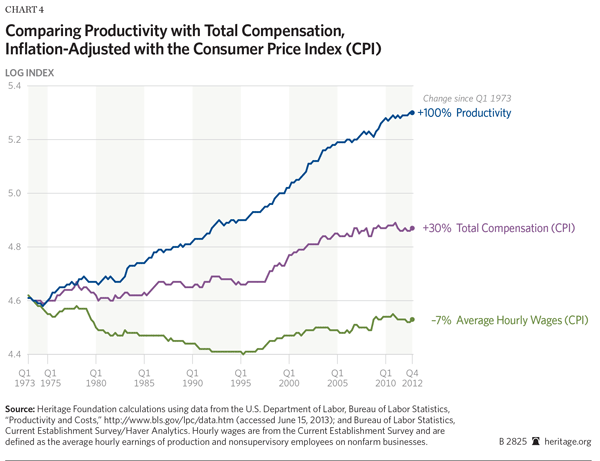
What percent of workers were affected by that change? I just don’t think it’s a credible explanation. There’s another one available. Consider this graph, graciously provided by Heritage.org:
Let me summarize that for you. For the last couple of decades Americans have been taking their pay increasingly in the form of health care insurance and the cost of that insurance has been rising rapidly.
If, as has been claimed for the last several years, health care expenses were not rising as fast as they had been, it means that employers might be able to offer more compensation in the form of wages.
Why, as the graph also illustrates, total compensation has lagged productivity so greatly for so long, remains an open question but it’s one that will need to wait for a later post.
“GIANFORTE GRABBED Jacobs by the neck with both hands and slammed him into the ground behind him.†That was Fox News reporter Alicia Acuna’s account of how Greg Gianforte allegedly assaulted Guardian reporter Ben Jacobs, the day before Mr. Gianforte won a special election to fill Montana’s at-large congressional seat. Along with an audio recording of the incident, the eyewitness accounts confirm that the now-congressman-elect engaged in brutish behavior. That he subsequently tried to blame Mr. Jacobs for the incident, in which the reporter was merely asking an honest question, makes Mr. Gianforte’s actions all the more inexcusable.
Inexcusable means inexcusable. The House, led by Speaker Paul D. Ryan (R-Wis.), who said “there’s never a call for physical altercation,†should have made clear that Mr. Gianforte would not be welcome in the chamber.
Historically, the Houses of Congress have had the power to limit their own membership. Ever since Powell v. McCormack the only grounds that either house of Congress has had for refusing to seat a member has been those specifically laid out in the Constitution. Shoving a reporter isn’t one of them.
I think that Paul Ryan should make it very clear to Mr. Gianforte that he’s not welcome in the House and do whatever lies in his power to follow through with that. Regardless of your feelings about reporters in general or the particular reporter involved, resorting to physical altercation is beyond the pale. Having principles means acting on them even when it goes against your interests.
Claims that this incident in Montana is emblematic of Republicans in general or of a grave disorder in our politics seem overwrought to me. There are more than a half million elected offices in the United States which means that there are more than a million candidates for office. One incident of battery doth not a trend make and claiming that it does sounds more to me like opportunism than analysis.
BTW, based on my experience as a juror in a case of battery, don’t be surprised if Mr. Gianforte is never convicted of anything or, if convicted, is merely given a nominal fine and probation. Battery is harder to prove than you might think. If my experience is any gauge it’s as indicative of malice on the part of the plaintiff as it is miscreance on the part of the defendant.
Yelp is beginning to play a role in helping patients with their health care decisions. But whether Yelp ratings will drive patients in the right direction—toward high-quality providers—is still unclear.
In an April 2017 New York State Health Foundation (NYSHealth)-funded study, the Manhattan Institute explored the extent to which Yelp ratings of hospitals in New York State correspond to objective outcomes measures across all of a hospital’s patients. The study found that higher Yelp ratings are correlated with better-quality hospitals and can offer consumers a useful, clear, and reliable tool that can be easily accessed. In short, for one very important measure—potentially preventable readmissions—Yelp ratings appear to have a moderately strong correlation with that measure. That is, higher Yelp scores for hospitals are associated with lower readmission rates. These results build on prior evidence that found a similar relationship between Yelp scores and Hospital Consumer Assessment of Healthcare Providers and Systems (HCAHPS) patient experience measures for the hospitals in the study.
But while this research has helped to move the needle on validating Yelp as an important asset in the tool chest of health care quality tools, there are still important questions left unanswered.
In fact, I think that the effect of the Internet, especially patients diagnosing their own conditions using Google, has probably to increase the cost of health care, at least at the margins.
The diagnosis or treatment that you want is not always the diagnosis or treatment that you need. I doubt that motivating physicians to accede to patients’ wishes is the right way to go. “Give the lady what she wants” is fine in retail. In the professions, not so much.
This article at Circa by John Solomon and Sara Carter on the FBI’s abusing the power it had been given by sharing the data it had received from warrantless wiretaps with third parties doesn’t really tell us anything we shouldn’t have already known. Governments can’t just be trusted with power. It will inevitably be abused because governments are composed of people not archangels.
It also suggests to us the likely outcome when protecting your institution is the highest value, a common failing of bureaucracies. It’s truly amazing what can be overlooked when your job depends on your overlooking it.