There’s a very interesting article at The American Interest you might want to read. The Reader’s Digest version is that just about every change in the economy, society, politics, and the media from the decline of ESPN to the election of Trump can be explained by “disintermediation”,
…innovation that undermines established or incumbent structures. It cuts out the middleman or middle layers in a process.
The American Interest speculates that progressives’ honeymoon with China will be short-lived, a consequence of President Xi’s crackdown on online content:
Nationalism and “healthy†family values are in, say the Chinese censors, while homosexuality and references to China’s past use of force against neighbors are out. And lest one think the guidelines were mere suggestions, the authorities have already begun to enforce them with severe force. As the FT reported last month, the government has already coerced top tech groups into deleting 300 mobile video platforms and firing 10,000 journalists who were in violation of the rules.
China has lately earned plaudits among Western liberal bien pensants for its paeans to the Paris agreement and rhetorical opposition to Trump’s protectionism. But China’s role as the liberal darling isn’t likely to last long as Xi turns key liberal beliefs into thought crimes.
They’re dreaming. One could hardly be less liberal than the Palestinians and they’ve been “liberal darlings” for the last 60 years. Before them the Soviets maintained that role for most of the 20th century, despite censorship of the media, active opposition to religion, and murdering tens of millions of their own citizens. There is a hierarchy of values and notionally liberal values fall way down on the list. The farce is strong with those ones.
Eiither someone at The New York Times doesn’t like Mayor Rahm Emanuel very much, or the Gray Lady needs to brush up on her history.
How else to account for the unfortunate evocation of murderous Italian fascist dictator Benito Mussolini in the headline NYT editors put on Emanuel’s op-ed column about his work to improve the CTA in Monday’s Times?
[…]
So Emanuel, who rides the “L” to work once a week, seized the chance to gloat that “Modernizing our existing mass transit is one reason Chicago’s economy has expanded faster than the economies of New York and Washington, and faster than the national average for the last five years.”
But the impact of the mayor’s boast may have been overshadowed by the headline, which called to mind the old fascist trope that you can “Say what you want about Mussolini, but at least he got the trains running on time.”
Emanuel spokesman Adam Collins said Times editors picked the headline. “They chose it,” he said.
CTA passengers may quibble with the mayor’s assessment of the “L.” But fascists, take note: Historians are in broad agreement that Mussolini did not, in fact, make the trains run on time.
Congratulations to Chicago for having a transit system that’s so popular with its passengers.
Now try getting them home without anyone getting shot.
That’s the message New Yorkers had Monday for Chicago Mayor Rahm Emanuel, who threw New York’s subway system under the bus while touting the Windy City’s mass transit approval rating.
While straphangers from Dyckman St. to Ditmas Ave. were swiping their MetroCards, Emanuel took a swipe at New York City in an off-the-rails column about the Big Apple’s mass transit woes.
In an op-ed for The New York Times Monday, Emanuel puffed his chest out about Chicago’s famed L (short for elevated), boasting of an 85% approval rating that is as high as the Windy City’s elevated tracks.
You’ve got to ask two questions about the Mayor Emanuel’s op-ed. Why did he go to the New York Times? There’s something unseemly about it. And why did he pick touting his record with the CTA rather than Chicago’s more basic problems?
I think the answers are that other than the CTA he’s been a complete failure as mayor (is he really responsible for the CTA’s success?) and that the audience for the op-ed doesn’t use mass transit either in New York or Chicago. Their limo drivers take them wherever they want to go. He’s appealing to his small but select donor base, more likely to read the New York Times than the Daily News or the Tribune.
We should also consider that he may be raising money and burnishing his national credentials for a presidential bid in 2020. It’s pretty obvious that he isn’t particularly interested in Chicago.
I’ve been a journalist for a long time. Long enough to know that it wasn’t always like this. There was a time not so long ago when journalists were trusted and admired. We were generally seen as trying to report the news in a fair and straightforward manner. Today, all that has changed. For that, we can blame the 2016 election or, more accurately, how some news organizations chose to cover it. Among the many firsts, last year’s election gave us the gobsmacking revelation that most of the mainstream media puts both thumbs on the scale — that most of what you read, watch and listen to is distorted by intentional bias and hostility. I have never seen anything like it. Not even close.
It’s not exactly breaking news that most journalists lean left. I used to do that myself. I grew up at the New York Times, so I’m familiar with the species. For most of the media, bias grew out of the social revolution of the 1960s and ’70s. Fueled by the civil rights and anti-Vietnam War movements, the media jumped on the anti-authority bandwagon writ large. The deal was sealed with Watergate, when journalism was viewed as more trusted than government — and far more exciting and glamorous. Think Robert Redford in “All the President’s Men.†Ever since, young people became journalists because they wanted to be the next Woodward and Bernstein, find a Deep Throat, and bring down a president. Of course, most of them only wanted to bring down a Republican president. That’s because liberalism is baked into the journalism cake.
In essence he makes several points. The first is something has genuinely changed in the media.
The evidence was on the front page, the back page, the culture pages, even the sports pages. It was at the top of the broadcast and at the bottom of the broadcast. Day in, day out, in every media market in America, Trump was savaged like no other candidate in memory. We were watching the total collapse of standards, with fairness and balance tossed overboard. Every story was an opinion masquerading as news, and every opinion ran in the same direction — toward Clinton and away from Trump.
He blames the New York Times and the Washington Post for abandoning any vestige of journalistic integrity:
For the most part, I blame the New York Times and the Washington Post for causing this breakdown. The two leading liberal newspapers were trying to top each other in their demonization of Trump and his supporters. They set the tone, and most of the rest of the media followed like lemmings.
It didn’t used to be this way:
The Times’ previous reputation for having the highest standards was legitimate. Those standards were developed over decades to force reporters and editors to be fair and to gain public trust. The commitment to fairness made the New York Times the flagship of American journalism. But standards are like laws in the sense that they are designed to guide your behavior in good times and in bad. Consistent adherence to them was the source of the Times’ credibility. And eliminating them has made the paper less than ordinary. Its only standards now are double standards.
And the change is irreversible:
Which brings us to the crucial questions. Can the American media be fixed? And is there anything that we as individuals can do to make a difference? The short answer to the first question is, “No, it can’t be fixed.†The 2016 election was the media’s Humpty Dumpty moment. It fell off the wall, shattered into a million pieces, and can’t be put back together again. In case there is any doubt, 2017 is confirming that the standards are still dead. The orgy of visceral Trump-bashing continues unabated.
I think that the likely outcomes of all of this are that the media conglomerates will continue their downward spiral and the present tendency for different factions to have their own facts will only accelerate.
Arash Shirazi is a pretty cosmopolitan guy. A music agent and filmmaker, he hangs out with creative types and bohemians. He’s lived in L.A., and spent time in cities such as, yes, Amsterdam, so it’s fair to say that he’s not particularly prudish in his social life.
And yet. . . leaving a Washington parking lot recently, he took pause when a distinctively skunky scent passed under his nostrils.
Of course he’d smelled marijuana before. But this was a weekday afternoon — in Georgetown!
“I was surprised,†he explained. “Georgetown’s a bit more buttoned-up.â€
Well, that’s what they used to say about Washington in general. But now, more than two years after the District legalized marijuana possession, it seems that everywhere you go in the nation’s capital, you catch a whiff of weed. And it’s often in the places where you least expect it.
On H Street downtown, as you wind your way between officeworkers rushing back from lunch.
At 10th and E, in the shadow of the FBI headquarters.
It’s everywhere and all of the time.
Sounds like a credible explanation to me. It would be a shame if they were behaving the way they are straight and sober.
For those of you who have just tuned in, here’s a summary of Illinois’s fiscal situation.
The state hasn’t passed a budget in three years.
The ratings agencies have threatened to downgrade Illinois’s credit rating again if it fails to enact a budget.
The next downgrade will put Illinois’s debt a junk status.
Since many institutions are required by their governance rules to purchase only instruments of investment grade, that will greatly limit the pool of possible purchasers of Illinois’s debt.
Illinois’s House just voted to raise the state’s personal income tax by a third.
The state’s Senate is expected to approve the House’s tax increase.
Gov. Rauner’s staff has said that he will veto the measure.
The bill passed the House with enough votes to override Rauner’s veto.
Consequently, unless Gov. Rauner can turn some votes a veto would be symbolic.
Illinois’s constitution requires the state to have a flat tax, i.e. the state legislature does not have the power to impose a graduated income tax.
Illinois’s constitution requires the state to pay the public employee pensions it’s promised. That’s been fully litigated and is unambiguous.
Changing that would require a constitutional amendment which is not politically possible.
The ratings agencies might decide to downgrade Illinois’s credit rating any way. Republicans are portraying Illinois’s problems as being mostly or solely due to Mike Madigan, Speaker of the Illinois House. Democrats are portraying Illinois’s problems as being mostly or solely due to Gov. Rauners unwillingness to compromise. What compromises have they offered? A tax increase now in exchange for what later? I will gladly pay you Tuesday for a hamburger today.
I don’t think that anyone really believes that raising Illinois’s personal income tax will solve its fiscal problems. After the tax increase the rate will be within .05% of where it was when Gov. Rauner took office. The state legislature couldn’t straighten out Illinois’s fiscal problems then; it certainly won’t be able to with that tax increase.
Illinois’s basic problem is that its tax base is declining while its liabilities increase. The solutions available to it are quite limited and none of them are appealing to the legislature’s Democratic leadership in the slightest.
It should have converted all public employees to a defined contribution plan decades ago. It can give present public employees a big haircut. It can reduce the number of public employees substantially. You can see how Democrats, who derive much of their shall we say durability from public employee labor union support, would find those measures difficult to stomach.
A therapy-animal trend grips the United States. The San Francisco airport now deploys a pig to calm frazzled travelers. Universities nationwide bring dogs (and a donkey) onto campus to soothe students during finals. Llamas comfort hospital patients, pooches provide succor at disaster sites and horses are used to treat sex addiction.
And that duck on a plane? It might be an emotional-support animal prescribed by a mental health professional.
The trend, which has accelerated hugely since its initial stirrings a few decades ago, is underpinned by a widespread belief that interaction with animals can reduce distress — whether it happens over brief caresses at the airport or in long-term relationships at home. Certainly, the groups offering up pets think this, as do some mental health professionals. But the popular embrace of pets as furry therapists is kindling growing discomfort among some researchers in the field, who say it has raced far ahead of scientific evidence.
I also have some reservations about it. My first reservation is that the author of the article is conflating different things as though they were one thing. No distinction is made among therapy animals, service animals, and comfort animals and, well, they’re very different. Here’s a quick example of a difference. If someone asks if you want to pet his or her dog, it’s probably not a service dog.
Part of what I think is going on in the United States is a sort of pendulum swing. By comparison with some other countries dogs in particular are very restricted. In France seeing dogs in restaurants or stores is a commonplace (the French tend to ignore “No Pets” signs). Today more and more businesses, e.g. Amazon, allow workers to bring their pets with them to work. If we were less restrictive here, perhaps so many people wouldn’t be looking for pretexts for bringing their pets with them.
And there are some people who don’t like that one bit. Some people have cultural problems with it.
My other reservation is that just because something doesn’t have iron clad proof doesn’t constitute iron clad proof that it’s ineffective. In the past we have spent billions supporting programs that are now considered suspect. When something is cheap and benign it deserves to be cut a little slack. I think that more attention should be devoted to ensuring that the practice is benign.
The reality is that not every person should have animals and not every animal is a candidate for every setting.
In honor of Canada’s 150th birthday, Bill Gardner provides what to my eye is an excellent primer on Canada’s health care system which American supporters and opponents both misunderstand. Among the misconceptions are that it’s not a federal program, although its administrative costs are lower than ours they’re higher than those of most other OECD countries, and by U. S. standards it’s a small program—just about half as many people are covered by it as are covered by Medicaid here. Another important feature: Canada’s health care system covers a small percentage more of total health care expenses than is the case when you combine all of the various local, state, and federal programs here. In other words Canada’s system is cheaper than ours because health care is cheaper there, not the other way around.
Basically, my view of Canada’s health care system is that it would be a good model for us if we had Canada’s immigration laws, didn’t have a 1,500 mile land border with Mexico, and health care were a lot cheaper here. As it is, it’s a good system for Canada but not a model for us.
CHICAGO — On Thursday, in the wake of a subway derailment and an epidemic of train delays, Gov. Andrew Cuomo of New York declared a state of emergency for the Metropolitan Transportation Authority, the busiest mass transit system in America. That same day, the nation’s third-busiest system — the Washington Metropolitan Area Transit Authority — handed out coupons for free coffee to riders stuck in the second year of slowdowns caused by repairs to prevent chronic fires.
Meanwhile, in Chicago, a recent survey found that 85 percent of passengers are satisfied with service on our transit system, the nation’s second most used.
The L, Chicago’s system, turned 125 this year. The elevated railway began as four wooden cars powered by coal and steam. Last year, more than 238 million rides were taken on the system, which, unlike the ones in New York and Washington, has not been troubled by systemic failures, breakdowns and delays. Even during a 28-day stretch of arctic temperatures in 2014, the L was never interrupted.
How have we done it?
He lists two factors:
Putting reliability ahead of expansion.
The CTA’s management structure works.
There’s a name for his first factor: making a virtue out of necessity. The CTA serves fewer riders than it did when Rahm Emanuel became mayor and less money is available for operating it. Obviously, the need for expansion is reduced. There’s also a name for the second claim: political posturing.
As the late Mayor Daley was known to say, let’s look at the record.
1. Chicago’s population has continued to decline under Emanuel.
CHICAGO — Chicago lost an estimated 8,638 residents in 2016, the third consecutive year the city saw a dip.
The city led all American cities in population loss, an expected title after the U.S. Census Bureau released data earlier this year that Cook County as a whole lost an estimated 21,000 people last year.
Chicago has lost just 0.3 percent of its population since 2015, but 2016 marked the year of its largest population drop in a three-year slump. In 2015, the population dropped about 4,934 people, and the year before it dropped by 357 people.
and most of those who have left are black. The white population is actually increasing.
2. Chicago’s homicide rate has risen to historic levels.
According to HeyJackass! more Chicagoans are murdered every year under Emanuel than under his predecessor, the number of homicides is higher than it was at this time last year, and the homicide rate per 1,000 population is higher than any time in decades, possibly the highest ever.
3. The Chicago Police Department’s homicide clearance rate is abysmally low.
When he took office the one year clearance rate was almost 30%. Now it’s 20%.
4. Chicago’s credit rating has fallen to near junk status under Emanuel.
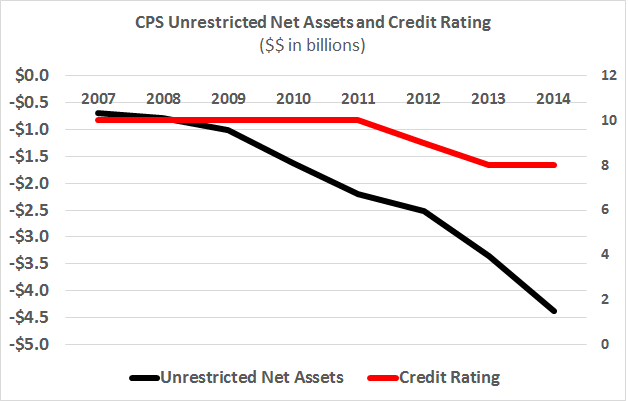
When he took office the city’s credit rating was AAA. Now it’s Baa, moving towards junk. Here’s a graph of the CPS’s falling credit rating:
5. Property values have continued to fall under Emanuel.
Consider this graph:
6. Property taxes are rising sharply.
Tax bills came out last week and many Chicagoans may have been surprised to find their taxes are 10% higher this year than last despite flat or declining property values.
Congratulation are in order for the city of Chicago. According to the web site HeyJackass!, my augur on such things, as of yesterday the number of homicides year-to-date in the city in 2017 has exceed the the number as of that date in 2016 which was the highest in absolute numbers in decades and in all likelihood the highest rate per 1,000 population ever.
Way to go, Rahm. You’ve failed in your most basic responsibility to the city.