What Doomed the Revolution?

In this centenary year of the Russian Revolution (there were actually two of them—the February Revolution and the October Revolution) much is being written about it. The New York Times, following in a long-standing American tradition, cf. Ten Days That Shook the World and the movie inspired by it, Reds, is romanticizing it. In his article at The Week Ryan Cooper probes into a lot of the political machinations and minutiae of the Russian Revolution in an exploration of how the revolution went wrong:

But it is simply not the case that Marxism — an arid and over-elaborate doctrine, very interesting in some ways and clearly mistaken in others — is some turn-crank formula for purges and dictatorship. All the European labor parties were officially Marxist for decades, which led only to generous welfare states and some experimentation with government-owned industry. The Nordic countries became the most decent nations that have ever existed through policies that have direct roots in an early 20th century socialist movement that was fervently Marxist.

So if Marxism didn’t doom the Russian revolution, what did?

The obvious culprit is the incomprehensible chaos and brutality of its circumstances. Immediately before the revolution, something like three million Russians had died in the First World War. The rapid collapse of Tsarism and the Provisional Government empowered the most hardline and radical factions on all sides. Immediately after the revolution, the Bolsheviks had to fight a civil war against virtually every other faction in Russia, many of them murderous reactionaries armed by Western powers. Winning required yet more brutal tactics and fighting, killing roughly 10 million more people in the process. It’s at that point when truly awful authoritarianism started to set in.

Make no mistake: the revolution was a colossal failure. Regardless of the dreamy suppositions of its supporters, particularly here in the United States, it did not usher in a workers’ paradise. It resulted in the deaths of tens of millions of Russians and stunted Russia’s economic, political, and social development for most of the last century.

What doomed the revolution was the revolution. Although they may carry the guns and wave the pitchforks, revolutions are not started or won by peasants and workers. They are always internecine warfare, pitting one group of elites against another. That has been true of every revolution from the Glorious Revolution 400 years ago to the American, French, and Russian Revolutions, Mao’s Long March, and the Cuban Revolution of 60 years ago.

William of Orange, George Washington, Marat and Robespierre, Lenin, Mao, and Castro were neither workers nor peasants.

Russia had no group of even more or less benign but decisive liberal democrats waiting in the wings to assume power. They had the corrupt, brutal aristocracy or the corrupt, brutal intelligentsia.

In the case of the Russian Revolution a group of intellectuals led by Lenin replaced the Tsarist aristocracy. The mechanics of the revolution and human nature ensured its failure.
6 comments

You’re Tearing Me Apart

I think I see the terrible incidents at Charlottesville in much same light as Jason Willick does at The American Interest:

We’ve had polarization and culture wars before. This is different. This feels different. Stretching back at least to Dylann Roof’s mass murder of black congregationalists in 2015, the country has been getting pushed closer and closer to the edge. The summer of 2016 saw the assassination of five police officers in Dallas by a black activist. Donald Trump’s rhetoric as a candidate flirted with political violence over and over again. And since his election, the temperature has only been escalating. A Montana congressional candidate physically attacked a reporter. There have been campus riots against right-wing speakers, and clashes between Leftists and neo-Nazis on the streets of Sacramento and elsewhere. It was less than two months ago that an anti-Trump activist opened fire on a group of Republican Congressmen playing baseball in Alexandria.

The events in Charlotesville—in which a neo-Nazi ran down anti-racist protesters after a white supremacist march, killing at least one person and injuring many more—were distinctively hideous. The anti-civilizational fascists of the alt-right, no longer confined to marginal online forums, were out in force in a storied American town, maiming people on the streets. The President whom they openly admire (former Klansman David Duke praised him in an interview at the march) deliberately equivocated when given the opportunity to condemn them. Maybe he was egging them on, or maybe he is simply so narcissistic that he cannot distance himself from anyone who has offered loyalty. It doesn’t matter. Neo-Nazi blogs delighted at the President’s non-response. Fascists are emboldened. More on the far-Left will become convinced that racism cannot be fought adequately within the political system.

Like him I don’t really see an escape route from the cycle we’ve entered. Only events will tell and an external event of sufficient magnitude is itself too terrible to contemplate.

16 comments

Middle Aged Spread

In his most recent Washington Post column Robert Samuelson reveals that he has just now become aware that big, old companies in the U. S. have become lazy and are holding the more general economy back:

Bolstering the case is a new study, published in the Journal of Economic Perspectives by Kathleen M. Kahle of the University of Arizona and René M. Stulz of Ohio State University. The scholars examined all U.S. public companies over a 40-year period, from 1975 to 2015, and found pervasive evidence of a two-tiered capitalism. Companies are sorting themselves into the strong and the weak.

(Recall: A public company has shares that are traded, typically on a stock exchange. Private firms, including most small and family businesses, are not publicly traded.)

Profits became more concentrated, especially among large tech firms. In 2015, Apple, Google, Microsoft and Amazon had combined profits of $82 billion, fully 10 percent of all profits of publicly traded companies. In 1975, 109 firms accounted for half the profits; by 2015, 30 companies did. More disturbing, companies below the top 200 reported negative earnings as a whole; many of these firms had significant losses.

A similar story applies to corporate investment in buildings and machinery (computers, vehicles). From 1975 to 2015, this capital investment has dropped from 8 percent of corporate assets to 4 percent. Interestingly, this decline in investment was mostly offset by increases in corporate research and development (R&D) — reflecting the need to develop new digital products and programs, say Kahle and Stulz. But the R&D spending was heavily skewed toward bigger firms. Half of publicly traded firms showed no R&D.

Big companies are older now, have grown through mergers and acquisitions, and are paying more out in dividends than ever before (although at typically low rates relative to capitalization).

While I’m glad that the scales have fallen from Mr. Samuelson’s eyes, it’s too bad it couldn’t have happened 15 years ago. Small companies’ business plans consisting of being acquired by, say, Microsoft are hardly new. It was commonplace 25 years ago.

Here’s a revolutionary plan for addressing whatever problems the dominance of large companies produce. Stop subsidizing them. Enforce the anti-trust laws. Let them succeed or fail based on their own efforts and merits rather than on how much the politicians and regulators like them.

An idea so crazy it might work.

2 comments

Partisan Contradictions

At The Hill Alan Dershowitz notes that Democratic politicians are condemning behaviors they would undoubtedly tolerate in a president of their own party while Republicans tolerate behaviors they would condemn in a Democrat. He declaims:

The time has come for all Americans who believe in enduring principles of morality and justice to insist on consistency. Ralph Waldo Emerson was wrong when he demeaned “foolish consistency” as “the hobgoblin of little minds, adored by little statesmen and philosophers and divines.”

Consistency of principles is neither foolish nor small-minded. It is the essence of any moral system. Principled consistency may be difficult to achieve, especially in our current hyper-partisan atmosphere. But if we are ever to end the partisan bickering and name-calling that is coarsening dialogue and making reasoned compromise impossible, we must insist on a single standard of legality and morality that applies equally to Democrats and Republicans. We are far from that in the current shouting match in which each side calls the other “criminal,” “racist” or worse.

We must declare an armistice in this divisive war of words and agree to do unto your political opponents what you would have your political opponents do unto you. That golden rule of consistency should be as applicable to political debate as it is to personal morality.

On what would these “enduring principles of morality and justice” be based? Exigent circumstances don’t seem like a good base for them. If human nature is infinitely malleable, no enduring principles can be enunciated based on that nature. Blut und Boden?

I’m at a loss.

2 comments

Land of Contradictions

Once you set out to expunge American history of anything you find offensive I wonder what will be left? Washington, Jefferson, Monroe, and Madison all owned slaves as did Andrew Jackson. Wilson was a racist. Franklin Roosevelt was a racist. Jack Kennedy’s father was at the least a Nazi appeaser and at the worst a sympathizer. He was certainly anti-Semitic.

Lyndon Johnson was a racist. Nixon was a racist. Jimmy Carter and Bill Clinton both wrote in praise of the Daughters of the Confederacy and are proud Southerners. Barack Obama had slaveowners on both sides of his family.

The United States is a land of contradictions. It is a land of freedom. It is a land of slavery. It is a land of opportunity. It is a plutocracy in which whites have advantages.

The contradictions are not flyspecks, mere unpleasant details in a history otherwise free of blemish. They’re an intrinsic part of the country.

I have no idea why people cling to a country they find intolerable.

1 comment

Omission Hurts

I think that the editors of the Chicago Tribune have it about right on the riot in Charlottesville and President Trump’s reaction to it:

Trump can’t be blamed for the rioting in Virginia. But the haters and stooges of white nationalism see something in the president that gives them permission to act out. Trump is no oratory giant. He’s a sloppy speaker whose nasty streak on the campaign trail acted as a dog whistle to the ugly right. Whether by design or carelessness, Trump avoided calling out the haters by name Saturday. That omission hurts.

He was right, though, to say that Saturday’s tragedy should be seen as a starting point for reflection. “We want to get the situation straightened out in Charlottesville, and we want to study it,” he said. “And we want to see what we’re doing wrong as a country, where things like this can happen.”

Whatever one may think of it the United States will be decreasingly a Western European-descended, Christian country than it has been for its history. We will either come to terms not just with that reality but with that history or we will tear ourselves apart. If you can’t love a country whose history is at times unlovely, there is no country that you can love. Living in a country whose history you can’t bear to look at and that you are unable to love doesn’t sound like a winning formula to me.

9 comments

Not Every Weather-Related Phenomenon Is Climate Change

I have high confidence that human action has caused, is causing, and will cause major changes in the environment. You only have to look at places where overgrazing has turned prairies into deserts to believe that’s the case. Another obvious example: the urban heat island effect and its consequences for local weather patterns.

My confidence in the climate change models relying on carbon emissions for their predictions is somewhat less. I think that emitting too much carbon dioxide is bad but I don’t know how bad or over what timeframe. My confidence in the policy proposals put on the table so far to remedy the problem nears non-existence.

All of that having been said the agonistic blaming of every weather-related phenomenon on climate change has reached absurd proportions. Earlier this week I noted the folly of blaming smoky air in Seattle on climate change. Here’s another example. The recent flooding in New Orleans was not caused by climate change. It was caused by pump failure as this Daily Caller post retorts:

New Orleans Sewerage and Water Board director Cedric Grant blamed widespread flooding over the weekend on “climate change,” but it wasn’t long before news broke that broken water pumps were actually to blame.

Throughout the week, media reports have shown that New Orleans’s antiquated water pumping system failed to keep flooding at bay, and the problem hasn’t been resolved.

The mayor’s office warned Thursday morning a fire had taken out a turbine that powers most water pumping stations in the East Bank of New Orleans.
With more heavy rain forecast for this week, Mayor Mitch Landrieu is asking residents to prepare for flooding. August is also hurricane season, a time when pumping stations are vital to keeping storm drains from being overwhelmed.

That’s a very different message from city officials earlier in the week when Grant blamed flooding over the weekend on climate change.

It reminds me of the people who persistently build in and farm the flood plain of the Mississippi, something I’ve been complaining about intermittently since I began posting here nearly 20 years ago. It really needs to be said. New Orleans is a lousy place for a large city. About half of the city is below sea level.

And New Orleans isn’t an isolated instance. The sinkhole outside Tampa Bay that’s made national news shows just how nuts things have become. What in the world do you expect when you build on a swamp?

It would seem to go without saying but apparently not. Swamps (Miami, Tampa, New Orleans), sandy beaches (Miami, Long Beach), and places without abundant natural water supplies (Los Angeles, Phoenix) are all lousy places for major cities.

4 comments

What Are the Implications of Mass Utilization of EVs?

Speaking of thought-provoking, I found that Jenna Hermann’s post at UtilityDive about the potential implications of the Tesla 3 might be for electrical utilities:

Coupled with flat or declining load growth, changing regulations, increasing customer demand, and new technology penetration, these challenges have given the electric utility industry good reason to describe its future as “threatened.” These trends, each exacerbating the others, mean essentially that utilities can no longer rely on traditional ways of doing business.

EVs have significant potential to help relieve the industry’s pessimistic outlook. This article will explore what EV growth could mean for utilities and how they can begin establishing critical foundations today to help ensure their ability to exploit this opportunity.

At the Bloomberg New Energy Finance (BNEF) Global Summit 2017, BNEF Advisory Board Chairman Michael Liebreich announced the group’s prediction that electric vehicles will comprise 35-47 percent of new vehicle sales globally by 2040.

U.S. utilities have good reason to be optimistic about this potential new revenue source. If all 236 million gas-powered cars in the U.S. — average miles driven per year: 12,000 — were replaced with electric vehicles, which travel an average of 100 miles on 34 kWh, they would require 956 billion kWh each year. At a national average cost of $0.12 / kWh, the incremental energy sold by utilities in the U.S. would bring in around $115 billion per year in new revenues. A variety of factors could increase or decrease this number, but it still represents an attractive opportunity for the utility sector.

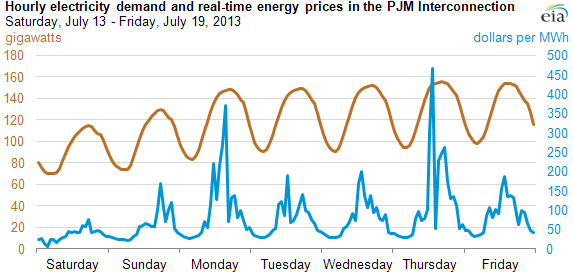
Frankly, I’m suspicious of the claim, examined here, that the present electrical grid is capable of supporting the mass adoption of electrical vehicles. The problem that I see isn’t a capacity problem; it’s peak load.

Courtesy of the U. S. Energy Information Agency, here’s a graph of electricity utilization during the week of July 13-July 19, 2013:

Adding one EV per neighborhood grid is roughly the equivalent of adding an additional house to it. In other words it increases the load on its grid from between 10% and 20%. Replacing half of the present internal combustion vehicles with EVs would be about the equivalent of increasing the load on neighborhood grids between 50% and 100%.

Consider that in the context of the graph. The entire curve would be raised between 50% and 100%. Peak load would be even worse because utilization isn’t distributed evenly through the day. I would expect surges in use between 9:00am and 1:00pm Central Time and between 5:00pm and 9:00pm Central as millions of people arrived at work and recharged their EVs or returned home and ditto.

Failure of power substations is dependent on a variety of factors including age, utilization, load, and environmental conditions. Under the most favorable possible circumstances one would expect more failures with increased utilization. However, the increased peak load would make the situation that much worse. Expect more substation problems.

Additionally, such problems tend to be preceded by surges. That would increase the likelihood of a cascading failure.

Consequently, the implications of EVs for the electrical utilities include not just a bonanza of increased utilization but greater risks as well in the form of increased maintenance costs and reduced reliability.

There are implications for government, too. Use of EVs cut into gas tax revenues. There have already been calls for new fees for EV users to make up the difference. As utilities’ revenues increase and the reliability of their service decreases, expect calls for additional scrutiny on them.

2 comments

Focusing the Mind

I don’t think that George Friedman’s recent musings on the situation in North Korea did much to inform me but it did help me to bring my thoughts more into focus. Here’s the gist.

The notion that North Korea with nuclear weapons is safer than North Korea without them is wrong. Although that’s the prevailing explanation for their pursuit of nuclear weapons, it doesn’t conform to the facts. The United States isn’t interested in North Korea as such and, frankly, has shown no evidence for decades that it is. We only become interested in it when it threatens us or its neighbors.

However, being “ferocious, weak and crazy” in Mr. Friedman’s phrase increases North Korea’s leverage and its options. Would anyone be talking about entering into negotiations (for what?) with North Korea if North Korea were mild and sane? I don’t believe it. And the possession of a formidable selection of weapons, e.g. nuclear weapons, intercontinental ballistic missiles, shorter range missiles, midget submarines, light and heavy artillery, gives North Korea the potential to become a supermarket for terrorists and dictators.

That provocation is North Korea’s strategy makes it all the more likely that they’ll use the weapons they have. That North Korea has engaged in drug trafficking, human trafficking, arms trafficking, and counterfeiting in the past to support its activities suggests that it’s likely to do so in the future.

3 comments

Reading the Last Page First

When I read the title of Eli Lake’s post at Bloomberg View, “The Alternative to Nuclear War Is a Revolution”, I immediately turned to it. Somewhat to my surprise he meant in North Korea rather than here:

The most depressing aspect of the current North Korean crisis is that even if Donald Trump wins, he loses.

Despite doubling down on his rhetoric of “fire and fury” and deriding his predecessors for failed negotiations, Trump looks like he wants to eventually strike a deal with the nation’s tyrant, Kim Jong Un. Just look at what Secretary of State Rex Tillerson is doing. Trump threatens war and Tillerson promises no regime change. Remember it was only a few months ago that Trump said he would be honored to meet with Kim. The president’s recent bellicosity aims for deterrence and leverage.

In substance, if not style, this is very similar to how past administrations have approached the Hermit Kingdom: threaten, cajole and bargain. “This is Obama plus,” Michael Auslin, a Korea expert at the Hoover Institution, told me. “It’s the same path of enhanced sanctions with the potential carrot of direct negotiations and trying to reassure our allies. There is not much different here.”

He calls for patience and imagination in our dealings with North Korea:

The imaginative part is to continue to give North Koreans a glimpse of a better future. Tom Malinowski, who served as President Barack Obama’s assistant secretary of state for democracy, human rights and labor, wrote in Politico in June that the U.S. should continue to flood North Korea with information. This may sound strange. But in recent years, the state’s ability to control information has waned. More and more Koreans living there have access to portable DVD players and cell phones, which are tools to break the state’s control over the minds of their citizens.

That’s actually the argument for normalizing relations with North Korea as quickly and as much as possible, sometimes called the “blue jeans strategy”. It has been claimed that one of the factors behind the fall of the Soviet Union was due to Western visitors bringing blue jeans and other consumer goods in plenty on their trips to the Soviet Union. It gave the lie to the Kremlin’s propaganda claims.

I think he’s underestimating how totalitarian the Kim regime is.

3 comments
