It Ain’t Me, Babe

Whenever I read an article like this one at Vox:

In America, breakfast is often nothing more than disguised dessert, as this tweet from author and researcher Alan Levinovitz reminded us:

it underscores how different my diet is from that of most Americans. For years I’ve eaten the same breakfast, 365 days a year: one soy sausage link, one Egg Beater (or whole egg), oatmeal with almond milk and a handful of berries (fresh or frozen).

No chocolate, no sugar, lots of fiber, lots of protein, fairly low in fat.

9 comments

Is That Really Our Primary Geopolitical Challenge?

I have grave problems with this:

US Defense Secretary James Mattis today outlined a new vision for the Pentagon that seeks to counter Iran and other nations that the United States accuses of pursuing a world order aligned with authoritarian values.

The new National Defense Strategy envisions America’s military focusing on combating authoritarian ideals rather than the protracted global war on terror. The announcement comes as the Donald Trump administration has made clear in recent days that it plans to keep 2,000 US troops in Syria indefinitely to help usher in a political process to replace President Bashar al-Assad and confront Iranian influence in the country.

as reported by Jack Detsch at Al-Monitor. Not only do I not think that Iran is our most serious geopolitical challenge, I don’t think it’s our most serious geopolitical challenge in the Middle East. That would be Saudi Arabia.

Iran isn’t the greatest state sponsor of terrorism; that would be Saudi Arabia. Iran isn’t sponsoring radical imams all over the world; that would be Saudi Arabia. Iran isn’t pursuing a war of aggression; Saudi Arabia is. I don’t think that Iran’s mullahocracy is benign but neither is Saudi Arabia’s version of theocracy.

IMO we should be trying to promote a balance of power in the Middle East rather than siding with either the Saudis or the Iranians. Just because the Israelis have a burr under their collective saddle about the Iranians isn’t enough reason for us to take sides with the Saudis against them.

3 comments

This Isn’t the 1920s

I recommend that you read Amity Schlaes’s lengthy history of economic growth and inequality at City Journal. In it Ms. Schlaes’s thesis is, basically, that growing economies tend to become more equal:

The geeky Gini metric fails to capture the American economic dynamic: in our country, innovative bursts lead to great wealth, which then moves to the rest of the population. Equality campaigns don’t lead automatically to prosperity; instead, prosperity leads to a higher standard of living and, eventually, in democracies, to greater equality. The late Simon Kuznets, who posited that societies that grow economically eventually become more equal, was right: growth cannot be assumed. Prioritizing equality over markets and growth hurts markets and growth and, most important, the low earners for whom social-justice advocates claim to fight. Government debt matters as well. Those who ring the equality theme so loudly deprive their own constituents, whose goals are usually much more concrete: educational opportunity, homes, better electronics, and, most of all, jobs. Translated into policy, the equality impulse takes our future hostage.

Consequently, the objective of policy should be growth rather than equality. So far, so good.

What made me uncomfortable about the piece is that Ms. Schlaes doesn’t seem to appreciate how different conditions are now than they were in the 1890s or the 1920s, other periods of great income inequality. Back in the day the federal government comprised a very small proportion of GDP—about 3%. Now it’s almost 25%. Then the CEOs of big companies didn’t rely on government muscle and support. Now they do. Big banks in particular know with a confidence based in experience that they won’t be allowed to fail. John D. Rockefeller, war profiteer that he was, didn’t really rely on the federal government for his wealth. He was an entrepeneur, as were Henry Ford, Gardner Hubbard, and Tom Edison. Nowadays a dominant business model is seeking government grants, cf. Elon Musk, or to become just successful enough to be acquired by a company that relies on the government for its wealth and power.

I would counter Ms. Schlaes that the objectives of policy should neither be economic growth nor income equality but social equality and freedom.

6 comments

What Does It Say?

Earlier in the week I mentioned Amazon’s short list for its second headquarters. The finalists are Atlanta, Austin, Boston, Chicago, Columbus, Ohio, Dallas, Denver, Indianapolis, Los Angeles, Miami, Montgomery County, Md., Nashville, Newark, New York City, Northern Virginia, Philadelphia, Pittsburgh, Raleigh, N.C., Toronto and Washington, D.C.

I’ve already expressed my opinion that the selection of any of them has implications about Amazon and how its managers think of the company and its future. Selecting Chicago, for example, would be potent evidence that they had taken leave of their senses. I’ve mentioned that I think the most likely winner is Atlanta but what would that mean? I think it would mean that Amazon sees itself as a global company and wants to be more connected to Europe, Africa, and South America than it presently is with its headquarters in Seattle.

Lots of people are touting Washington, DC as the eventual favorite. What would that say about the company? I think it would say that Amazon sees its primary business as rent-seeking.

14 comments

The Sources of Liberalism

I can’t say that I’m impressed by Sheri Berman’s argument at Dissent to the effect that we should be pleased with the mobocracy in the Middle East on the grounds that, ultimately, it will promote increased liberalism:

France—the birthplace of both modern democracy and illiberal democracy—is a critical and revealing case. When the French rose up against the world’s most powerful dictatorship in 1789 many hoped it was the dawn of a new era, but the transition soon went awry. In 1793 the king was executed and a republic with universal male suffrage and a commitment to a broad range of civil and political rights was declared. But Europe’s first modern democracy did not last long, descending quickly into the so-called “Reign of Terror” in which 20,000–40,000 people were executed for “counter-revolutionary” activities. The English political theorist Edmund Burke was only the most well-known conservative critic to argue that France’s experience showed the dangers of democracy and the need to restrain the people and their passions. But Burke and the other critics were wrong. Even though France’s first democratic experiment slid quickly into illiberalism and then dictatorship, eliminating the ancien régime made a profound contribution to the eventual development of liberal democracy. It did so by replacing a feudal economic and social order with a market system based on private property and equality before the law, and embedding in France (and spreading across Europe) the idea that society was composed of equal citizens, rather than functionally different hereditary groups (such as nobles or peasants).

because I think it relies on a fundamental misconception about societies, institutions, and how liberalism develops. Societies are based on institutions and the goals of those institutions are frequently in conflict or at least in tension. France had both illiberal and antidemocratic institutions, e.g. the monarchy and the aristocracy, and liberalizing and democratic institutions, .e.g the Church and the universities. The Enlightenment grew from the soil of Italian humanism. It didn’t spring forth fully grown like Athena from the brow of Zeus. England had liberalizing institutions going back more than a millennium—the environment there was a good one for the growth of liberalism.

In Russia the liberalizing institutions are weak. In the Muslim countries of the Middle East they are somewhere between weak and nonexistent while illiberal institutions like the tribe are strong.

For liberal democratic governments to flourish in Russia, Central Asia, and the Middle East, institutions that encourage liberalization are the prerequisites. They will not develop spontaneously, a natural outgrowth of democracy. Without the support of liberalizing institutions increasing democracy will lead to repression of minorities and limitations on fundamental freedoms.

That is the error of Whig history. I think that Ms. Berman needs to examine the histories of France, Italy, and Germany more closely. France did not become more liberal until after it had murdered more than 40,000 of its citizens and imprisoned hundreds of thousands of others, followed by a century of turmoil. Liberal democracy was forced on Germany and Japan through losses in war. Liberal democracy did not merely grow in those places, as natural outcomes of native democratization.

The sample cases for this are Turkey, Iran, and Afghanistan. In Turkey the military and was, ironically, a liberalizing institution. Kemalism’s secularism was a liberalizing institution. In Iran the Shah was a similar liberalizing institution as was the monarchy in Afghanistan.

Turkey is more democratic now than it was under the previous secular government but it is not more liberal. Similarly, Iran is more democratic now than it was under the Shah but not more liberal. Afghanistan was more democratic under the Taliban. We should not wish for a return of their rule.

2 comments

How Much Immigration?

Today George Will muses on U. S. immigration:

The border was irrelevant to the 42 percent of illegal immigrants who entered the United States, mostly at airports, with valid visas that they then overstayed. Spending on border security quadrupled in the 1990s, then tripled in the next decade. Now that net immigration of Mexicans has been negative for 10 years, Americans eager to build a wall should not build it on the 1,984-mile U.S.-Mexico border but on Mexico’s 541-mile border with Guatemala.

Fifty-eight percent of the more than 11 million — down from 12.2 million in 2007 — who are here illegally have been here at least 10 years; 31 percent are homeowners; 33 percent have children who, having been born here, are citizens. The nation would recoil from the police measures that would be necessary to extract these people from the communities into the fabric of which their lives are woven. They are not going home; they are home.

After the Sept. 11 attacks, attitudes about immigration became entangled with policies about terrorism. So, as the Economist noted, “a mass murder committed by mostly Saudi terrorists resulted in an almost limitless amount of money being made available for the deportation of Mexican house-painters.” This month, U.S. Immigration and Customs Enforcement agents raided 98 7-Eleven stores in 17 states, making 21 arrests, approximately one for every 4.5 stores. Rome was not built in a day and it would be unreasonable to expect the government to guarantee, in one fell swoop, that only American citizens will hold jobs dispensing Slurpees and Big Gulps.

For me the questions surrounding immigration are:

  • Who should the new immigrants be?
  • Who decides?
  • How do we encourage new immigrants to assimilate?
  • How many immigrants can we accept without excessive social disruption?

In the 19th century per capita GDP rose pretty steadily and that continued for nearly two hundred years. Now per capita incomes and the marginal product of labor have been flat for nearly twenty years. I attribute that to the increased financialization of the economy, globalization, and deadweight loss.

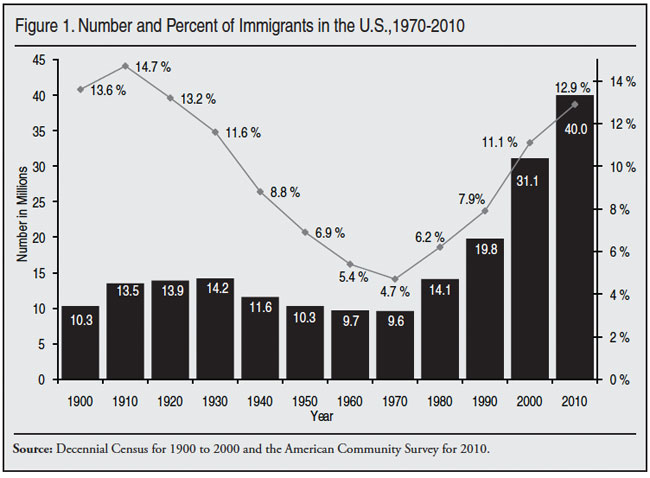
IMO we have one pressing social problem and it’s illustrated by this graph:

I attribute the substantial improvement that took place in the 1990s to the work requirement in welfare reform and the Dot-com boom.

The very high level of immigration illustrated in the graph at the top of the page has impeded the social progress we need in several ways. Blacks, particularly black youth, and the new immigrants, many of them illegal and unskilled, compete for jobs at the low end. The ready availability of entry level workers changes how work will be accomplished to favor keeping wages low.

In that context here are my answers to the questions I ask above:

  • The new immigrants should be a limited number of people with substantial skills.
  • The citizenry of the United States should decide who the new immigrants should be and how many of them there should be.
  • For assimilation to take place we’ll need to limit how many immigrants arrive from any one country. Large coherent communities of immigrants impede assimilation.
  • We already have about the number of immigrants that we can accept now. If we are to accept refugees and the high-skilled immigrants mentioned above, we’ll need to reduce the number of those who don’t fit in those categories.

or, in other words, we need an immigration policy more like those of Canada and Australia.

6 comments

Johnny One-Note

For anyone who questions my assessment of the narrow range of topics being entertained by the major media outets’ opinion pages, consider the Washington Post today. Of the first 14 pieces on the front page, seven are anti-Trump, one pro-Trump, one (George Will’s) remarks on immigration (regulating immigration is hard), two are anti-Russia, one is about sexual abuse among Catholic clerics, and one is about DC schools.

We already know that the WP’s editorial position is against Trump. I’m not particularly fond of him myself. Unless you’ve got something new and substantive to say, move on. He will be president for at least another three years. There are many, many other topics.

3 comments

Brinksmanship

If you’re not familiar with the term “brinksmanship” it means pursuing a policy right up to the limits of safety, effectively playing “chicken”. The term game into use in the 1950s, mostly in the context of our nuclear defense policy. It was probably coined by Adlai Stevenson and I suspect that the neologism was inspired by “gamesmanship” (the art of winning without actually cheating) from the popular book by Stephen Potter of the same name.

Right now the members of Congress are engaging in brinksmanship with respect to the budget. Historically, the Democrats have won this particular game of “chicken”. My inference is that the Democratic leadership thinks that they will benefit by insisting on a sweeter deal for the resolution of the DACA issue or spending levels or both.

Opinion polls suggest that most Americans favor some sort of resolution of the DACA issue which allows the “DREAMers” to stay in the United States and they don’t support Trump’s wall. Are the Democrats calculating correctly or are they overplaying their hand? I tend to think that they’re calculating correctly and, if there’s a federal government shutdown, the Republicans will be blamed for it.

11 comments

The Living Dead

Jeffrey Snider makes a darned good argument that the biggest U. S. banks are, in fact, zombies:

To end 2017, JP Morgan says it’s fortress totaled $2.5 trillion in assets. When Dimon was talking about it in 2011, the bank reported $2.3 trillion in assets. To close out 2008, JPM held $2.2 trillion.

This was, obviously, a stark departure from the bank’s prior operating paradigm. It had begun the 21st century as JP Morgan Chase with fewer than $400 billion in assets. Rapid growth predominated, through organic wholesale efforts as well as frenzied merger deals, up until late 2007 you got bigger at any cost. That’s what banks did.

JPM was and is no outlier. All the major firms on Wall Street and beyond trace the same pattern in their quarterly filings. Parabolic growth is observed for all of them – until 2007 or 2008. What has followed afterward has been a curious sideways condition, almost like a once vibrantly beating heart was stopped and never truly revived. It is the pattern of the undead, the zombie.

Jamie Dimon is paid $28 million per year. Why?

3 comments

AI and Medicine

There’s an interesting article on artificial intelligence and medicine at The Conversation:

I studied robotic surgery for over two years to understand how surgeons are adapting. I observed hundreds of robotic and “traditional” procedures at five hospitals and interviewed surgeons and surgical trainees at another 13 hospitals around the country. I found that robotic surgery disrupted approved approaches surgical training. Only a minority of residents found effective alternatives.

Like the surgeons I studied, we’re all going to have to adapt to AI and robotics. Old hands and new recruits will have to learn new ways to do their jobs, whether in construction, lawyering, retail, finance, warfare or childcare – no one is immune. How will we do this? And what will happen when we try?

It’s going to be a major issue over the coming years if only for the same reason that Willie Sutton robbed banks. There’s a lot more pay-off in reducing a surgeon’s hours than a hamburger-flipper’s hours. It doesn’t have any real visibility for me these days but I suspect the pushback will be immense. I sincerely doubt that the 21st practice of medicine will be the sort of medicine that most physicians want to practice or thought they were going to practice. And that isn’t limited to increasing use of artificial intelligence.

0 comments
