Illinois’s 2018 Gubernatorial Race

Via Capitol Fax.com J. B. Pritzker is far and away the leader among the Democratic candidates for governor with Daniel Biss a distant second and Chris Kennedy coming in third:

JB Pritzker maintains his large lead in the Democratic Primary – nearly twenty points ahead of his nearest competitor. JB currently leads with 41% of the vote, ahead of Daniel Biss at 22%, Chris Kennedy at 16%, and 20% of voters undecided.

Pritzker is running on a platform of increasing taxation and spending. He has put forward no plan other than increased taxation for solving Illinois’s public pension problem, among the worst in the U. S. Unless that problem is dealt with increasing spending on anything is a pipedream.

I think that’s the wrong platform. Illinois is already losing population, income, and jobs, driven away by increasing taxes and the state’s adverse regulatory environment. Conducting an experiment to see how many people you can actually drive out of the state doesn’t seem prudent to me.

4 comments

Reforming Congress

Fueled by the polls showing that Congress’s reputation has fallen to its lowest level since they’ve been taking polls, at Roll Call Jason Grumet reports that the Bipartisan Policy Center’s Commission on Political Reform has proposed some ways to reform Congress:

For instance, the House and Senate should schedule synchronized five-day workweeks in Washington, with three weeks in session followed by a one-week recess. Lawmakers spend far too much time in (and traveling to and from) their districts, and not enough time in Washington getting to know one another and mastering their key committees’ subject areas. It is inconceivable that we seek to govern our diverse and complex nation principally on Wednesdays. As unseemly as the mid-January shutdown was, senators said it forced meaningful private talks between Republicans and Democrats — something that should happen in advance of future crises.

Both chambers should continue the House’s recent practice of allowing committees to work every morning without the interruption of floor business and votes. Congressional committees are the engines of our democracy. Empowering them — and, by implication, reducing the power of leadership — would go a long way toward improving the legislative process. Substantive legislation should not reach the House or Senate floor without benefit of committee deliberations. Legislation with broad committee support should expect to receive floor consideration, and members should have a minimum of three days to study these bills. Finally, full-fledged conference committees should resolve differences between House and Senate versions of important legislation.

Dream no small dreams. In my opinion much more extreme measures are called for. Congress needs to be dragged, kicking and screaming if necessary, not just into the 1980s which is where the reforms proposed would put it, but all the way into the 21st century. Here are some of the things that I would do to reform Congress, amending the Constitution as required:

  • Congressmen should be required to reside in the districts they serve.
  • The place where you sleep 50% or more of the time should be defined as one’s official residence.
  • Teleconferencing should be adopted as the official way for the Congress to perform its duties.
  • No Congressman should receive a pension of any kind for services in Congress.
  • If Congressmen require staffs of any kind beyond one assistant/clerk/secretary, they should pay for them themselves.
  • All lobbying activities should take place within Congressmen’s districts.

That would be a start.

12 comments

There Will Be No Trump Doctrine

I’m seeing a lot of writers on foreign policy madly searching through the State of the Union trying to find a unifying theme in the Trump foreign policy other than a few slogans (America First!, Make America Great Again). They shouldn’t bother. Trump is transactional in his approach. There will be no Trump Doctrine. He’ll throw any number of bargaining chips up against the wall and see how many he can get. That’s so obvious it’s amazing that everyone can’t see it.

10 comments

Whaddaya Know? I’m Not Alone

I’m gratified to see that I’m not the only one who thinks that the Democrats erred on Tuesday night during the State of the Union message. So does Dana Milbank in his Washington Post column:

It gives me no pleasure to say this, but the Democrats’ behavior at the State of the Union was embarrassing.

I take a back seat to nobody in decrying President Trump’s cynical and divisive performance. He repeatedly exploited Americans’ divisions on race, guns, God, immigration — anything to distract from the broken promises, vulgarity and worse that define his presidency.

But the Democrats, with their childish protests, took the bait. Symbolic dissent is fine, but this was a cacophony of causes: black clothing (for #MeToo), kente ties and sashes (because of Trump’s Africa insult), butterfly stickers (for the “dreamers”), red buttons (for a victim of racial crime) and the more bipartisan purple ribbons (for the opioid epidemic).

Worse, dozens of Democrats refused to stand when the president entered the House chamber, forgetting that one stands out of respect for the office, not the officeholder. Rep. Bennie Thompson (D-Miss.) grabbed a middle-aisle seat only to turn his back on the president when he walked past. Democrats groaned, scoffed, heckled and made lemon-biting faces. Others simply boycotted. In short, they did the same sort of things they (and I) denounced Republican lawmakers for when they did them to President Barack Obama.

Same here. It doesn’t matter if you don’t like him. It doesn’t matter if the other guys did it. Exemplify the behavior you want to see in others. Be the change.

Democrats can’t win in 2018 simply by appealing to people who hate Trump. The most recent Monmouth University poll (PDF) comparing support for a generic Republican to a generic Democrat has narrowed to insignificance. Not everyone hates Trump as much as they do. They’ve got to appeal to them, too.

The Senate landscape for 2018 does not favor Democrats. If they fail to capture the House and the Republicans strengthen their hold on the Senate, which seems likely, it is not a good outcome for them.

11 comments

Credit and Blame

In his Washington Post column Charles Lane says, just one minute—Trump doesn’t really deserve the credit for an improving economy:

The economy is in good shape — phenomenal shape, really. The labor market is nearing full employment, inflation’s mild, and Wall Street bulls are running. So the question on everyone’s mind is: Who deserves the credit — President Trump or his predecessor, Barack Obama?

In a Post/ABC News poll released Jan. 21, Obama won, 50 to 38. Surprise, surprise: These percentages correspond closely to Trump’s overall approval and disapproval ratings.

The pollsters should have offered a third choice. If personal responsibility for prosperity belongs to anyone, it would be the cerebral economist who on Wednesday presided over the last Federal Reserve meeting of her four-year term as chair: Janet L. Yellen.

My own view is that, broadly, that’s correct. I think that presidents don’t have as much impact on the economy as many people seem to think they do, particularly in the first year of their presidencies. Barack Obama didn’t “save” the economy. It was already saved by the time he took office. The trends in employment were already in place when Donald Trump took office.

I think there’s one exception to that: the stock market. The stock market dove when George W. Bush took office and when Barack Obama took office and has soared under Donald Trump. If you think that’s a good thing, then Trump unquestionably deserves some credit for it just as Bill Clinton deserves some credit for the stock market during his term of office. He was a great cheerleader for the economy.

But let’s turn to Janet Yellen. Does she deserve credit for the improvements in the economy from 2014 to the present, blame for how slow the improvement has been, or both? I think both but the main culprit was Ben Bernanke. If you want to blame someone for the slow growth in the economy, the slow growth of wages, widening income inequality, and the massive problems with public pension plans, look no farther. And it was a deliberate policy, not unforeseen.

1 comment

The 2016 Metro Area Vote


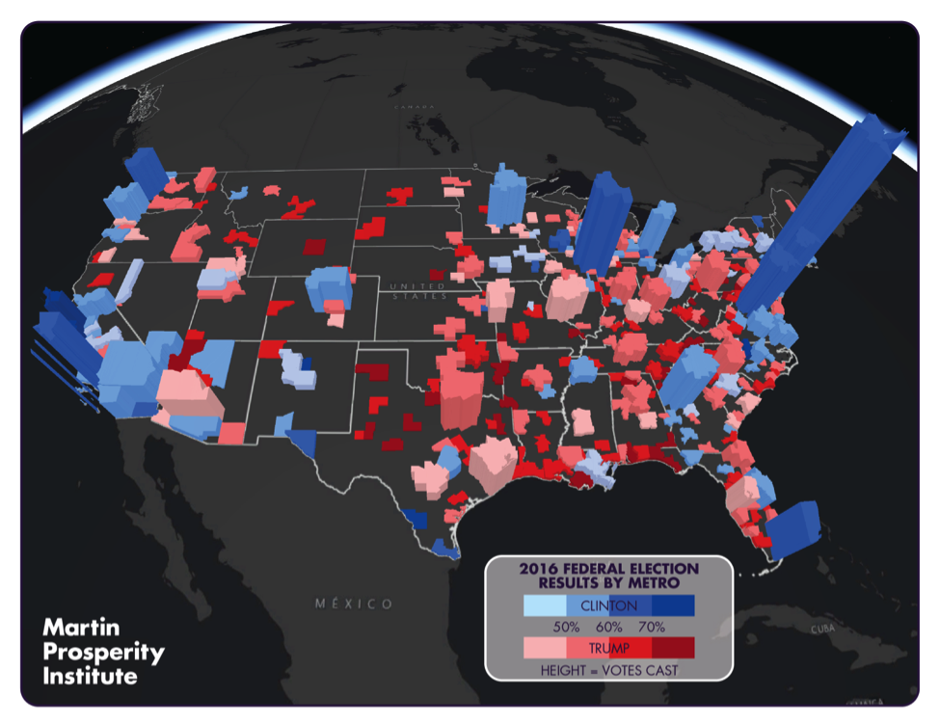
Back in 2016 City Labs mapped who carried the country’s various metro areas. As it turns out Hillary Clinton carried the largest metro areas but Trump carried more metro areas:

Hillary Clinton won the largest metros, but Donald Trump carried more of them, as well as rural and micropolitan places. Overall, the 2016 election served to harden and solidify America’s enduring fault lines of class and geography, knowledge, and density.

I wanted to take a closer look at the metros that went for Trump versus Clinton. As I noted previously, election returns are not typically collated by metro area, but county-level results are available. My Martin Prosperity Institute (MPI) colleagues arrayed the county-level data to the country’s 350-plus metros using data from two sources. Our main source was Dave Leip’s county-level election results. Where data was missing, we used data from Simon Rogers, data editor at Google News Lab. (Again, I note that while there are still some vote tallies yet to be certified, the overall shares of the vote at the metro level are unlikely to change much at this point).

The map below by MPI’s Taylor Blake charts the metro area vote. Clinton votes are in blue, Trump votes are in red, and the height of the bars indicates the percent of the national vote cast in metros.

Check your stereotypes. There are strong regional differences in political preference and they go beyond the urban/rural bifurcation.

I think it’s likely that as Midwesterners flee the consequences of decades of mismanagement that Texas, North Carolina, Virginia, and Tennessee will become purpler but so will Illinois, Wisconsin, and Michigan.

1 comment

The Three Syllable Word

There’s a reason that Americans’ faith in our institutions is declining, the reason that The Economist considers the United States a “flawed democracy”. We don’t trust our institutions as much as we used to because our institutions are less trustworthy than they used to be.

Question: What’s a three syllable word beginning with ‘P’ that means you think that people are against you?

Answer: Perceptive

6 comments

Convergence

This year’s Grammy awards drew 19.8 million viewers. That’s a 24% decline from last year.

The Country Music Awards last November drew 14.3 million viewers, an increase of 16%.

3 comments

How We Got to Today

At RealClearWorld Andrew Bacevich traces the path that led us Donald Trump’s being elected president:

Where exactly did Trump come from? How are we to account for his noxious presence as commander-in-chief and putative Leader of the Free World? The explanations currently on offer are legion. Some blame the nefarious Steve Bannon, others Hillary Clinton and her lackluster campaign. Or perhaps the fault lies with the Bernie Sanders insurgency, which robbed Clinton of the momentum she needed to win, or with Little Marco, Lyin’ Ted, and Low Energy Jeb, and the other pathetic Republicans whom Trump trampled underfoot en route to claiming the nomination. Or perhaps the real villains are all those “deplorables” — the angry and ignorant white males whose disdain for immigrants, feminists, gays, and people of color Trump stoked and manipulated to great effect.

All such explanations, however, suggest that the relevant story began somewhere around June 2015 when Donald Trump astonished the political world by announcing his intention to seek the presidency. My aim here is to suggest that the origins of the real story are to be found much earlier. The conditions that enabled Trump to capture the presidency stemmed from acts of commission and omission that occurred well before he rode down that escalator at Trump Tower to offer his services to the nation.

Here’s the sad part: at each step along the way, other alternatives were available. Had those alternatives been exercised, a Trump presidency would have remained an absurd fantasy rather than becoming an absurd and dangerous reality. Like the Cuban Missile Crisis or the Vietnam War or 9/11, Trump qualifies as a completely avoidable catastrophe with roots deep in the past.

Read the whole thing. To my eye every step along the trail passes through the Washington Consensus. I also think he underestimates the role of social change in bringing the Trump presidency.

Is he right? Wrong? Partially right and partially wrong? I think I can see a Forrest Gump in his story, a figure that shows up in most of the debacles of the last 30 years. Please share your thoughts.

14 comments

State of the Union, 2018

At my wife’s insistence we watched the 2018 State of the Union message last night. It had the usual recitations of accomplishments. There was also the wish list we’ve become accustomed to hearing. Is it my imagination or were there more than the typical number of call-outs?

I don’t care for President Trump’s prosody or diction, e.g. stacking modifiers “very”, “beautiful”, but I thought it was okay as these messages go. Neither a hit nor a flop.

If you were looking for division, you found it and I’m confident the opinion pages will be full of emotional condemnations of the president’s divisive SOTU. If you were looking for unity, you found that, too. What’s the opposite of a “dog whistle”? Deafness that only the hyper-focused recognize? I’m also quite confident that Mr. Trump’s supporters will proclaim it the best SOTU ever.

I think that highlights that the gap between our differing views is real, not just posturing, and will be hard if not impossible to bridge. The 50%+1 style of governance isn’t working and won’t be improved by changing who’s in charge.

I don’t think the Democrats did themselves much good last night by maintaining their sullen, taciturn demeanor. They may have thought it was resolute but I thought it was churlish. As me auld mither used to say it’s not the man it’s the cloth.

Update

The editors’ of the New York Times response was more balanced than I expected. After reciting a list of the benign things that have happened in the last year, they follow up with their complaints:

Despite promising a $1 trillion infrastructure plan a year ago, a phantom plan whose price tag he raised to $1.5 trillion on Tuesday, he has yet to do anything to fix rusting bridges and faltering rail lines. His tax plan will undermine local efforts to make improvements around the country. He has yet to take serious action to end the opioid crisis. (“We have to do something about it,” he said Tuesday night, rather pathetically.) He has rubbed raw the nation’s wounds of bigotry and sexism. Without study or discernment, he has stripped away regulations meant to restrain climate change and to protect consumers. He seems utterly indifferent to improving an education system that is the foundation of the global competitiveness he insists he cares so much about. He’s deepened America’s commitment to Afghanistan with no exit strategy, and he’s raised tensions in the Middle East to no clear end. By gratuitously alienating allies and upending trade deals, he has eased the way for China’s hegemony.

I haven’t bothered to reproduce the many hyperlinks in the quote above. There are a dozen of them. They do bring up one question to my mind—are good intentions enough?

he has stripped away regulations meant to restrain climate change and to protect consumers.

Their study and discernment doesn’t seem to have reached as far as measuring the actual net effects of the regulations. We need to start reckoning the value of policies against what has happened rather than against what their proponents wanted to happen.

E. J. Dionne’s column was about what I would have expected. Here’s an example of the divisiveness he complains about:

“All Americans deserve accountability and respect. And that’s what we are giving to our wonderful heroes our veterans,” Trump said. “So tonight, I call on Congress to empower every Cabinet secretary with the authority to reward good workers and to remove federal employees who undermine the public trust or fail the American people.”

This sounded like an attack on the entire civil service system. It sounded like a demand by Trump that he and those who work for him have the right to fire federal employees whenever he or they feel like it. Perhaps this idea will come with safeguards, perhaps not. Trump didn’t say.

I guess I’m tone deaf. It didn’t sound like that to me. It sounded like a call for long overdue civil service reform. Is that inherently divisive?

Dana Milbank’s reaction was even sharper:

When he said “we proudly stand for the national anthem” — a reference to black NFL players who have protested by taking a knee — there was a lusty roar from the GOP side and wan looks from Democrats. Trump applauded the cheering Republicans.

which I found to be weak tea. This is more to the point:

He drew Democrats’ heckling by alleging that “a single immigrant can bring in virtually unlimited numbers of distant relatives.” Trump, in the context of immigrant violence, even tried to make off with the “dreamer” label applied to young undocumented immigrants brought to the United States as children. He said his duty is to “defend Americans, to protect their safety. . . . Because Americans are dreamers too.” By implication: The “dreamers” are not American.

quoting what will undoubtedly be seen as the most memorable line in the speech. Is that divisive or a case of where you stand depends on where you sit?

The editors of the Washington Post cited divisiveness as well:

HAVE A president’s words ever rung more hollow? In his first State of the Union address Tuesday night, President Trump spoke of “what kind of nation we are going to be. All of us, together, as one team, one people and one American family.” Yet Mr. Trump could not avoid, even for an hour, lacing his address with divisive references to hot-button issues and graceless attacks on his predecessors: to “disastrous Obamacare,” “the mistakes of past administrations,” “the era of economic surrender” and more.

The editors of the Wall Street Journal strike a note closer to what I heard:

Democrats want to legalize the young adult Dreamer immigrants, spend money on roads and bridges, and give ex-cons a second chance at a better life. More dangerously for the economy, more Democrats than Republicans share Mr. Trump’s protectionist views on trade, which we were glad to see him play down on Tuesday night.

Mr. Trump’s immigration message was a mix of rhetorical edginess with policy compromise. He spent far too much time flogging immigration as an issue of crime rather than highlighting the many contributions that newcomers make. He also included a gratuitous gibe that “Americans are Dreamers too,” which will insult more people than it persuades. This rhetoric may have been intended to placate supporters who are nervous about Mr. Trump’s willingness to negotiate with Democrats, but he missed a chance to seem more big-hearted.

On the other hand, Mr. Trump’s legislative offer last week is a bid for compromise between left and right that includes a path to citizenship for 1.8 million Dreamers who were brought to the U.S. as children. That’s far more than the 700,000 or so that applied for work permits under Barack Obama’s illegal order—and far more than GOP restrictionists want.

Did the Democrats already signal their response? If compromise is betrayal and you won’t accept anything you want unless you get everything you want, it’s the end of republican government.

16 comments