A Tale of Two Job Approvals

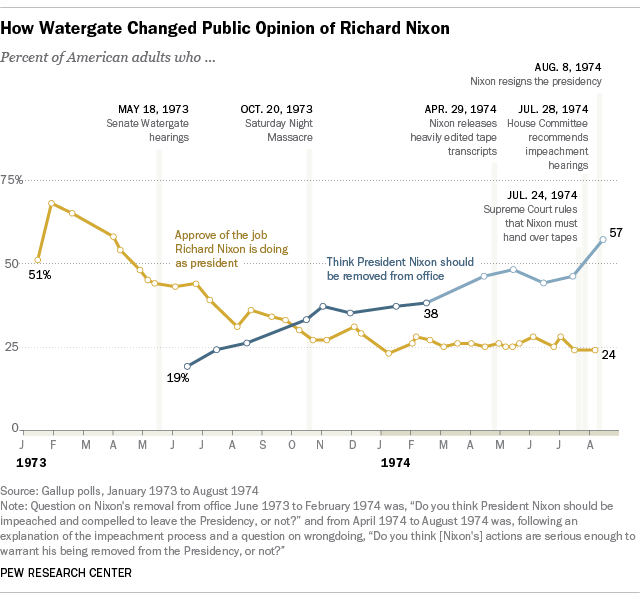
Here’s Richard Nixon’s job approval rating for his second term of office:

and here’s Donald Trump’s:

As I’ve been saying for some time, if you have visions of Trump being driven from office as Nixon was, you’re fantasizing. His approval rating would have to drop a lot.

At this point would any revelation cause his supporters to abandon him? I think that anything would either be ignored, be proclaimed “fake news”, or dismissed as partisan.

What a world, what a world.

10 comments

The Contradiction

In his latest New York Times column Thomas Edsall points out the challenge today’s Democratic Party faces:

Allies on Election Day, the two wings of the Democratic Party are growing further estranged in other aspects of their lives, driven apart by the movement of advantaged and disadvantaged populations within and between cities. These demographic patterns exacerbate intraparty tensions.

Florida, writing with Benjamin Schneider of CityLab, expands on this point:

While the advantaged members of the knowledge, professional, and creative class have enough money left over even after paying the cost of housing in these cities, it’s the less-well-paid members of the service and working classes who get the short of end of the stick, with not nearly enough left over to afford the basic necessities of life. They are either pushed to the periphery of these places or pushed out altogether.

The competition for housing between rich and poor has become a critically important and divisive issue in urban AmericaAllies on Election Day, the two wings of the Democratic Party are growing further estranged in other aspects of their lives, driven apart by the movement of advantaged and disadvantaged populations within and between cities. These demographic patterns exacerbate intraparty tensions.

Once upon a time (as all good stories begin) both of our political parties were “catch all” parties, uniting contrasting even competing groups. Some of that was geographic, some economic. Midwestern farmers, working holdings of many sections, tended to be Republicans. Small farmers in the South and East Coast tended to be Democrats. Small businessmen tended to be Republicans. Until the Great Depression blacks used to vote consistently for Republicans. Since then they’ve voted just as consistently for Democrats.

That’s changed over the last 50 years as Southern Democrats became Republicans and northeastern Republicans became Democrats. Now the Republican Party is an uneasy alliance between white social conservatives, many in the South, and libertarians.

The Democrats actually have several different factions to contend with. They have the white urban intelligentsia, heavily unionized public employees, blacks, Hispanics, and some groups of sexual libertarians. These groups are actually in competition with one another not just for money but for the attention paid to the issues in which they’re most interested.

Mr. Edsall continues:

In firmly Democratic neighborhoods across the country, the economic status of those moving in and out began to shift radically starting at the beginning of this century.

Take, for example, “Accounting for Central Neighborhood Change, 1980-2010,” by Nathaniel Baum-Snow, an economist at the University of Toronto, and Daniel Hartley, an economist at the Federal Reserve in Chicago. They found that the core of the nation’s cities is being taken over by members of the affluent wing of the Democratic Party at the expense of the less affluent, disproportionately minority wing of the party:

Central neighborhoods of most U.S. metropolitan areas experienced population decline 1980-2000 and population growth 2000-2010. 1980-2000 departures of residents without a college degree accounted for most of the decline while the return of college educated whites and the stabilization of neighborhood choices by less educated whites drove most of the post-2000 rebound.

Baum-Snow and Hartley cite what they call “a shifting balance between departures of low SES (socioeconomic status) minorities and inflows of high SES whites” and point out that neighborhoods surrounding cities’ central business districts have experienced a turnaround

driven by the return of college-graduate and high-income whites to these neighborhoods, coupled with a halt in the outflows of other white demographic groups. At the same time, the departures of minorities without college degrees continued unabated.

In Chicago, Baum-Snow and Hartley point out, the largely minority census tracts that gained whites the fastest from 1980 to 2010 were “almost exclusively within 4 kilometers (2.5 miles) of the central business district.”

A similar pattern has emerged in the urban West. “Gentrification in the Bay Area, Portland and Seattle,” Bruce Cain, a political scientist at Stanford, told me in an email, “is definitely pushing disadvantaged populations out of old neighborhoods and into far-flung exurbs.”

Here in Chicago “gentrification” is clearly a strategy that has been embraced by City Hall. Lakefront projects, primarily of interest to well-to-do downtown residents, have been greenlighted at the expense of greater services in the South and West Sides. Neighborhood schools there have been closed, magnet schools, some with admissions tests, others with other pre-qualifications, have been opened or expanded.

Meanwhile, public employee salaries and benefits here have been expanded far ahead of general inflation. In other words public employees and members of the “creative class” are winning; blacks and Hispanics are losing.

Democrats are promoting this strategy. Voting more Democrats into office won’t change it. Here in Chicago nearly all officeholders are already Democrats. As in other major cities blacks are voting with their feet.

To compound the problem in Chicago Hispanics now outnumber blacks. As I’ve been predicting blacks and Hispanics will increasingly contend for resources, leaving the present incumbents, mostly white, holding the reins of power.

1 comment

Pointing the Finger

I think the editors of the Wall Street Journal are pointing their fingers in the wrong direction over the crash of the IRS’s web site at the worst possible time, on April 17th:

A Treasury Department Inspector General last fall told Congress: “The IRS’s reliance on legacy (i.e., older) systems, aged hardware, and outdated programming languages pose significant risks to the IRS’s ability to deliver its mission. Modernizing the IRS’s computer systems has been a persistent challenge for several decades and will likely remain a challenge for the foreseeable future.”

A Government Accountability Office report last year found 166 outstanding recommendations about IT security. Good thing these folks don’t have sensitive information . . .

These deficiencies are a matter of priorities, not funding. The cynical reality is that bureaucracies are shrewd and skimp on core services—taxpayer customer service lines—to extort more public dollars.

They’re conflating the IRS’s internal systems with their web hosts and web pages. A cursory examination of the IRS’s web site suggests that it’s, essentially, state of the art. Hosted by Akamai, built on Drupal, Java, JavaScript, etc. similar to the web sites of many large companies.

I believe that a less superficial examination of the problem would reveal that the failure wasn’t caused by legacy hardware and software but by legacy staff and hopelessly antiquated procurement system. They all but undoubtedly had their web site built for them by consultants and their internal staff were not up to the task of evaluating the consultants’ work. They didn’t do sufficient load testing, maybe did no load testing, and when the system came under load it failed.

It’s a problem very similar to the one that caused Healthcare.gov to fail under comparable circumstances and it happened for the same reasons.

5 comments

Interpreting Xi’s Actions

If you’d like to see an excellent exercise in sophistry, you could do a lot worse than reading Keyu Jin’s essay at Project Syndicate which seeks to explain to us why Western concern over Xi Jinping’s effectively being named president for life is so misplaced and it is actually democratic reform. Also war is peace, freedom is slavery, and ignorance is strength.

In rebuttal I’ll only make one point. Over the period of the last two hundred years the United States has had one government. Over the same period China has had five (by some reckonings six or even more). One of the reasons for our relative stability and persistent success is that our system takes human nature into account. Without structural checks power will always seek more power.

3 comments

What’s In It For Us?

At Brookings, Michael O’Hanlon, ever-hopeful proposes guidelines for a U. S. strategy on Syria consisting of the following plans:

  • Help local allies in Syria hold their ground.
  • Take advantage of the threat of further U.S. military operations.
  • Establish a more realistic political vision for the country—one that no longer seeks Mr. Assad’s immediate removal.
  • Develop a better answer to the Kurdish question to secure Turkey’s cooperation.

Maybe it’s just me but that strikes me as being on the borderline of insanity like Constantinople’s senate debating the number of angels that could dance on the head of a pin while the Turks laid siege to the town.

First and foremost, Trump doesn’t do strategy. He’s purely transactional in his approach. Is there a way of nudging him towards that strategy? I don’t see it.

Second and for the umpteenth time, we have no allies in Syria and supporting the Islamist Sunni rebels means only prolonging the carnage.

Further U. S. military operations court a direct U. S.-Russia conflict, something that in turn risks a nuclear exchange unless one or the other country could back down. How could they? The only way to win is not to play.

The “allies in Syria” of which he speaks hold Assad’s immediate removal as their sine qua non. Is there a way to square that circle? Mr. O’Hanlon does not propose one.

Is securing Turkey’s cooperation even possible? They appear to be bent on a neo-Ottoman expansion. How in the world is that in our interest?

Here’s my proposal. Take everything Mr. O’Hanlon suggests and do the opposite.

Or a more moderate approach. What outcome benefits the U. S. most? It would take some persuading to convince me that anything in Mr. O’Hanlon’s proposed strategy advances our interests. Radical Sunni Islamists, Turks, the Israelis, yes. The U. S.? Not so much.

5 comments

Unintended Consequences

Wow. I really disagree with Julian E. Zelizer’s interpretation of the evolution of the Congress from his article at Atlantic. Why have recent House Speakers been so weak?

Why the perpetual instability? Why have speakers struggled to regain the standing they once held in the days of Rayburn, John McCormack, Tip O’Neill, and other legends who amassed great power?

Part of the answer goes back to the congressional reforms of the 1970s. No longer willing to live under the kind of iron-clad authority that committee leaders enjoyed since the early 20th century, younger Democrats and Republicans implemented new rules and norms that would enable the rank-and-file to keep their speakers accountable and on a short leash. Tightened ethics regulations, for instance, offered a powerful tool for members to bring down those in power should they act in corrupt fashion. The purpose of the reforms was to avoid the kind of situation that Congress faced from the 1930s to the 1970s, when a bipartisan coalition of Southern Democratic committee chairs and Republican ranking members—working closely with the speaker—controlled debate in the House and stifled initiatives such as civil rights.

The era of reform quickly gave way to the era of partisan polarization. The divide between the Democrats and Republicans kept growing as there were fewer members in the middle of the two parties. With greater polarization came more intense partisan warfare. More speakers—like Jim Wright—were caught in the crossfire.

He might want to re-examine his account of the history of civil rights legislation. It was enacted by a coalition of northern Democrats and Republicans. Blaming Republicans for some things is legitimate; blaming them for the slow progress of civil rights legislation 1930-1970 is a bum wrap.

My explanation would be quite different. Reducing (or eliminating) earmarks has removed a powerful tool from the Speaker’s toolbox. Speakers are weak because the members of Congress are weak. It’s a voluntary condition; they’d rather be weak and re-elected than strong and serve only a single term. Partisan polarization was an express outcome of the reforms of the 1970s. Campaign finance reform and increasing polarization have changed the character of candidates. And so on.

Every putatively well-intended reform of the last forty years has had unintended consequences and we’re moving inexorably from liberal democracy to plutocracy to hereditary aristocracy.

1 comment

Barbara Bush, 1925-2018

I don’t have much to say about the death of former First Lady Barbara Bush other than that my mother had interacted with her and held her in high regard. My mom was a pretty good judge of character so she must have been all right.

Also, if memory serves she’s only the second post-war former First Lady to predecease her husband, the other being Pat Nixon. It’s actually something of a rarity.

0 comments

Which Is It?

You may have heard of the stink over an incident at a Philadelphia Starbucks. It’s all over the news and opinion pages. If not, it’s summarized here.

“Mau-Mauing” is a term popularized by Tom Wolfe in his 1970 essay, “Mau-mauing the Flak Catchers”. The article is about intimidation tactics used against public employees, whose jobs have essentially been reduced to taking abuse.

I have absolutely no doubt that racism continues to be a factor the United States in the 21st century. No doubt at all. Is this particular incident an instance of that racism or of mau-mauing? I’m undecided. Many private businesses in the United States reserve their tables and restroom facilities for the use of their customers. Were the two men involved asked to leave because they were black or because they weren’t customers? Who’s at fault here, the Starbucks employee for making the 911 call, Starbucks, or the two men? Everybody? Nobody?

15 comments

Making the Rich Pay Their Fair Share

Here in Illinois the Democratic nominee for governor, J. B. Pritzker, is undoubtedly one of the richest people ever to run for elective office in the United States. He’s not in Michael Bloomberg territory but he’s rich enough to make Donald Trump or Bruce Rauner, Illinois’s sitting governor, look like pikers.

He’s running on a platform of creating a graduated income tax in Illinois to “make the rich pay their fair share” (whatever that might be). Frankly, that puzzles me.

The Illinois constitution mandates a flat income tax or, more precisely, it prohibits progressive income taxes. Here’s Article IX, Section 3 of the state’s constitution:

SECTION 3. LIMITATIONS ON INCOME TAXATION
(a) A tax on or measured by income shall be at a non-graduated rate. At any one time there may be no more than one such tax imposed by the State for State purposes on individuals and one such tax so imposed on corporations. In any such tax imposed upon corporations the rate shall not exceed the rate imposed on individuals by more than a ratio of 8 to 5.

or, in other words, imposing a graduated income tax requires amending the state’s constitution which requires more than a simple majority. It it were easy we’d’ve done it a long time ago..

Illinois’s present starts with federal adjusted gross income, reduces that with several deductions, and applies a flat rate of 4.95% to that.

Now here’s what puzzles me. There are all sorts of strategies that would ensure that the rich “pay their fair share” and still pass constitutional muster. Here are to. Rather than taxing adjusted gross income we could tax based on a flat percentage of total federal income tax. Or, even better, we could tax based on a flat percentage of total federal deductions. There are any number of others.

Why wouldn’t that accomplish the purported objective?

Here’s another question. In 2016 Mr. Pritzker’s adjusted gross income was around $15 million on which he paid about $4.1 million in federal taxes. My back-of-the-envelope calculation tells me that means he took more than $4 million in deductions.

There is no law that requires anyone to tax deductions. Doesn’t Mr. Pritzker’s own behavior suggest that whatever the marginal tax rate he and those with incomes like his will take whatever deductions they can to reduce their tax liabilities? In other words the entire flat rate/graduated income tax is a red herring.

4 comments

State Spending Priorities

I disagree at least in part with the editors of the Wall Street Journal’s take on the teacher strikes in West Virginia and Oklahoma:

Oklahoma teachers went a decade without a significant raise, and only three states pay less on average, according to the National Education Association. Depending on which grade they teach, Oklahoma educators’ mean annual pay lags around $1,000 to $3,000 behind the overall state mean of $43,340, according to the Bureau of Labor Statistics.

Yet Sooner State teachers received a big pay hike before their recent strike began. In March Oklahoma raised taxes on oil and gas, cigarettes and fuel. The new taxes pay for a raise of about $6,100 per teacher and more school funding. But union leaders sense an opportunity to press for more, especially with Republicans on edge about the midterm elections.

In Kentucky the protests have been about pensions, not pay, but the same Medicaid crowding out is taking place. The Bluegrass State was one of the first Medicaid expansion states under ObamaCare. Some 22% of residents—more than two million people—are enrolled. In 2008 Medicaid spending in Kentucky was $4.9 billion, but by 2017 it was $9.9 billion. The federal government paid $7.7 billion of that sum last year, but the burden has already begun shifting to states.

As for education, Kentucky’s public pension woes place it on par with New Jersey and Illinois, and teachers’ pensions are only 56% funded. Participants can draw full benefits as early as age 49, and some collect longer for more years than they’ve worked.

The Republicans who gained control of the Kentucky government in 2017 have made pension reform a priority. Legislation that passed in March leaves benefits untouched for retirees and current employees.

But it stops teachers from cashing in on accrued sick days at the end of their careers, a common strategy to game the system. And it shifts new hires to a hybrid retirement plan that operates more like a 401(k). The most optimistic estimates have the teachers’ pension running a $14 billion liability, and the changes make a dent of around $500 million to $800 million over 20 years.

The strikes in Kentucky were an effort to lobby Gov. Matt Bevin to veto even this modest reform, never mind that strikes are illegal in the state. Mr. Bevin signed the bill last week and slammed Kentucky Education Association leaders for “looking out for the best interests of themselves.”

He has a point. Teachers unions saw an opening after West Virginia teachers got a raise after nine days on strike, but other concessions they won benefit labor at the expense of students. One casualty was a plan to open the state’s first charter—a science, technology, engineering and math school that would have operated with Marshall University and West Virginia University. Union leaders also killed a reform to let school districts consider teacher performance as they determine which employees to lay off from shrinking schools.

Arizona seems to be following the West Virginia model. Teachers are demanded a 20% pay raise, while protesting and planning for a walkout. Last week Gov. Doug Ducey announced a proposal to increase teacher pay by 20% over 2017 levels by 2020, also restoring education funding to pre-recession levels. The proposal has to get through the legislature, so you may soon read about strikes there.

Arizona also expanded Medicaid under ObamaCare, and the program’s share of the general fund has grown to 18.5% from 12.4% a year earlier. In this election year, Democrats and unions want to portray taxpayers as stingy for not paying them more. But if teachers aren’t getting bigger raises, two reasons are the progressive priorities of Medicaid and runaway pensions.

I haven’t researched Kentucky or Arizona but I did look into teacher compensation in Oklahoma and West Virginia. IMO teachers are underpaid in those states by the standards of those states. They’re earning below median income. Oklahoma and West Virginia should pay their teachers more.

But it’s true that the big line items in state budgets are education and health care and that both are increasing in cost rapidly, health care costs at a multiple of non-health care costs. It’s also not true that people will accept raising taxes so that health care costs can rise to any level their little pea-pickin’ hearts desire. Incomes when rising are rising very slowly; people have mortgages and rents to pay. They need to buy food and clothing and pay the utilities. They already aren’t saving. Many are borrowing to pay ordinary operating expenses.

1 comment
