Why Aren’t They More Worried?

See here at The Diplomat for a summary of North Korea’s conventional military capabilities and the threat it poses to South Korea.

Now explain something to me. Why doesn’t South Korea act as though it faced that great a threat? Fatalism? They think, incorrectly, that the United States will keep them safe from attack?

10 comments

Rational But Maybe Not Your Reason

I agree with Fareed Zakaria that Kim Jong Un is rational:

In fact, the summit has one benefit, regardless of the outcome. As the two sides meet and talk, it probably ends the idea of North Korea as crazy. Some of Washington’s biggest mistakes have been when it has treated countries or governments as 10 feet tall and fanatical or lunatic. And for years, the conventional wisdom about North Korea was that it was unpredictable, irrational and thus undeterrable. After all, people said, just look at the bizarre rituals and crazy haircuts of its leaders.

In fact, as I have often pointed out, the North Korean regime has been rational, strategic and successful — given its core goal, survival. It has preserved its basic form of government for 70 years, persevering through the breakdown of the Soviet Union and its empire, the Arab Spring and the demise of other Asian dictatorships, from South Korea to Taiwan to Indonesia. How many family dynasties have been able to hand over power, father to son to grandson?

I don’t quite know how he reaches this conclusion:

In doing so, we will realize that it is a rational regime. And we will also understand that if negotiations fail, it can be contained. North Korea is capable of being deterred. But it also capable of outwitting an American president, especially one too eager to make a deal.

The emphasis is mine.

“Rational” means that using logic and based on your premises and the evidence at hand you recognize that your actions have certain consequences. It doesn’t mean that another party uses your premises or evidence. For Kim Jong Un the premises are that he’s divine and has preternatural tactical and negotiating powers and that China will back his hand. The facts on the ground include that the United States has not successfully deterred North Korea from obtaining and testing its nuclear weapons and that the U. S. has been deterred from unseating the Kim regime over the period of the last 70 years.

I’m pretty sure that Kim is rational but I have my doubts about Fareed Zakaria. I think the only thing we can assume is that North Korea will cheat on any agreement that is negotiated.

1 comment

The Difference

Anybody who wants a “Democratic Trump” to run in 2020 doesn’t understand the difference between the two political parties.

5 comments

Free Riders Wanna Ride Free

Canada, Britain, France, Germany, and people in the United States who are prospering can’t get their heads around the idea that a lot of Americans don’t think we’re getting enough from the deal that we’ve cut with the rest of the major economies where they sell and we buy. We pay for a large standing army and they don’t. The demand for the dollar means that we have an absurdly large financial economy relative to the rest of the economy and they don’t.

6 comments

And Nothing Else

There are all sorts of posts, articles, and op-ed today, musing over whether the Democratic Party has “gone too far left”. Rather than add my voice to the din, I’d like to go off on a bit of a tangent.

Political scientists distinguish among all sorts of different kinds of political parties. Catch-all parties, class-based parties, interest-based parties, programmatic parties, cadre parties, mass-based parties, dozens of different kinds. I’m just going to talk about two kinds of political parties: catch-all parties and programmatic parties.

A “programmatic party” is one in which the party advocates a particular programmes, there is a tight relationship between the party membership and the party’s programme, and there are rules for determining whether you’re in the party or not. A “catch-all party” on the other hand is more loosely organized and it can sometimes be difficult to tell whether an individual is actually a party member or not. You just take their word for it.

The system of elections that prevails in the United States is called “winner take call, first past the post”. Places with such elections tend to gravitate to two and just two political parties. Historically, the United States has had just two major parties at any one time and both parties have been catch-all parties.

Right now both of our political parties are trying to force themselves through painful transitions from the catch-all parties they’ve always been into programmatic parties. The irony of this is that neither political party would have become major parties in the first place if they’d been programmatic parties. They’d have been relatively small, local parties, insignificant nationally. But now they have control of the reins of power, they won’t relinquish them, they’ll block any upstarts, and, well, there’s no one who can stop them in their march to become programmatic parties.

That has several consequences. The fastest-growing party affiliation today is “independent”, i.e. no party affiliation and we get lots of breast-beating wondering whether the Democratic Party has “gone too far left”. It’s just right for some places in the country.

I think that for the United States two programmatic parties and just two is not a comfortable fit. We’re just too large and diverse for that.

1 comment

Let Us Now Praise Carbon Extraction

At Bloomberg View Leonid Bershdisky touts the advantages of carbon extraction over electric vehicles:

Carbon Engineering is a company co-founded by Harvard physicist David Keith and funded, among others, by Microsoft founder Bill Gates. Since 2015, the firm has been running a CO2 extraction plant in Canada, testing out a technology that was until recently rejected as too costly. Keith and his collaborators, who wrote the paper, have used an independent cost assessment to calculate that using the process they developed allows the capture of a metric ton of carbon dioxide at the cost of $94 to $232, depending on variable costs such as the price of natural gas. (Since energy is used in the process, about 0.9 tons of CO2 is actually removed from the atmosphere with each ton captured).

That is far lower than previous estimates for the technology, ranging from $550 to $1,300 per ton. The paper’s authors explain that the reduction comes from simply using industrial equipment already available on the market without much customization, a strategy they put in place at the Canadian plant.

At Keith’s prices, investing in CO2 capture can be a better idea both for consumers and for the environment than car electrification. According to the International Energy Agency, increasing the number of electric cars on the road from the current 2 million to 280 million by 2040 will only displace 1 percent of the expected global CO2 emissions, largely because other demand for carbon-based energy, including from planes and ships, will push emissions up – and because electricity to power the giant electric vehicle fleet won’t come entirely from clean sources. To achieve this unimpressive result, carmakers have already pledged some $90 billion in EV investment, and that’s not counting the cost of the ubiquitous infrastructure necessary to give EVs mass appeal, the investment needed to expand power generation and network capacity and the government subsidies to electric car buyers.

Even better: energy provided by small scale modular thorium nuclear reactors and carbon capture and ending the subsidies to alternative energy, electric vehicles, and oil production.

6 comments

Alternative Political History

I think that Jonathan Berstein has been sniffing too much printers’ ink again. At Bloomberg View he speculates about what might have happened had Robert Kennedy not been assassinated:

It’s virtually certain that Kennedy would not have won the Democratic nomination for president in Chicago. In the pre-reform system, winning a few primaries just wasn’t that important. As long as Lyndon Johnson backed Hubert Humphrey, Humphrey had the delegates necessary to win.

So far so good. But then he’s overcome by the fumes:

But with Kennedy alive, the disastrous convention might well have been very different, especially if (as Nelson W. Polsby once speculated) Kennedy had been offered and accepted the vice presidential nod. With that, the Democrats would have been able to come a lot closer to being united at their convention, and it’s hardly implausible that a Humphrey/Kennedy ticket might have defeated Richard Nixon and Spiro Agnew.

That’s three changes to history and that’s at least one above the legal limit. Let’s put it this way. Would Jack Kennedy have accepted the Vice Presidency if Lyndon Johnson been the Democratic Party’s nominee in 1960? Not a chance.

But I’ll play along. Which states would have switched from Nixon to Humphrey? In my opinion not one and RFK was bright enough to understand that his popularity was a consequence of being viewed as an anti-Johnson candidate. You can’t side with Johnson’s vice president and maintain that veneer.

No, if Robert Kennedy had lived, Humphrey would still have been defeated, Kennedy would have been the Democratic nominee in 1972 instead of McGovern, and he would have gone down to the same defeat that McGovern did with exactly the same advisors and for precisely the same reasons.

But while we’re engaging in wildly counter-factual and unsupportable speculations, what would have happened if Barry Goldwater had won the presidential election in 1964? Would he have escalated the Vietnam War as Johnson did? Now there’s an alternative history worth speculating about.

1 comment

Prospects for the Trump-Kim Summit

At Bloomberg View Tobin Harshaw interviews Victor Cha on the prospects for the meeting between U. S. President Donald Trump and North Korean Supreme Leader Kim Jong Un. As Mr. Cha sees it here’s the definition of success:

I think the bare minimum would be statements by the North Korean leader committing to denuclearization and negotiating a process, conducted at a high level such as Secretary of State Pompeo and his equivalent, to negotiate terms of full denuclearization. That is the bare minimum of what could be called success.

and here’s his view of the worst case scenario:

If there are just a bunch of words, we know it’s just made for TV and not a real process. That wouldn’t make us more secure — if anything it would make us less secure.

“Worst case scenarios” always amuse me. No matter how bleak, I can always think of something worse. IMO the worst case scenario would be that President Trump views the talks as building a case for a military strike at North Korea’s inevitable next provocation. Now that’s a worst case scenario.

As to the best case scenario I think that what Mr. Cha referred to as the “bare minimum” is pretty close.

1 comment

Health Care Costs

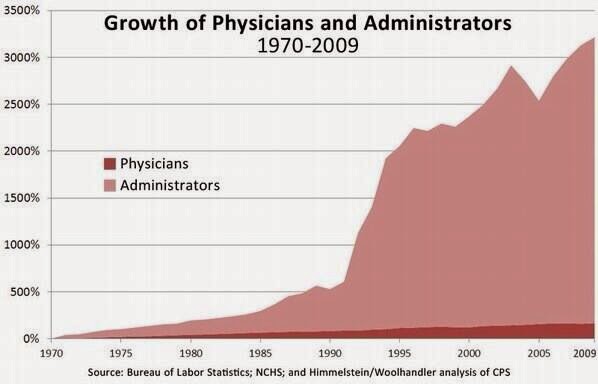
If a picture is worth 1,000 words, how much are two pictures worth?

How about three?

4 comments

The U. S.’s Policy Towards China

You might want to look at Minxin Pei’s analysis at Project Syndicate of the long term prospects for the U. S.’s policy with respect to China. Here’s the kernel of the post:

Under this scenario, economic disengagement would occur gradually, but not completely. Despite the adversarial nature of the relationship, both sides would have some economic incentives to maintain a working relationship. Similarly, while both countries would compete actively for military superiority and allies, they would not engage in proxy wars or provide direct military support to forces or groups engaged in armed conflict with the other party (such as the Taliban in Afghanistan or Uighur militants in Xinjiang).

Such a conflict would certainly carry risks, but they would be manageable – as long as both countries had a disciplined, well-informed, and strategically minded leadership. In the case of the US, however, such leadership is nowhere to be seen today. Trump’s erratic approach to China demonstrates that he has neither the strategic vision nor the diplomatic discipline to devise a policy of managed strategic conflict, much less a doctrine (like that created by President Harry Truman in 1947) to pursue a cold war.

It didn’t need to be this way. A more patient, thoughtful approach to integrating a liberalizing China into the global economy coupled with a slower deindustrialization of the United States would have avoided most of it. That horse has already fled the barn.

Author: Eric Miles


Now we face a China that is militarizing rapidly, is heedless of conforming to the international accords to which it is party, sees economic and foreign policy as a zero-sum game, and for which time is not on its side.

0 comments