John Halpin has a very interesting post at Liberal Patriot on what he terms “anti-politics”,
public opposition to traditional democratic norms and procedures ranging from radicalism and conspiracy theories to elite technocracy and one-man authoritarian rule
He goes on to characterize the two leading figures in right-wing anti-politics, Donald Trump:
Anti-politics in America is exemplified by two populist leaders from the right and left: Donald Trump and Bernie Sanders. Trump is America’s leading master of a certain kind of anti-politics emanating from the nationalist right: against all established institutions they don’t control, dismissive of “elites” and “experts,” distrustful of elections and political processes that don’t advance their positions, disdainful of outsiders, and dedicated to the belief that only their leadership can break through governmental corruption to restore the country. Trump tries to achieve some ideological coherency in his approach, but his form of anti-politics ultimately boils down to an agenda based on his own whims, lifelong obsessions, demands for fealty, and attacks on anyone or anything that gets in his way.
Because of America’s two-party system, Trump has emerged as the world’s most successful practitioner of anti-politics, both in terms of taking over his entire party apparatus and in achieving notable election and governing successes. As seen in 2016 and 2024, there’s a relatively large constituency in the U.S. for his brand of anti-politics. Some right-wing populist and nationalist parties around the world have found governing success, such as Giorgia Meloni in Italy and Viktor Orban in Hungary. But other populist leaders and parties tend to operate mainly as opposition forces rather than governing entities and end up toiling away with relatively small voter support and multiparty systems that block their influence.
No current right-wing populist leader in the democratic world truly matches the scale and success of Trump’s efforts to turn anti-politics into real governing power.
and left-wing anti-politics, Bernie Sanders:
In contrast, Bernie Sanders represents a more ideological form of leftist anti-politics based on the primary belief that everything in American life is a rigged game that favors the wealthy. Although Sanders competes for influence within the Democratic Party, he remains an independent. His supporters despise establishment politics. His solution for nearly every problem is always to attack the “oligarchs” and “billionaires” and to replace plutocratic government with some nascent form of democratic socialism built on high taxation, nationalized health care, a smaller military, green energy policies, and universal social spending.
Leftist anti-politics generally performs better in continental Europe than in America given historical left-wing activism in countries like France, Greece, Portugal, and Spain. Unlike Trump, however, Bernie Sanders has been less successful in capitalizing on leftist anti-politics within America’s two-party system. Sanders and his progressive followers clearly have amassed influence but have never taken over or transformed the Democratic Party the way Trump did on the Republican side. Although Sanders has built a fiercely loyal constituency, and enjoys decent personal popularity and support for his attacks on the rich, he faces a strong counterbalance from moderate Democrats while his national support is capped by Americans’ general resistance to higher taxes, more governmental regulation of the economy, and higher social spending.
My question is what is the endgame for anti-politics? Here’s what Mr. Halpin has to say about that:
One possible end game is that Trumpian anti-politics from the right cements its power in government and maintains electoral advantages for the next few presidential cycles as a cohesive plurality movement with the ability to reach majority status by bringing in other disgruntled Americans who like their disruption and change. Given the president’s political skills, the dynamics of the Republican Party, and the reality of the Electoral College, this is a plausible if difficult scenario for Trump’s successor to pull off. Anti-politics worked well for Trump in 2024 but the viability of this approach four years from now is uncertain.
Another possible outcome is that Trump’s second term ends up in a ditch, probably due to economic mismanagement and right-wing culture wars. This could allow leftist anti-politics to finally take over the Democrats and convince enough disappointed Americans among the larger electorate to give the opposite end of the ideological spectrum a chance to prove their worth. This scenario is plausible but not probable. It would first require centrist and moderate Democrats to give up their internal fight for control of the party and then would require mainstream Americans to take on notably more progressive economic and cultural views than they currently hold.
A third scenario is that anti-politics on the right and left fails in the eyes of many Americans who instead band together to back a “return to normalcy” as represented by something other than the Trump or Sanders wings of their respective two parties. Since Trump is in power and completely dominates his party, this would most likely have to come from a moderate or reform-minded presidential nominee giving voice to this sentiment from the Democratic side. Joe Biden was elected in 2020 based on this approach but he did not deliver the goods in the eyes of most Americans thus fueling another round of anti-politics from Trump.
I agree with him that any “return to normalcy” is likely to be short-lived for the simple reason that ordinary establishment politics, whether on the left or the right, has run out of gas. Trump illustrated that in 2016 when he ran over all of his Republican opponents for the nomination, a blow from which the party may never recover.
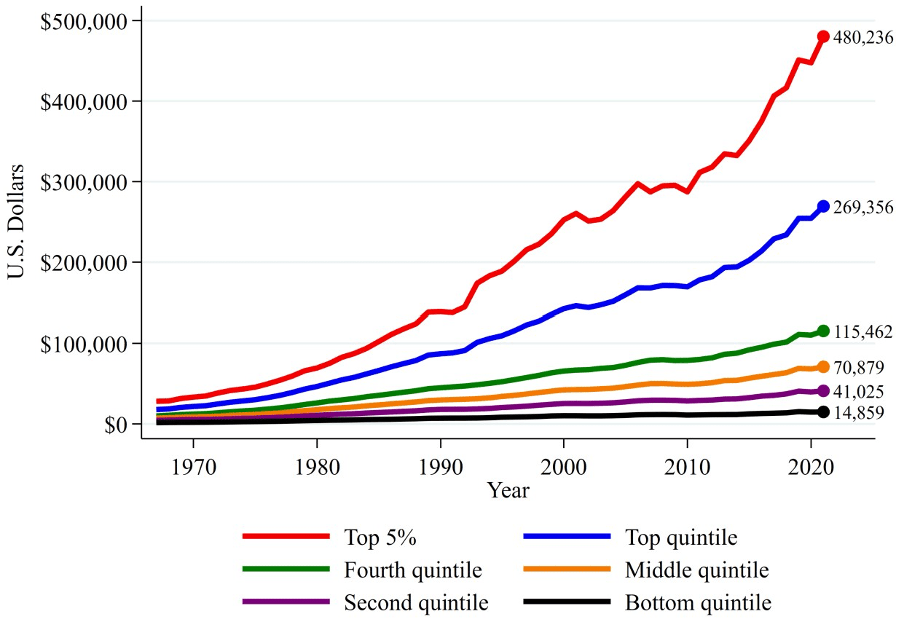
On the Democratic side of the ledger it would be hard to come up with a better epitome of the problems of Democratic politics than those encountered by the Biden Administration. You can’t do what they want to do without spending money. They won’t raise taxes because that would alienate their own funders. They won’t increase production because that would alienate their supporters for whom the environment is a significant of overwhelming importance. Spending more money beyond the increase in aggregate product, i.e. borrowing or just printing money, produces inflation which undermines your support among the bottom four quintiles of income earners, i.e. most of the country.
And that illustrates my problem with anti-politics whether the right-wing version or the left-wing. The numbers just don’t add up. Cutting taxes beyond a certain point makes it impossible to pay for the things you support while raising taxes beyond a certain point kneecaps the private economy.