Chicago PD Deputy Chief Dies in Apparent Suicide

The Chicago Sun-Times> reports that a deputy chief of the Chicago Police Department has, apparently, taken his own life:

A newly promoted Chicago police deputy chief was found dead Tuesday morning of an apparent self-inflicted gunshot wound in the Homan Square police facility on the West Side.

The death of Dion Boyd, 57, was announced at Chicago Police Department headquarters Tuesday afternoon by Supt. David Brown.

Brown, flanked by other members of the CPD’s leadership, said Boyd was “a respected command staff member.”

He was with the department for nearly 30 years.

“There’s really no way to convey or express the magnitude of this loss,” Brown said. “We are shocked and saddened at the loss that is deeply felt by me and the many colleagues and friends with whom Deputy Chief Boyd worked and mentored throughout his career.”

Brown pleaded with officers to “always remember to take care of ourselves and each other.”

“There is no shame in reaching out for help,” he added. “Please, officers, please, stay humble, stay human, stay safe and stay well.”

I think there’s a lot more to this story than is being revealed by the Sun-Times. This officer was newly-appointed deputy chief. Either this officer should never have been promoted, the new pressures of the job were just too much, there were things in this officer’s life that caused him to take his own life, or a combination. How could it have come as a surprise?

Note, too, that the suicide rate among CPD officers is 60% higher than the average among police officers. I don’t know how that relates to the suicide rate among big city police officers or among higher-ranking officers. I wonder if there is a worse time to be a police officer than today.
2 comments

I Hate Reruns

Speaking of outrage, Democratic Party political consultant Ted Van Dyk uses his Wall Street Journal op-ed to express dismay at the present crop of Democratic leaders. It takes him a while to screw up his courage but he finally gets to the point about the situation in Portland and other U. S. cities:

Any president dating back to Franklin D. Roosevelt would have taken action under these circumstances. First, there would be denunciation of the violence. Then the president would ask local officials if they needed federal help. If the answer was yes, it would be sent immediately. If the answer was no but disorder continued, the president would no doubt dispatch officers to protect federal buildings and otherwise restore order as authorized by the Constitution. He would know that the country at large looked to the president as the ultimate guarantor of public safety.

I wonder if he’s realized yet that the progressives presently in positions of party leadership aren’t liberals? When you combine an apportionment system that favors clumping ideological minorities together into safe seats to create more safe seats for “regular” party members with seniority rules that’s what happens. It’s the same reason so many Southern Democratic in the 1960s were Klan members.

The clue should have been when Sen. Obama said “We are five days from fundamentally transforming the United States of America”. You only “fundamentally transform” something that isn’t working. Liberals think the system is working but, since there is always room for improvement, it can be changed in detail. More radical ideologues believe in throwing the liberal and democratic baby off the back of the troika.

Mr. Van Dyk’s concern is that Democrats will “blow” the 2020 election, effectively throwing it to President Trump. Sort of a re-run of the 1972 election. He should have started expressing his concern in 2017.

19 comments

For Want of a Nail

For want of a nail the shoe was lost,
for want of a shoe the horse was lost,
for want of a horse the knight was lost,
for want of a knight the battle was lost,
for want of a battle the kingdom was lost.
So a kingdom was lost—all for want of a nail.

That observation in various forms goes back roughly a millennium at least. Seemingly insignificant things may have grave consequences.

I’m of mixed minds about the “authoritarian” use of force against rioters tearing down barricades and setting fires, including setting fire to a federal courts building, in Portland. I’m very outraged that the federal government, apparently, has scores of special incident law enforcement units. I don’t think it should have any. Law enforcement including the enforcement of federal law is up to state and local governments. But that, apparently, is no longer how our system works and it hasn’t worked that way since before I was born.

I’m very outraged that state and local officials refuse to enforce federal law. That will inevitably lead to many other outrages. I’m very outraged the state and local officials are not exercising their most basic responsibility of protecting public and private property and lives.

I’m very outraged at mass demonstrations since I believe they’re inherently authoritarian. The demonstrators should be organizing politically. That is how things are done in a representative democracy governed by laws. And before you bring up the Boston Tea Party that was against an authoritarian government not against a representative liberal democratic one. The demonstrators in the pre-civil rights South had no other alternative—they were being denied their voting rights. When you take to the streets, destroying property and generally imposing your will on other people, in opposition to a representative liberal democratic government, how can it be other than authoritarian?

I’m very outraged that as many of the demonstrators are prepared to fight and setting fires, setting off fireworks illegal under Oregon law, throwing bottles, tearing down barricades, and injuring law enforcement officers by shining lasers into their eyes. Does anyone really doubt the federal courts building in Portland would be destroyed without protection? And then when destroyed there would be complaints that the lack of availability of a federal courts building placed an undue burden on the poor?

I’m outraged that people are claiming that there’s no way of identifying the federal law enforcement officers in Portland when there clearly is—identifying numbers. Chicago police officers don’t wear their names on their uniforms, either.

I’m outraged that people are more concerned about the putative rights of people engaging in unlawful demonstrations while ignoring the rights of ordinary law-abiding citizens. I’m outraged that people are willing to let those law-abiding citizens who, literally, have no recourse, “stew in their own juices”.

So you can see my conundrum. There are so very many things about which to be outraged.

6 comments

Heavens Save Us From Well-Meaning Idiots

I find it dismaying that the one thing that all of the plans for reducing global warming seem to have in common is the vast amount of building they will require including rebuilding much of the housing stock in the U. S., electric vehicles, and wind and solar power facilities. The amounts of rare earths that will be required for those last three are genuinely daunting.

The greenhouse gasses that will be emitted by producing the amount of cement that will be required for these plans will probably be more than they plan to save.

The blades of wind turbines have finite lifespans and at this point there is no practical way recycling them. Mostly they’re just thrown into landfills.

When your plan for saving the environment requires basic scientific breakthroughs, you don’t have a plan you have a wish. It’s the same as with reopening the economy. If your plan requires a safe, effective vaccine against SARS-Cov-2, you don’t have a plan.

One of the things that brings all this to mind is the public service-type television advertisement for Amazon that I’ve been seeing lately. You know what would really save the environment? Shutting down Netflix and Facebook, two of AWS’s best customers.

16 comments

Reminder

In case anyone has forgotten, I chided President Obama for turning his attention from the economy to health care after the ARRA was passed and criticized President Trump’s cut in the personal income tax (the reform in the corporate income tax was long overdue). I have also produced any number of posts on reducing federal expenditures. Tops on my list would be abandoning our counter-insurgency efforts in Afghanistan. That should have been done 15 years ago.

The folk Keynesian pump-priming on which the Congress has relied for decades became much less effective when imports exceeded 12% of GDP which happened several decades ago. IMO folk MMT under which the U. S. can expand its credit unmoored from aggregate product is even worse.

0 comments

Olivia De Havilland, 1916-2020

Olivia De Havilland, the last surviving bona fide star of the Golden Age of Hollywood, has died at 104. From the Los Angeles Times:

Olivia de Havilland, the last remaining star from the 1939 epic film “Gone With the Wind” and a two-time Academy Award winner who for decades was seen as the essence of Hollywood royalty, has died at her residence in Paris. She was 104.

De Havilland, who died Sunday of natural causes, was generally considered the last of the big name actors from the golden age of Hollywood, an era when the studios hummed with activity and the stars seemed larger than life.

The actress — always a free spirit in what then was a buttoned-down world — gave up on Hollywood and moved to Paris in the early 1950s but remained firmly in the public eye into her final years, when she waged a 1st Amendment fight for privacy over the use of her image in the 2017 docudrama “Feud: Bette and Joan.”

She made headlines on the eve of her 101st birthday by announcing that she was suing FX over what she alleged was the unauthorized use of her identity in the miniseries, which chronicled the storied rivalry between actresses Bette Davis and Joan Crawford. Catherine Zeta-Jones portrayed De Havilland in the serial.

That wasn’t the first time Miss De Havilland had turned to the courts. In 1943 she sued Warner Brothers, insisting that her seven year contract she had with the studio elapsed in seven years rather than the seven years measured in days worked as claimed by the studio’s attorneys. Leaving WB gave her the opportunity to play roles other than the ingenue parts into which the studio slotted her. Her performances in To Each His Own (1946) and The Heiress (1949) for which she won Academy Awards as Best Actress, are unforgettable not to mention her electrifying and courageous performance in The Snake Pit (1940). The “De Havilland Laws” have benefited actors, actresses, and other performers since then including Johnny Carson, Jared Leto, and Rita Ora.

Her Broadway performances included Juliet in Romeo and Juliet (1951), Candida (1952) in revival and A Gift of Time (1962) opposite Henry Fonda.

Her death really marks the end of an era of Hollywood glamor.

1 comment

A Modest Proposal for Public Pensions

At Forbes Andrew Biggs and Sheila A. Weinberg have a proposal for filling in the public pensions hole that state and local governments have dug for themselves:

We propose, at least for discussion purposes, that if a state requests and receives federal aid for pension funding, then the state must agree to bring that public pension under federal regulation that was qualitatively similar to what private pensions work under.

[…]

Put in simple terms, in exchange for near-term financial assistance, states would accept the same deal that federal law requires of private sector employers: Run your pensions right or don’t run them at all. If a state choses to continue running a defined benefit pension plan, it must do so using more prudent funding rules and more rapid repayment of unfunded liabilities. If the state can’t run a traditional pension on those terms, federal law would give the state the leeway to shift its employees to defined contribution retirement plans. That may be a better option than waiting for states to declare bankruptcy.

That’s a lot easier to say than it is to do. In Illinois such an agreement would require not merely a single but probably a slew of amendments to the state’s constitution. Even were the amendments to be enacted the inevitable lawsuits would need to be decided in ways that did not vitiate them. Keep in mind that state Supreme Court justices have their own public pensions to watch out for.

Illinois’s problem has been a corrupt arrangement by which elected officials protect public employee pensions in exchange for contributions, campaign workers, and votes. For decades those politicians kept the ball in the air by not paying into the public employee pension funds at the rate required to maintain solvency. As long as the incentives remain the same I’m not sure how the proposal would solve anything. Once they had the cash Illinois’s governor and legislature would just reneg on the deal. Then what?

3 comments

What Happened to California?

There is one passage worthy of consideration in the interview of Joel Kotkin about his book on neofeudalism at RealClearPolitics:

If there was a California “miracle,” and I think it was true, it is now occurring increasingly elsewhere. For a dedicated Californian this is very painful. I still believe California has the resources and know-how to create a functioning social democracy based on work, not welfare, but there is little political support for what would be something of a return to the old Pat Brown policies of nurturing growth and the middle class. The greens, the greedy, self-absorbed oligarchs and the government clerisy have no interest in developing an independent citizenry; they want numbed subjects they can rule and cajole with little restraint.

The notion that you can maintain a viable economy just by building and selling houses, much of the muscle power being supplied by Mexican workers has always been fundamentally flawed. Some major fortunes were built that way, however.

2 comments

Perpetual Motion

There is a common thread that will run through several of my posts this morning: perpetual motion. Briefly stated, perpetual motion is the idea that a machine (or system) can be created that produces outputs without inputs. However designed or cleverly built, this is impossible. It violates the laws of thermodynamics as we understand them.

Perpetual motion schemes have been around for at least a millennium and will continue as long as people want to get something for nothing which is to say forever. Consider, for example, the cat and rat farm.

Your investment scheme that always makes money or your plan to support most of the people just by extending credit are forms of perpetual motion. In the long term that cannot work and when they fail it can be disastrous.

6 comments

Why We Borrow

This post is a response to something in comments. These are all just round numbers. The aggregate personal income, that is, the total of all personal incomes in the United States was around $18 trillion in 2019. Roughly 150 million personal income tax returns are submitted annually. A little long division tells you that there are 1.5 million people in the top 1% of income earners. The gross collections from all personal income taxes is just under $2 trillion. The average income for someone in the top 1% of income earners is around $1.3 million per year—the median is much lower.

1.5 million X $1.3 million = $1.95 trillion. That’s the total income of all of the people in the top 1% of income earners. That means that the most you can realize in revenue just by taxing the top 1% of income earners is just under $2 trillion. And that would be by confiscating all of their income. Most of those people aren’t rich by anyone’s standards. Prosperous, yes, but not rich. Most are physicians, lawyers, and other professionals, middle level managers, and so on. It should be obvious that we can’t tax their incomes at 100%. They would be unable to pay their mortgages or feed their families.

According to the St. Louis Federal Reserve, the amount of federal taxes extracted from the economy as a proportion of GDP has varied from 5% (1930) to 20% (in 1945). It has never gone above 20% and for most of that period has been right around 17%. There is simply no political will in either political party to extract more.

Add up Social Security payments of various kinds, Medicare and Medicaid payments of various kinds, interest on the debt, and all of the other things the federal government spends money on and you come up with about $4.4 trillion. Total federal revenues in 2019 was about $3.3 trillion. We borrowed the difference. Under the CARES Act earlier this year we’ve spent something $1.75T and $2.25T more. We did that by borrowing, too.

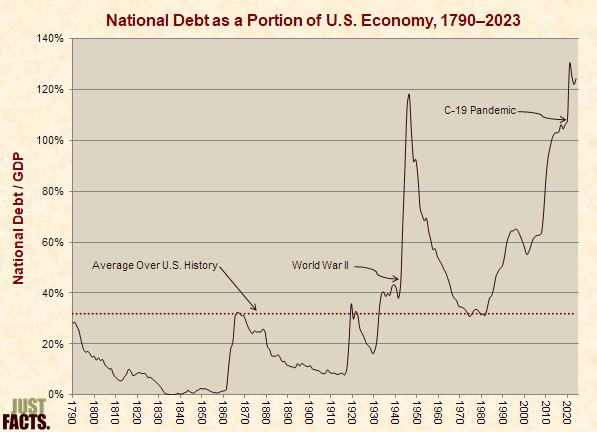
Let’s take a gander at the present size of that debt:

As you can see it’s the highest it’s been since 1945. We borrowed to finance World War II, too. There is strong empirical evidence that large public debt acts as a brake on economic growth. It used to be believed that there was a sort of cliff at 100% but that is no longer believed to be the case. Nonetheless the empirical evidence still supports the idea that public debt retards economic growth. Said another way after a certain level of debt it becomes extremely difficult to outgrow your debt. Do you see that dip in the graph in 1990 and the early Aughts? That’s what we did—we outgrew our debt.

There’s another alternative to borrowing, as those who support something called Modern Monetary Theory point out. We could just issue ourselves credit without actually borrowing the money, effectively inflating the money supply. I agree with them up to a point. I think that is safe and practical to do as long as you limit your expansion to the rate at which aggregate product is growing. Beyond that it will create inflation. I’m honestly not particularly worried about inflation at this point.

The bill that is presently being debated to extend supplementary income payments to those out of work would cost something between $1T and $3.4T (the HEROES Act). That would be in addition to the roughly $2T of the CARES Act.

The risk that concerns me is not inflation but hyperinflation. Hyperinflation is not just a species of inflation. It is a psychological and behavioral phenomenon—a catastrophic loss of confidence in the currency. Hyperinflation would be difficult for all of us but it would be disastrous for the very people the HEROES Act is trying to help. If countries like China and Japan which hold considerable dollar reserves decide the dollar is just too risky, it could provide a shock that spreads. It can happen very quickly and without a gradual period of high inflation as a warning.

18 comments
