Why Do People Work?

The editorial policy of the Wall Street Journal is resolutely pro-business which makes all of the sense in the world. The WSJ hasn’t had the problems that other news organs have. It is a business newspaper. People subscribe to the WSJ because there is a direct relationship between the intelligence they glean from it and making money. Thinking that they’re “pro-rich” or “pro-Republican” is a misconception or, at worst, a ceding of the criticism sometimes made that the Democratic Party is anti-business.

In a recent editorial the editors of the Wall Street Journal take a predictably pro-business stance regarding extending the moratorium on evictions that was put in place in reaction to COVID-19 last year:

The eviction moratorium was perhaps justifiable amid the early lockdowns that threw millions out of work, but it’s now a cautionary tale of how bad policies distort behavior and are difficult to end. The original Cares Act moratorium that only applied to federally subsidized housing expired last July, but the Trump Centers for Disease Control and Prevention imposed its version in September. The moratorium applied to all rental housing and tenants who earned less than $99,000 ($198,000 for couples) who claimed they lost income because of the pandemic. Landlords who evicted non-paying tenants could go to jail.

Congress extended the ban in December for a month, but then the Biden Administration extended it three times through Saturday despite rulings from several judges that the CDC had exceeded its authority. Last month Chief Justice John Roberts and Justice Brett Kavanaugh joined the liberals in maintaining a stay on a lower-court injunction reversing the ban.

Justice Kavanaugh wrote that he agreed the CDC acted unlawfully but allowed the moratorium to continue so rental assistance appropriated by Congress could have more time to be distributed. But he said a “clear and specific congressional authorization (via new legislation) would be necessary for the CDC to extend the moratorium past July 31.”

Cue the political panic.

and I think that editors are completely right when they note:

The moral imperative now is to let landlords collect rent so they can stay in business and avoid bankruptcies that would lead to cascading damage throughout the rental housing market.

It is not just there that the damage would be done. Unless you believe that large companies and slumlords are better landlords. Those are the ones that would survive the debacle.

From my vantage point those who supported the moratorium last year ceded the moral high ground when they neglected to to impose a real estate tax moratorium and an interest payment moratorium at the same time. Failing to do so effectively created a subsidy for renters, state and local governments, banks, and large companies that rent property at the expense of small landlords. Just how serious a gap is that? According to the National Association of Realtors, it’s a pretty substantial one. Not only are the majority of properties owned by small operators, their largest expenses tend to be their mortgage payments and their property taxes.

I understand the impulse that leads representatives to want to help their constituents out. What I don’t understand is picking one group of constituents over another.

But there is another impulse that I truly don’t understand and it is rearing its head with some regularity these days. Not only does it inform the discussion of the moratorium on foreclosures but the multiple spending bill making their way through the Congress, and the discussion of a universal basic income and that is that it is the role of the federal government to ensure that every human want is satisfied by the government, not just for the poor but for people who can only be described as the middle class, maybe even the upper middle class. Characterizing these things as “human infrastructure” is a sales technique rather than a definition. Literally everything that anybody might want can be termed that way not just child or elder care and education but food, clothing, transport, rent (or mortgage payment), and so on. That’s precisely what you’re talking about when you talk about ever-extending eviction moratoria and student loan jubilees.

And that gets me to the title of this post. Why do people work? The reality, even if you think it terribly unfair, that most people work because they must to support themselves and their families. Relatively few people work for self-expression, fulfillment, or job gratification. I think that most people see those as luxuries that are beyond their grasp.

It should also be noted that giving people things takes something important from them: they are unlikely to believe they earned them. It robs them of self-esteem. That most will just take the money and run does not negate that. And as Sam Clemens said the difference between a man and a dog is that if you feed a dog and make him prosperous he won’t bite you.

7 comments

Nothing Ever Happens in August

Despite having a reputation for being a month in the doldrums, August has historically been a very eventful month, frequently not in a good way. In a good column in the Wall Street Journal Andy Kessler takes note of several important developments that have taken place in August:

Surprise! On Aug. 11, 1951, New York’s WCBS-TV broadcast the first baseball game in color, a double-header from Brooklyn’s Ebbets Field. The surprise was that television could do color at all—maybe 100 color sets existed at the time. Yes, “The Wizard of Oz” stunned theatergoers with color in August 1939. But television? Around 20% of U.S. homes had black-and-white TVs, often to watch Rocky Marciano’s almost monthly boxing matches, which my dad called the Bum of the Month club. By 1960 almost 90% of homes had sets. As broadcasts in color ramped during the ’60s, color-TV sales boomed. Someone paying attention 70 years ago would have seen the future.

Surprise! On Aug. 13, 1961, the world woke up to 32,000 troops in the Soviet sector of Berlin installing 97 miles of barbed wire and eventually building concrete fences—not to keep people out, but to keep anyone from leaving. The Berlin Wall stood for 28 years, as the icy Cold War proved that capitalism in the West, especially West Germany, completely outdistanced the stagnant communist Five Year Plans and neighbor turning in neighbor via East Germany’s Stasi secret police. The only question is why it took so long to implode.

Surprise! On Aug. 15, 1971, President Nixon ended the international gold standard set up at the 1944 Bretton Woods Conference. Most didn’t see that coming. After years of funding Lyndon B. Johnson’s Great Society and the never-ending Vietnam War, the U.S. couldn’t afford both guns and butter as other countries began demanding physical gold instead of printed dollars for trade imbalances. Subsequent inflation was definitely not “transitory.” Oil embargoes and economic “malaise” followed. Real assets soared, stocks flatlined. This was broken only when President Reagan had Federal Reserve Chairman Paul Volcker’s back as he slew inflation with punishing interest-rate hikes.

Surprise! On Aug. 5, 1981, Reagan fired more than 11,000 striking air-traffic controllers, members of the Patco union. Union membership as a percentage of the U.S. workforce peaked in 1945, but the decline slowed in the 1960s and 1970s. It’s been steadily falling since Reagan’s action. That and capital-gains tax cuts, encouraging capital formation, set up U.S. companies for rapid and profitable growth. A massive bull market began in 1982—Aug. 13 actually—with the Dow Jones Industrial Average at 777. We’ve rarely looked back.

Others include the publication of the first web site (1991) and the removal of Moammar Gadhafi’s regime in Libya (2011). However, I fear that Mr. Kessler is a captive of the misconception, common today, that nothing ever happened before he was born.

Some other notable developments in August:

August 1, 1894: the beginning of the first Sino-Japanese War
August 1, 1914: the German Empire declares war on the Russian Empire and although declared on July 28, World War I, the Great War truly got under way
August 1, 1944: the start of the Warsaw Uprising

No one has ever accused me of being a cockeyed optimist. Given all of the COVID-19 related upheaval throughout the developing world, I would not be a bit surprised if a major war didn’t break out somewhere this month.

5 comments

Ziva Is Gone


Today has been a very, very difficult day. A month or so ago we noticed that Ziva’s lymph nodes were increasing in size in many places in her body. We never actually received a diagnosis but all of the signs pointed to lymphoma. At more than 12 and multiple other health problems we did not feel that chemotherapy or, indeed, any aggressive therapy was in her best interest. We did our best to make her as comfortable as possible and support her general health. The lymph nodes continued to enlarge from the size of peas to the size of robins’ eggs.

Last week we decided to have her euthanized, made an appointment with a vet to come to our home, and set a date—today. We’ve spent the last day or so pampering her—we were no longer worried about spoiling her!

The vet arrived a little after 1:00pm. She was very, very nice. Kara, our remaining Samoyed, stayed with us during the entire process. She was very calm and I thought it was good for her to know what was happening.

That’s Ziva in the picture above in our yard with some of her favorite toys. She had a wonderful day yesterday and a great, happy morning. Now she has no more mornings and we will miss her terribly. The Aussies are looking for her and I suspect they will continue to do so for a time. We and the pack will recover but I don’t know how the pack dynamics will change.

10 comments

Not Good Enough

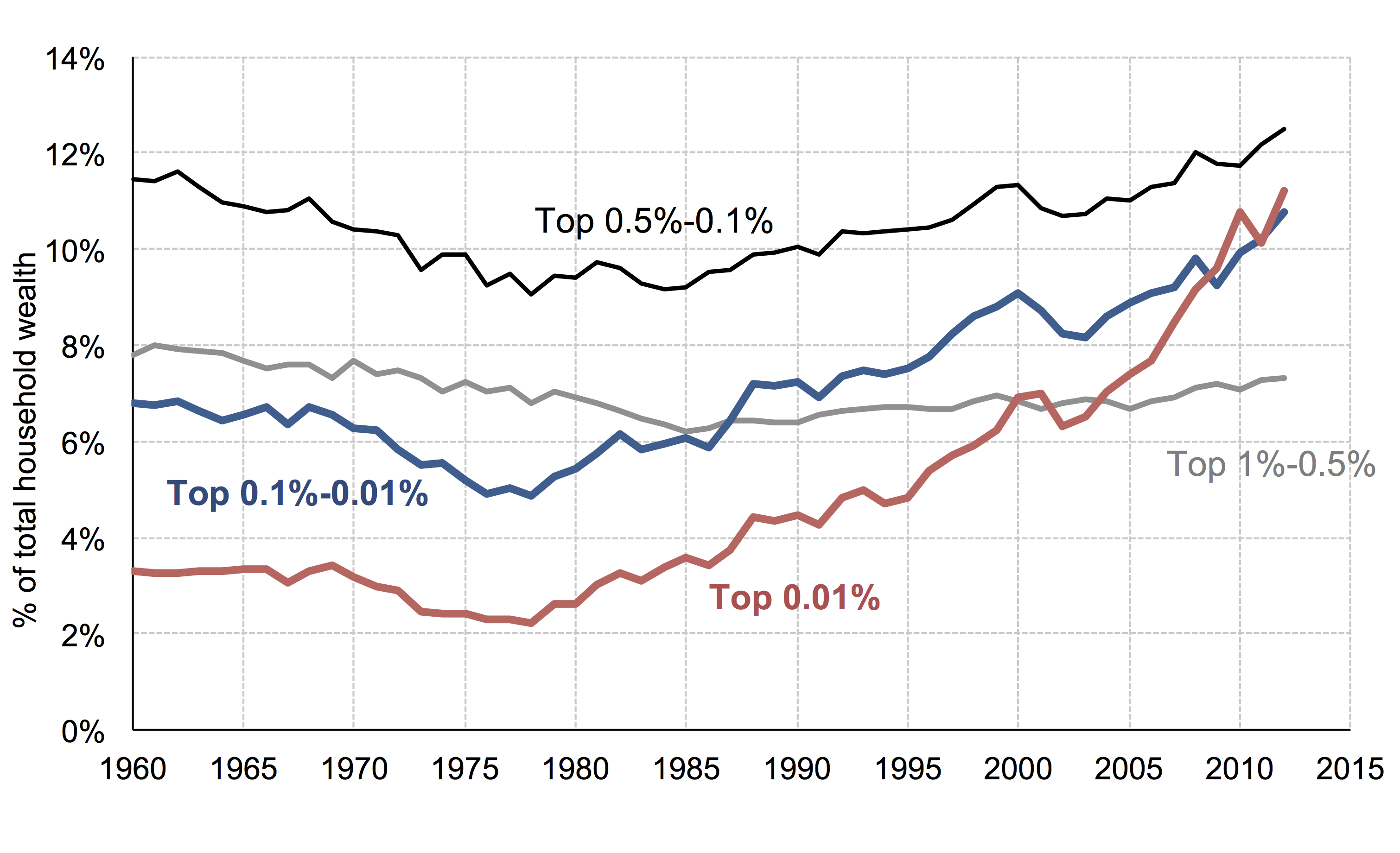
I don’t find the data on wealth inequality in the U. S. quite as encouraging as the editors of the Wall Street Journal do:

In the 40 to 59 age group that is the paper’s focus, the top 5% of households control 63.5% of “market wealth”—liquid assets, housing, and accounts like 401(k)s. But include future pension and Social Security income, and the top 5% share is a more modest 45.4%, the authors find.

Under this measure of wealth, the increase in inequality over time has also been less steep. While the share of “market wealth” held by the top 5% of households age 40 to 59 increased 15% over the last 30 years, their share increased only 10.2% with Social Security and defined-benefit pensions included.

Graphs explain the source of my concern:

I wasn’t able to locate the graph I was actually looking for quickly. Hard as it may be to believe 50 years ago 50% of the population held 50% of the wealth. We’re now getting back to Gilded Age, pre-industrial levels of inequality.

It’s easier to illustrate income:

In my view three things are necessary

  1. Reduce the growth in income and wealth subsidies for the top 10% of income earners. Over the last 20 years those subsidies, largely from the Federal Reserve, have been prodigious.
  2. Restrict immigration. As I’ve said before there is no way to reduce wealth and income inequality when we’re importing poor people as quickly as we have been for the last 40 years.
  3. Revitalize the U. S. industrial sector. We can’t remain a great nation on the basis of retail sales and services.
28 comments

Living With a Virus

I see that Andrew Sullivan has settled on the view of COVID-19 not unlike the one I encouraged more than a year ago:

Living with a virus — rather than defeating it — is not emotionally satisfying. It does not, in our minds, remove the threat. But the truth is: humans have no choice but to live with viruses. We always have. I’ve lived with a potentially fatal one buried in my bone marrow for almost 30 years. I still test HIV-positive. Almost certainly, I will die HIV-positive. But I will not die of HIV. And that’s ok. As long as I can prevent it wreaking havoc on my immune system, and ruining and ending my life, I’m content to live with it. We’re almost friends at this point.

These viruses challenge the psyche, and the trick, it seems to me, is not to deny their power and danger, but to see past them to the real goal: the living of your life. If you are not careful, this one viral threat can crowd out all other perspectives, distort your judgment of risk, and cause you to be paralyzed by excessive caution and fear. But defeating a virus often does mean living with it. We already do this with the flu. There’s no reason we can’t do it with Covid as well.

which is consistent with the view expressed the other day by the editors of the Wall Street Journal:

But let’s be clear, unlike the CDC: The virus will never be eradicated. It will eventually become endemic, and the public-health goal is to protect people from getting severely ill.

For the info from the Centers for Disease Control to which they are both reacting see here.

Be responsible. Take prudent action. Getting vaccinated against COVID-19 is prudent even though we don’t know the vaccines’ long term effects, especially if, like me you don’t need to worry about the vaccines’ effects 30 years down the road. Wearing a mask in a store or office building is prudent, too. Big cities look a lot less prudent than they used to. Presently, Lollapalooza, a large four-day music festival is under way in Chicago. IMO not cancelling the event was not just imprudent on the part of city officials it was cynical.

A six week lockdown a year ago was prudent under the circumstances. A 20 week lockdown was less prudent. A restoration of lockdowns would be darned hard to justify. Refusing to enforce the lockdown or, worse, enforcing it on some but not on others was grossly imprudent.

Based on the best information we have available right now “herd immunity” against COVID-19 is beyond our grasp for the foreseeable future. That will be true as long as vaccinations do not convey immunity. We’ve been spoiled by the experience with smallpox and polio, even measles. We need to learn to live with SARS-CoV-2 and its descendants.

14 comments

WWJD?

The editors of the Washington Post summarize the recent findings of rapid expansion of China’s nuclear weapons capability:

One month ago, a disturbing report based on satellite imagery showed that China was building about 120 silos for intercontinental ballistic missiles near Yumen in Gansu province, some 1,300 miles west of Beijing. At the time, we raised questions about China’s intentions. Now, a new report has identified a second field taking shape, with about 110 silos near Hami in eastern Xinjiang, 240 miles northwest of the first site. Considering other locations where missile silos are under construction, China seems to be aiming for a tenfold increase in intercontinental ballistic missiles if each silo were filled. What is going on?

and remark:

An unanswered question is what China thinks it will gain by vaulting to a nuclear posture closer to that of the United States and Russia. The response by the United States and the West is either more nuclear weapons — a new arms race — or nuclear arms control, in which China has not shown much interest. The new missile silos are an ominous sign of a growing challenge, made even more vexing by the other tensions between Washington and Beijing.

In my view while we should be modernizing our nuclear deterrence and missile capabilities, we should refrain from taking more strenuous actions in response to this Chinese build-up but that wasn’t the question that occurred to me on learning of it. I wondered what would Japan do?

I would not be a bit surprised if we saw Japan working on a nuclear deterrent of its own. Not to mention Taiwan. India, which already has a nuclear arsenal, may start increasing it. Cold War II, indeed.

4 comments

Question of the Day

Yesterday the Senate passed its version of the infrastructure spending bill on a bipartisan basis with 17 Republicans joining all of the Democrats in voting in favor of it. What will the outcome be?

  1. True to her word Nancy Pelosi will not take the bill up in the House until the Senate moves on the $3.5 trillion reconciliation bill. That doesn’t happen and the bill dies.
  2. The Senate approve the $3.5 trillion with no Republican votes and Kamala Harris breaking the tie.
  3. The $3.5 trillion bill passes the Senate with one or more Republican votes.
  4. The $3.5 trillion bill does not receive 50 Democratic votes in the Senate.
  5. Other

Place your bets.

4 comments

Jaw-Jaw

I don’t know whether this report by Lingling Wei in the Wall Street Journal indicates a change in tone by the Chinese leadership, a change in reporting by the U. S. press, or differences in personal styles between individuals and with relationships between individuals:

NEW YORK—China’s new envoy to the U.S. struck a conciliatory note upon his arrival in Washington on Wednesday, pledging to repair the increasingly testy relationship between the two world powers days after Chinese Foreign Ministry officials greeted a visiting senior State Department official with a chilly lecture on diplomacy.

Qin Gang, a veteran diplomat and trusted aide to President Xi Jinping, said in remarks posted on the website of China’s embassy in the U.S. that he will “endeavor to bring China-U.S. relations back on track, turning the way for the two countries to get along with each other…from a possibility into a reality.”

His tone contrasted sharply with the tense exchange between senior Chinese and U.S. diplomats in the port city of Tianjin on Monday, when a Chinese vice foreign minister gave U.S. Deputy Secretary of the State Wendy Sherman an earful, saying Washington was entirely to blame for the souring bilateral relationship.

The more placating remarks by Mr. Qin—in which he said he would “seek to build bridges of communication and cooperation with all sectors of the U.S.”–show that Beijing still hopes to reset relations with Washington—but on its own terms.

In a commentary that roughly coincided with Mr. Qin’s remarks, China’s official Xinhua News Agency urged the U.S. to “discard its habitual bullying of China.”

Relations between the U.S. and China have continued to deteriorate after having plummeted during the Trump administration. President Biden has been trying to build alliances to confront a more self-confident and assertive China on issues as diverse as human rights, technology and geopolitics, while Mr. Xi is intent on reshaping the relationship as one between two head-on competitors.

I agree with Churchill. Talking is better than the alternative. I just wish that more Americans including American diplomats recognized that China has its interests, we have ours, they rarely coincide and there’s nothing inherently wrong with that. We should worry less about China pursuing its own interests and devote more attention to pursuing our own. Spoiler alert: those aren’t always the same as Apple’s or Walmart’s.

1 comment

Puzzlers

I’m going to admit to being puzzled by this report in the Washington Post from Karla Adam and William Booth:

LONDON — This is a puzzler. Coronavirus cases are plummeting in Britain. They were supposed to soar. Scientists aren’t sure why they haven’t.

The daily number of new infections recorded in the country fell for seven days in a row before a slight uptick Wednesday, when the country reported 27,734 cases. That’s still almost half of where the caseload was a week ago.

The trajectory of the virus in Britain is something the world is watching closely and anxiously, as a test of how the delta variant behaves in a society with relatively high vaccination rates. And now people are asking if this could be the first real-world evidence that the pandemic in Britain is sputtering out — after three national lockdowns and almost 130,000 deaths.

Public health experts, alongside the government, predicted that cases would be rising in Britain at this point, perhaps even exponentially.

The highly contagious delta variant of the virus, first detected in India, accounts for almost all new cases here. On July 17, the number of new day cases reached 54,674, the highest since January.

Two days later, dubbed “Freedom Day” by the press, Prime Minister Boris Johnson’s government ended almost all government mandates in England for mask-wearing and social distancing. Pubs are serving pints at the rail and night clubs have reopened with maskless youths packed on the dance floors. Viral defense is now a “personal choice.”

And so some of the best infectious-disease modelers on the planet warned that 100,000 new cases a day this summer could be expected.

But the trend since then has been on a sharp decline.

The reason for my confusion is not just that Britain’s COVID-19 cases are “plummeting”. That’s good news and I hope it continues. Neither is it that the Brits declared “Freedom Day”.

My confusion is that the number of daily cases in the U. S., adjusted for population, is actually considerably lower than the UK’s. And yet here, rather than rejoicing, political leaders are warning us that things are getting worse. Which they are. They’re worse than the best it has been but that’s still considerably better than it was as recently as May 2021.

I wouldn’t proclaim “Freedom Day” or say we’re rounding a corner but I see little reason for doom and gloom, either. People are still getting sick but many fewer are dying; people should get vaccinated but many continue to be. Our health care system has not been brought to its knees.

10 comments

It Will Never Be Over

This post is a reaction to this post by Cheryl Rofer to which she linked in the comments thread of this post by James Joyner. The particular passage to which I am reacting is this paragraph:

People who are not vaccinated will become sick and die. Those who recover will be immune to the disease. Either way, they will be removed from the susceptible pool. People are being vaccinated every day. They are removed from the susceptible pool after the appropriate number of shots and waiting period. The numbers of the susceptible decrease every day.

With all due respect I think that Cheryl is mistaken in almost every particular in that statement. The population is not divided into two groups (the vaccinated and the unvaccinated). There are many groups. We do not know whether those who do not elect to be vaccinated will become sick but we can be pretty confident that most who contract COVID-19 will not die because that has been the experience to date. We do not know whether some proportion of the population is simply not susceptible to the disease without either previous contracting of the disease or vaccination. We can be pretty confident, again based on present experience, that people who have been vaccinated can, in fact, contract the disease. At this time we cannot say with confidence whether vaccinated individuals who nonetheless contract COVID-19 are able to spread it to others. We are hopeful that they cannot but we do not actually know. We do not know whether those who have been fully vaccinated and nonetheless contract COVID-19 may die of the disease. We have fair confidence they will not but we do not actually know.

All of these reasons point to why my view differs dramatically from Cheryl’s. I don’t believe that the pandemic will ever be “over” in the sense that we will return to the status quo ante September 2019. The pandemic will technically be over but it will be endemic. “Zero COVID” is not an achievable goal. It probably was not an achievable goal as early as December 2019 and it may never be achievable. People will contract COVID-19, spread it to others, and some will die of it and all of those will be true regardless of how many people are vaccinated.

Just for the record I am fully vaccinated, I believe it is prudent to do so, and I wear a facemask when entering stores or other buildings in which I encounter the public. I do not see my self as either a “anti-vaxxer” or even as a pessimist. I think I am a realist and an empiricist.

15 comments
