Defense Spending Priorities

Something else you may not have noticed. Last week the House passed a $768 billion defense appropriations bill. Connor O’Brien reports at Politico:

The House on Thursday easily passed a $768 billion defense policy bill that endorses a major budget boost, dealing the biggest blow yet to President Joe Biden’s Pentagon spending plans.

Lawmakers approved the National Defense Authorization Act in a 316-113 vote with broad support from Democrats and Republicans as momentum builds on Capitol Hill to add upwards of $25 billion to Biden’s defense proposal.

What did it include?

In all, the legislation would authorize $768 billion for national defense programs, including $740 billion for the Pentagon base budget — an increase of $25 billion from what Biden requested — and $28 billion for nuclear weapons programs under the Energy Department.

On the House floor this week, Armed Services leaders touted the legislation as a key step in shedding aging weapons and helping the Pentagon pivot toward emerging technologies that help match threats posed by China and Russia.

“Everybody here will find something that they do not like,” House Armed Services Chair Adam Smith (D-Wash.) said on the House floor. “But it is also the nature of the legislative process, in this case, that we have produced a product that everybody in this House can be proud of.”

The top Armed Services Republican, Rep. Mike Rogers of Alabama, added that the bill is “laser-focused on preparing our military to prevail in a conflict with China.”

and

The bill also would:

— Authorize $28.4 billion for 13 new Navy ships, including three Arleigh Burke-class destroyers and two Virginia-class attack submarines.

— Authorize the purchase of 85 Lockheed Martin F-35 fighters, matching the Pentagon’s budget request.

— Procure 24 Boeing F-15EX jets for the Air Force, double the number requested by the Pentagon.

— Prohibit private funding for cross-state National Guard deployment except for emergency or disaster relief efforts.

— Require generals and admirals to be out of the military for 10 years before they can serve as defense secretary, up from the current seven-year cooling off period.

— Provide a 2.7 percent troop pay raise.

$768 billion sounds like a lot of money and it is. It’s about 3.5% of GDP which is a lot less than it has been in the past but not nearly as much as some hawks in the U. S. think we should be spending. My priorities would be, well, different than those reflected in the article. I think we should be downsizing the Air Force, and the Army, sharply cutting the size of the general staff, and focused more on readiness, which has suffered somewhat during 20 years of continuous deployment and warfare, than on big ticket item spending.
0 comments

About That German Election…

You might not have been aware of it with all of the partisan bickering going on in the U. S. but today the Germans went to the polls to elect a new chancellor. For the first time in sixteen years Angela Merkel is not on the ballot. NPR reports:

Early exit polls from Germany show an extremely close race between the center-left Social Democratic Party and the center-right Christian Democratic Union, in an election that will decide the next chancellor of the country after 16 years of Angela Merkel in office.

Merkel’s Christian Democratic Union and its partner, the Christian Social Union, have 25% of the vote, placing them in a tie with the Social Democratic Party. Following behind is the Greens with 15%.

Additional context if provided by Reuters:

BERLIN, Sept 26 (Reuters) – Leaders of Alternative for Germany (AfD) put on a brave face after projected election results showed support for the far-right party dropping and said they rejoiced in seeing Chancellor Angela Merkel’s conservatives slump to their worst-ever result.

The mood was subdued at a restaurant in Berlin where party leaders and a few dozen members had gathered after the party failed to improve on the 12.6% it secured four years ago, settling instead on 10-11%.

“Should this result stand this would mean that Merkel has ruined my former party,” said AfD honorary leader Alexander Gauland, who was a member of the outgoing chancellor’s Christian Democrats (CDU) before joining the far-right party.

“Despite our relatively weaker result we have accomplished our mission: Merkel is out,” added Gauland, drawing applause.

Although only the election for chancellor is on the ballot there are actually two questions: who will be elected chancellor and will Germany move farther to the right or to the left? Alternative für Deutschland (AfD) is generally described as “far-right”. A better description would be nationalist, Eurosceptic, and anti-immigration. I will be interested in seeing the election returns in Bavaria and Saxony, where AfD is particularly strong.

I do wish that Americans would stop trying to understand foreign political parties through the prism of our own politics. None of the parties above is much like either of our major political parties. In particular both the SDP and CDU are farther to the left than our Democratic Party while AfD is in some ways farther to the right than our Republican Party and in some ways farther to the left. There’s just no comparison.

It’s pretty much the same with all political parties in other countries. Britain’s Tories are more like our Democrats and more like our Republicans than than Labour is like either.

A German chancellor who is not Angela Merkel will unquestionably provide important challenges for Europe, the United States, and the world. We’ll need to see how it all turns out before making any predictions.

0 comments

The Struggling Supply Chains

I thought you might find some of the observations in Costas Paris and Jennifer Smith’s Wall Street Journal article on the ongoing issues in our supply chains interesting:

Participants in each link in the U.S. chain—shipping lines, port workers, truckers, warehouse operators, railways and retailers—blame others for the imbalances and disagree on whether 24/7 operations will help them catch up. All of them are struggling with a shortage of workers.

The ports of Los Angeles and Long Beach are managed separately and operate 13 private container terminals. Long Beach officials said last week they would try operating 24 hours a day from Monday to Thursday. Gene Seroka, executive director of the larger Port of Los Angeles, said his port will step more cautiously, keeping existing hours while waiting for truckers and warehouse operators to extend their hours.

with this particularly telling:

Union Pacific Corp. , one of two main railroads moving freight from the West Coast into the country, is primarily seeing delays, or dwell, when it picks up cargo from ports and hands it off to trucks at destinations, Chief Executive Lance Fritz said in a recent interview. “Where we see dwell is on either end,” he said.

Nike executives said Thursday that the amount of time it takes to move a cargo container from Asian factories to North America is now about 80 days, or twice as long as it was before the pandemic. Moving items such as paper towels or furniture within the U.S. is also a challenge, with Costco executives saying it can be difficult to find trucks or drivers on short notice.

The “dwell time” refers to how long a container sits waiting to be unloaded from transport or loaded into transport for the next stage in its journey. A doubling of dwell time is a lot.

Interpretations of all of this may vary but mine is that “just-in-time” inventory (JIT) has come back to bite us in the butt. JIT requires predictable and, indeed, short dwell times. A doubling of dwell time means that factories are idled or store shelves empty.

JIT enables both manufacturing and retail to operate smoothly with a lot less warehousing and, consequently, significantly lower capital investment. If JIT no longer works or can’t be made to function acceptably it will have grave repercussions that echo through the economy. This is just about the worst time to be increasing corporate income taxes or increasing the cost and risk of capital investment.

4 comments

Is It Just Me?

Is it just me or have the opinion pieces (editorials, op-eds, blog postsl, etc.) of today become incredibly boring and repetitive? As I’ve pointed out before a lot of blogging is reaction and it’s hard to post when there’s so little to which to react. If it were August, I could understand it.

7 comments

A Wretched Situation

In a lengthy jeremiad in the Washington Post Robert Kagan identifies an incipient constitutional crisis, as grave in his view as the one that Lincoln faced or that was faced in the nullification crisis:

The United States is heading into its greatest political and constitutional crisis since the Civil War, with a reasonable chance over the next three to four years of incidents of mass violence, a breakdown of federal authority, and the division of the country into warring red and blue enclaves. The warning signs may be obscured by the distractions of politics, the pandemic, the economy and global crises, and by wishful thinking and denial. But about these things there should be no doubt:

First, Donald Trump will be the Republican candidate for president in 2024. The hope and expectation that he would fade in visibility and influence have been delusional. He enjoys mammoth leads in the polls; he is building a massive campaign war chest; and at this moment the Democratic ticket looks vulnerable. Barring health problems, he is running.

Second, Trump and his Republican allies are actively preparing to ensure his victory by whatever means necessary. Trump’s charges of fraud in the 2020 election are now primarily aimed at establishing the predicate to challenge future election results that do not go his way. Some Republican candidates have already begun preparing to declare fraud in 2022, just as Larry Elder tried meekly to do in the California recall contest.

How grave is the danger?

The stage is thus being set for chaos. Imagine weeks of competing mass protests across multiple states as lawmakers from both parties claim victory and charge the other with unconstitutional efforts to take power. Partisans on both sides are likely to be better armed and more willing to inflict harm than they were in 2020. Would governors call out the National Guard? Would President Biden nationalize the Guard and place it under his control, invoke the Insurrection Act, and send troops into Pennsylvania or Texas or Wisconsin to quell violent protests? Deploying federal power in the states would be decried as tyranny. Biden would find himself where other presidents have been — where Andrew Jackson was during the nullification crisis, or where Abraham Lincoln was after the South seceded — navigating without rules or precedents, making his own judgments about what constitutional powers he does and doesn’t have.

Today’s arguments over the filibuster will seem quaint in three years if the American political system enters a crisis for which the Constitution offers no remedy.

I don’t disagree with him about the gravity of the situation but I don’t believe he truly understands the sources of the problem and I would set the clock all the way back to 2016. Trump was elected to the presidency legitimately. After his election the Clinton campaign, the Congress, the media, the political appointees in the executive branch, and the permanent civil service employees, particularly those in State, Justice, and Defense, did not precisely cover themselves in glory. For four years there was an if not concerted at least unison effort to frustrate President Trump and his supporters which went well beyond ordinary politics. I think that the nomenklatura‘s rejection of a duly-elected president is a crisis as dire as the one to which Mr. Kagan calls attention.

To clarify:

  1. I did not vote for Donald Trump either in 2016 or 2020.
  2. I think he was elected legitimately in 2016.
  3. I don’t think he was a good president.
  4. He pursued some of the correct policies. I don’t much care why.
  5. I think that Joe Biden was elected legitimately in 2020.
  6. I condemned the events of January 6 of this year unconditionally.
  7. I think it was better described as disorderly conduct, a demonstration that had gotten completely out of hand, rather than as an insurrection.
  8. All of the actual homicides of the day appear to have perpetrated by the Capitol Police.
  9. The deaths of several Capitol Police officers, as far as I can tell sick old men, are as much the fault of the Congress which is directly responsible for the governance of the Capitol Police as it is of those who breached the Capitol
  10. I have no reservations in declaring that the actions of President Trump on that day were reprehensible.

I agree with Mr. Kagan that we are already in the midst of a constitutional crisis but I think its scope is significantly broader than he appears to.

12 comments

It Takes Two

In his regular Washington Post column Josh Rogin laments that President Biden’s initiative to stabilize U. S.-China relations is failing:

The problem is that China’s actions do not match Xi’s words. The Chinese government has responded to the Biden foreign policy team’s repeated outreach attempts with antagonism, while doubling down on its military expansion, economic aggression, domestic atrocities and wholesale disregard for the international community’s legitimate concerns about all of this behavior.

When Secretary of State Antony Blinken met Chinese leaders in Anchorage, they lectured him publicly. When Deputy Secretary of State Wendy Sherman visited China to establish working-level ties, Chinese authorities criticized the United States in a news release before the meeting even ended. Beijing used former secretary of state John F. Kerry’s repeated trips to China to send a clear signal China won’t cooperate on climate change unless the Biden administration reverses every single Trump administration policy it finds objectionable.

I think that the administration’s essay to stabilize our relationship with China has been doomed from the start and Trump’s activities are only a minor component of that. To want to stabilize things both parties must like where matters stand as they are and I don’t honestly believe that either party likes the present state of affairs. Quite to the contrary of what Mr. Rogin suggests I don’t think the Chinese see the United States as a reliable negotiating partner. Why should they? For our part I don’t think we should like any order that the Chinese found worth stabilizing. There’s just no meeting of minds here.

I would add that under a Westphalian order how China handles its strictly internal affairs is completely up to China. Appeals to human rights or international norms are completely irrelevant. And we don’t even honor the Westphalian order but matters today are very different than they were 70 years ago when we set the present international order up to suit ourselves. And we don’t even honor that.

So, which is it to be? A Westphalian order or the post-war international order? Take your pick and be prepared to live with your choice. Or just do as we like and be prepared when the Chinese do the same.

2 comments

Status Report on Nursing

I found this post at The Conversation by Rayna M Letourneau on the problems facing the nursing profession interesting and informative.

I don’t really have anything additional to say about it. I think Ms. Letourneau calls out some interesting issues. I don’t have any solutions. IMO COVID-19 has aggravated problems that have been brewing for a long time.

4 comments

How?

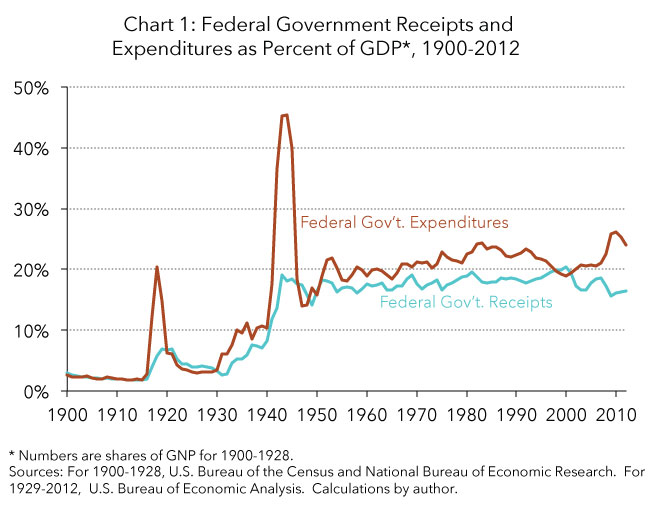
Rather than responding to the various articles and editorials, pro and con, on the massive spending bills being drafted in the House, let’s talk ways and means a bit, shall we? To start out let’s look at a couple of graphs, courtesy of the Tax Foundation. The first is a graph of federal revenues as a percentage of gross domestic product:

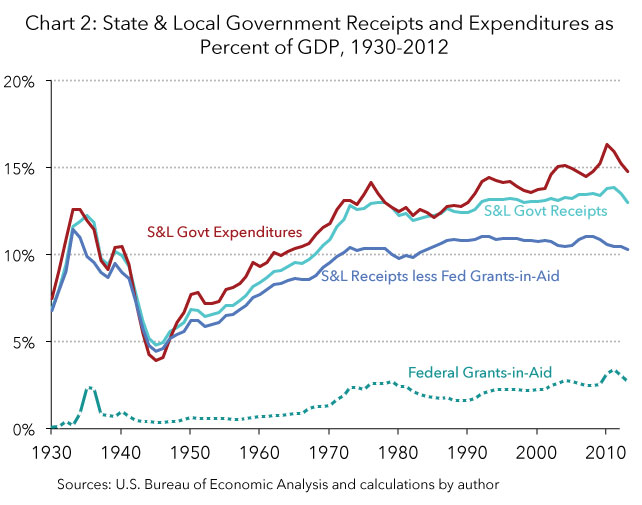
and the second is state and local government revenues as a percent of GDP:

I want to point out some interesting things about them. The first is how constant the proportion of the private sector income the federal government has been extracting since 1950—it’s hovered right around 18%. Similarly, after 1970 the amount of private income state and local governments have extract has been right around 13%. What caused the sharp uptick in state and local taxing in the 1960s? I’m not really certain but it could possibly be related to the introduction of Medicaid. I’m open to suggestions.

The key point is that when the highest marginal rate on private income was around 90%, federal taxes brought in about 18% of GDP and when they declined to less than 40% they still brought in about 18% of GDP. What has varied over that period is spending and most of the difference was supplied by borrowing. Why has that amount been so persistent? Again, I don’t know. I think that some of it is political and some is practical. The practical part is that it becomes increasingly difficult to get Americans to pay taxes as they rise about 18% of GDP. The political part is that people start voting against tax-raisers at about that level.

So, Mr. or Ms. Congresscritter, you want to extract more than 18% in taxes for the federal government. There’s a lot you’d like to spend it on. How are you going to do it? Don’t tell me you’re going to raise the highest marginal tax rate—that won’t be enough. What else are you going to do? Or, more precisely, how are you going to keep your job if you do what you actually need to do to extract that much in taxes?

The Congressional Budget Office says we’re likely to run a $1.5 trillion this year. Unlike some I agree with the Modern Monetary Theorists to the extent that I believe we can run small deficits in perpetuity without adverse consequences. How small? No more than the increase in aggregate product which is running about 3%. $1.5 trillion is quite a bit more than 3%.

What do I think? I think that we should be willing to pay for what we want and we should constrain what we want to about 21% of GDP. There’s a lot you can’t when you maintain that level of discipline just as there’s a lot you can’t eat when you’re holding to a diet of fewer than 2,000 calories per day. Refusing to pick and choose is popular; making choices is hard. Which is why we’ll continue to live beyond our means.

What does that mean in practical terms today? It means that the progressives who are pushing the massive spending bills should be willing to try to extract an additional $350 or $500 billion per year in taxes and do whatever they need to do to accomplish that. I don’t think they will. I think they’d prefer to borrow us into default or inflation.

2 comments

The Fed’s Mandate

Federal Reserve Chairman Jerome Powell’s present term expires next year. The editors of the Wall Street Journal are unimpressed by his performance to date. Failings include

  • Potential ethical violations on the part of Fed governors
  • Inflation significantly in excess of estimates
  • Maintaining the easiest monetary policy in Fed history

They comment:

Wall Street desperately wants Mr. Powell to be reappointed to a new four-year term, and no wonder given how his policies have lifted asset prices. President Biden may agree, since there’s little tightening of policy on the horizon.

Notice how much the qualifications for a Fed Chairman have changed. It used to be that credibility on prices was essential. Now if you miss your consumer-price target by a mile, but keep asset prices inflated, you’re the favorite.

Famously, the Federal Reserve has a dual mandatw:

  • Price stability
  • Maximization of employment

Over the years that has transmogrified from the plain language of the empowering legislation first to maintaining a consistent rate of increase in prices and now to a consistent acceleration in increase in prices and largely ignoring employment. Neither of the two things it has been trying to do—”running the economy” and keeping equity values high—fall within their mandate. Mr. Powell either needs to start doing his job, resign, or be fired for nonfeasance.

1 comment

Fighting Back Against Oligopsony

I was prepared to disagree with Eric Posner’s New York Times op-ed, “You Deserve a Bigger Paycheck. Here’s How You Might Get It.”, on a variety of grounds including how you determine whether higher wages are “deserved” but I found myself agreeing with him materially. He opens by explaining something anyone with a rudimentary knowledge of economics knows: how a labor market with only a single employer (monopsony) or one dominated by just a few employers (oligopsony) will push wages down. Now we get to the good part:

Economists have understood these things since Adam Smith, who famously called wage-fixing by employers “the natural state of things, which nobody ever hears of.” But economists did not take this risk very seriously until recently, instead usually assuming that employers compete vigorously for workers. As a result, though the logic for using antitrust law to address market power is the same for monopsony as it is for monopoly, the legal community did not embrace the possibility that antitrust law should be brought to bear against employers, except in unusual cases.

But in recent years, thanks to the remarkable work of a diverse group of mostly young economists, this conventional wisdom was shattered. Exploiting vast data sets of employment and wages that had become available, they discovered that concentrated labor markets — that is, with one or few employers — are ubiquitous. In one paper, José Azar, Ioana Marinescu, Marshall Steinbaum and Bledi Taska found that more than 60 percent of labor markets exceeded levels of concentration that are regarded as presumptive antitrust problems by the Department of Justice. Numerous papers have made similar findings.

That isn’t just true in technology; it’s true in many sectors. And the consolidation that’s been going on for the last several decades has made it worse. Consolidation has been occurring at a rapid pace in all sorts of sectors, from media to health care. Recently, my wife and I investigated having our backyard fence replaced and, like good little consumers, we started looking for competitive bids. We found that there were far fewer companies to do the job than had been true just 15 years ago: many had been acquired or gone out of business. In many sectors that has been promoted and accelerated by globalization.

Here’s his prescription:

Antitrust law applies to “restraint of trade,” and courts agree that when employers enter cartels to suppress wages, they violate the law. Yet until a few years ago, there were hardly any antitrust cases against employers. The major exception was a 2010 case against Big Tech after Google, Apple and other companies agreed not to solicit one another’s software engineers. This was potentially criminal behavior, but the Justice Department slapped them on the wrist. (A subsequent lawsuit secured more than $400 million in damages for the workers.)

But it was the academic research, not the tech case, that finally woke the antitrust community from its torpor. In the past year, the Justice Department has brought several criminal indictments against employers for antitrust violations (the first ever). The Federal Trade Commission is pondering a rule to restrict noncompetes. State attorneys general brought cases against franchises and other employers that used no-poaching agreements and noncompetes. Congress is holding hearings next week on antitrust and the American worker. Private litigators have joined in as discoveries of abusive wage practices have piled up. For example, “Big Chicken” companies face lawsuits not only for fixing the prices of chicken but also for fixing the wages of their workers.

If the academic research on labor markets is correct, then millions of Americans are paid thousands or even tens of thousands of dollars less than they should be paid. Labor monopsony affects people at all income levels, but it is a particular problem for lower-income workers and people living in stagnant rural and semirural parts of the country.

with which I concur wholeheartedly. Sadly, it won’t be enough. We need to change our trade policies and legal immigration laws as well. Our present approaches are great for the Walmarts, Facebooks, and Amazons but not nearly as good for ordinary people.

2 comments
