
I wanted to pass along a bit of gossip. Today I heard a couple of people from New Zealand conversing about the country’s PM, Jacinda Ardern. Apparently, not all kiwis are happy with her. They were referring to her as “Silly Cindy”.
Advice for President Biden
January 18, 2022Wall Street Journal columnist William Galston has some advice for President Biden:
On Covid, the people have specific complaints. They don’t support your effort to extend vaccine mandates and they don’t think your administration was prepared for the Omicron variant. Medical professionals have noted the failure to ramp up the procurement of home tests during the summer and fall of 2021. About 7 in 10 Americans believe that the information coming out of your pandemic task force has been confusing.
If I were you, I would pay attention to these complaints. About 1 in 5 Americans will never get vaccinated, and trying to force them has backfired. It’s time to accept this reality. If the coronavirus task force’s weekly news conferences are creating confusion, pause them until you solve the problem. Rather than a steady stream of defensive statements from senior officials, admit mistakes. People are asking what happened to the tens of billions of dollars appropriated for testing. They deserve a straight answer.
As for inflation: Blaming it on corporate greed may thrill progressives, but most economists and commentators, including Democrats, aren’t buying it. Two-thirds of people are blaming supply-chain issues, which is a lot closer to the truth. I’d be doing regular events highlighting your administration’s efforts to clear the backlog at ports and mobilize new truckers to fill the gaps in the transportation system. Even if progress is slow, people will give you credit for focusing on what they think is important.
In the long run, legislation does matter. But your legislative agenda has hit a wall, which won’t collapse because you blow your trumpet louder. You aren’t Joshua, and a miracle isn’t in the offing. It’s time to set aside what you want and take what you can get.
This can’t happen until you stop subcontracting your priorities to the Democratic congressional leadership. If you don’t know already, find out which elements of Build Back Better dissenting Senate Democrats will accept—and make that the core of your bill. Support the nascent bipartisan efforts to fix the Electoral Count Act of 1887, whose dangerous flaws enabled Donald Trump’s failed effort to get his vice president to overturn the results of the 2020 election. Get the House to pass its version of the U.S. Innovation and Competition Act, which could help mitigate the computer chip shortage.
And about that speech in Georgia:
Speaking of which: I don’t know who advised you to deliver last week’s Georgia voting-rights speech, but I do know that it was a political fiasco. Many members of your own party regarded it as over-the-top and unpresidential. Others saw it as empty rhetoric. It changed few minds, and none in the Senate. It did nothing to reinforce the brand of politics that earned you the Democratic nomination and the presidency. And it made you look weak.
I think he must be thinking about some other Joe Biden. Nothing in President Biden’s present circumstances or Joe Biden’s history would lead him to do any of those things although you may notice the similarity between his advice and what I’ve been saying around here. President Biden is acting precisely as Joe Biden has throughout his career, tacking to the center of the Democratic Party and that center is shifting to the left practically on a daily basis. He can’t alienate the progressives as long as he plans to run again in 2024 (all presidents plan to run again). It’s from that caucus that primary challenges are most likely to emerge.
I hold to the antiquated view that politics is local, try as the folks in DC might to nationalize everything. Running good candidates that can win will help Democrats’ fortunes in the mid-terms but they will have President Biden dragging them down. The harder they try to tie their Republican opponents to Donald Trump, the more likely it is to be a wave election and I don’t mean a Blue wave.
My advice would be a little different: maintain a low profile. The less he talks, the higher his approval rating gets. He has a pretty decent floor of approval and he can avoid raising his disapproval by being more decorous than Trump. I have no confidence he’ll take that advice, either. Alice Roosevelt’s wisecrack about her famous father applies pretty much equally to all presidents.
Company Town
January 18, 2022There’s a line in the musical Gypsy that remains with me. Maybe it’s Ethel Merman’s delivery. “New York is the center of New York!” I was reminded of that line when I read Paul Krugman’s most recent New York Times column, the thesis of which appears to be that New York is a “company town”, much as Detroit was a company town (maybe still is for all I know) 60 years ago, and the company is Wall Street, meaning the financial industry:
All of America suffered steep job losses in the early months of the pandemic. New York City’s job losses, however, were much bigger in percentage terms than the national average, and as the national economy has recovered New York hasn’t made up the lost ground.
What’s behind this underperformance? Some of it reflects the effects of the pandemic on tourism and business travel — Times Square was just starting to become intolerable again (normally nobody goes there because it’s too crowded) before Omicron hit. But the larger issue, I’d argue, is New York’s lack of economic diversity.
That may seem a strange thing to say about a city that is incredibly diverse in so many ways — including the jobs people have. But a city’s economic fortunes are largely driven by its “export base†— the things it produces that are sold elsewhere. This base normally has a large “multiplierâ€: Much of the money earned in the base is spent locally, supporting restaurants, shops, gyms and more. But the base is what drives the city’s growth.
And New York’s base is remarkably narrow for a city its size. As Harvard’s Ed Glaeser has pointed out, in economic terms the city is pretty much a monoculture: It sells financial services to the rest of the world and not much else.
Just looking at employment numbers can be misleading: Only about 8 percent of New York’s workers are employed in finance and insurance. But their incomes are so high compared with everyone else’s that they account for about 20 percent of the city’s economy and most of its export base.
And the trouble with having a one-industry economy is that bad things happen if something undermines that industry. Think of coal in West Virginia or cars in Flint, Mich.
The odd thing about New York’s troubles is that in some ways the city’s export base has been holding up fine; Wall Streeters aren’t decamping en masse. But what Wall Street has stopped doing, for now at least, is going to the office — because finance turns out to be one of those industries in which a lot of work can be done remotely. This in turn means that financial workers aren’t buying lunch, shopping downtown, going out to eat and so on. The problem, in other words, is less a shrinking base than a reduced multiplier.
But why has New York lost its economic diversity? The answer, surely, is that the immense purchasing power of Wall Street and those who serve it has collided with a housing stock limited by zoning and regulation, making the city too expensive for everyone except financiers and those who, directly or indirectly, cater to their needs. And the solution is obvious: Allow more housing to be built.
I suspect he’s exaggerating New York’s dependence for employment on the financial sector and underestimating the effect that the pandemic had on other industries that employ people in New York, e.g. the garment industry. But that’s not the point of this post.
I want to consider this point from early in his column:
New York suffered badly at the beginning because it’s still America’s leading gateway to the world, so it got heavily infected first, at a time when we didn’t know much about how to protect ourselves from the coronavirus.
I would never deny that New York is a “gateway to the world” for the U. S. but I don’t believe it’s uniquely so. How would you go about quantifying that?
One way would be be tallying the number of international routes for cities. New York provides 127 international routes, the most of any U. S. city but not dramatically so. Miami provides 112 and Toronto provides even more. If Dr. Krugman’s hypothesis is correct, wouldn’t you expect Toronto and Miami to rival New York in suffering badly? That wasn’t the case so I think you’d need to add some other factor.
I propose factoring in population density. New York (28,211) dwarfs both Toronto (11,226) and Miami (12,047) in that respect. I think you also need to factor climate in but that’s another subject.
If my hypothesis is correct, following Dr. Krugman’s advice (build more housing), would not be a successful strategy. It would merely expose the city to additional risk.
I don’t honestly believe that the metaphoric dust of COVID-19 will ever really settle but I also don’t believe that it will loom as important in the future as it has for the last two years. However, when we do reach that much hoped for point, I don’t believe that the megacity hypothesis will hold as much lustre as it has for some over the last couple of decades. I think that for lots of people WFH is here to stay.
Returning to my original point, there are other ways of reckoning America’s leading gateway to the world. For example, I would not be a bit surprised if the Seattle or San Francisco metro areas had more interactions per day between their respective residents and companies and people all over the world than New York does. “Gateway” ain’t what it used to be.
The IoT in a Boiler Room
January 18, 2022I found this post by Emily Newton at The Moderate Voice on the applicability of the Internet of Things (IoT), Internet-connected devices, surprisingly interesting:
An IoT boiler system lets people get real-time information that helps them better manage their time while keeping the machine running smoothly. Data also becomes a time-saver in such cases by minimizing instances where people arrive at work to find boiler-related surprises that disrupt their schedules for the rest of the day.
Who knew?
I look upon such interconnectedness with suspicion, mostly for security reasons. I’m reminded of an old wisecrack: with the aid of a computer you can make a mistake in moments it would have taken you years to do by hand. At least on this version of the Internet I believe that it will always be cheaper and easier to break into such systems than it will be to secure them. Furthermore my experience has been that those who develop such systems don’t have either the attitude or knowledge necessary to secure them. What irks me about it is that it would be so easy to fix.
However, when it’s time to railroad everybody railroads so going ahead I guess we’d best be prepared for that level of interconnectedness.
It’s a Bad Habit
January 17, 2022In an op-ed in the Wall Street Journal Tad Dabrowski and John Klingner explain why Chicago Public School teachers have gone out on strike five times in the last ten years:
The union should be called out for its militancy, but Illinois lawmakers are most at fault. Their laws and actions have made Illinois an outlier when it comes to giving public-sector unions power over ordinary residents.
Illinois unions are empowered by some of the most union-friendly collective-bargaining laws in the country. Illinois lawmakers make it compulsory for state and local governments to bargain with public-sector unions over a host of issues. They also give public-safety workers the power to force arbitration and allow teachers to strike—one of only 13 states to do so. Gov. J.B. Pritzker signed legislation last year that expanded the number of employment issues the CTU can strike over.
States like North Carolina, Texas and Georgia, by contrast, put the needs of taxpayers before those of their public-sector unions. Those states ban collective bargaining with teachers unions altogether.
Chicago’s leaders have emboldened the CTU by consistently giving in to its demands. Former Mayor Rahm Emanuel folded twice, first in 2012 after a weeklong strike and then again in 2016 after a one-day walkout. Mayor Lori Lightfoot has appeased the union several times. Three years ago, she pre-emptively offered the CTU what she called the “most generous†contract offer in the history of Chicago Public Schools. The unions rebuffed her offer, and Ms. Lightfoot ended up giving away even more after an 11-day strike. In January 2021, when Chicago teachers refused to show up for work, Ms. Lightfoot moved the district start date back multiple times instead of confronting the union.
Lawmaker giveaways have made Chicago teachers some of the highest-paid in the nation, which in turn has boosted member support for the union’s aggressive actions. CPS teacher salaries, adjusted for cost of living, consistently rank in the top five of the country’s 148 largest school districts, according to salary data compiled by the National Council on Teacher Quality. At nearly $60,000, a new Chicago teacher with a bachelor’s degree is the highest paid of any equivalent big-district educator.
Don’t forget pensions. The average career CPS educator retires at 62 with a starting pension of $74,000. Tack on a compounding 3% annual cost-of-living increase and that teacher can expect more than $2.3 million in total benefits in retirement.
To the rank and file, the results speak for themselves. Bigger paychecks tell teachers that CTU strikes and walkouts are worth supporting. In 2016, 95% of union members were in favor of a strike. In 2019, 94% of teachers voted to strike. And this latest walkout began when 73% of members voted to shut classrooms down.
Then there is the CTU’s political clout. Beyond the picket line, the union collects millions in member dues that are then spent on lobbying, legal issues and political campaigns. In the 15 months before its two-week strike in 2019, the union spent $1.5 million on lobbying and other political activity, according to the Chicago Sun-Times. It also funneled $1.2 million into the political-action committees of allied candidates and groups.
As if all of this weren’t enough, Illinois lawmakers recently voted to add a referendum to the November 2022 ballot that would enshrine and vastly expand the state’s extreme union powers in the Illinois Constitution. That amendment would deny any chance at future labor reforms and create a new, personal constitutional right that would subject even more labor issues to litigation.
It’s hard to see what to add to that. Chicagoans need to be delivered from the tyranny of the public employees’ unions but I can’t imagine any leader getting elected who would do it. When the average teacher earns three times the median Chicago wage, cushy pensions are added to that, enrollments decline faster than the population of the city even as its liabilities rise, something’s got to give.
That’s Not a Supply Chain Problem
January 17, 2022At the New York Times Ana Swanson and Keith Bradsher lament that impending Chinese lockdowns may aggravate supply chain problems:
WASHINGTON — Companies are bracing for another round of potentially debilitating supply chain disruptions as China, home to about a third of global manufacturing, imposes sweeping lockdowns in an attempt to keep the Omicron variant at bay.
The measures have already confined tens of millions of people to their homes in several Chinese cities and contributed to a suspension of connecting flights through Hong Kong from much of the world for the next month. At least 20 million people, or about 1.5 percent of China’s population, are in lockdown, mostly in the city of Xi’an in western China and in Henan Province in north-central China.
The country’s zero-tolerance policy has manufacturers — already on edge from spending the past two years dealing with crippling supply chain woes — worried about another round of shutdowns at Chinese factories and ports. Additional disruptions to the global supply chain would come at a particularly fraught moment for companies, which are struggling with rising prices for raw materials and shipping along with extended delivery times and worker shortages.
I would submit that’s not a supply chain problem or at least not just a supply chain problem.
We’re two years into the pandemic at this point. That’s plenty of time to make alternative arrangements unless
- the complexity of the product was such that more time was needed
- no alternative source was possible
- there was no downside risk in delay
- management opposes seeking alternative sources
a is possible but probably uncommon; I simply don’t believe b; c is likely; d is possible. Why isn’t this problem already sorting itself out?
Gang Aft Agley
January 17, 2022Ezra Klein was not a good student in high school or, I believe, in college. I have no evidence that he ever took an economics course and presume he relies for his views on economics on the advice of those with whom he agrees politically. In his latest New York Times column on how differently the challenges facing President Biden are from those that President Obama faced, after a number of claims with which I strongly disagree, he finally arrives at a conclusion with which I agree:
So Biden’s task now is clear: to build a government that can create supply, not just demand.
This may not be the presidency Biden prepared for, but it’s the one he got.
First, let’s return to something that’s axiomatic:
Inflation = Nominal GDP – Real GDP
7% inflation means that consumption is growing faster than production. Why? I think there are multiple reason including lack of confidence, misplaced taxes, regulations that discourage production, and the continuing attractiveness of the financial sector over production.
Here’s an example of a claim of Mr. Klein’s with which I disagree:
The 2009 stimulus was too small, and while we avoided a second Great Depression, we sank into an achingly slow recovery.
As evidence that is incorrect I submit the following
- the testimony of Dr. Lawrence Summers that the size of the stimulus was exactly right
- the NBER declared the recession over before a single dollar of the ARRA “stimulus package” had been disbursed
Under the circumstances quite to the contrary if the 2009 stimulus had been larger President Obama would have faced exactly the same problem that President Biden is facing now. We don’t produce enough.
Nonetheless I look with foreboding at federal government measures to stimulate production. I think the members of Congress will be overwhelmingly tempted to continue to stimulate consumption and merely try to rebrand consumption as production. It’s all they know.
What would a program to stimulate domestic production look like? I suspect it would need to consist of both carrots and sticks, carrots in the form of grants for specific largescale projects and sticks in the form of new taxes on buying and selling equities. They’d also need to abandon rhetoric about greedy capitalists, something I can’t imagine.
Is This the Objective?
January 17, 2022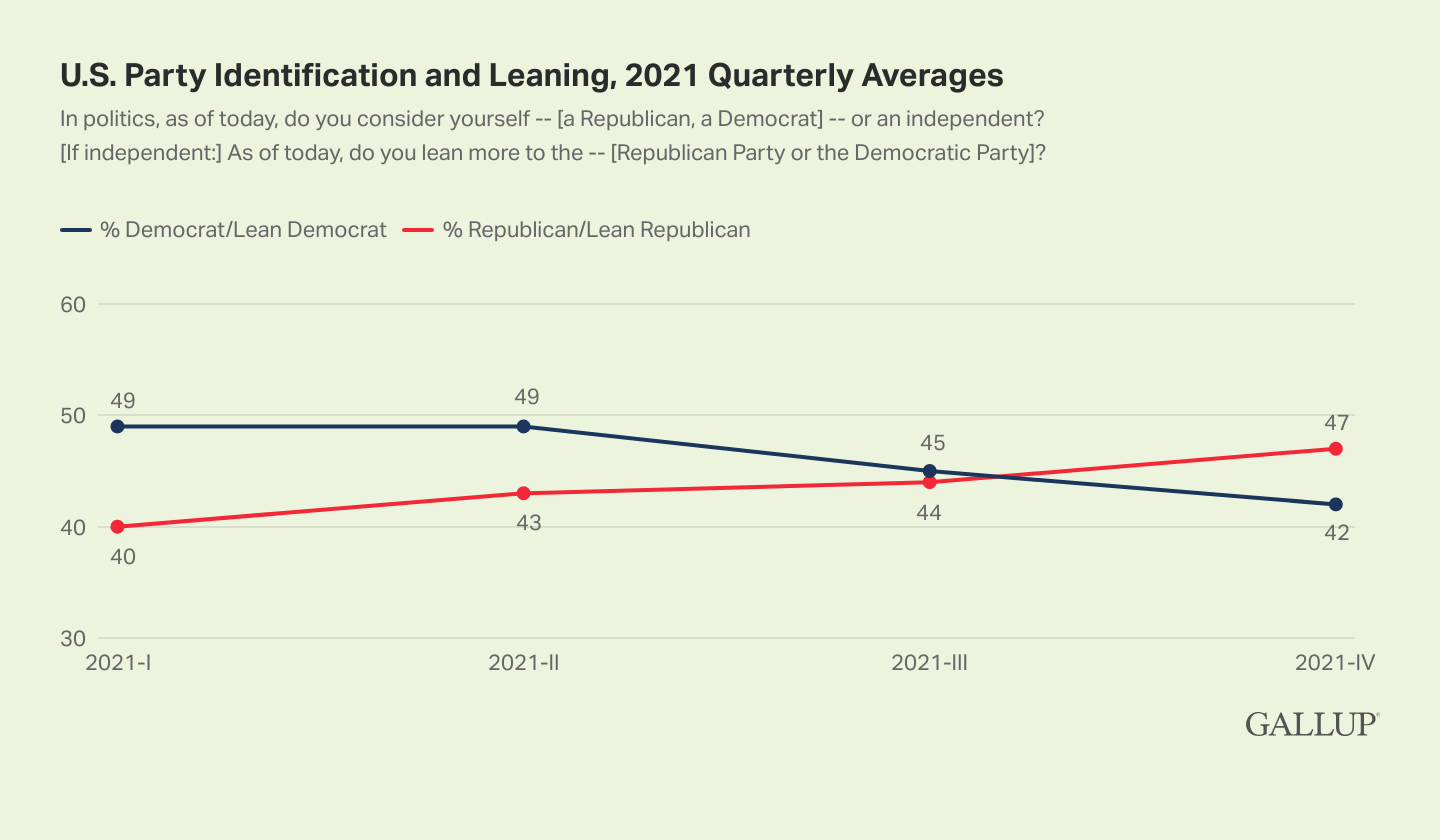
For what I believe is the first time in thirty years, in late 2021 Gallup found that the percentage of Americans who considered themselves Republicans or leaned Republican exceed the percentage who considered themselves Democrats or leaned Democratic:
WASHINGTON, D.C. — On average, Americans’ political party preferences in 2021 looked similar to prior years, with slightly more U.S. adults identifying as Democrats or leaning Democratic (46%) than identified as Republicans or leaned Republican (43%).
However, the general stability for the full-year average obscures a dramatic shift over the course of 2021, from a nine-percentage-point Democratic advantage in the first quarter to a rare five-point Republican edge in the fourth quarter.
These results are based on aggregated data from all U.S. Gallup telephone surveys in 2021, which included interviews with more than 12,000 randomly sampled U.S. adults.
Gallup asks all Americans it interviews whether they identify politically as a Republican, a Democrat or an independent. Independents are then asked whether they lean more toward the Republican or Democratic Party. The combined percentage of party identifiers and leaners gives a measure of the relative strength of the two parties politically.
Both the nine-point Democratic advantage in the first quarter and the five-point Republican edge in the fourth quarter are among the largest Gallup has measured for each party in any quarter since it began regularly measuring party identification and leaning in 1991.
Is that the progressives’ who control the party’s objective? To reduce the Democratic Party to a minority party, possibly a boutique party? That’s an enormous shift over a very short period. I presume their hope is that it’s transitory.
Would Martin Luther King, Jr. Have Been Cancelled By Today’s Progressives?
January 17, 2022Holding the views he held (rather than the views they would like him to hold), would Martin Luther King, Jr. have been cancelled by today’s progressives? Even if they could get past the view expressed in his most famous quote which to my ear appears at odds with what is proclaimed as “anti-racism”, I don’t think they could get past his views on homosexuality which appear to have been tolerant but not supportive.
How Do You Assess a President?
January 16, 2022In recognition of the end of the first year of President Joe Biden’s presidency, we’re seeing quite a number of assessment, many critical, of that first year. Rather than round them up or comment on them, I want to ask a question: how do you assess a president’s performance as president?
There are clearly multiple criteria for doing so including what is accomplished during that presidency, the challenges he or she may face during that presidency, approval rating, and, like it or not, the criteria he or she may set up for themselves. That’s one of the reasons James K. Polk is pointed to by many historians as one of our greatest presidents: he accomplished everything he said he would when running for president.
Based on those criteria how is Joe Biden doing? I think we can safely acknowledge that he’s a doing at least a fair job of not being Donald Trump, unquestionably the reason that some of those who voted for him did so. Tempting as it is I can’t award him an excellent rating on that because events are catching up on him and he’s re-adopting some of Trump’s policies, in some cases impelled by the courts.
In honesty he’s doing pretty much what I expected him to. I expected him to be a mediocre president, a moderate only in relation to the center of the Democratic Party, and (important to me if not to most Americans) have a pretty terrible foreign policy. We’ll see what happens on the foreign policy front. A+ for leaving Afghanistan, C- for execution of leaving Afghanistan. He has some major credits to his name: the additional spending for COVID-19 relief and his infrastructure bill. I didn’t much agree with either policy but those are major credits nonetheless and fair is fair.
In terms of approval rating he’s not doing particularly well and it’s obvious why. On most opinion polls Americans list their three most greatest interests as COVID-19 (particularly Democrats), the economy, and immigration, particularly the situation at our southern border and he’s not doing particularly well on any of them. You can question how much influence a president has on any of them (particularly COVID-19 and the economy) but Americans’ concerns are Americans’ concerns and a lot of energy is being expended on issues like voting rights and climate change which are not near the top of their concerns. Why is President Biden out of alignment with the American people on these priorities? Probably two reasons: first he’s in pretty good alignment with Congressional Democrats and they’re out of alignment with most Americans. Not only that but his actions on inflation (aggravating it if anything) and immigration (our southern border) are also in close alignment with Congressional Democrats. And, as I pointed out before, there’s not much he can do on any of those priorities which will not take him out of alignment with Congressional Democrats which would be disastrous with such narrow majorities.
Is there any question that, relative to the criteria the present has set up for himself, e.g. unifying Americans, accomplishing a considerable amount, etc., he’s doing very poorly indeed?
I did want to touch on what impelled me to write this post: Steven L. Taylor’s post at OTB criticizing David Ignatius’s WaPo column criticizing President Biden. I think that Steven is missing the point. The only reason I read what David Ignatius writes is that I think he’s a pretty good barometer of the prevailing wisdom in DC. Otherwise why read him, pay any attention to him, or write blog posts about him? Why does what he write have any significance? Maybe I’m wrong. Maybe David Ignatius has lost the thread and no longer speaks for the prevailing wisdom in DC. Then why write about him?
Consequently, from my perspective every criticism that Steven makes of Mr. Ignatius (silly, “Green Lanternism”, etc.) is rightly levelled at DC opinion among the civil bureaucracy and other nomenklatura. That’s extremely valuable intelligence.


