More Gossip

Here’s some more gossip I thought I’d pass along. This comes from two high school classmates of mine (we took Russian together, were in the same homeroom for four years, etc.). Both resided and worked in Russia and/or Ukraine for decades. The first is from a classmate who as it happens is married to a Russian woman as well as speaking Russian fluently and having resided and worked there for a substantial period:

…[my wife] and I both agree that Putin is (literally) crazy, and that it’s next to impossible to predict what a crazy man will do. We both fear that he will take some sort of military action involving Ukraine. We are hoping that he is bluffing – and that NATO can call his bluff by, for example, supplying lethal offensive weapons to Ukraine. But, truly, nobody knows what’s in the mind of Putin and his inner circle.

Putin has an extreme inferiority complex regarding the image of Russia, never getting over the disgrace of the implosion of the USSR. Russia’s military has long been its primary claim to honor and glory. While possible, it is highly unlikely that the 100,000+ troops amassed along Russia’s border with Ukraine will simply withdraw without some sort of (further) incursion into Ukraine’s territory.

In addition to Russia’s current de facto occupation of the Donbass – while claiming only to be supporting Ukrainian separatists in the Donetsk and Luhansk Oblasts with (at a minimum) armaments and advisers, plus distributing Russian passports to separatists and non-combatants alike – Russia is still struggling to find a source(s) of water for the Crimean peninsula, which has an inadequate water supply for its inhabitants and which – pre-annexation – obtained its water from the Ukrainian mainland.

There is also Putin’s oft stated possible quest to reunite Russia – like with Crimea – with Novorissisk, a historically Russian-speaking part of the pre-Soviet Russian Empire stretching within the borders of Ukraine from Mariupol to Odessa. Putin often decries the “discrimination” against Russian speakers living outside of Russia in places like Donbass – and, of course, also like the Baltic Republics of Estonia, Latvia, and Lithuania.

Russia’s claim of having been previously deceived by NATO has more than a little validity. George H. W. Bush and James Baker made some relatively clear statements – at the time of reinstating the GDR into a reunited Germany – that NATO would not move eastward into the Soviet Union’s “near abroad”. Not only was NATO membership extended to nearly all of the former Warsaw Pact members: Poland, Hungary, Czechia, Slovakia, Romania, and Bulgaria, but also to 3 of the 15 former Soviet Socialist Republics of the USSR – Estonia, Lithuania, and Latvia. After NATO’s subsequent political overtures to Georgia and Ukraine, one might agree that there is more to Putin’s “drawing red lines in the sand” than just his paranoid bluff and bluster.

Lastly, Putin – and his coterie of kleptocrats and oligarchs – rightfully have serious concerns that the bad example of Ukraine’s movements toward establishing democracy and fighting corruption is already giving “wild ideas” to the millions of Russians living in an autocratic state under Putin’s control. There are serious domestic problems in Russia exacerbated not only by Alexey Navalny (even while in prison) and rampant inflation, but also by the foreign sanctions on Russia (in place already for some time) and by Russia’s global image becoming more and more like that of a pariah. In his worldview, Putin cannot afford allowing something very bad to become even worse by failing to keep a rogue Ukraine under control. Putin’s annexation of Crimea occurred after the regime change in Ukraine in 2013 when the Ukrainian President Yanukovych fled Kyiv for sanctuary in Russia. Further reforms in Ukraine could similarly trigger nervous reactions in Moscow, even including resort to military force enabled by troops along the border.

The other is from another classmate who lived and worked even longer in Russia:

…there is perhaps a 60% likelihood that Russia will indeed invade Ukraine, and only a 10% possibility that Putin will accept some deal with the U.S. and NATO, perhaps on the basis of resumed arms control negotiations and a suspension of ABM deployments. However, I recognize that there is something like a 30% possibility that it will be neither or none of these outcomes, including perhaps a 1% possibility that Putin will be replaced or will lose power. But even with it more likely than not that Russia will start an incursion into Ukraine, it is not certain what that will be or will become. Putin might push to set up a new government in Kyiv, but that depends on Russian and Byelorussian forces being able to advance quickly. If the Ukrainians put up sufficient resistance, it may force Putin to rethink his strategy although he is unlikely to stop until he can claim a victory of some kind.

For what it is worth.
4 comments

What’s the Greatest Hollywood Movie?

Enough of politics and COVID-19 for the moment. Let’s talk movies.

What’s the greatest Hollywood movie? I know lots of professional critics love Citizen Kane but I’m not a fan. My candidates for the very best Hollywood film would include

  • Casablanca
  • The Best Years of Our Lives
  • The Wizard of Oz
  • The Maltese Falcon
  • North By Northwest

Those have something in common: great ensemble performances, taut direction, decent writing, and above all, they are entertaining. And, with the possible exception of North By Northwest they all have heft—they have meaning. And they’ve all crept into the culture in one way or another. People quote them all of the time, sometimes without knowing that they’re quoting them.

If you twisted my arm I could be forced to add a few more contemporary movies to that list. Movies like Jaws (the movie that saved Hollywood) or Indiana Jones and the Raiders of the Lost Ark but good as those movies are I think they’re lightweights compared with those in my list. Some people would, presumably, add Apocalypse Now or The Godfather but both of those are a bit too tendentious for my taste. And I don’t much care for Marlon Brando. I don’t know whether I’ve mentioned it before but I have an odd characteristic, possibly the consequence of being from a show business family, which I refer to as “the actors’ real characters coming across the proscenium at me”. I think that’s the reason I don’t care for Marlon Brando, Marilyn Monroe, or Robert De Niro.

So, what’s the greatest Hollywood movie?

9 comments

Where’s That Ward Map?

I see that the Chicago City Council is sticking with its core competency and not doing anything. In this case it’s the new ward map necessitated by the decennial redistricting. Crain’s Chicago Business reports:

The remap process has been fraught for months: A majority of City Council’s Latino Caucus is standing firm behind their map, dubbed the “Coalition Map.” It would create 15 Latino-majority wards, up from the current 13; 16 Black-majority wards, down from 18; a new Asian-majority; 15 majority-white wards and three wards with no racial majority.

Their map, they argue, reflects the city’s growing Latino population, which grew as the city’s Black population dropped. Latinos make up 30% of the city’s population, compared to 29% for Black Chicagoans, 31% for white, and 7% for Asians.

“Coalition Map” supporters are at continued loggerheads with 33 aldermen who stand behind a map created under Rules Committee Chair Michelle Harris, 8th. That map has the support of a majority of City Council’s Black Caucus and would create 16 Black-majority and one Black-influence ward, 14 Latino-majority wards and an Asian ward.

Harris hopes to get 41 total aldermen to support the Rules Committee map in time to avoid a referendum letting voters decide instead in the June 28 primary. The deadline to avoid that fate is in mid-May. Several Latino Caucus members filed paperwork already to put that measure on the ballot.

But recent spats suggest detente is out of reach: During the previous three hearings, members of Council could barely agree on who would testify first, who had access to the map room where districts are draw, or the basic protocols for negotiations. Harris supporters have said she “has faced more disrespect and disparagement from her colleagues than anyone prior to her” throughout the process.

Everything is unfolding exactly as I foretold. The black caucus and the Hispanic caucus, rather than making common cause are jockeying for power that their numbers don’t support. The beneficiaries of this political infighting will be white politicians.

I’m betting that it will be left up to referendum. I wonder what it would take to get another map to choose from? My guess is that the fairest map is probably the one supported by the Hispanic caucus but that actually overstates Hispanic strength in terms of voters.

0 comments

Conspicuous By Their Absence

When I listened to the panic-stricken coverage of the Ukraine situation on this morning’s talking heads programms, I was struck by one serious omission. Not one of them mentioned Germany and its reluctance to impose economic sanctions on Russia. The repeatedly spoke about Europe but never Germany. Europe will do whatever Germany says it will do.

Can you imagine the Germans marching to the defense of the Ukrainians? Me, neither. They’ll cluck their tongues and say “something should be done” (translation: we’re not going to do anything). Their plans for future prosperity are heavily dependent on a strong trade relationship with Russia.

1 comment

Is Inflation the Better Choice?

The editors of the New York Times admit that President Biden is failing their version of the “Big Mac test”:

In a late December tweet, Mr. Biden quoted with evident approval an assessment that he had compiled “the strongest first-year economic track record of any president in the last 50 years.” The Treasury secretary, Janet Yellen, said Friday, “By most traditional metrics, the pace of our current recovery has exceeded even the most optimistic expectations.”

Most Americans don’t share the administration’s sunny view of its economic record, and it is little mystery why: The average worker’s paycheck doesn’t buy as many hamburgers as it did last year. (Using hamburgers to measure inflation is a twist on The Economist magazine’s Big Mac Index, which tracks the price of the classic hamburger in different currencies.) The government’s Consumer Price Index rose by 7 percent in 2021, the biggest jump since 1982. Mr. Biden’s approval rating remains low, and poll after poll finds that Americans are not pleased with his handling of the economy. Nearly two-thirds say the administration is insufficiently focused on inflation, according to a recent CBS News poll. There are similar numbers in other recent polls.

Nonetheless they believe he made the right choice:

The discomforting truth is that the United States last year faced a choice between a protracted period of economic pain and an economic recovery whose benefits are temporarily attenuated by high inflation. Mr. Biden made the right choice. But it came at a real price — economically, for the nation, and politically, for him.

That’s a good example of the tertium non datur fallacy or the false dilemma fallacy. Only two alternatives are provided: either inflation or a slow recovery. But there are other alternatives (that’s what makes it a fallacy) and one of them is to reduce imports and increase domestic production. When you borrow, i.e. “print money” or in our case issue ourselves credit to spend more you have several alternatives:

  1. Import more
  2. Produce more
  3. Inflation

That is the tautology not an alternative between inflation and slow growth. “Production” in this case is measured in tons of steel, bushels of wheat, barrels of oil, and so on that are produced. For the last 40 years we have chosen to import more. I believe it’s time to take the other alternative. Re-industrializing will be harder than de-industrializing was and it can’t be done instantaneously.

Those I have referred to as “folk Keynesians” or “folk MMT-ers” don’t understand this but real Keynesians and real modern monetary theorists do.

Let’s give a single example. If you increase healthcare spending without increasing the amount of healthcare produced, it will raise the cost of healthcare, i.e. it will “inflate”. You can increase the supply of healthcare by reducing the amount of slack time for healthcare workers, i.e. the amount of time they’re not working, by making them more productive, or by increasing the number of healthcare workers (doctors, nurses, and technicians). Healthcare workers don’t have a lot of slack time at this point. Physicians are more likely to report that they’re overworked rather than they’ve got a lot of spare time on their hands. If you cap the number of doctors, that limits your choices to increasing productivity. That is very difficult to accomplish.

10 comments

Disappointing

The editors of Bloomberg have found President Biden’s first year in office “disappointing”, something they largely attribute to his deferring to “the progressive left of his party”:

From the outset, Biden has deferred to the progressive left of his party — its most energetic wing, but one that is badly out of touch with much of the country and sees any kind of compromise as capitulation.

The most egregious? His speech in Atlanta last week:

The president’s most recent nod to the left is the most alarming. His speech last week in Atlanta made the case for voting-law reforms in a way that might’ve been calculated to kill any possibility of future cooperation across the aisle. Reasonable people can disagree about how best to ease voting access while protecting ballot security. But to slam opponents of the proposals as enemies of democracy and champions of “Jim Crow 2.0” — as the president did— is both inapt and self-defeating: How can Biden imagine that such rhetoric makes agreement more likely?

As I’ve said whenever the subject has come up, President Biden has no choice but to “defer” as they put it to the progressive wing of his party. His Congressional margins are so narrow he needs every vote and they are the loudest and most insistent.

By the way there is an unstated assumption within the punditry and, presumably, within the White House itself which is almost certainly not true. What makes them think that Joe Manchin and Kirsten Sinema are their only barriers within their own party in the Senate? That Joe Manchin’s position is secure enough for him to take stands unpopular with his own leadership grants to other Democratic senators who are not in complete agreement with the leadership but aren’t in as secure a position as Manchin, either, the leeway to vote against their own interest. There are probably two or three other senators in just that position. Members of the House, too.

Voting for a lousy bill you know won’t pass is one thing; voting for it when it will only pass with your vote is something else again.

3 comments

Approval of Congress (Updated)

And speaking of cognitive dissonance, Gallup has found that Americans’ approval of Congress has declined to 18%:

WASHINGTON, D.C. — Americans’ approval rating of the job Congress is doing has fallen to 18%, the lowest point in more than a year, as congressional Democrats’ efforts to pass spending and voting rights bills have stalled. The latest five-percentage-point decline in congressional approval is largely attributed to a 10-point decline among Democrats whose frustration appears to be mounting with their party’s senators and representatives who hold majorities in both houses of Congress.

Meanwhile, according to Gallup’s most recent update (2020) of approval of one’s own Congressional representative, that’s 59%. I wonder who people think Congress is?

Update

According to the RCP Average of Polls, the spread between President Joe Biden’s approval rating and his disapproval rating is the greatest of his presidency. It’s -14.8. He’s “underwater” as they put it. It’s not quite as bad as Trump’s was in the immediate aftermath of the breaching of the Capitol on Jan 6, 2021 but it’s flirting with it.

Update 2

At Mediate Joe DePaolo reports that 37% of Americans give Joe Biden a failing grade for his first year in office while only 11% give him an “A”:

According to a Politico/Morning Consult poll out Wednesday, 37 percent of respondents give the president an “F” for the first quarter of his presidency. By contrast, a meager 11 percent give Biden an “A” thus far, while 20 percent give him a “B.” Nearly a third of the country put Biden in the “C” or “D” category — with 18 percent giving the president a “C” and 12 percent giving him a “D.”

At this point in his term, Biden’s failing grade exceeds even former President Donald Trump’s. The 45th president got an “F” from 35 percent of Americans, compared to Biden’s 37 percent.

Biden got his worst marks on the economy, immigration, and “restoring unity” — with 40 percent flunking him in the latter two categories, and 38 percent giving him an “F” on the economy. His best grades came on Covid-19 and health care, where 35 percent and 31 percent respectively gave him an “A” or a “B.”

That means that 49% of Americans gave him an F or a D and only 31% an A or B. I think attributing that to partisanship alone is a stretch.

6 comments

Losing the Plot

The same New York Times focus group I cited yesterday apparently caught Andrew Sullivan’s attention as well. Here’s a telling passage from his remarks:

Now imagine these people watching Biden’s press conference on Wednesday.

It would have said absolutely nothing to them. It would show that the president doesn’t share their priorities, that he sees no reason to change course, that he has no real solution to inflation, and that his priority now is a massive voting rights bill that represents a Christmas tree of Dem wishes, opposition to which he categorized as racist as Bull Connor. Biden was, as usual, appealing as a human being: fallible, calm, reasonable, and more “with it” than I expected. I can’t help but like him and want the best for his administration.

But the sheer gulf between the coalition that voted for him and the way he has governed became even wider as the time went by. Joe Biden can say a million times that he’s not Bernie Sanders. But when his priority has been to force through two massive bills full of utopian leftist dreams, and conspicuously failed to pass either, while also embracing every minor woke incursion in American life, he’s just a Bernie Sanders without the conviction or mandate. Which is … well, not great.

and this is an important observation:

And Biden did something truly dumb this week: he cast doubt on the legitimacy of the election in November now that his proposal for a federal overhaul has failed: “I’m not going to say it’s going to be legit.” No sitting president should do this, ever. But when one party is still insisting that the entire election system was rigged last time in a massive conspiracy to overturn a landslide victory for Trump, the other party absolutely needs to draw a sharp line. Biden fatefully blurred that distinction, and took the public focus off the real danger: not voter suppression but election subversion, of the kind we are now discovering Trump, Giuliani and many others plotted during the transition period. Reforming the Electoral Count Act could, in fact, help lower the likelihood of a repeat of last time. And if the Dems had made that their centerpiece, they would have kept the legitimacy argument and kept the focus on Trump’s astonishing contempt for the rules of the republic.

So why didn’t they? For that matter, why did the Democrats design massive cumbersome bills in 2021 — like BBB and the voting rights legislation — which are so larded up with proposals they are impossible to describe in simple terms? Why did they not break out smaller, simpler bills — such as the child tax credit — and campaign on one thing at a time?

That hearkens back to a point I’ve made here from time to time. The way to show your commitment to a principle is by modelling it in your own behavior. If you support democracy, support it in your own state and those of your allies rather than focusing only on the lack of democracy in your political opponents’ states. “How wilt thou say to thy brother, Let me pull out the mote out of thine eye; and, behold, a beam is in thine own eye?” If you are opposed to authoritarianism you can’t govern by edict. If you are dedicated to the rule of law, enforce the law when that’s your responsibility. Otherwise democracy, opposition to authoritarianism, and the rule of law are not principles for you—they’re expedient tactics for achieving your political objectives.

Here’s Mr. Sullivan’s conclusion:

Maybe a huge Republican wave this November will force Biden to recalibrate, as happened with Bill Clinton. But Biden, one is increasingly reminded, is a party man, and his party has moved so far to the left in the past five years there is no way he can pull a Sister Souljah moment without splitting the Democrats in two.

So he may well become a transitional figure like Jimmy Carter — a response to a criminal president, as Carter was, but too isolated, partisan and controlled by left interest groups to build a coalition for the future. Instead, a growing backlash including many Latinos, black voters, a slice of Asian-Americans, and suburban parents could create a viable and resilient multiracial coalition for the center right. We just have to pray that Trump is not the man who leads it.

His advice to President Biden is that he should observe a focus group from behind a one-way mirror on a regular basis. While I think that the ability to observe and analyze the behavior of others dispassionately and without interjecting yourself into the conversation is a great gift, it’s not generally one that leads to the presidency.

11 comments

Apocalypse Now?

I don’t agree with everything in Edward Luce’s characterization of the present moment in America in Financial Times but I agree with a lot of it. There is a very apocalyptic tone in a lot of the political discourse and nearly all of it is overblown or “fake news” as we’re saying these days. And a lot of it is a completely logical outcome of a loss of confidence:

It is easy to forget that a country founded on the creed of self-belief — not the customary blood, soil and messy evolution of the rest — can turn dark when its self-confidence goes. Doom is the flip side to the hope of US exceptionalism. Just as the American upside is overdone — and highly selective in its self-image — so the darkness can become a self-soothing cult.

I have characterized it as a drawn out national nervous breakdown, beginning with the attacks on September 11, 2001, further fueled by the financial crisis, and then stoked by COVID-19. It does not help that some have seen fit to attack the very foundations of that confidence with nothing substantial with which to replace it.

I think he sugar-coats the situation in which the Biden Administration finds itself a bit. Its conundrum is not the “wildly unrealistic expectations” of Biden’s supporters but the wildly unrealistic expectations that President Biden has set up for himself. He was narrowly elected through a longing for normalcy not through revolutionary fervor. Attempting to revolutionize our entire system system with only the narrowest of Congressional majorities in essence is providing his supporters with precisely the opposite of what they wanted. It would be enough were he to simply do his job without striving to be the reincarnation of Franklin Roosevelt or Lyndon Johnson but as weak as his political performance has been his performance on the day-to-day activities of government is even worse.

I think this passage is worthy of some consideration:

Liberal America’s chief worry, which is not a figment of its imagination, is over the future of US democracy. The fact that Biden is unable to pass his election reform bills, and that the system has so far been unable to hold the plotters of last year’s January 6 failed putsch to account, is the deepest source of angst. Yet there is an underrated distinction between the next presidential election and last year’s one — the people occupying the White House.

Whatever happens, between now and January 2025 no other American will come close to wielding Biden’s power as commander-in-chief. An electoral coup requires federal connivance, which it will not get in 2024. The doomscrollers might pause briefly on that fact. It was Mike Pence, Donald Trump’s vice-president, who refused to go along with last year’s plot to reject the result of the electoral college. No such courage will be required of Kamala Harris in 2024.

I would have said that the notion that U. S. democracy was dangling by a thread was a paranoid fantasy. Our institutions held. We should take the steps necessary to ensure they continue to hold rather than responding as though they’d already failed. Maybe it looks different from Old Blighty. I don’t think so because I think his conclusion is about right:

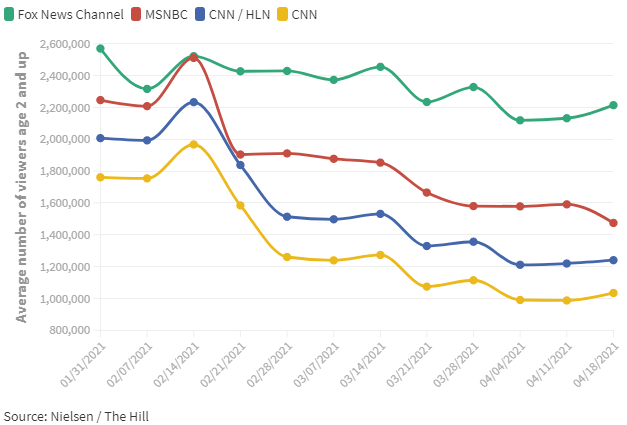
The maths of America’s media habits are oddly reassuring. Most Americans have switched off. The most demagogic Fox News anchor gets about 3.5m viewers a night. Betting on an apathetic majority may sound odd. But they still greatly outnumber the fanatics.

It isn’t just or even mostly Fox News that has seen a decline in viewership:

Americans are tuning out the news generally. The media have lost the confidence of their viewership and the louder they shriek the worse that loss of confidence becomes.

11 comments

The Reality Sinks In

I strongly recommend Ruy Teixeira’s analysis of the fix in which the House progressives have placed the Democratic Party which he characterizes as “How Not to Build a Coalition”. Key points include

  1. Increasing turnout hasn’t worked.
  2. Clumping blacks, Hispanics, and Asians together as “people of color” hasn’t worked.
  3. The majority of Americans reject “cultural leftism”.
  4. Promoting the notion that there’s a “crisis of democracy” hasn’t worked.
  5. Promoting the notion that the there’s a dire need for radical transformation in the United States hasn’t worked.

Here are a few important snippets:

In the 2020 election, running against Donald Trump (Donald Trump!) and in the wake of a social upheaval after George Floyd’s murder that associated the Democratic party closely with a left stance on the centrality of “systemic racism” to pretty much every policy issue…the Democrats actually lost ground among nonwhite voters. They lost 7 margin points from their 2016 margin among black voters and a stunning 16 points from their 2016 margin among Hispanics (Catalist two party vote) The black share of voters in 2020 was actually slightly smaller than the black share in 2016 because, while black turnout did go up, it did not go up as much as other groups. Overall, nonwhite voters contributed less to Biden’s margin over Trump in 2020 than they did to Clinton’s margin over Trump in 2016.

and

The left in the Democratic party insists that cultural leftism is central to consolidating the “rising American electorate” that will power the Democratic party to dominance in an increasingly multicultural, multiracial America. It is a feature they say, not a bug, of current Democratic practice.

But in the process, the left has managed to associate the Democratic party with a series of views on crime, immigration, policing, schooling, free speech and of course race and gender that are quite far from those of the median voter. That’s a success for the left but the hard reality is that it’s an electoral liability for the Democratic party.

What should be done? The party should focus on popularism—ideas that are popular with most Americans, without poison pills, “gotchas”, or extras. There are plenty of them like DACA, and voter ID. It’s been said that the Republicans are looking for converts while the Democrats are busy searching for heretics. Stop looking for heretics. Abandon vanguardism. That’s the path to becoming a boutique party.

The reason that Democrats have control of the cities is that historically they’ve “brought home the bacon”, i.e. people in those cities benefited. Increasingly, they’re voting Democrat through force of habit. That won’t persist forever. Without reinforcement habits are extinguished.

And for goodness sake don’t just write off getting Republican votes in Congress. Strategies that have been used successfully for 200 years haven’t been tried and found wanting. They’ve been found to violate the Marcusist principles of the Congressional progressives and not tried.

6 comments
