Spot the Difference

In discussing the Federal Reserve’s plan to control inflation, comparison is nearly always made between today and Paul Volcker’s successful strangling of inflation in the early 1980s. I’ve been mulling this over and I’m beginning to wonder if the comparison is really warranted. Consider:

Year Debt (billions) GDP (trillions) Ratio
1980 $908 2.857 31.78
2022 30,930 23.000 134.47

It has been demonstrated empirically that the higher the national debt, the slower GDP growth. It used to be thought that there was a sort of “cliff” at 100% but that is now known to be untrue but the inverse relationship between debt and GDP continues to hold true.

There are presently differences of opinion on whether we are in a recession or not and whether the Federal Reserve can engineer a “soft landing” (a gradual slowing in growth). It seems to me that the tremendous differences in our fiscal situation now as opposed to 40 years ago must certainly figure in the discussions

2 comments

Is the West Preparing to Book on Ukraine?

I found this piece by Alastair Crooke at Strategic Culture Foundation concerning:

The inflection has begun. It has been messaged by the Financial Times (FT) and The Economist – the two media that so faithfully transmit any ‘replacement narrative’ to the globalist sherpas (those who carry the baggage up the mountain, on behalf of the mounted nabobs).

The Economist leads with interviews with Zelensky, General Zaluzhny and Ukraine’s military field commander, General Syrsky. All three are interviewed – interviewed in The Economist, no less. Such a thing does not occur by happenstance. It is messaging intended to convey the Ruling Class’ new narrative to the ‘golden billion’ (who will all read and absorb it).

On the surface, it is possible to read The Economist piece as a plea for more money and many more weapons. But the underlying messaging is clear: “Anyone who underestimates Russia is heading for defeat”. The Russian force mobilisation was a success; there is no problem with Russian morale; and Russia is preparing a huge winter offensive that will start soon. Russia has huge reserve forces (of up to 1.2 million men); whereas Ukraine now has 200,000 who are militarily trained for conflict. The ‘writing is on the wall’, in other words. Ukraine cannot win.

It is appended with a huge shopping list of sought-after weapons. But the shopping list is ‘pie in the sky’; the West simply does not have them in inventory. Period.

The FT’s ‘Big Read’, by contrast, is a venting of deep western anger at those Russian ‘reformist’ siloviki technocrats who, instead of breaking with Putin over the SMO, instead shamefully enabled the Russian economy to survive western sanctions. The message uttered – through clenched teeth – is that Russia’s economy has successfully survived western sanctions.

It continues.

I have further questions. What was the objective of the those interviewed? In negotiating theory there are several prices: the asking price and the selling price are two that come to mind. But there is also something called the “insult price”—terms so outrageous they are intended to end negotiations. The Ukrainians must surely know the West does and does not have and that there are limits to what it can offer. Was the “shopping list” an insult price?

I also can’t help but wonder if they’re looking around for someone to blame for an emerging defeat and we’re nominated.

I also wonder what The Economist’s and Financial Times’s objectives were. Sometimes a cigar is just a cigar. But sometimes it’s a phallic symbol.

8 comments

The Criminal Referrals

The House’s January 6 committee has completed its work, making a criminal referral on several charges to the Attorney General. The editors of the Washington Post declaim:

This criminal referral is symbolic; the Justice Department is responsible for making a tough call on whether such charges would stick — and whether it would be prudent to indict a former president and current presidential candidate.

The committee has secured its legacy in different ways, providing a searing picture of what occurred on Jan. 6, 2021, and exhibiting the cowardice of those who, out of fear of Mr. Trump, refused to help it reckon with that dark day.

The public now knows much more about Mr. Trump’s culpability. New details, including videotaped testimony from former Trump aides, showed Mr. Trump had been told he’d lost the election but nevertheless leaned on state officials, the Justice Department, his vice president and others to keep him in power — a campaign that resulted in the Jan. 6, 2021, riot.

The editors of the Wall Street Journal remark:

The House Jan. 6 committee decided Monday that the best way to cap its 18 months of work would be a political gesture. It thus referred President Trump to the Justice Department for potential criminal prosecution for his efforts to reverse the 2020 election, which culminated in the Capitol riot.

What is this supposed to accomplish? A Congressional referral to the Justice Department has all the legal force of an interoffice memo. Attorney General Merrick Garland has appointed special counsel Jack Smith to investigate Mr. Trump’s schemes to stay in office. The Jan. 6 committee’s loud public intervention makes his job more complicated, given the clear partisan context.

The House Jan. 6 inquiry has done useful work gathering documents and putting witnesses under oath. The wiser course was to let the established facts speak for themselves, while releasing full transcripts of its interviews to provide a complete public record.

concluding:

Jan. 6 was a disgrace, and Mr. Trump’s behavior on that day and since is a reason not to trust him with the Presidency ever again. But Justice must balance a decision to indict Mr. Trump with the risk of setting a momentous precedent: prosecuting a former President running against a current President.

The proof to support such a charge would have to be undeniable, with a legal theory straightforward enough to convince most of the country, including most Republicans. Otherwise it could cleave the country in two, and it might even help Mr. Trump in rallying supporters to his defense. Indicting a former President would also take the scourge of criminalizing political differences to new heights. Democrats would surely be future targets.

I think the Department of Justice would be prudent to demur from indicting President Trump. Since the events of January 6, 2020 I have maintained that President Trump should be prosecuted to the full extent of the law but that many would be disappointed at how limited that extent is. IMO we need a constitutional amendment to address this particular set of facts. There are both common law and case law arguments that a president cannot be charged with crimes for actions taken while in office. There are also separation of powers arguments. Consider, too, that the Department of Justice is subordinate to the president. A sitting president indicting his predecessor for crimes in office will open a Pandora’s box of problems we might well wish to avoid. Gerald Ford saved us from that eventuality in the aftermath of the Watergate incident and it probably cost him re-election. I doubt that any future president will escape being indicted for something if he should happen to be succeeded by a president of a different party.

9 comments

Advice for the Federal Reserve

In an op-ed in the Washington Post Lawrence Summers gives his advice to the Federal Reserve:

What should the Fed do next? The choices from here get harder, not easier, as both the risk of a severe recession and enduring inflation make policymaking more challenging. Chair Jerome H. Powell was right in his Dec. 14 news conference to emphasize that there is no basis for confident economic prediction.

and

It is very unlikely that we will have a recession so severe as to drive the underlying inflation rate below the 2 percent target. Hence, overshooting on inflation reduction is not the primary risk, and the Fed is right to emphasize its inflation objective going forward.

However

Fiscal policy will need to respond if and when recession comes. There will not be room for massive, across-the-board efforts. But now is the time to put in place carefully targeted measures to refund child tax credits, strengthen unemployment insurance and be ready to pull forward federal spending on maintenance and replacement cycles to periods when overall demand is soft.

The challenge in that is that any additional spending fueled by borrowing (“printing money”) will aggravate the present situation which, simply stated, is that too many dollars are chasing too few goods and services. My own view is that we need to produce more of what we consume and that’s where the White House’s focus should be. Since I don’t believe that’s politically possible and would be very unpopular within the president’s own caucus to boot, I don’t think it will happen.

What I do think will happen is that fiscal policy and monetary policy will be at cross-purposes.

2 comments

Japan Bids Farewell to Pacifism

Related to the previous post, Japan has approved a new military budget that is a significant departure from the past. From the Wall Street Journal report by Alastair Gale and Chieko Tsuneoka:

Releasing its long-awaited military strategy for the next decade, Tokyo said Friday that by fiscal 2027, it would spend about 2% of its gross domestic product on defense, up from about 1% now. Based on current GDP, that would bring annual spending to the equivalent of around $80 billion, putting Japan third in the world behind the U.S. and China.

Around $3.7 billion is earmarked over the next five years for missile systems, including American Tomahawk missiles, which would give Japan the ability to target foreign military facilities if an attack appeared imminent. That is a turnaround from Tokyo’s postwar pacifist outlook, enshrined in its war-renouncing constitution, which made it wary of threatening other countries.

The new strategy “marks a major transformation of our postwar security policy,” said Prime Minister Fumio Kishida at a news conference. The strategy said the missile plans and other steps would warn potential aggressors such as China, North Korea and Russia that it would be too costly to attack Japan.

I don’t believe that Japan is acting as a lackey to U. S. aggression in this. It is rather obviously Japan’s reaction to China’s military buildup and “wolf warrior diplomacy”. Additionally, Russia’s invasion of Ukraine must have caused the Japanese to hear footsteps.

Consider:

Shedding Tokyo’s usual reticence over China, the strategy released Friday includes a long list of complaints about Beijing’s conduct, including its close ties with Russia and its incursions near Japanese-held islands.

Whatever its cause I suspect the Chinese will look at this development with some foreboding. It is just barely within living memory but a militaristic Japan inflicted considerable suffering on China 85 years ago. And as we should not forget the Japanese can be fearsome opponents.

3 comments

The Shanghai Communiqué, Revisited

Since the Shanghai Communiqué was touched on in comments, I thought I’d promote the discussion to the front page. The Shanghai Communiqué was a joint statement by the United States and the Peoples Republic of China 50 years ago. The complete text is here. It’s about 1,700 words long and takes the form of a sort of dialogue, attributing some statements to the United States and others to the PRC.

Here’s the portion relevant to the present discussion:

The US side declared: The United States acknowledges that all Chinese on either side of the Taiwan Strait maintain there is but one China and that Taiwan is a part of China. The United States Government does not challenge that position.

There are competing interpretations of that passage. One interpretation is that the United States concurred with “all Chinese on either side of the Taiwan Strait”. The other, which is what I hold, is that it is diplo-speak for an agreement to disagree. The United States neither affirms nor rejects the unity of Taiwan but states a preference to a peaceful settlement of the issue by the Chinese and Taiwanese.

I have no ability to determine what the views of the people of Taiwan were 50 years ago but, assuming they were as stated, it is rather clear they have changed. See these findings by Pew Research:
and

I suspect that events in Hong Kong since reunification have not bolstered support for unification with the mainland in Taiwan. Also note that Taiwanese opinion does not appear to be moving in China’s direction—the young are more likely to consider themselves as Taiwanese only than the old.

IMO attributing tensions in the Asia-Pacific to an abrogation of the Shanghai Communiqué by the United States is at best an exaggeration and at worst fantastical. Considerably more important is that China like Russia is irredentist and is seeking to expand into areas it believes it owns.

5 comments

Kara at 9


Today is Kara’s ninth birthday. Kara is my special friend. I spend more time with her than I do with any of the other dogs. She and I walk five miles a day together, practically every day regardless of weather. She is probably the sweetest Samoyed we have ever had.

0 comments

Where You Sit

A day or so ago James Joyner posted a riff on my earlier post on the general loss of confidence in institutions.

Within my own wheelhouse of civil-military relations, we have seen the United States military go from being perhaps the most consistently-admired major institution in our society to one with less-than-majority support—with a 25% drop between November 2020 to February 2022. And, no, it’s not because of losing efforts in two wars, for which the American public largely blames politicians. It’s because the military brass are increasingly seen as partisan political actors taking sides in the culture wars.

I find the assertion that confidence in the media is instrumental with Republicans averring confidence in Fox News while Democrats believe CNN misses the point. It hasn’t always been that way. Just 20 years ago, believe it or not, scholarly analysis found Fox News to be among the most unbiased sources. Fox is even more biased now than it was 20 years ago and the same is true for most outlets. I found this remark from James’s comments gobsmacking:

Fox News is , objectively, a propaganda organ of the Republican Party.
CNN is a reasonably accurate news organization.

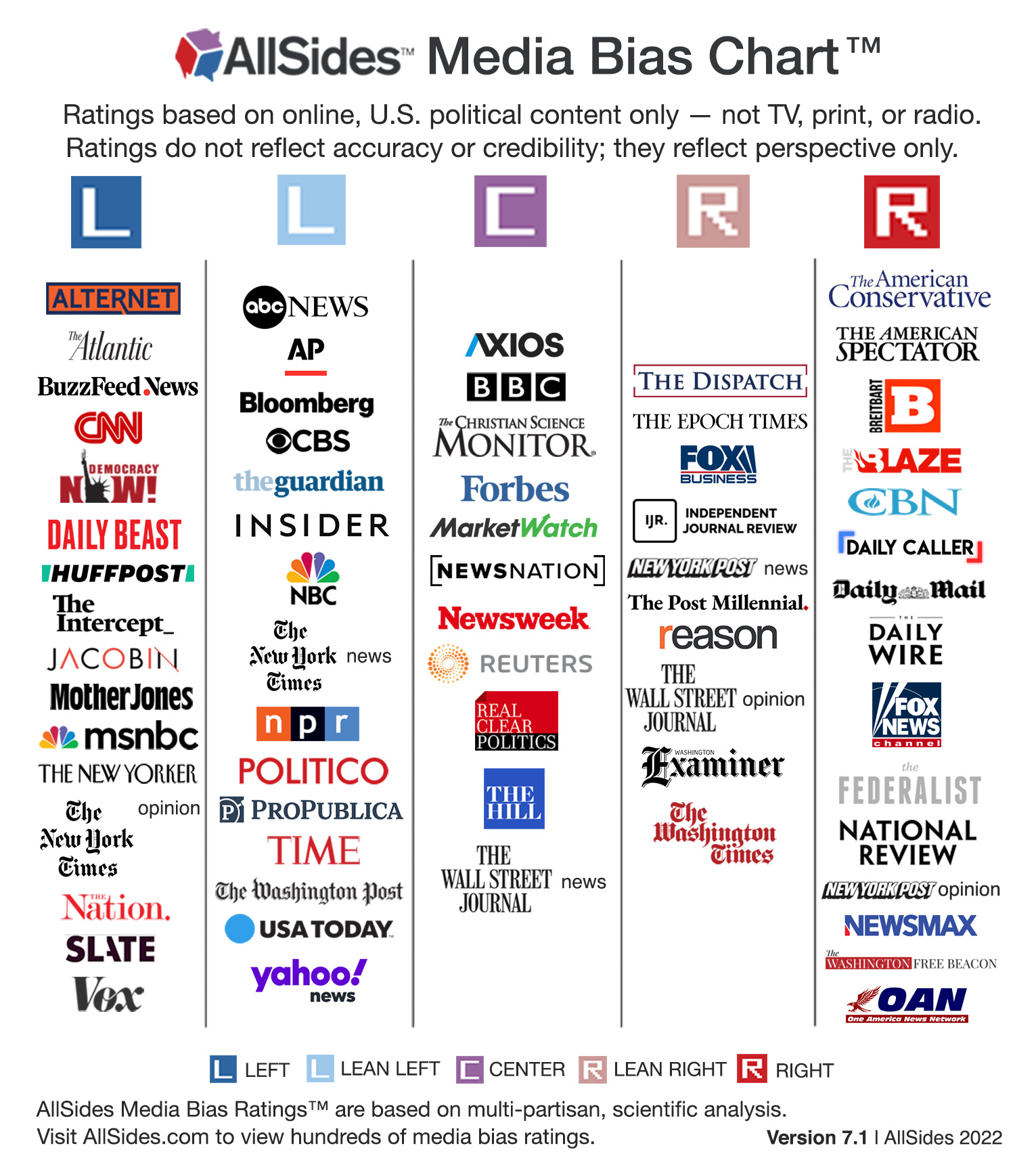
for which the commenter received substantial support. I agree that Fox News has become a propaganda organ. As evidence that CNN, too, is a propaganda organ I submit the following:

Take note of the following:

  • Fox News has a right bias.
  • CNN has a left bias.
  • CBS, ABC, NBC, the Washington Post news reporting, and New York Times news reporting lean left.
  • Wall Street Journal news reporting exhibits neither a left nor right bias.
  • New York Times opinion articles illustrate a left bias.
  • Wall Street Journal opinion pieces are right-leaning.

The reactions at OTB hearken back to one of my earliest posts here at The Glittering Eye. Where you sit depends on where you stand. If your views are far left, you tend to view views that comport with your own as unbiased while any view less on the left than yours is a right-wing view and conversely with the far right.

5 comments

The Power of China’s Air Force

I also wanted to commend this post by David Roza at Task & Purpose on the present assessment of China’s air force to your attention. Here’s a snippet:

For years, U.S. Air Force leaders have sounded the alarm about China’s increasing power and America’s shrinking technological edge. But what are the specific forms of power and technology that have U.S. officials so worried? Considering the language barrier, cultural differences and the lack of transparent governance or a free press, it is difficult for average Americans to know what threats service members may face in a possible conflict in the western Pacific.

But not to worry, the Air Force prepared several easy-to-read briefings and videos to bring you up to speed. Though some of the videos date to late 2021 or early 2022, their general observations still hold up.

“[W]e must accelerate learning across the Air Force to stay ahead of the pace,” said Air Force Chief of Staff Gen. Charles ‘CQ’ Brown Jr. in a memo published on Thursday, alongside a series of “toolkits” put together by the Air Force’s China Aerospace Studies Institute (CASI).

Were it up to me I would not be overly concerned about Chinese air power but Taiwan, Japan, South Korea, and Philippines don’t have the luxury. India in particular should take note.

3 comments

The New Jobs Market

I rarely cite Zerohedge but I found “Tyler Durden’s” post there about the strange things going on in the labor market pretty interesting. Here’s the meat of it. There are two major metrics for employment: the establishment survey which tallies payroll head counts and the household survey which reckons individual employment situations. Normally, they’re pretty closely aligned but starting in March of this year something “snapped”. Now they’re diverging sharply.

Whether this divergence was due to wrong seasonal adjustments (a remnant of the overreaction taken by the Dept of Labor following the covid crunch to normalize for a new normal labor market), due to erroneous Birth-Death assumptions (here too, the Dept of Labor was assuming early cycle new business creation which clearly is wrong with the economy late cycle and millions of businesses shutting down, ignoring the open PPP fraud that took place in early/mid-2000s as everyone “opened up” businesses to get free money from the government), due to the Establishment Survey inability to tell the difference between full, part and multiple-jobs – as a reminder we first showed that since March, the US had lost 400K full-time jobs offset by far lower paying part-time jobs as well as double-counted multiple jobholders…

… due to the record high rate of estimation – recall the 49% Establishment survey response rate was much lower than the 70-75% rate typical in November, meaning the Dept of Labor was literally making numbers up to “complete” the survey…

… or some other reason, perhaps including the Biden admin tapping certain Bureau of Labor Statistics officials on the shoulder and advising them to show strong numbers if they want to keep their… well… jobs, we did not know, but we did know that according to the Household Survey, just 12,000 jobs were created since March, while according to the Establishment Survey – which moves markets and sets Fed policy – the increase in jobs over the same period was 2.692 million!

The divergence is now at an all-time high. Most policymakers including the Federal Reserve rely on the establishment survey. If the household survey is correct, that means that a lot of policy is being predicated based on bad assumptions.

5 comments