Why don’t we think about movies about labor this Labor Day? Organized and a few otherwise.
For a dystopian view of the potentially dehumanizing character of labor it’s still hard to beat Fritz Lang’s 1927 science fiction classic, Metropolis. After all these years it’s still visually stunning, full of haunting imagery.
For a similar take in a tragicomic vein, watch Charlie Chaplin’s last “silent” film, 1936’s Modern Times. Bonus extra: one of the loveliest of all popular songs, Smile.
When you say the words “movies about labor” the first words out of many people’s mouths are “Norma Rae”, Sally Fields’s Oscar-winning performance as a young Southern woman working in a textile mill, trying to organize a union in the plant.
Hard economic times tend to bring out movies about labor. Norma Rae was made in 1979, as inflation was rising to frightening levels. The 1930’s and pre-war 1940’s had plenty of them. The events in the classic 1940 film The Grapes of Wrath are driven by the difficulty of finding work. And I suspect that a lot of people today would be shocked by King Vidor’s Our Daily Bread. Like all of Vidor’s films, it’s beautifully shot and edited.
There were several post-World War II pictures in which labor is a central factor. Corruption in the longshoreman’s union is the lynchpin of On the Waterfront. For something a little more lighthearted The Pajama Game centers around labor negotiations for seven-and-a-half-cent raise by the workers in a pajama factory.
Women in the workplace was a key topic in the economic turndown of the early 1980’s. Two different comedic takes are Nine to Five and Mr. Mom. While we’re on the subject of Michael Keaton (who played the title role in Mr. Mom), Gung Ho is an amusing look at a Japanese takeover of an American car company.
As usual the Brits are more biting in their satire. I’m All Right, Jack skewers both management and labor in a way that no American movie probably could.
Any other suggestions for great pictures about labor?
This column from the Detroit Free Press may cast a little light on the point I made yesterday, that healthcare costs, specifically in the form of healthcare insurance premiums, are rising sharply although incomes are declining:
In the past few days, 114,000 Michigan households have received bad-news letters from Blue Cross Blue Shield of Michigan, socking individual health insurance subscribers with premium increases averaging 22%, effective Oct. 1.
Blue Cross could have said, “Hey, things could have been worse. We asked for a 56% rate hike first and dialed it back to 22%” — but that probably would have just made folks angrier.
Instead, the Blue Cross letters simply stated, “We know every Michigan resident faces financial challenges, and we thank you for your business and loyalty to the Blues.”
Insurance is highly regulated, mostly by state governments (typically in the form of insurance regulation boards). In Michigan state law requires Blue Cross to insure all comers and it also requires that the company not lose money on its insurance products:
State law requires Blue Cross to offer insurance to anyone, but it also demands that the company not lose money on its insurance products. Therein lies the rub: Blue Cross lost $133 million last year on individual subscribers.
“Increased efficiencies by Michigan HMOs allowed them to improve their income last year — up to a slender 2.6 percent of premiums — despite low premium increases and declining enrollment,†said Rick Murdock, executive director of the Michigan Association of Health Plans.
But premiums may be going up more this year to more closely match rising costs, according to interviews with HMO executives and OFIR data.
Hawkins said Priority has increased premiums an average of about 6 percent, although the effective premium increase was lower because some companies changed benefit plans that cut costs.
Kluge said Blue Care increased premiums 7 percent to 8 percent.
Additionally, Blue Cross won approval from state regulators for an average 4.7 percent interim increase on its supplemental Medicare policies, known as Medigap, which are held by about 210,000 seniors.
Insurance commissioner Ken Ross ruled that Blue Cross had proved it needs the interim increase to stave off losses.
Blue Cross, however, will continue to seek its original request of an average 31 percent rate hike on three Medigap plan options. The insurance commission is expected to make a final decision on Nov. 6.
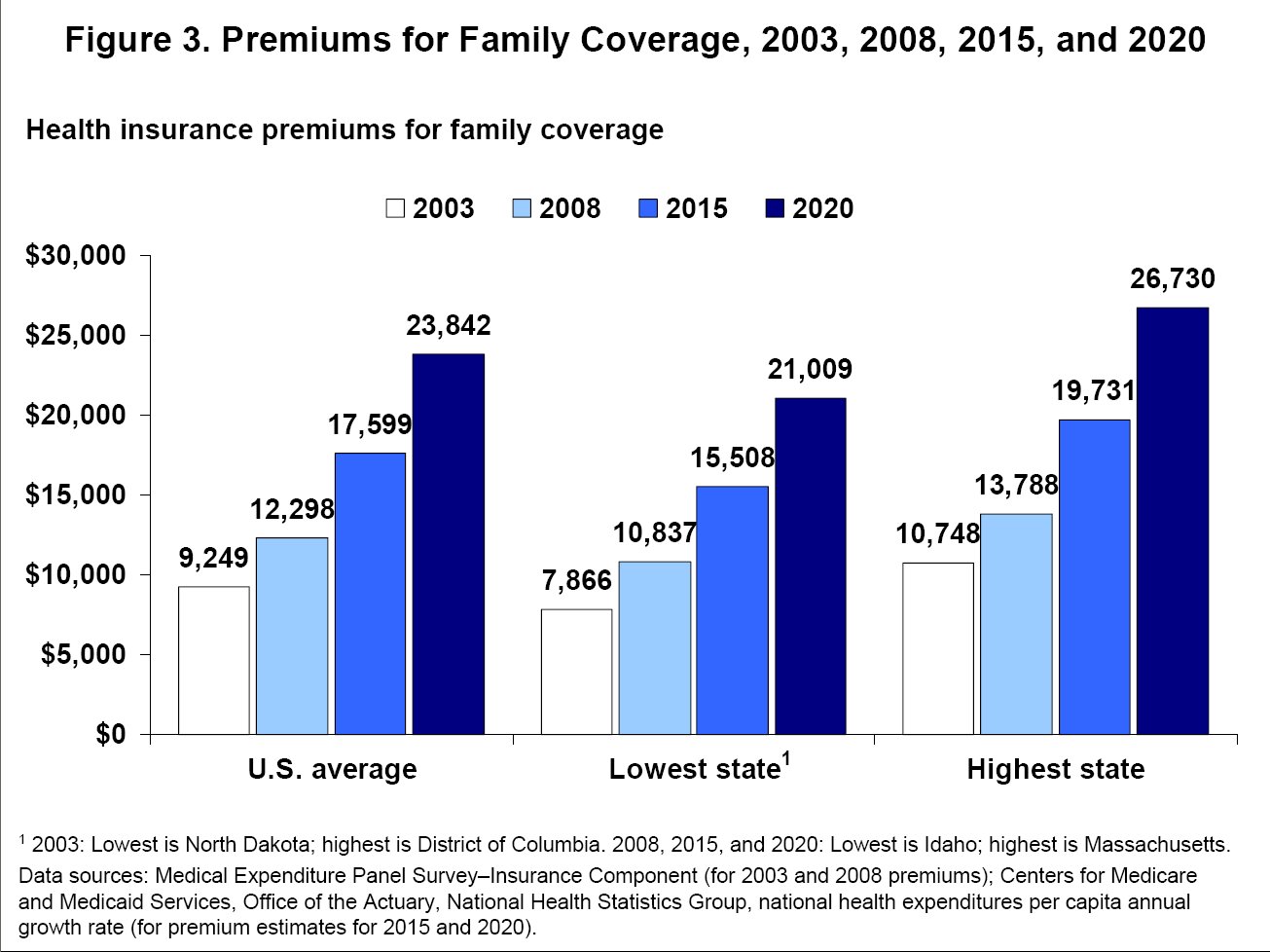
Family premiums for employer-sponsored health insurance in the U.S. increased 119% between 1999 and 2008, far, far higher than any increase in wages, according to a new survey. If current trends continue, premiums are on course to increase another 94% by 2020, to an average of $23,842 per family. Employees pay on average about 30% of this amount.
The study, by the non-profit, non-partisan Commonwealth Fund, found that in 2008 total premiums—the amount paid by both the employee and employer—equaled or exceeded 18% of the average household income for the under-65 population in 18 states, compared to just three states in 2003. In Mississippi, Tennessee and West Virginia, family premiums averaged 20% or more. Southern and South-central states in general felt the pain of rising premiums the most, because incomes are lower than national averages.
There are some great charts and maps of the premium increases on a state-by-state basis here. One of the charts is pictured above. They provide a virtual definition of unsustainability. I don’t just mean unsustainable for individuals and companies. I mean unsustainable for the federal government, too.
The insurance companies attribute the increased cost to increased pharmaceutical cost, higher utilization, and increased provider costs.
A few days ago I posted on Robert Fogel’s analysis of healthcare as a luxury good, i.e. a good on which more is spent proportionately as incomes rise. At that time I suggested that the hypothesis was wrong but was susceptible to proof:
If his assertion is true in the short term we should expect a nearly 2% decline in healthcare spending nationally. I’m willing to bet a bright, shiny new dime that won’t be the case.
Health care costs are expected to increase by more than 10% in 2010 for employer-sponsored plans, according to separate surveys by two benefit consultants.
Aon Consulting, a unit of Chicago-based Aon Corp., projects an average 10.5% increase based on input from more than 60 leading health insurers representing more than 100 million insured individuals. The rate increases will average 10.4% for health maintenance organizations and point-of-service plans, 10.7% for preferred provider organization plans and 10.5% for consumer-driven health plans, according to the survey.
The trend rates projected by Aon are slightly lower than they were for 2009 for HMOs and POS plans, and the same rate of increase as last year for PPOs and CDHPs.
According to a survey by New York-based Segal Co., cost increases for managed care plans in 2010 will be about the same as in 2009, ranging between 10.2% and 10.8%, and high-deductible CDHPs will increase 11.9% next year, which is about 1% more than in 2009.
That’s not the behavior of a luxury good. Quite to the contrary I think it’s the behavior of a good that is rising without reference to incomes, a quality that I would assert can only take place in the absence of a functioning market. I think it also effectively refutes Dr. Fogel’s point and I wish that some economists would take him to task for it.
Those who get their news from anything except blogs are probably puzzled, wondering what the resignation of Van Jones is all about:
White House environmental adviser Van Jones resigned Saturday after weeks of controversy stemming from his past activism.
“On the eve of historic fights for health care and clean energy, opponents of reform have mounted a vicious smear campaign against me,” Jones, special adviser for green jobs at the White House Council on Environmental Quality, said in a statement announcing his resignation just after midnight Saturday. “They are using lies and distortions to distract and divide.”
He continued: “I have been inundated with calls — from across the political spectrum — urging me to ‘stay and fight.’ But I came here to fight for others, not for myself. I cannot in good conscience ask my colleagues to expend precious time and energy defending or explaining my past. We need all hands on deck, fighting for the future.”
Jones issued two public apologies in recent days, one for signing a petition that questioned whether Bush administration officials “may indeed have deliberately allowed 9/11 to happen, perhaps as a pretext for war” and the other for using a crude term to describe Republicans in a speech he gave before joining the administration.
The entire matter has gone all but uncovered in the conventional media. Why?
What I’m hearing right now is that, since Mr. Jones wasn’t a cabinet-level official, it wasn’t important enough to cover. Contrariwise, I think this brings to mind the conspiracy among the newspapers 80 years ago to prevent the American people from knowing just how impaired President Franklin Roosevelt’s health actually was. They supported the president’s policies and were eager to help in any way that they could.
I think this matter highlights a weakness in the political narrative that’s been promulgated over the last several years, namely that the problem with the Bush Administration was that they were incompetent and the solution was put competent people, i.e. Democrats, in charge. But branding alone isn’t enough, there’s more to competence than a party label, and even formal credentials are insufficient to ensure competence. Competence includes factors of temperament, experience, and past performance including past performance that isn’t specifically job-related.
I don’t have a great deal more to say about this other than to remind people of the nascent Obama Administration’s famously thorough vetting process, a gauntlet of 63 tough questions. Question 13 was reportedly:
(13) Electronic communications: If you have ever sent an electronic communication, including but not limited to an email, text message or instant message, that could suggest a conflict of interest or be a possible source of embarrassment to you…
Was there no follow-up on this vetting? Didn’t anybody check anything? Didn’t they think that Mr. Jones’s statements, actions, communications, and (for goodness sake) recordings over a period of years was embarrassing? Who vetted the vetters?
In an op-ed in the Washington Post cardiologist Dr. Arthur Feldman lists ten things he hates about healthcare reform as it’s currently being presented:
Private insurance companies escape real regulation
We urgently need tort reform, but it’s nowhere to be seen.
“Prevention” won’t magically make costs go down.
Reform efforts don’t address our critical shortage of health-care workers.
We need more primary-care physicians — but we also need specialists.
We have to streamline drug development and shake up the Food and Drug Administration.
We can’t fund health-care reform by cutting payments to doctors.
We can’t forget about research.
Cutting reimbursements could shut some hospitals down.
We need to improve the quality of care.
I agree with a lot of what Dr. Feldman has to say. In particular I’m glad that he pays some attention to medical education. For example, most people here in the States don’t realize how greatly the government subsidizes medical education nor that in most of the world becoming a physician isn’t post-graduate education. The evidence that our system produces better doctors is meager, indeed, although the evidence that it produces more expensive doctors is a matter of simple arithmetic.
However, I think that he, like a lot of people inside and outside of healthcare, has yet to appreciate that the world of healthcare as he’s experienced it simply cannot continue. There just isn’t enough money to pay ever more for healthcare even as our incomes recede. Unless we can figure out how to deliver more while paying less, we’re going to need to come to terms with the idea that there will be less healthcare rather than more in the future. That is the necessary implication of an unsustainable systematic over-investment in healthcare over a period of decades and if that means the incomes of all of the players in the healthcare sector whether insurance companies, hospitals, or physicians must be restrained at the very least, so be it.
The fascinating graph at the left is from Calculated Risk. The three bars in each quarter represent the assumption about unemployment in the baseline stress test that the administration applied to banks at the beginning of the year (green), the unemployment rate in their “more adverse” stress test (blue), and the actual unemployment rate (red). You can click on the graph for a larger image.
There are a few observations I’d like to make based on this information. First, the actual unemployment rate has already exceeded the maximum unemployment rate envisioned under the administration’s baseline stress test. That suggests that, if you only assume that the administration was right about the change in the unemployment rate under their baseline stress test from the 2nd quarter of 2009 to the 1st quarter of 2010, we will have double digit unemployment before the end of the year.
Second, the actual unemployment continues to exceed the unemployment projected in their “more adverse” stress test. I think you can only conclude that the administration’s projections were unrealistically optimistic. That is very likely to have implications for the health of the banking system. Banks that the administration rated as passing the “more adverse” stress test may well fail the real conditions that we’ll see by the end of the year.
Third, I also think that you can only conclude that the stimulus package was insufficiently front-loaded. I wonder if they had it to do over again if the administration would have pushed for a bill whose provisions could have been implemented faster? It looks to me like a perfect case of having too many oars in the water. If I were in the shoes of President Obama’s economic advisors, I would be looking for ways that I could shift some of the spending scheduled for 2011 into 2009 or 2010. Further extending unemployment benefits is an obvious candidate.
Fourth, if the unemployment rate is actually running well over 10% in the 3rd quarter of 2010, the Obama Administration is likely to have a good opportunity of seeing how well it can pursue a strategy of bipartisanship for the remainder of President Obama’s term. Perhaps the voters will forget that there will have been a Democratic Congress since 2006 and a Democratic President for two years and continue to blame everything on Bush.
My readers, particularly those of my readers who are lawyers, may want to read this prescription for reform of the legal profession from a physician. It’s a modest proposal.
There is a notable difference between the circumstances of the legal profession and the medical profession, however. If wages for physicians had increased only at the rate at which the wages for lawyers and the members of other professions have over the period of the last 40 years, we wouldn’t be talking about a crisis in healthcare now.
State government finances are a wreck. The drop in tax receipts is the worst in a half century. Fewer than 10 states ended the last fiscal year with significant reserves, and three-fourths have deficits exceeding 10% of their budgets. Only an emergency infusion of printed federal funny money is keeping most state boats afloat right now.
Most governors I’ve talked to are so busy bailing that they haven’t checked the long-range forecast. What the radar tells me is that we ain’t seen nothin’ yet. What we are being hit by isn’t a tropical storm that will come and go, with sunshine soon to follow. It’s much more likely that we’re facing a near permanent reduction in state tax revenues that will require us to reduce the size and scope of our state governments. And the time to prepare for this new reality is already at hand.
The coming state government reset will be particularly wrenching after the happy binge that preceded this recession. During the last decade, states increased their spending by an average of 6% per year, gusting to 8% during 2007-08. Much of the government institutions built up in those years will now have to be dismantled.
I said it at the time but state and local governments (not to mention the federal government) made a serious error in the late 1990’s. When money was flowing into the treasuries, a byproduct of the dot com boom and general economic good times, was the perfect time to figure out how to re-engineer their structures to provide services more effectively and at lower cost. Instead, they expanded their payrolls.
The single most important reform that must be made in state and local governments is that pensions for public employees must become defined contribution plans rather than defined benefit plans. That alone will probably be enough to incite rebellion. But it’s a fiscal necessity.
Here in Illinois that will be all but impossible, requiring an amendment to the state constitution that will be bitterly opposed by judges, state representatives, state employees, and the representatives of local government employees, particularly the police officers’ and firefighters’ unions. That harsh reality is the reason that former Gov. Blagojevich’s cavalier raiding of government employee pension funds for operating expenses was not simply foolish but insane.
David Brooks gives President Obama a reading list to prepare for his upcoming speech on healthcare reform. The list has two items on it, David Goldhill’s essay, “How American Health Care Killed My Fatherâ€, in the current issue of The Atlantic which has been frequently recommended to me and which I have read. It’s online here. The other is a report from the Brookings Institution on healthcare reform, online here.
There is a common thread uniting these two: the greatest problem with our healthcare system is the perverse incentives, a problem I’ve commented on here with some regularity. It is pervasive and end-to-end in the healthcare system. Unfortunately, the bills most likely to be enacted into law by the Congress enshrine those incentives rather than reforming them. No good can come of that.