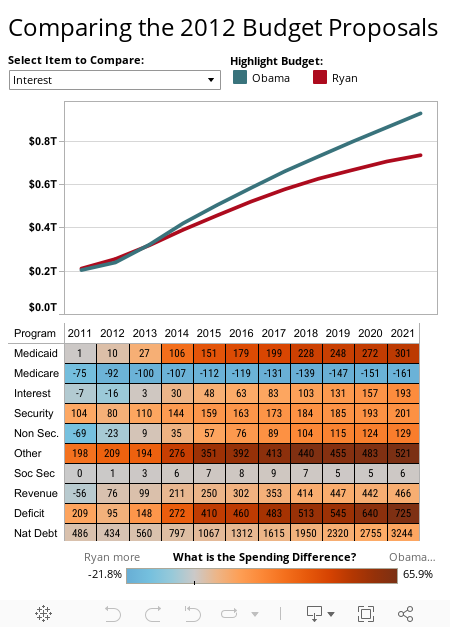
As the federal budget plan for 2011, already months late, finally passes the House of Representatives on its way to the Senate from whence it will be signed by the president, roughly six months late, we already seem to be deluged with proposals for the 2012 budget.
There’s the Ryan plan, the “People’s Budget” produced by the Congressional Progressive Caucus, the “Gang of Six” plan produced by Democratic and Republican senators, and now President Obama’s plan. Paul Krugman characterizes them aptly in his column:
For the contrast between Mr. Ryan last week and Mr. Obama on Wednesday wasn’t just about visions of society. There was also a difference in visions of how the world works.
Indeed there were and I found them visions that varied from mistaken to delusional to demagogic. But it likely explains why the 2011 budget was so late: there are conflicting and irreconcilable visions of how the world works and all parties finally came together on the single point they could agree on (getting re-elected).
A couple of digressions. First, I think that Dr. Krugman in using the phrase “call Mr. Ryan’s bluff” is wrong. I don’t believe that Mr. Ryan is bluffing and Dr. Krugman has produced no evidence that he is. I think the phrase he’s looking for is either “call Mr. Ryan’s bet” or, even better, “upping the ante”. Second, is President Obama’s budget really serious? I’m skeptical. To see what I mean let’s use the example Dr. Krugman does: Medicare Part D. We’re currently spending about $50 billion per year on it. Using Dr. Krugman’s numbers if we were to save 40% of that it would save about $20 billion per year. While that’s a start when we’re borrowing anything from a half trillion to a trillion per year it’s a drop in the bucket. Total Medicare spending is expected to grow at the rate of 7.5% a year over the next ten years or so. $20 billion sounds like a lot but it’s just a fraction of the amount by which Medicare is expected to grow.
My second digression is on “The People’s Budget”. Could any naming be less felicitous? Not only does it bring to mind The People’s Republic of China and other communist states it would appear to be a direct reference to Lloyd George’s 1909 People’s Budget, a budget that increased Britain’s welfare state by a substantial increase in taxes. It lost the Liberal Party seats in Parliament, took more than a year to pass, and only passed after the land tax was removed.
I am overwhelmed with questions about these budgets. First, Paul Ryan and the Republicans in Congress. The tax cuts of the early years of the Bush presidency did very little to stimulate the economy: mostly, they were saved. Why would a return to the rates that prevailed under Clinton be economically harmful? The cuts weren’t economically beneficial. And should military spending really be exempt from budget cutting? It’s the largest item of discretionary spending and I find it incredible that there’s nothing from it that can be spared.
Next, the Progressive Caucus. Have you never heard of deadweight loss? Can you really believe that a 49% maximum tax rate will not result in less economic activity? How many jobs are you willing to sacrifice to a war on the wealthy? And why not propose a wealth tax and attack the enemy’s front line?
To President Obama. How can you restrict tax increases to those making over $250,000, expand the use of our military, and exempt two-thirds of the budget (Medicare and Social Security) from cuts? Details, please.
Finally, some assertions.
- We cannot continue to borrow a half trillion or more per year without repercussions. That’s not just too much relative to U. S. GDP, that’s too much relative to world GDP.
- Medicare costs cannot be allowed to grow indefinitely at three times the non-healthcare rate of inflation. No foreseeable level of tax increases will produce that much revenue and the consequences for the economy, already being felt, will be disastrous.
- No advisory board will be able to control Medicare costs, no advisory board can, and anybody familiar with modern views of planning can possibly believe that they can. You are dealing with intelligent actors. For every action taken by an advisory board there will be counter-moves.
- “Medicare as we know it” is doomed by the laws of arithmetic. There will be cuts to benefits. Deeming that reality as “cruel” is either delusional or political posturing, not serious.