When I read this headline, “Danish archaeologists discover 300 year old toilets”, my immediate reaction was “Were they staying in an English B&B?”
How Bad Is the Debt Problem?
October 3, 2011James Kwak has a lengthy analysis of our debt problem that’s worth your time. In his analysis he updates the CBO Extended Baseline and Alternative scenarios with the new developments of the last couple of monhs and adds some &147;Realistic Scenarios” of his own. He remarks:
So the bottom line is: If we extend the Bush tax cuts, we have very big deficit problems over the next ten years and the next twenty-five years. If we let them expire, there is no ten-year problem. That’s the same as in my earlier post, and I don’t think that’s controversial to anyone who understands the numbers.
What’s more controversial is my claim that if we let the tax cuts expire, there is a twenty-five year problem, but it’s not a huge one. Many other people argue that even if we let the tax cuts expire, we still have to cut Social Security and Medicare. On my reading, the problem is a national debt at 69% of GDP and growing steadily. If we have another financial crisis, or we start losing our status as the reserve currency, that could be a serious problem. My opinion is we should do something about it. But it’s not necessarily the end of the world.
I think the problem is more serious than Dr. Kwak apparently does for several reasons. First, his accounting for puiblic debt, like the CBO which he follows, does not include intragovernmental debt. Once you’ve included intragovernmental debt into the reckoning the public debt nears 100% of GDP rather than 69%. 69% is worrisome enough but 100% or more is disastrous.
Second and more importantly, his analysis is not robust: it is highly dependent on his assumptions and contrary to his claim that his assumptions are conservative to my eye they appear hopelessly optimistic. So, for example, he estimates an average 2.1% growth rate in real GDP, approximately the long term average growth rate. This year we will fall far short of that and IMO we are likely to do so for the foreseeable future. As evidence I’d submit that a) the current real GDP growth rate is far below 2.1%; b) when you account for the two consecutive bubbles we’ve experienced the real GDP growth rate has been below 2.1% for some time; c) to achieve an average 2.1% growth rate when you have growth rates significantly below that in some years means that you’ve got to have significantly higher growth rates in other years; d) there are no prospects whatever for growth rates significantly over 2.1% in coming years, not at least without serious structural changes; e) levels of public debt as high as the one we have are associated with lower rates of growth and f) just this morning PIMCO’s Bill Gross noted:
There are no double-digit investment returns anywhere in sight for owners of financial assets. Bonds, stocks and real estate are in fact overvalued because of near zero percent interest rates and a developed world growth rate closer to 0 than the 3 – 4% historical norms. There is only a New Normal economy at best and a global recession at worst to look forward to in future years.
I intend to return to Mr. Gross’s article in a later post. However, zero growth rates and near zero inflation means negative real growth rates.
Finally, look at the deficit and debt from a cashflow standpoint. We’re already paying a half trilllion a year in interest on the debt. At our present level of debt tiny changes in the interest rate we’re paying can push that up very rapidly.
Update
Here’s a very interesting muli-country analysis of public debt. Take particular note of the debt to GDP and interest to GDP ratios illustrated graphically in the report.
A Question About Fiscal Stimulus
October 2, 2011This post isn’t really fully fleshed out but I’m just going to blunder ahead and hope for the best. I have a question or, more correctly, a series of questions for those among my commenters who support a large fiscal stimulus. Here’s the question: why?
That may seem like a dumb question on my part but I think there’s more to it. First, the more recent articles by the model-makers like Moody’s Mark Zandi and Macroeconomic Advisers have cautioned that the effects of fiscal stimulus are temporary. Any increased GDP produced by fiscal stimulus in 2012 would be followed by GDP growth lower than it otherwise would be in 2013 and 2014. What this tells me is that either 1) any fiscal stimulus must be large enough to “jump start” the economy on its own or 2) fiscal stimulus merely provides the political space to undertake other necessary reforms that will help to produce sustained economic growth.
Second, we have a serious demographically-based cashflow problem which will continue for several decades. That’s no surprise. We’ve known about it for a half century. The additional interest we will pay as a result of the borrowing we do for fiscal stimulus will only exacerbate that problem.
Third, there are no prospects whatever that robust growth will enable us to pay down the additional debt. For the last two hundred years the U. S. has seen a very steady 3% year-over-year GDP growth, 2% in real terms. That itself is very atypical among developed countries (the UK, France, and Germany haven’t had the same experience).
Fourth, the current level of debt is around 100%. There’s economic scholarship that’s shown that levels of public debt this high reduce growth.
I’ve made no secret of my wariness of fiscal stimulus as a solution to our economic problems or of my dismay that the stimulus that was enacted into law in 2009 was the size that it was, had the structure it had, and was spread out over so long a period. IMO to whatever degree fiscal stimulus might have helped us was negated by the construction of the bill that was enacted into law. I also don’t think that permanently higher taxes, the natural implication of undertaking higher debt, is a formula for greater prosperity.
That’s why I’ve emphasized methods of stimulus that don’t include increasing the debt like approving more free trade agreeements and replacing measures that don’t produce a great deal of increased economic activity with those that do.
Please help me out with this. Why more fiscal stimulus? In your answer please address some of the issues I’ve brought up in this post. “What else we can do?” isn’t a very reassuring answer. Please don’t try to explain Keynesian multipliers to me. I understand that. The question is what the multipliers of specific strategies are and whether they exceed their cost.
Saving Europe
October 2, 2011Simon Johnson, former chief economist of the IMF, comments on what it would take to save Europe:
If Italy or any other eurozone country is in good shape and can pay its debts, the European Central Bank (ECB) can provide ample short-term support – through buying up bonds to prevent interest rates from reaching unreasonable levels. The euro is a reserve currency – meaning investors around the world hold it as part of their rainy day funds – and all European debt is denominated in euros. In Mexico in 1994, for example, much of their debt was in dollars; in such a situation, a foreign loan can help stabilize a crisis – although even there the right policies have to be put in place.
But if Italy cannot pay its debt, then the ECB has no business lending to it. The Europeans have to decide for themselves: Is Italy’s fiscal policy reasonable and responsible? If yes, provide full support as need – from within the eurozone. If not, then find another way forward.
Meanwhile, Germany has reached the end of the road on its contributions to the EU bailout fund:
German Finance Minister Wolfgang Schaeuble has ruled out Germany contributing any more money to the beefed-up EU bail-out fund than the 211 billion euros ($A294.51 billion) approved by parliament.
‘The European Financial Stability Facility has a ceiling of 440 billion euros, 211 billion of which is down to Germany. And that is it. Finished,’ he told the magazine Super-Illu in an interview published on Saturday.
which sounds like a triumph of politics over policy to me. Whatever German public opinion on the subject the primary objective of the bailout fund isn’t to allow lazy and profligate Greeks, Portuguese, Spaniards, and Italians to keep the party going. It’s to prop up greedy and irresponsible German and French banks that are too exposed to Greek, Portuguese, Spanish, and Italian debt.
What Are They Rebelling Against?
October 2, 2011Whadda you got? Henry Blodget provides a pretty fair interlinear commentary to the Declaration of the Occupy Wall Street protesters. Here’s a snippet:
We come to you at a time when corporations, which place profit over people [unfair blanket smear], self-interest over justice [also an unfair smear], and oppression over equality [oh, please—Procter & Gamble makes toothpaste—it’s not their job to worry about “equality”], run our governments [“run” is a bit strong, but “influence” is certainly fair].
The entire thing is a mixed bag with some legitimate complaints and a lot of boilerplate. If you want to know what the hoopla is about or at least what some people say it’s about, read the whole thing.
It will be interesting to see (interesting is, perhaps, not the right word) whether protests of this sort gain any traction. I can’t help but feel that I’ve seen this movie before.
The Pax Americana
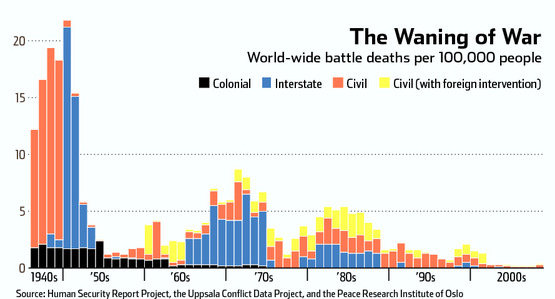
September 30, 2011There’s a post over at Outside the Beltway I’d like to draw your attention to on the decline of war from the second half of the 20th century to the present. I’d intended to comment on this in a post of my own but his will do. Here’s a snippet:
In a mass media environment where we hear about horrible events from all over the world every day, it’s easy to think the world is falling apart. Or at least getting worse. But, according to Harvard Prof. Steven Pinker, the world has been becoming more peaceful and less violent throughout the history of civilization–and continues to do so&@133;
Take particular note of the graphic attached to the post. I won’t bother reproducing it here but, since much of this post is based directly on it, the post may not make a great deal of sense to you without it (it may not make much sense to you with it but that’s another issue).
First, if you needed a graphic illustration, literally, of the Pax Americana, the American Peace, for good or ill here it is. All of the spending (and borrowing) borne by Americans, all of the loss of life has bought this. We have made war futile. Attention must be paid.
That would probably be denied vehemently by some (which is largely why I’m posting this here rather than at OTB) and I recognize that the Europeans, in particular, reject this explanation. IMO it’s blindingly obvious and has some implications. Our challenge going forward is to preserve the peace while doing it at a cost we can bear. I sincerely believe that in a couple of centuries the history of our times will be seen by how successful we are at that.
Second, look at the jump ups in the light blue bars, the increases in battle deaths in interstate war. With two exceptions those jumps are when America went to war, first during the Second World War in the 40s, Korea in the 50s, Viet Nam in 60s and 70s, and the first Gulf War in the 90s. The jump during the 1980s is almost certainly primarily due to the war between Iran and Iraq while the jump in the late 1990s was presumably due to a number of small, bloody conflicts that took place largely without the notice of the American media because we weren’t involved in the fighting.
The wars in Iraq and Afghanistan are invisible. Painful and costly as they’ve been to us they haven’t provided the number of battlefield deaths that previous wars have done.
Finally, how you choose your terms is important. The graph reflects battlefield deaths in interstate wars, civil wars, and colonial wars. It does not reflect the hundreds of million of deaths due to countries killing their own people. We will never know how many people were killed in Germany, Russia, Eastern Europe, China, Cambodia, Iraq, Iran, and so on, murdered by their own governments. They don’t show up on the chart.
Were these deaths added to the chart it would strip away any illusion that the present is less violent than the past. But Leviathan’s hand reaches only so far.
Don’t Look to Big, Established Companies
September 30, 2011Charles Kenny is absolutely right that small companies as such won’t solve the problem of the millions who are unemployed:
In the U.S. in 2007 there were around 6 million companies with workers on the payroll. Ninety percent of those businesses employed fewer than 20 people, according to analysis of the latest census data by Erik Hurst and Ben Pugsley of the University of Chicago. Collectively, those companies accounted for 20 percent of all jobs. Most small employers are restaurateurs, skilled professionals or craftsmen (doctors, plumbers), professional and general service providers (clergy, travel agents, beauticians), and independent retailers. These aren’t sectors of the economy where product costs drop a lot as the firm grows, so most of these companies are going to remain small. And according to Hurst and Pugsley’s survey evidence, the majority of small business owners say that’s precisely their intent—they didn’t start a business for the money but for the flexibility and freedom. Most have no plans to grow.
but his adulation of the virtues of large, established companies provides cold comfort:
If you’re looking for a lot of good-paying, stable jobs, you’d better hope there are some big companies around that want to hire. Kansas City Federal Reserve economist Kelly D. Edmiston’s analysis of U.S. data found that each year, 22 percent of staff in companies with fewer than 100 employees quit or are fired, compared with only 8 percent for companies with 2,000 or more workers. Edmiston also found that the jobs offered at large businesses were better than those at small businesses. Hourly wages at the largest companies, those with more than 2,500 employees, average around $27, compared with $16 in companies with payrolls of fewer than 100. Companies with more than 100 workers are almost twice as likely to offer retirement benefits and insurance, and considerably more likely to offer health care.
The problem is that those very companies have reduced their payrolls in the United States by millions of job over the period of the last 25 years. Can anybody reasonably predict they’ll start hiring a lot more people in the foreseeable future.
Can anybody think of a large company that is less than 15 years old that has a net increase in U. S. employees in the last year? In the last five years? I can’t. GE, GM, and Ford have all reduced their domestic employment. Apple is cagey about its employment figures (it doesn’t report them in its 10-K filings). What jobs its added have been mostly low wage retail clerks for its Apple stores and, as I read the reports, most of the growth in that area has been overseas.
The size of the company is largely misdirection. New companies hire; old, established ones don’t. That’s why policy should pay more attention to greasing the skids for the creation of new companies, not to mention getting the dinosaurs out of the way.
His Lips Are Moving
September 30, 2011but I can’t hear what he’s saying. George Soros presents his prescription for “preventing a second Great Depression”:
Three bold steps are needed. First, the governments of the eurozone must agree in principle on a new treaty creating a common Treasury for the eurozone. In the meantime, the main banks must be put under European Central Bank direction in return for a temporary guarantee and permanent recapitalisation. The ECB would direct banks to maintain credit lines and outstanding loans, while closely monitoring risks taken for their own accounts. Third, the ECB would enable countries such as Italy and Spain to temporarily refinance themselves within limits at a very low cost. These steps would calm markets and give Europe time to develop a growth strategy, without which the debt problem cannot be solved.
I see how this could block the immediate problem but I don’t see how it resolves the fundamental, structural problems of the euro: a common currency with different, even conflicting fiscal policies. Greece will still need to borrow. German and French banks will still hold too much Greek debt.
I don’t see another practical alternative other than Greece exiting the euro or German taxpayers being willing to backstop Greek spending indefinitely, much as New York taxpayers propped up Tennessee for decades.
Smile, Darn Ya, Smile!
September 30, 2011Gregg Easterbrook’s prescription for healing the aging economy? Optimism! After noting that we’ve had two rounds of tax cuts and and two rounds of stimulus spending, all of which have failed to jump-start the economy, he remarks:
That means more than $7 trillion in borrowing for the economy in just five years, roughly the amount per capita, in today’s dollars, the United States borrowed during World War II. Amazingly, some commentators call this “austerity.†Whatever the label, the Keynesian borrow-to-spark-demand formula has not worked. It is time to accept that more government spending is not the solution.
If more borrowing or more tax cutting aren’t what the economy needs, what is? Optimism. Human psychology is a bigger force in economics than current policy debate acknowledges.
In 2005, many fundamentals of the economy were worrisome – a housing bubble, highly leveraged banks and investment banks, a profusion of liars’ loans. Yet the economy boomed, partly because optimism was universal.
In 2011, many fundamentals of the economy are sanguine – high corporate profits, no resource shortages, low interest rates, ample money supply, low international tensions. Yet the economy is flatlined, partly because there is little optimism.
In reflecting on my own circumstances, I have plenty of reasons for optimism. I have all of my own hair and teeth. I’m fitter than many men half my age. I take no medications. Barring the things about which little can be done and I find tolerable I’m in extremely good health.
I am mentally more acute, if anything, than I was ten years ago. As Camus paraphrases the conclusion of Oedipus at Colonus, “Despite so many ordeals, my advanced age and the nobility of my soul make me conclude that all is well.”
Blogging may play a part in that. For me it’s a form of therapy or mental gymnastics, like sudoku or a crossword puzzle.
Our economic circumstances are fine, too. We own our own home and are planning to stay there until we’re carried out feet first (the addition we put on several years ago made our home completely liveable on the first floor alone). Barring some catastrophe, in ten years our income will probably be higher than it is now albeit from different sources and our present income places us easily in the top quintile of income earners.
I recognize that many are not nearly so fortunate. How can they be helped?
As I scan the transcripts of recent speeches and interviews by our leaders, the persistent message I take away from our political leaders is one, ultimately, of pessimism. Does that help or hinder? I think the latter. I wish they’d find some way to split the difference between an out-of-touch and Pollyannaish optimism and overwhelming doom and gloom. Tenacity and confidence in the face of adversity, perhaps. I see the tenacity but not the confidence.
I Can’t Figure It Out
September 28, 2011I rarely read op-eds from The Nation’s Katrina vanden Heuvel because as a rule I find it such an unpleasant experience and, well, life is only so long. However, I deviated from my typical practice to look at this op-ed in the Washington Post and immediately came up with a question. Here’s her statement:
Corporations continue to ship good jobs abroad, while the few jobs created at home are disproportionately in the lowest wage sectors.
There appears to be evidence that this is the case. Unfortunately, the report cited has a problem. It’s comparing apples to oranges. Sectors with low median wages and low wage jobs are not synonymous. You can’t derive the wages being paid by new jobs based on the median wage in the sector. The jobs could be paying the highest wages in the sector or the lowest. There’s just no way to tell using sector as a benchmark.
Let me give an example. Median wages are higher in the healthcare sector are higher than in most other sectors of the economy and over the period of the last decade the healthcare sector has seen substantial job growth. Is this a good or bad thing from the standpoint of “good paying jobs”? The answer is there’s no way to tell based on this information alone. If all of the jobs are for cardiac surgeons, it’s a good thing. If all of the jobs are for bedpan emptiers, it’s a bad thing.
But here’s my question. Let’s assume that the jobs that are being created are mostly low wage jobs, as suggested by Ms. vanden Heuvel. How do you reconcile that with the assertion that the way out of our fix is more education. Will that result in a “Field of Dreams” outcome (“if you build it they will come”) or will it just result in the best educated bedpan emptiers and fast food order takers in the world?
I can’t figure it out.